MuScriptor, our music transcription model, can now make sheet music and tabs! We export PDFs and editable MusicXML.
Under the hood, we generate these from MIDI using @musescore + some custom preprocessing.
HydroGym: A Reinforcement Learning Platform for Fluid Dynamics
Now published in Nature!! https://t.co/o1zTn2DIHg
GitHub: https://t.co/9MLBzJAMiJ
Amazing collaboration with Christian Lagemann, S Mokbel, M Gondrum, M Rüttgers, Y Wang, P Suárez, L Paehler, D A Bezgin, A B Buhendwa, J L Callaham, S Ahnert, N Zolman, X Shao, J-Ch Loiseau, N A. Adams, M Meinke, W Schröder, K Lagemann, E Lagemann, R Vinuesa & S L Brunton
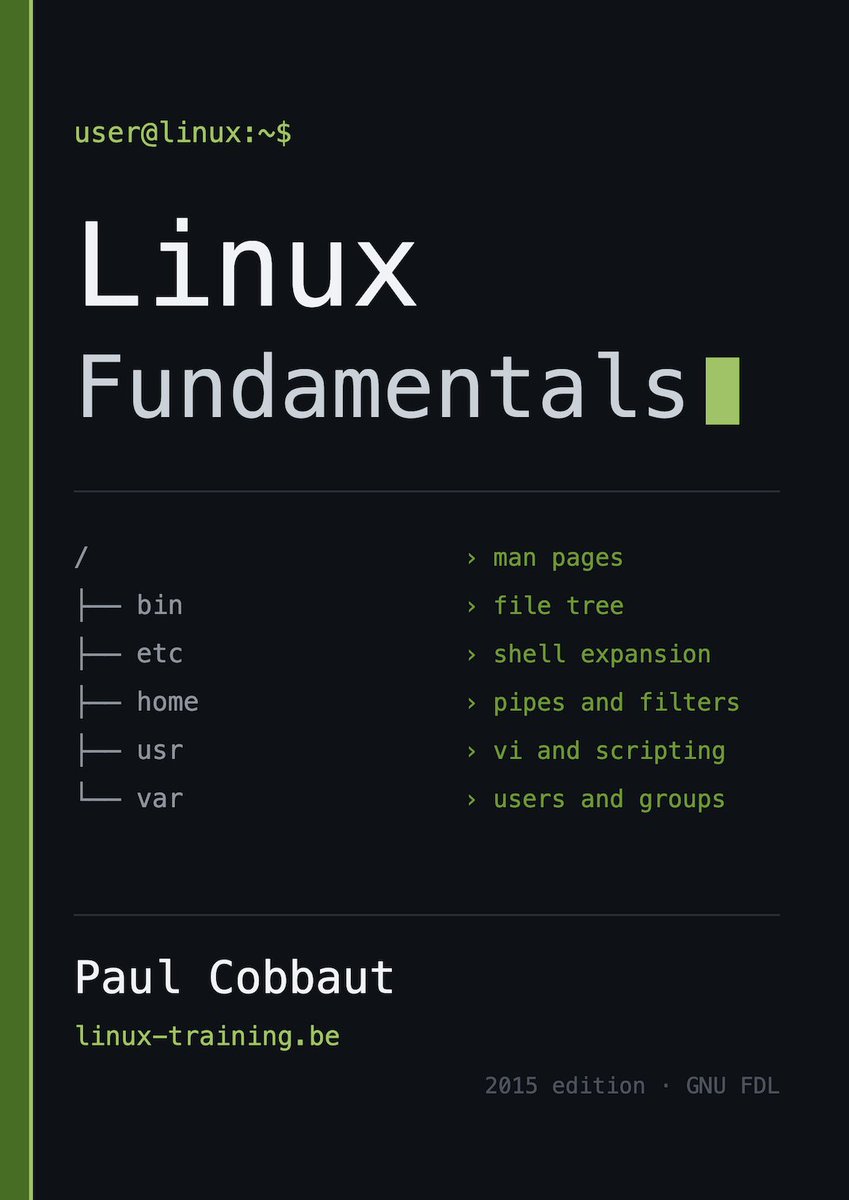
One of the best hands-on introductions to Linux, "Linux Fundamentals" by Paul Cobbaut, is now available on @ChapterPal.
Enjoy: https://t.co/uMuNHA6JSe
(All books and papers on ChapterPal are free to read.)
Anthropic's Andrej Karpathy just released 1-hour Stanford lecture on full AI engineering from scratch:
"You can actually delete everything… Delete everything, keep Graph"
here's his lessons:
10% → LLM: I treat GPT as a general-purpose computer that can be reprogrammed at runtime
30% → Prompt: I give that computer a program written in natural language
50% → Agent: I surround the model with a goal, context, memory, and tools that turn prediction into action
70% → Loop: I separate the inner loop, where the model learns from context, from the outer loop, where training updates its weights
100% → Graph: I organize communication as data-dependent message passing over directed graphs
This 1-hour at Stanford will teach you more about AI than 100 YouTube video guides
“Just chop up everything and throw it into the mix”
watch - bookmark, then read the article below ↓
Andrew Ng:
“AI agents are doing almost 100% of my tasks now - the hype has exceeded my expectations.
in 3-6 months, we’ll all be building graphs to orchestrate self-improving agents. No more prompting.”
In a 40-minute talk, Andrew Ng explains how to build self-improving agentic systems from scratch.
Worth more than a $500 agentic course.
Watch this video, then read the article below on how to become a graph architect.
Free PDF of my new Optimization book:
https://t.co/2QQMQMJqr2
If you like it, check it out on Amazon or at Cambridge University Press!
Please leave a review and email me with any typos/corrections.
300 agents just finished your research in 40 minutes. congrats, now go read 300 documents.
that's what a swarm gives you. a pile.
the useful part isn't in any single one of them. it's in how they link up. 100 assets have 4,950 possible connections between them.
nobody holds that in their head.
kimi agent swarm keeps the links. 300 agents in one launch, up to 4,000 steps. every asset and every wallet an agent touches becomes a node. two agents hit the same counterparty, it draws an edge between them.
you don't get 300 answers. you get one map.
point it at your own trading portfolio and the picture gets uncomfortable. positions you thought were unrelated land in the same cluster, because the same market maker quotes all of them.
one bridge lights up as the hub half your holdings route through. that's your single point of failure, and nobody asked for it in the prompt.
Renaissance hedge fund keeps around a hundred PhDs on staff to catch things like that.
it also doesn't die when you close the tab. next launch adds to the same graph.
that's the gap opening right now. one guy re-reads 300 docs every week. the other one has a base that gets smarter every run.
my friend broke down the full framework and wrote the guide in the article below. read it, then go look at what your last agent run left you with.
Today @databricks we're publishing a detailed analysis of techniques we used to drastically reduce our internal AI spend while aggressively growing adoption. Savings come from layering in several techniques, which combine to drive unit costs down as much as 90% in some scenarios. Tl;dr, the wins come from:
1. Shifting defaults to more efficient models, including OSS models such as GLM. Maximum intelligence models simply aren't needed for many coding tasks, and "good enough" models are quickly becoming very cheap. We shift traffic between models using Unity AI Gateway. Approximate savings: 50% or more.
2. Using smart routing to automate model selection. Routing can further squeeze efficiency by dynamically selecting the model or harness that can most efficiently execute a particular task. Our task-level routing leverages @omnigent_ai. Approximate savings: 30%.
3. Providing user visibility and adaptive budgeting. Every user can see how much they spend, and users receive hints on how to contain spend. Heavy spenders encounter progressive friction as they ratchet spend above certain levels. Approximate savings: 10%.
4. Managing context bloat by pruning tool call results and tuning harness settings. Extraneous context costs $$ and delivers no value. Tuning cache settings also help lower average token costs. Approximate savings: 10%.
Google Brain founder, Andrew Ng:
"Prompting will die in 6 months.
Loops and Graphs are what's replacing it."
In 2 hours, he shows exactly what the best engineers already build instead, and how to start building it yourself.
The missing piece most people skip: how to connect those loops into a graph that compounds every time it runs.
Watch it, then read the full guide on loops and graphs below.
Ten million people have watched an MIT professor accidentally destroy the executive coaching industry.
He filmed the lecture once in January 2018 and died eighteen months later.
Executive coaches charge fifteen thousand dollars a session to teach a third of what he covered in one hour for free.
His name was Patrick Winston. He ran the MIT Artificial Intelligence Laboratory from 1972 to 1997 and wrote the AI textbook every computer science major in the world read for thirty years.
Every January for four decades, he gave a lecture called "How to Speak."
His entire framework fits on a napkin.
Do not read. Be in the image. Keep images simple. Eliminate clutter. Start with an empathetic connection. End with a punch line the audience can repeat over dinner. Never open with a joke. Never end with "thank you."
That last rule alone has probably cost the executive coaching industry a hundred million dollars.
"Your success in life will be determined largely by your ability to speak, your ability to write, and the quality of your ideas. In that order."
That is the actual opening line of the lecture. Winston believed it strongly enough to spend fifty years teaching computer scientists how to talk.
Founders spend $80,000 on an MBA and then hire a communications coach to teach them the same material Winston filmed once for free. Engineers write brilliant code and lose promotions to teammates who watched this lecture on the train.
The lecture is free on MIT OpenCourseWare. The textbook is free on his page.
Winston died in 2019. Almost none of the ten million viewers have actually implemented the four rules on the napkin.
The napkin is free. The willingness to actually use it in your next meeting is the entire edge.
Can AI agents conduct open-ended AI research?
Most evaluations of agents conducting AI research focus on narrow, verifiable tasks. But AI research is often open ended. Researchers pick hypotheses, decide what evidence is appropriate, and recognize a failing approach.
We gave agents research questions from two unpublished papers, six days, and thousands of dollars of API credits and compute. The authors of the original papers then reviewed the AI-generated papers. They unambiguously rejected agents' outputs. https://t.co/6HTHywjwzZ
We call these "shadow evaluations", since the agents are shadowing the original research effort by the authors.
Agents were fluent at most *engineering* tasks
They conducted serious literature reviews, debugged GPU environments, ran hundreds of experiments, and turned in camera-ready LaTeX without human help. We also found no evidence of reward hacking. If anything, we found the opposite: the agents started with marketable claims and walked them back to negative results as the evidence came in.
Neither agent output was close to the bar of a top conference paper
Both papers suffered from similar failures: poor judgment about the bar for an AI paper submitted to a top conference, the lack of creative problem solving and ineffective backtracking, poor awareness of resources, and instruction drift.
1) Lack of judgment about the bar for a top conference. The agents had a poor model of the bar for an AI paper submitted to a top conference. We allowed agents to self review their papers. Despite the poor paper quality, their reviews predominantly labeled the papers "weak rejects".
2) Lack of creative problem-solving to address feedback. When they received negative reviews, the agents typically narrowed their hypothesis and claims, rather than working out creative ways to address these concerns.
3) Ineffective backtracking. The agents dropped their most ambitious hypotheses within the first fifteen hours of carrying out the experiment and never changed course afterwards.
4) Poor resource awareness. Both runs ended with over half the API budget unspent. One agent declared itself done seven hours before the deadline, right after its own self-reviewer returned another reject.
5) Instruction drift. They did not follow explicit instructions on minimum exploration time, incorporating feedback for reviews, and on paper length (the outputs exceeded the page limits in both cases).
This research design has many limitations
Limitations include the small sample size, non-blind reviews, and the reviewers knowing that the work was AI-generated. We also couldn't test Anthropic's strongest model, because Fable 5 is deliberately limited on frontier AI research tasks, so ended up using OpenClaw with Opus 4.8 (extra-high) for our main experiments and Codex with Sol 5.6 (ultra) for a robustness check.
But we think the research design is still helpful in assessing AI agents' ability to conduct research, and it is complementary to evaluations on verifiable tasks, as well as blinded reviews of AI outputs.
Our results show early evidence that even though agents are proficient on verifiable research tasks, they do not make genuine progress on open-ended ones. It is worth understanding if this is a fundamental limit, or if better models, scaffolds, and more compute could help close it.
As the evidence for the gap between open-ended and verifiable tasks firms up, it is also worth understanding how much progress in AI depends on open-ended research rather than hill-climbing on well-specified objectives.
In follow-up studies, we are expanding the set of non-public papers we evaluate. If you are an AI researcher with unpublished papers, we would love to collaborate with you on our next shadow evaluation. Expression of interest: https://t.co/7YcYAIbYka
Conducting shadow evaluations involves a lot of researcher degrees of freedom. In many places, our coauthors disagreed with our interpretation of the findings, and we have surfaced those disagreements in the paper. (This is one reason why having a group of coauthors with different priors is important for open-ended research.)
We also release the agent logs, one of the AI-generated papers (the other original paper is still not public), and all the code and data, so that others can conduct their own analyses of our results: https://t.co/K0zvuD1Xpk
Finally, we plan to conduct shadow evaluations regularly, and are hiring a senior researcher to help lead these efforts. Apply here: https://t.co/TPyOFyNxJE
I'm grateful for the core team leading this effort: @PKirgis, Andrew Schwartz, @steverab, and @random_walker, and to our collaborators who reviewed AI papers, analyzed agents logs, and gave feedback on the paper: @DavidDAfrica, @KozzyVoudouris, Viet Nguyen, Toby Pilditch, @DubMagda, @HarryCoppock, @CUdudec, @nityndg, Matilda Orona, @tilmanbayer, Derrick Chan-Sew, Yue Ling, Abhishek Shetty, @hlntnr, @ghadfield, @sethlazar, @snewmanpv, @shostekofsky, @RishiBommasani
We’re introducing imagination models: a new foundation model architecture that unlocks learning from internet-scale video.
Our first imagination model, Photon-1, learned to use a computer by watching 18 years of screen recording video without action labels.
I've been waiting for this all my life. Both Codex and Claude can generate https://t.co/usOnt3pse4 diagrams based on a verbal description or a drawing. They can also adjust an existing one.
That's just a time-saving killer feature for any textbook author or a tech blogger!
By the way, the diagram below is the gradient flow during the backward pass in deep RL when the target is not detached. I'm sure you read about gradient flow and target detachment when, for example, implementing GRPO from scratch, and wondered how the hell does the gradient flow? My upcoming Deep RL book will explain this important feature.
The Hundred-Page Language Models Book by Andriy Burkov is well regarded, and for a specific niche: readers who want to actually build a language model, not just read about one.
Why it's good:
- Density without fluff. True to the "hundred-page" branding, it moves fast through n-grams → RNNs → Transformers → LLM finetuning/prompting without padding. If you already know general ML but haven't sat down and coded a Transformer, this closes that gap efficiently.
- Hands-on code. All examples run in PyTorch on Google Colab, so you're not just reading math — you build three different language model architectures yourself, including a Transformer from scratch. That's the book's real differentiator versus most "intro to LLMs" material.
Endorsements from figures like Vint Cerf and Tomáš Mikolov (author of word2vec) call it clear and a solid starting point for language modeling, and reviewers like the CEOs of Weaviate, Qdrant, and LlamaIndex praise its concision and clarity for understanding how LLMs work under the hood.
Burkov's prior book (The Hundred-Page Machine Learning Book) has a strong track record and is used as a university textbook, so there's real precedent for his teaching style working.
Bottom line: if you want a fast, code-first path to genuinely understanding and building Transformer-based LLMs, and you're comfortable with Python and some math, it's a strong choice.
Avec 1000ha de brûlés, l'incendie en forêt de Fontainebleau est désormais le troisième plus gros feu dans la moitié nord de la France depuis 2006 et le feu le plus important de l'histoire récente de la forêt (près de 5% de la forêt a été brûlé).
En France, plus de 40 000ha ont déjà brûlé en 2026 (toutes types de surface et de feux, écobuage et champs compris) soit le record avant un mi-juillet pour le XXIème siècle. Il est difficile d'avoir des données fiables avant.
🇫🇷🏦💶 FLASHBACK | Il y a 61 ans jour pour jour, les femmes mariées obtenaient le droit d'ouvrir un compte bancaire sans l'autorisation de leur époux, ainsi que le droit de signer un contrat de travail seules.