New publication from the lab @pnas . With the collaboration of Dr. Ping Kang @pingkang0, we uncovered how developmental NF-kB signaling links developmental timing (time to maturity) to lifespan😊😊https://t.co/9ahLavon7E
Really interesting study showing that disrupting vgll3 (a gene associated with age at maturity in humans) accelerates growth and maturation in male killifish but shortens lifespan.
A striking example of antagonistic pleiotropy 👀
In a paper just published in @sciencemagazine, we teamed up with @teichlab to construct the most detailed atlas to date of hormone production and action in humans at cellular resolution. (1/8)
Link: https://t.co/5iPOCq9yfu
Just published @Nature
Very impressive study of gene expression and hallmarks of aging across 4 mammalian species (including humans), by @gladyshev_lab. Transcriptomic clocks add to epigenetic, organ and cellular clocks for predicting health outcomes. Example of a few proteins found with prediction of disease/event risk in Figure below
https://t.co/t3HDtDAfOT
I’m thrilled to share that our paper is out in Molecular Cell! We developed Ribo-Tweezer, a new technology that lets us rapidly and reversibly remove specific proteins from mature ribosomes to ask what they actually do in translation.
I’m thrilled to announce my new podcast, Longevity Science with Matt Kaeberlein.
Episode 1 is now live and takes a deep dive into the story of dinitrophenol (DNP) — an experimental weight loss drug linked to hundreds of deaths and a cautionary reminder of what can happen when enthusiasm for new therapies gets ahead of the science.
Episode 2 drops Friday and features a Longevity Roundtable with @BKennedy_aging and @docmranney . We discuss proactive healthcare, rapamycin, peptides, epigenetic reprogramming, biological age testing, and where the field of longevity medicine may be headed next.
My goal with this channel is simple: thoughtful, evidence-based conversations that separate signal from noise in the rapidly evolving world of longevity science.
I hope you’ll check it out — and subscribe on YouTube, Spotify, or wherever you listen to podcasts.
YouTube: https://t.co/gMJLYOf5aj
Spotify: https://t.co/q12wY567gA
NAD probably doesn't actually decline with age. This is one of the problems in NAD-world that I've been warning about for years. I'm glad to see it finally reaching publication.
https://t.co/0n2bzuBfeW
The myth that NAD levels broadly change with age in humans and other animals has been propagated by some high-profile people in the field, both in the scientific literature (mostly review articles not real data, which should tell you something) and in the pop-sci podcast world. This has generated hundreds of millions of dollars in sales for NAD precursors and hundreds of millions of dollars in grant funding for those investigators.
To be clear, NAD biology is real and important. There are likely specific disease states, tissues, or individuals where NAD availability becomes limiting and where interventions targeting NAD metabolism may prove useful. But that is very different from the much broader claim that declining NAD is a universal driver of normal aging in otherwise healthy people.
The evidence increasingly suggests that NAD precursors like NR and NMN do not extend lifespan in mice under standard conditions and likely provide limited or no meaningful benefit to the average healthy person.
This is a good reminder of how science should work. Strong claims require strong evidence, especially when they become the basis for major commercial industries and public health narratives. Aging biology is complex, and we need to be careful not to confuse plausible mechanisms with demonstrated outcomes.
Today in @Nature, we report MouseMapper: foundation-model AI to map disease perturbations across the entire mouse body cell-by-cell.
In obesity, it revealed body-wide inflammation & unexpected facial nerve damage. 🧵👇🔉
https://t.co/BERf5GQ10Z led by @Dorie00 & @yingchen733
Albumin in urine, even as low as 1.1mg/mmol, is an independent risk factor for cardiovascular diseases , even in healthy individuals without any other risk factors such as diabetes etc
How do mitochondrial ribosomes keep pace with membrane insertion?
We address this question in our paper “Membrane insertion of mitochondrial-encoded proteins regulates ribosome decoding speed,” now out in Nature Structural & Molecular Biology (Link).
I wrote this piece to promote thoughtful, respectful, and rational engagement with controversial science topics. I hope it fosters constructive dialogue in the scientific community—thank you for reading and sharing 🙏🏼 @NatRevImmunol
https://t.co/iSdbikwy9p
Yale Prof. Akiko Iwasaki writing in Nature:
"Our inability to remain open and engage in rational discussions about controversial subjects may be eroding public trust in science."
"I remember a colleague whose daughter developed a life-threatening autoimmune encephalitis after receiving the human papillomavirus (HPV) vaccine. I watched her struggle with obstacles in even asking whether her daughter’s illness might be linked to the vaccine. These questions are not only unwelcome in the field but also could jeopardize one’s career and credibility."
"The pressure to stay within the consensus view is at an all-time high, for fear of reputational damage, funding exclusion and lack of career promotion, which is amplified at a massive scale on social media. However, there are broader epistemic consequences to staying within the consensus and suppressing alternative viewpoints, which could undermine trust and progress in science."
"scientists are unable to freely inquire about the risk of [post-vaccine syndrome] without being labelled as ‘anti-vaxxers’."
"True scientific progress depends on a culture that
protects dissent"
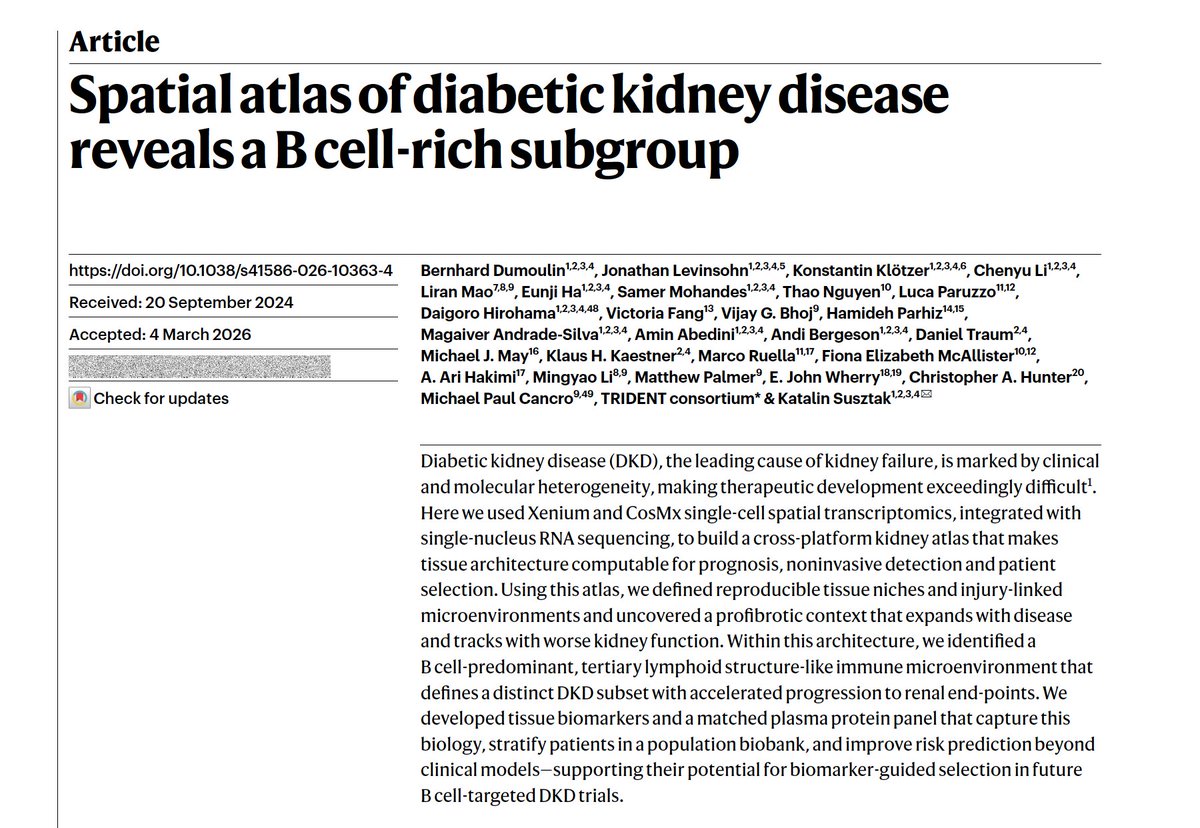
🗞️📸🌟🤩Beautiful work led by @BernhardDumoul1 with the team builds a single cell spatial atlas of human DKD using Xenium + CosMx + snRNA-seq. @Nature This is not incremental. This is a new layer of pathology. Diabetic kidney disease (DKD) is still treated as one disease. That is the problem. Patients look similar clinically but behave very differently. We asked: is there a biologically distinct subgroup we are missing?
https://t.co/Au83tayvR9










![matthewshaw1111's tweet photo. Yale Prof. Akiko Iwasaki writing in Nature:
"Our inability to remain open and engage in rational discussions about controversial subjects may be eroding public trust in science."
"I remember a colleague whose daughter developed a life-threatening autoimmune encephalitis after receiving the human papillomavirus (HPV) vaccine. I watched her struggle with obstacles in even asking whether her daughter’s illness might be linked to the vaccine. These questions are not only unwelcome in the field but also could jeopardize one’s career and credibility."
"The pressure to stay within the consensus view is at an all-time high, for fear of reputational damage, funding exclusion and lack of career promotion, which is amplified at a massive scale on social media. However, there are broader epistemic consequences to staying within the consensus and suppressing alternative viewpoints, which could undermine trust and progress in science."
"scientists are unable to freely inquire about the risk of [post-vaccine syndrome] without being labelled as ‘anti-vaxxers’."
"True scientific progress depends on a culture that
protects dissent"](https://pbs.twimg.com/media/HHZjKfxXoAAT5NU.jpg)