The Wyss Institute seeks to transform engineering, medicine and the environment by creating new materials and devices using Nature’s design principles.
Prior to the Wyss' founding in 2009, a working group at Harvard University assembled envision the future of biomedical engineering. Now, we see the how this foundation led to successful technologies positively impacting human and planet health.
https://t.co/z3cWeOh0v5
Excited to share a link to our new ms in BioRxiv! It showed that BBB expression of brain shuttle receptors is stable between brain regions, diseases (AD, PD, ALS, HD) and ages in human subjects. Expression between individuals varied > 10x. https://t.co/RBRLYNqAb8
Translating protein recognition into DNA single-molecule readout: a nanopore digital immunoassay for sensitive plasma biomarker quantification.
Read it here 🔗 https://t.co/7G1kaZsnT8
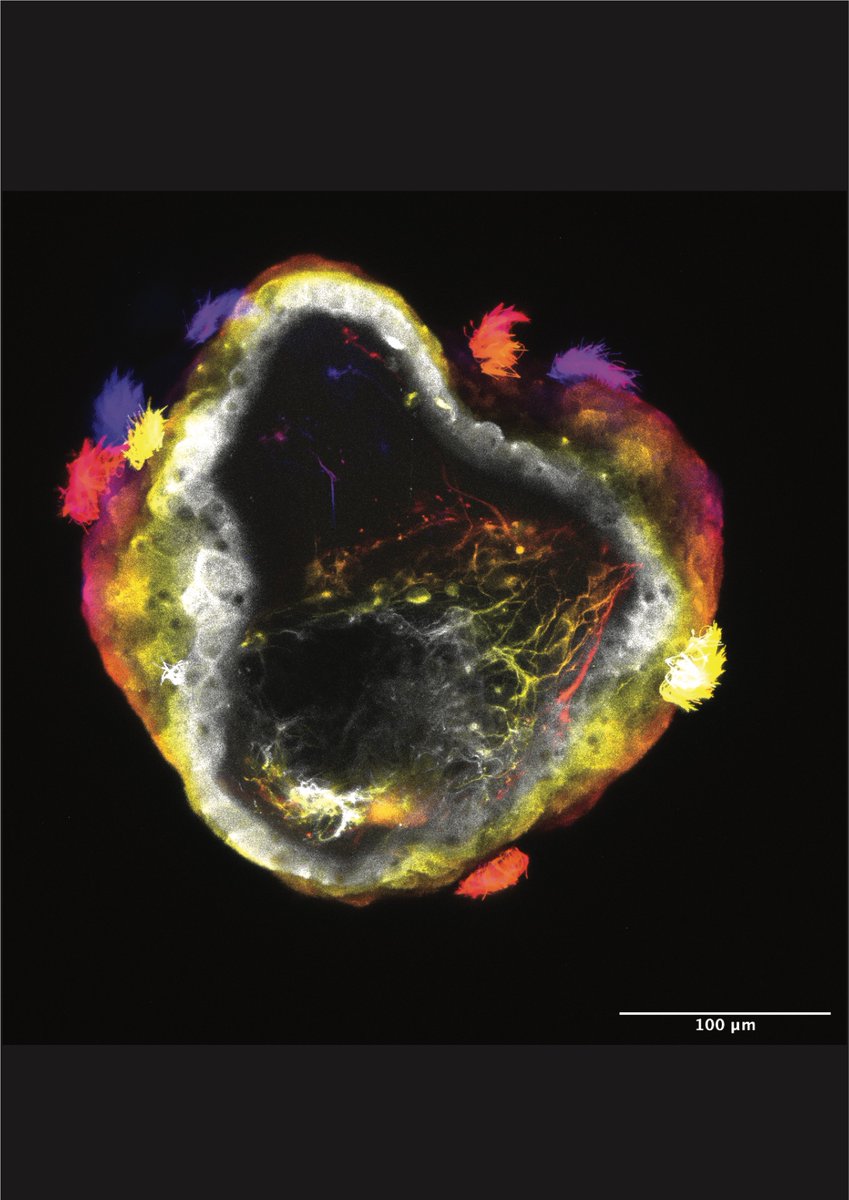
Ever wonder what a nervous system would look like if it self-assembled inside a novel being that hadn't faced a history of selection for its organism-level form and function? Or, perhaps you wondered how #Xenobots would look and act, or what their transcriptome would be like, if they had nervous systems?
Well, here's the first step: https://t.co/MVtFw0RcQg
"Engineered Living Systems With Self-Organizing NeuralNetworks: From Anatomy to Behavior and Gene Expression"
Our awesome team: led by @halehf: @LaurieONeill99, @mmsperry, @LPiolopez, @DrPatrickE, and Tiffany Lin.
The @TuftsUniversity and @wyssinstitute press releases are here, for summaries:
https://t.co/PQkBfUFZS5
https://t.co/LPwoLPeBqN
Our grantee @wyssinstitute is harnessing the power of Artificial intelligence to accelerate the development of transformative medicine, diagnostics, and medical devices, ushering in a new era of accuracy and efficiency in healthcare. 👩⚕️💻🧬
https://t.co/WAPzHBmbsn
Digital SHERLOCK: Rapid Detection and Resistance Profiling of Candida auris
dSHERLOCK, a rapid CRISPR-based diagnostic, detects Candida auris and #antifungalresistance mutations in patient samples in under an hour
@wyssinstitute#CRISPR#Candida
https://t.co/VTtyfh1G5O
Our new publication:
Plasmid2MC: efficient cell-free generation of high-purity minicircle DNA for genome editing in mammalian cells
https://t.co/z3J0jbds6C
A personalized biomaterial #CancerVaccine just passed its first-in-human test!
Started by Drs. Stephen Hodi and David Mooney's labs at the @wyssinstitute in 2013, the trial showed that the system can be consistently fabricated and applied to patients: https://t.co/SL97RyL4XY
✂️ #CRISPR research by Dr. George Church (@geochurch) inactivated all 62 copies of porcine endogenous retrovirus.
🐖 Now, eGenesis at @wyssinstitute & @harvardmed builds upon this work to develop safe and effective pig organs for #xenotransplantation: https://t.co/5XRwPZEk8n
💡 Researchers from the @WyssInstitute have showed they can use messenger RNA to activate the pathway and trigger the immune system to attack tumors!
Check out the work from Dr. @NatalieArtzi's lab in PNAS: https://t.co/fueVk1TWXT
Press release: https://t.co/hVsOKaE6cN
Clinical researchers and bioengineers at SEAS and the @wyssinstitute have developed slowly biodegradable, injectable biomaterial scaffold vaccines that could solve the problem of device infection in patients.
https://t.co/2mZYKUDFOK
We’re excited to share a new multi-year collaboration with @TakedaPharma, building on the success of our first engagement. Under the agreement, Nabla will receive double-digit millions in upfront and research payments and is eligible for success-based payments exceeding $1 billion.
The partnership deploys Nabla’s AI-driven JAM platform across Takeda’s early-stage programs to include de novo design of antibodies in parallel for multiple targets, multispecifics, challenging targets, and other custom therapeutics.
Read more below
Just published in ACS Central Science—our latest work using the Centrifuge Force Microscope to quantify immune-cell interactions. The new setup combines high-throughput force spectroscopy with multichannel fluorescence for single-cell studies. https://t.co/sRLCxSaYui
Stem Cell Differentiation Method Induces Meiosis to Address Infertility
A new approach triggers #meiosis, the cell division process responsible for producing egg and sperm, to aid future fertility treatments
@geochurch@wyssinstitute#infertility#iPSCs
https://t.co/nljpYLbX5m
Grantee the @wyssinstitute (Wyss Institute for Biologically Inspired Engineering at Harvard) announced last month that it developed a new drug to treat coronaviruses using AI dynamic modeling! 👩🔬💊
#medicine#innovation#health
https://t.co/y4pROEZVFB