One reason it's more difficult to work with people you don't have faith in is simply that there are more possibilities to consider whenever they do something. You also have to consider all the ways they might have screwed up. Even if they didn't, you still have to think about it.
“What’s my approval rating?”
- It’s bad Mr Prime Minister. It’s -43. It’s…it’s in the mud.
“Could it get lower?”
- I mean anything COULD happen but realistically-
“Kill the ponies.”
- Wha-
“The ponies. The cute little ponies. Kill them.”
- Sir, they’re endangered
“Fuck ‘em. Make the call.”
"You need to make yourself a big target for luck, and the way to do that is to be curious. Try lots of things, meet lots of people, read lots of books, ask lots of questions."
— Paul Graham, How to Do Great Work
https://t.co/AyIk5fnKZL
The lesson I take from the SpaceX IPO is that the only thing stopping us from solving arbitrarily difficult problems is extreme creativity in business models.
No amount of tax and spend programs got us reusable rockets and great electric cars. Customer delight is a necessary precondition for success.
There seems to be some discussion around whether successful entrepreneurs should give up control of their companies so they can subsidize some philanthropic venture that otherwise has no value prop sufficient to run it as a business where customers voluntarily exchange money for goods and services at a competitive and reasonable price.
This misses the point. Transformational products deliver tangible value at 1000x the rate of charities whose value cannot be tested in the market place. Think about the undeniable value of the smart phone, satellite Internet, electric consumer devices, etc etc.
I think the transformational moment for SpaceX was when Elon stepped away from the philanthropic Mars greenhouse concept and fixed his resolve on unlocking radically better rockets for humanity. The greenhouse would have been, at best, a neat trick. Falcon and Starship give humanity a durable economic engine to maintain and improve access to space, forever.
Absolutamente increíble. Lo que hoy ha hecho Barcelona se recordará mucho tiempo. La Sagrada Familia, Gaudí y los que durante 140 años han creído en ello, lo merecían.
Deep inner suffering inevitably arises when the human person is reduced to performance, consumption, or a statistical datum. Many young people today live under the yoke of expectations to perform, immersed in an exasperated competitiveness that generates anxiety, fear of not measuring up, and disorientation.
Pope Leo quotes Gandalf in encyclical debut:
“It is not our part to master all the tides of the world, but to do what is in us for the succour of those years wherein we are set, uprooting the evil in the fields that we know, so that those who live after may have clean earth to till.”
Sir Kenneth Clark’s opening short clip on civilization’s fragility and the decline of the Roman Empire.
“What happened? Well, it took Gibbon nine volumes to describe the decline and fall of the Roman Empire. And I shall not embark on that. But thinking about this almost incredible episode does tell one something about the nature of civilization.
It shows that however complex and solid it seems, it is actually quite fragile. It can be destroyed.
What are its enemies? First of all, fear — fear of war, fear of invasion, fear of plague — fears that make it simply not worthwhile constructing things, or planting trees, or even planning next year’s crops.
And fear of the supernatural, which means you don’t question anything or change anything. The late antique world was full of meaningless rituals, mystery religions that destroy self-confidence.
And then boredom, the feeling of hopelessness which can overtake people with a high degree of material prosperity. There’s a poem by a modern Greek called Cavafy, a poem in which he imagines the people of some late antique city waiting every day for barbarians to come and sack it. And then finally the barbarians move off somewhere else and the city is saved. But the people are disappointed. It would have been better than nothing.
Of course, civilization requires a modicum of material prosperity, enough to provide a little leisure. But far more it requires confidence — confidence in the society in which one lives, belief in its philosophy, belief in its laws, confidence in one’s own mental powers.
The way that stones at a bridge are laid is not only a triumph of technical skill. It shows vigorous belief in discipline and law. Energy, vitality.
All great civilizations — or civilizing epochs — have had a weight of energy behind them.
People sometimes think that civilization consists in fine sensibilities and good conversation and all that. Well, these can be among the agreeable results of civilization. But they are not what makes a civilization. And a society can have these amenities and yet be dead and rigid.
So if one asks why the civilization of Greece and Rome collapsed, the real answer is: it was exhausted.”
Clark was filmed seated on the rocks beside the Pont du Gard aqueduct in France. The full 11 hour series can be found on YouTube. https://t.co/o9Dbb1C96J
That water clarity is an engineering decision, and the math behind it is wilder than the video.
Roman aqueducts ran on gravity alone. No pumps, no pressure systems. Engineers carved channels with a gradient so shallow it borders on absurd. The Pont du Gard in southern France drops 2.5 centimeters over 275 meters. That's roughly the thickness of a coin over the length of three football fields. They surveyed that accuracy with plumb lines and wooden leveling instruments.
The clarity you're seeing is a direct product of flow velocity. Too steep and the water erodes the channel walls, picks up sediment, turns brown. Too flat and it stagnates. Roman engineers targeted a slope of about 20 centimeters per kilometer, which kept the water moving fast enough to stay fresh but slow enough to stay clear. Before the water reached the city, it passed through multi-chamber settling tanks where velocity dropped near zero. Suspended particles sank. Clean water flowed out the top into the next chamber. Repeat three or four times.
Pliny specified the minimum slope in writing. Vitruvius published the exact mortar ratio for hydraulic cement: one part lime to two parts volcanic ash for underwater work. The pozzolana from Pozzuoli reacted with water to form a calcium-aluminum-silicate compound that actually gets stronger the longer it sits submerged. Modern concrete degrades in water. Roman concrete bonds with it.
Scale the whole system and it gets harder to process. Eleven aqueducts fed Rome at its peak. Combined output: roughly 1 million cubic meters of water per day. That works out to about 250 gallons per person for a city of one million. Modern New York delivers about 125 gallons per person per day. Ancient Rome had access to double the per capita water supply of the largest city in the United States, running entirely on slope and stone.
The Trevi Fountain in Rome is still fed by one of them. Two thousand years, same source, same gravity, same water.
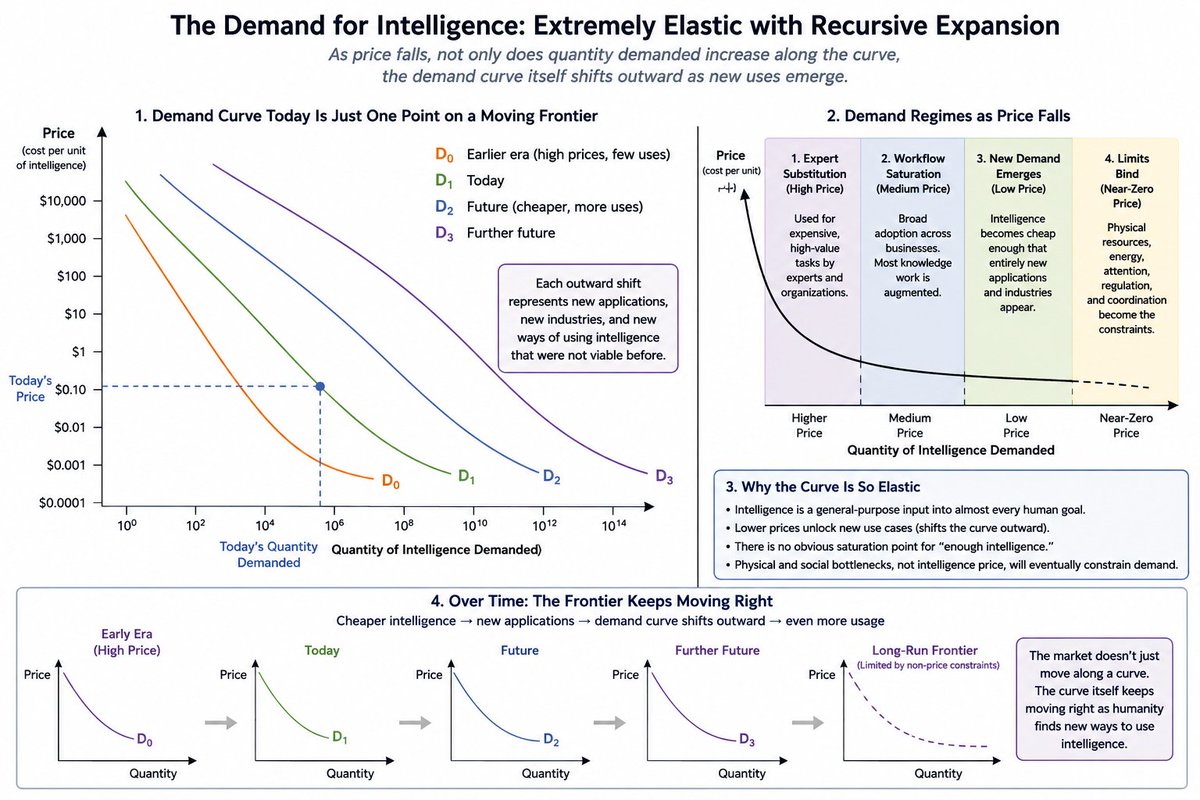
In all of human history, has there ever been a commodity with infinite demand, as there appears to be for intelligence? I can't think of one. Even compute, energy or just silicon/sand are just downstream of intelligence, which is the main demand driver.
In economics, rather than modeling the usual price/demand curve to reach an equilibrium, perhaps you'd have to model price/*rate of demand growth* (ie, the derivative of demand, or some other indicator of velocity)
Interestingly, ChatGPT (below) prefers the framework of "recursive expansion of demand" as increasing intelligence opens new applications/markets.
But the end result is the same -- the demand curve keeps moving to the right, maybe forever.
Which I think is unprecedented.
"Paying attention is in fact one of the most challenging and meaningful things you can do. Because what you pay attention to shapes what you care about. And what you care about shapes who you become."
The students were lucky to hear this speech; it's excellent advice.
Key to winning:
Choose to be positive and grateful. Then, just keep at it. Time is the great compounder and will do the rest.
So many people just don’t have the discipline to stay positive and grateful. Then time compounds the bitterness instead.