The ability to stay focused when things aren't fun is the real talent. Deep learning is often boring, repetitive, frustrating. The fun part is witnessing your growth day after day. You just need the discipline to show up regardless of your mood. You just need to respect yourself.
@systemdesignone No doubt these are world-class books but I'm wondering how can these books be leveraged in AI revoultion? Not talking here about fundamentals that would help you review code but how can AI agents them selves leverage this books knowledge?
API Design Playbook
Giveaway Alert!!!
• Core API fundamentals.
• Clean & scalable design principles.
• Popular patterns used in real-world systems.
• Practical concepts for interviews & building projects.
(24 hours only.)
To get it for free:
1 Follow @systemdesignone [MUST]
2 Like & Retweet to get DM
3 Reply "Playbook"
Then I'll DM you the details.
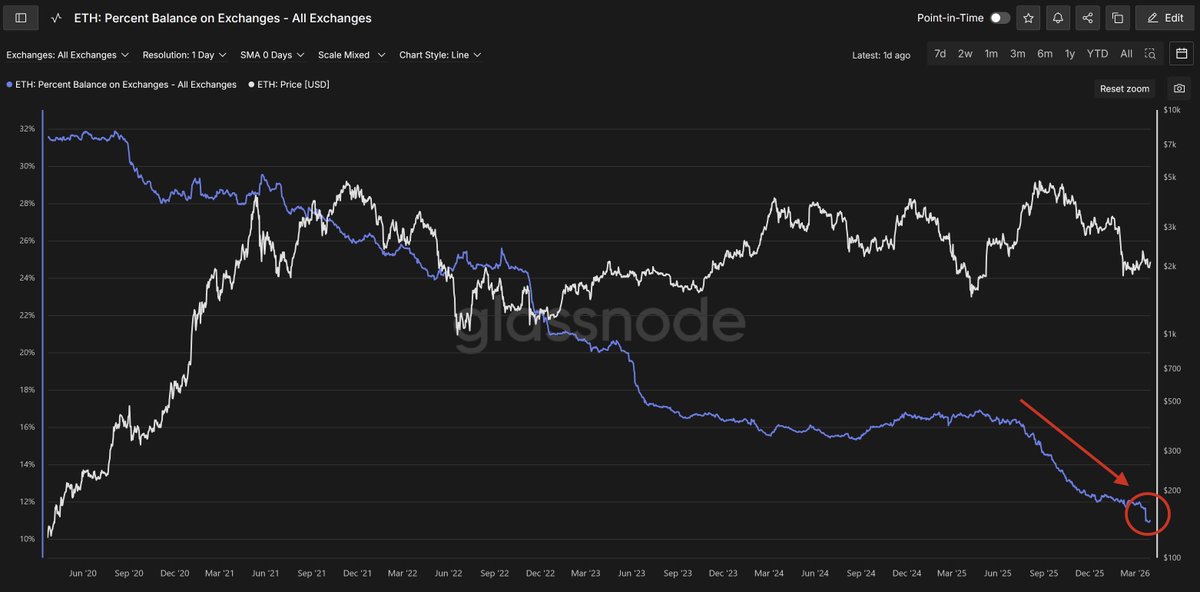
What a chart!
ETH balance on exchanges just hit an ALL-TIME LOW! 📉
Only 11% of total supply left on exchanges.
🔹 Jun 2020: 32% of ETH sat on exchanges
🔹 2022-2024: slow, steady decline
🔹 Mar 2026: VERTICAL drop to 11%
Less ETH on exchanges = less immediate sell pressure.
Holders are pulling it off and keeping it.
At $2K ETH, people aren't selling. They're accumulating.
BULLISH.
Data via @glassnode
There have recently been some discussions on the ongoing role of L2s in the Ethereum ecosystem, especially in the face of two facts:
* L2s' progress to stage 2 (and, secondarily, on interop) has been far slower and more difficult than originally expected
* L1 itself is scaling, fees are very low, and gaslimits are projected to increase greatly in 2026
Both of these facts, for their own separate reasons, mean that the original vision of L2s and their role in Ethereum no longer makes sense, and we need a new path.
First, let us recap the original vision. Ethereum needs to scale. The definition of "Ethereum scaling" is the existence of large quantities of block space that is backed by the full faith and credit of Ethereum - that is, block space where, if you do things (including with ETH) inside that block space, your activities are guaranteed to be valid, uncensored, unreverted, untouched, as long as Ethereum itself functions. If you create a 10000 TPS EVM where its connection to L1 is mediated by a multisig bridge, then you are not scaling Ethereum.
This vision no longer makes sense. L1 does not need L2s to be "branded shards", because L1 is itself scaling. And L2s are not able or willing to satisfy the properties that a true "branded shard" would require. I've even seen at least one explicitly saying that they may never want to go beyond stage 1, not just for technical reasons around ZK-EVM safety, but also because their customers' regulatory needs require them to have ultimate control. This may be doing the right thing for your customers. But it should be obvious that if you are doing this, then you are not "scaling Ethereum" in the sense meant by the rollup-centric roadmap. But that's fine! it's fine because Ethereum itself is now scaling directly on L1, with large planned increases to its gas limit this year and the years ahead.
We should stop thinking about L2s as literally being "branded shards" of Ethereum, with the social status and responsibilities that this entails. Instead, we can think of L2s as being a full spectrum, which includes both chains backed by the full faith and credit of Ethereum with various unique properties (eg. not just EVM), as well as a whole array of options at different levels of connection to Ethereum, that each person (or bot) is free to care about or not care about depending on their needs.
What would I do today if I were an L2?
* Identify a value add other than "scaling". Examples: (i) non-EVM specialized features/VMs around privacy, (ii) efficiency specialized around a particular application, (iii) truly extreme levels of scaling that even a greatly expanded L1 will not do, (iv) a totally different design for non-financial applications, eg. social, identity, AI, (v) ultra-low-latency and other sequencing properties, (vi) maybe built-in oracles or decentralized dispute resolution or other "non-computationally-verifiable" features
* Be stage 1 at the minimum (otherwise you really are just a separate L1 with a bridge, and you should just call yourself that) if you're doing things with ETH or other ethereum-issued assets
* Support maximum interoperability with Ethereum, though this will differ for each one (eg. what if you're not EVM, or even not financial?)
From Ethereum's side, over the past few months I've become more convinced of the value of the native rollup precompile, particuarly once we have enshrined ZK-EVM proofs that we need anyway to scale L1. This is a precompile that verifies a ZK-EVM proof, and it's "part of Ethereum", so (i) it auto-upgrades along with Ethereum, and (ii) if the precompile has a bug, Ethereum will hard-fork to fix the bug.
The native rollup precompile would make full, security-council-free, EVM verification accessible. We should spend much more time working out how to design it in such a way that if your L2 is "EVM plus other stuff", then the native rollup precompile would verify the EVM, and you only have to bring your own prover for the "other stuff" (eg. Stylus). This might involve a canonical way of exposing a lookup table between contract call inputs and outputs, and letting you provide your own values to the lookup table (that you would prove separately).
This would make it easy to have safe, strong, trustless interoperability with Ethereum. It also enables synchronous composability (see: https://t.co/9jy6v1X6Fw and https://t.co/gZmu3YjebM ). And from there, it's each L2's choice exactly what they want to build. Don't just "extend L1", figure out something new to add.
This of course means that some will add things that are trust-dependent, or backdoored, or otherwise insecure; this is unavoidable in a permissionless ecosystem where developers have freedom. Our job should make to make it clear to users what guarantees they have, and to build up the strongest Ethereum that we can.
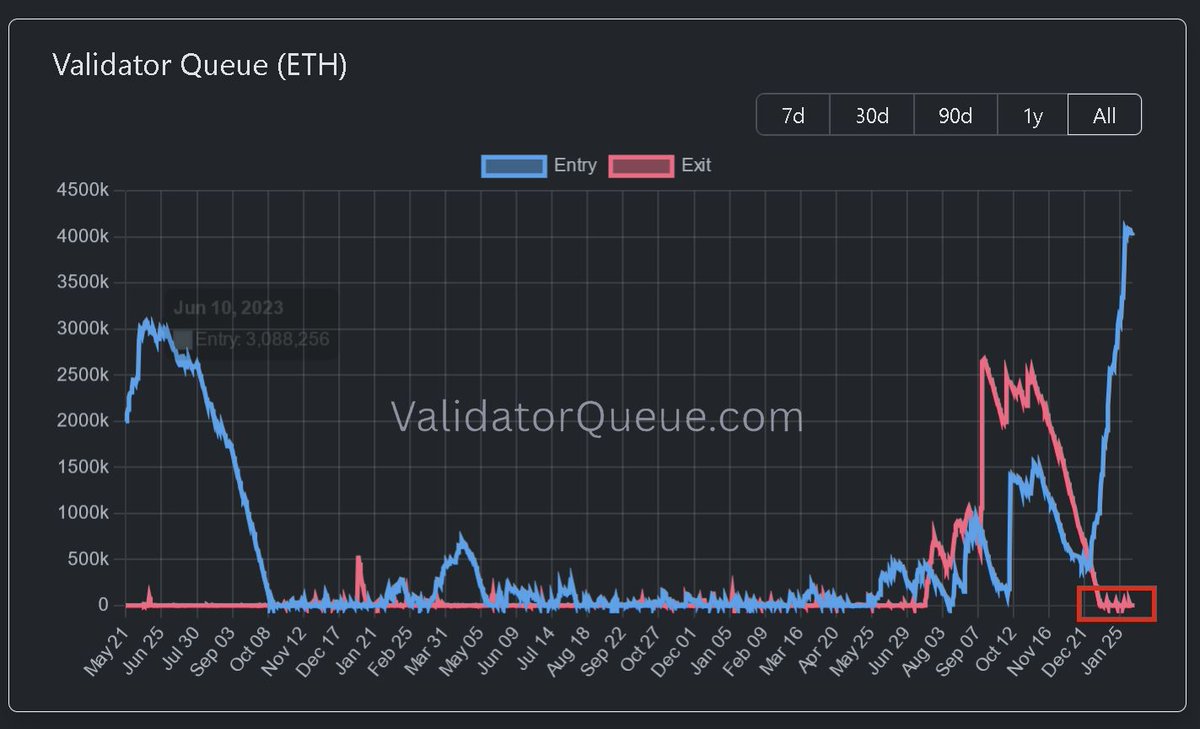
🚨 ETH is down over 60% from its all-time high!🚨
AND YET — 4,000,000 ETH are waiting in line to STAKE.
Only 32,000 ETH want out.
➡️ Still ZERO signs of PANIC among Ethereum stakers!
🔹 Entry Queue: 4,065,246 ETH (~$10B+) waiting to get IN
🔹 Exit Queue: just 31,915 ETH waiting to get OUT
🔹 Wait time to stake: 70 DAYS
🔹 Wait time to exit: 13 hours
Let that satisfying imbalance sink in for a second.
For every 1 ETH trying to leave, 127 ETH are trying to enter.
This is the LARGEST entry queue in Ethereum's history.
During the biggest price drawdown of this cycle.
Now here's the thing...
I am not sure if this should make YOU bullish or bearish.
🐂 The bull case:
Stakers have EXTREME conviction. Price crashed 60%+ and they're STILL willing to wait 70+ days to lock up their ETH. That's insane commitment. Smart money is not leaving.
🐻 The bear case:
We haven't seen REAL panic selling yet. If sentiment ever flips, there's a massive wall of staked ETH that hasn't even thought about exiting. When that dam breaks — IF it breaks — it won't be pretty.
Make of that what you will.
I remain OPTIMISTIC and BULLISH, as I always do! 😉
Massive respect for @ensdomains deciding to deploy ENSv2 on mainnet.
These kinds of shifts are never easy once a protocol is mature, but the teams that adapt to where Ethereum is actually going are the ones that survive long term.
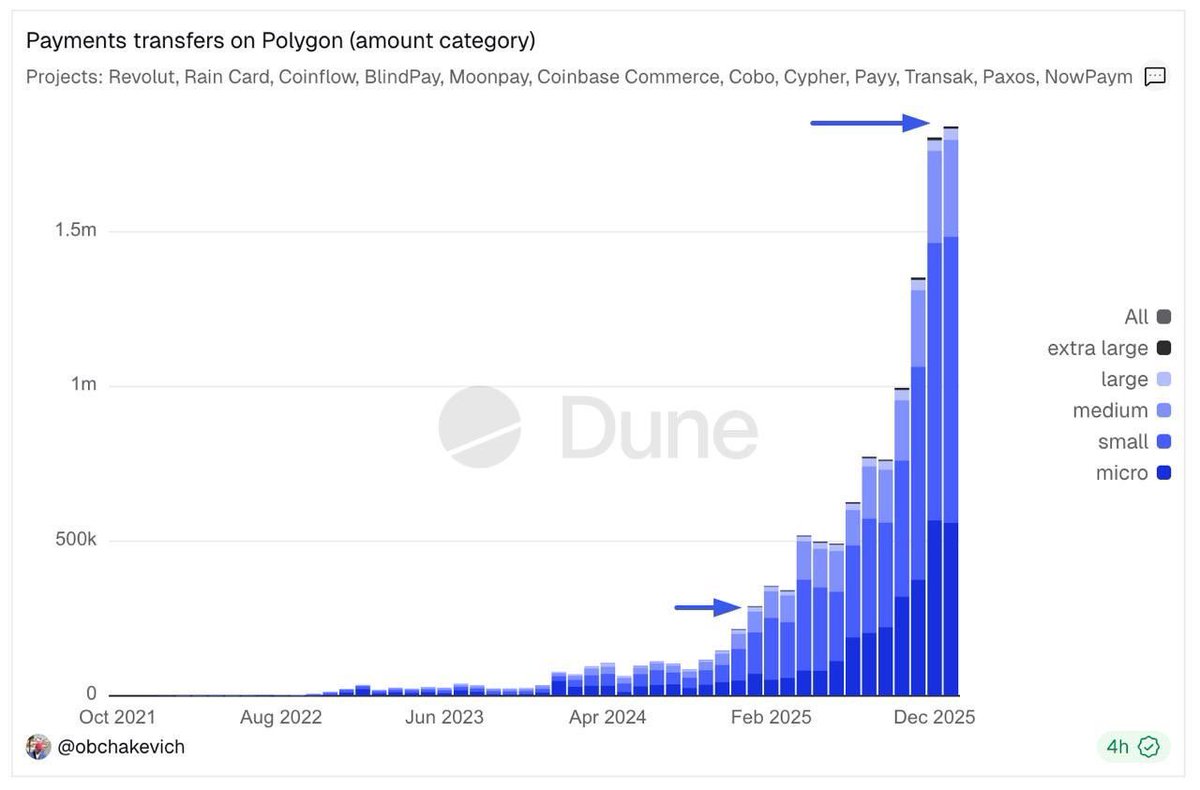
Payments on Polygon are growing rapidly. 📈
From almost nothing in 2021
to ~1.5 million payment transfers per month by late 2025.
🔹 Micro and small payments are exploding
🔹 Medium and large payments are rising in parallel
🔹 Even extra-large transfers are showing up consistently
Ethereum continues to be foundational infrastructure for AI, governments, institutions, global financial systems, and more.
Here are 28 things the Ethereum ecosystem shipped this month.
0/ @Fidelity announced the launch of FIDD, a USD stablecoin built on Ethereum and issued by Fidelity Digital Assets, reinforcing Ethereum’s role as institutional-grade settlement infrastructure.
1/ ERC-8004, a new standard for AI agents, went live on Ethereum. Onchain Identity, Reputation, and Validation registries will enable secure AI agent discovery and interaction across organizations.
There have been over 24,000 agents registered, 80+ agent services verified, and 685+ feedback exchanged.
2/ The @ethereumfndn formed a new Post-Quantum (PQ) research team, marking an important inflection point in Ethereum’s long-term cryptographic strategy and resilience against future quantum threats.
3/ @MorganStanley proposed a spot Ethereum ETF, expanding regulated institutional exposure to ETH.
4/ An Ethereum Community Hub launched in Hong Kong, expanding local access to Ethereum education, collaboration, and ecosystem coordination.
5/ @thedaofund launched and will activate more than 75,000 ETH to strengthen Ethereum’s security, sourced from unclaimed “edge case” funds from the original DAO recovery process.
6/ The Ethereum L1 reached a new all-time high in transaction activity, underscoring sustained demand for mainnet settlement, security, and composability.
7/ The second Blob-Parameter-Only (BPO2) fork went live on Ethereum mainnet, increasing blob targets and limits to strengthen data availability as part of the Fusaka upgrade path.
8/ @OndoFinance expanded Ondo Global Markets with 98 new tokenized stocks and ETFs on Ethereum, bringing total onchain offerings to 200+ equities.
9/ @Aave integrated with @balance_canada, enabling institutional clients to earn yield on assets held in offline or warm storage.
10/ @fileverse launched Offline Mode v2, enabling document creation, access, and recovery without an internet connection.
11/ @worldcoin launched a redesigned World App, positioning it as a consumer super-app for humans in the AI era.
12/ @arbitrum activated the ArbOS Dia upgrade, adding Fusaka EIP support and improving performance and user experience.
13/ @Optimism introduced OP Enterprise, offering production-grade, managed blockchain infrastructure with enterprise guarantees and revenue capture.
14/ @Mantle_Official upgraded to Ethereum blobs as its primary data availability layer, advancing toward a full Ethereum ZK rollup architecture.
15/ @0xPolygon surpassed $1B in daily USDC P2P payments, driven by everyday, real-world transactions.
16/ @Lighter_xyz launched Lighter EVM, an EVM-equivalent rollup enabling low-latency composability with onchain trading liquidity.
17/ @uncapfinance announced the launch of a WBTC yield vault on Ethereum mainnet. It enables users to deposit WBTC on Ethereum and access curated strategies on @Starknet through a single interface.
18/ @LidoFinance launched Lido V3 on Ethereum mainnet, introducing modular stVaults for customizable, builder-native staking infrastructure.
19/ @AlloraNetwork launched mainnet on @Base, enabling predictive AI signals for risk-aware lending, adaptive liquidity, and agent-driven trading.
20/ @ensdomains data is now live on @googlecloud BigQuery, enabling large-scale ENS analytics using simple SQL.
21/ @phylaxsystems went live on @LineaBuild, integrating its Credible Layer directly into the sequencer to prevent exploits before execution.
22/ Following its public debut on the NYSE, tokenized @BitGo became accessible via @OndoFinance Global Markets
23/ @MetaLeX_Labs v2 launched, expanding from DAO legal infrastructure to an onchain corporate finance stack for real-world startups.
24/ @Lighter_xyz enabled 24/5 equity perpetuals, expanding onchain access to traditional market exposure.
25/ @zapper_fi launched a redesigned mobile app featuring gas-less wallets, social graphs, and real-time onchain discussion.
26/ @Corkprotocol launched Cork Phoenix on Ethereum mainnet, a programmable risk layer for RWAs, vault tokens, and yield-bearing stablecoins.
27/ @jumperapp launched Jumper Earn and Jumper Portfolio, unifying cross-chain capital movement, deployment, and management in a single interface.
1/ never been a better time to build with
🤝🤝🤝
Arbitrum:
https://t.co/8s6VC594ZB
Base:
https://t.co/q2e6C2ioqt
Starknet:
https://t.co/88WtCE1y6n
Linea:
https://t.co/8gt0DSeViU
Optimism:
https://t.co/8eZNRrUkqO





![systemdesignone's tweet photo. API Design Playbook
Giveaway Alert!!!
• Core API fundamentals.
• Clean & scalable design principles.
• Popular patterns used in real-world systems.
• Practical concepts for interviews & building projects.
(24 hours only.)
To get it for free:
1 Follow @systemdesignone [MUST]
2 Like & Retweet to get DM
3 Reply "Playbook"
Then I'll DM you the details.](https://pbs.twimg.com/media/HJPoe7VWgAAEnVI.jpg)