Someone bought https://t.co/cP939Hi3hK just to show what Sony did to him.
A ₹1,50,031 BRAVIA died in month 22 of Sony's own 3-year warranty. No dent, no crack. Sony called it "external damage" from WhatsApp photos and billed him ₹29,130.
No proof, ever. @Sony@sony_india
https://t.co/902EjU3ojQ
Today, we’re launching Lead Management for Photographers on https://t.co/aTzuKlXG5e, a simple, focused tool built specifically around how photographers capture, follow up and convert enquiries into bookings.
DM for a personal demo and launch benefits.
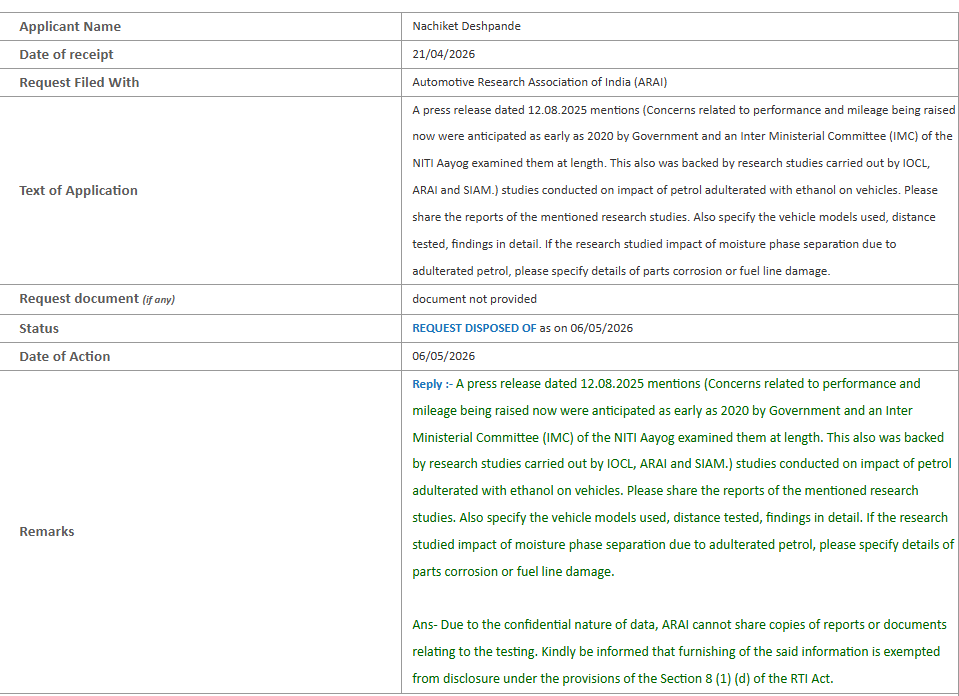
First, the Ministry of Petroleum sits on my RTI for 2 months. Then, they play a shell game, deflecting it to ARAI and OMCs. Now, ARAI hides behind "confidentiality" to suppress the research reports.
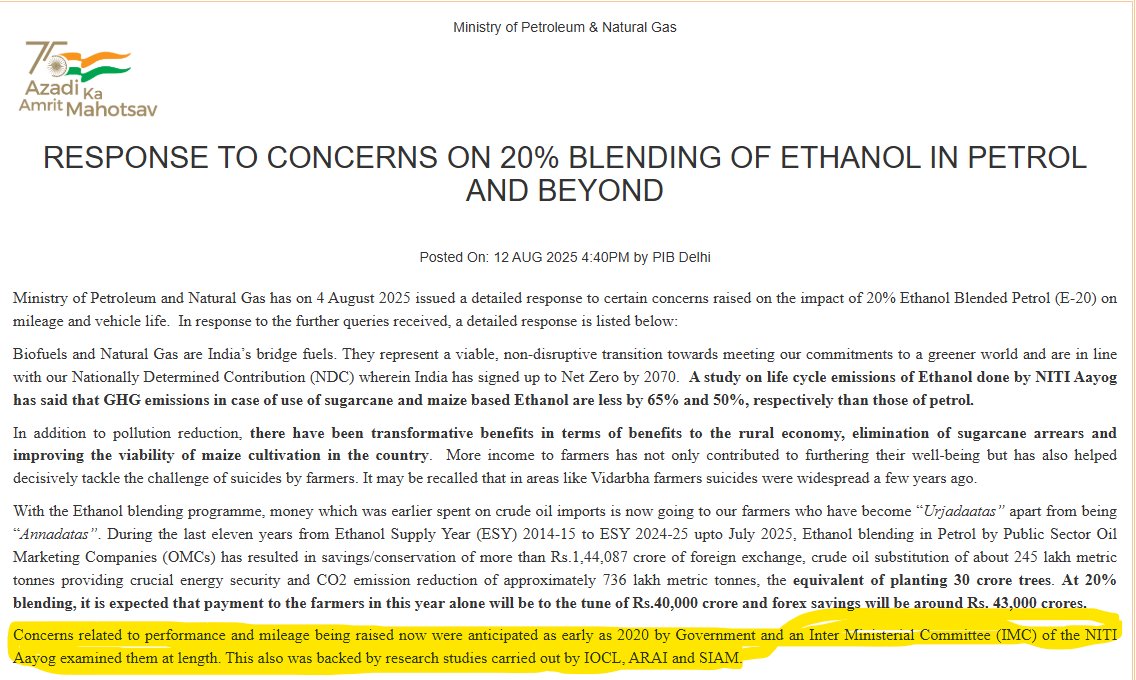
If the Govt cited IOCL, ARAI, and SIAM studies in their press release to push the E20 mandate, why is the data now a state secret? What’s "confidential" about mileage drops and engine corrosion?
This isn't about trade secrets; it’s about a total lack of accountability. The refusal to share reports only confirms the suspicion: the Ministry lied in their press release, and the "extensive research" is a ghost. Millions of vehicle owners are being used as guinea pigs for a policy backed by zero transparent science.
@PetroleumMin@HardeepSPuri@arai_india@siamindia@IndianOilcl
Absolutely terrific use of a small, often unrecognized nuance in language to make a larger point for Mother's Day, by Philips India (agency: Magic Circle). Loved the way the point was made organically, using the generational gap in language and understanding.
There are so many words like this that offer a gendered split leading to the tasks being seen as only one person's even though they are (and should be) shared responsibilities.
'Babysitting', for instance. It's a temporary (often paid) job, but when a father proudly says that he is 'babysitting' it implies he is looking at it as someone else's full-time responsibility and he is simply "helping" for the time being.
Men saying, 'I allowed her to go', or women saying, 'He lets me work', is another example. These are words of 'permission' not a partnership. Women are often said to be 'managing' the house, which makes the men to 'living' in the house? And then the perennial advertising favorite that should stop: women portrayed as 'multi-taskers' or worse, 'superwomen'. The framing not only romanticizes exhaustion but also absolves the people around her from picking up the slack.
That said, there are 2 points of minor counterpoints that came to my mind even as I was enjoying the ad.
One is around the class blind-spot. We are in an era of the "10-minute househelp" offered so many VC-funded startups. When housework is often outsourced to paid domestic workers, the narrative of "everyone’s shared responsibility" becomes muddled because the labor is actually being performed by a third party from a different social class.
The second blind-spot is around economics. The message of "democratizing the kitchen" through an airfryer only applies to those who can afford the gadget. For the vast majority, the "gendered gap" isn't solvable with an expensive (relatively) appliance because it's a mindset that is at play.
#advertising #marketing #creativity
Nvidia CEO Jensen Huang says don't listen to CEOs with a god complex on AI (lol, Dario) $NVDA
On AI destroying jobs: "these kind of comments are not helpful .. somehow they became CEOs, you adopt a god complex and before you know it, you know everything"
"ground ourselves to talking about the facts" AI will "generate hundreds of thousands of jobs .. trillions of dollars [to the U.S. economy]"
It is hard to communicate how much programming has changed due to AI in the last 2 months: not gradually and over time in the "progress as usual" way, but specifically this last December. There are a number of asterisks but imo coding agents basically didn’t work before December and basically work since - the models have significantly higher quality, long-term coherence and tenacity and they can power through large and long tasks, well past enough that it is extremely disruptive to the default programming workflow.
Just to give an example, over the weekend I was building a local video analysis dashboard for the cameras of my home so I wrote: “Here is the local IP and username/password of my DGX Spark. Log in, set up ssh keys, set up vLLM, download and bench Qwen3-VL, set up a server endpoint to inference videos, a basic web ui dashboard, test everything, set it up with systemd, record memory notes for yourself and write up a markdown report for me”. The agent went off for ~30 minutes, ran into multiple issues, researched solutions online, resolved them one by one, wrote the code, tested it, debugged it, set up the services, and came back with the report and it was just done. I didn’t touch anything. All of this could easily have been a weekend project just 3 months ago but today it’s something you kick off and forget about for 30 minutes.
As a result, programming is becoming unrecognizable. You’re not typing computer code into an editor like the way things were since computers were invented, that era is over. You're spinning up AI agents, giving them tasks *in English* and managing and reviewing their work in parallel. The biggest prize is in figuring out how you can keep ascending the layers of abstraction to set up long-running orchestrator Claws with all of the right tools, memory and instructions that productively manage multiple parallel Code instances for you. The leverage achievable via top tier "agentic engineering" feels very high right now.
It’s not perfect, it needs high-level direction, judgement, taste, oversight, iteration and hints and ideas. It works a lot better in some scenarios than others (e.g. especially for tasks that are well-specified and where you can verify/test functionality). The key is to build intuition to decompose the task just right to hand off the parts that work and help out around the edges. But imo, this is nowhere near "business as usual" time in software.
90% of American businesses still don’t use AI in production. That single number reframes this entire post.
An AI startup CEO wrote 5,000 words comparing AI to Covid in February 2020. His argument: he describes what he wants built in plain English, walks away for four hours, comes back to finished software. He says every white-collar job faces the same experience within 1-5 years. Millions of people are sharing it as a wake-up call.
The capability trend he’s describing is real. METR, the independent research org measuring AI task completion, shows the length of tasks AI handles autonomously has been doubling roughly every seven months. The models released in early February represent a genuine step change for coding work specifically. If you build software, you’ve felt this.
Here’s what the post skips entirely. Anthropic’s own economic research, published with Census Bureau data, shows AI adoption among US firms went from 3.7% in fall 2023 to 9.7% by August 2025. Two years of the fastest capability improvement in computing history, and fewer than one in ten businesses use AI in production. ISG’s 2025 enterprise study found only 31% of AI use cases reached full production. Lucidworks surveyed 1,600 AI leaders and found 71% of organizations have introduced generative AI, but only 6% have implemented agentic AI, the autonomous agent capability this post describes.
This tells you everything about where the bottleneck actually sits. It moved from “can AI do this task” to “can our organization deploy it.” That second bottleneck runs on procurement cycles, compliance reviews, data infrastructure buildouts, change management, and institutional trust. None of those compress the way model capabilities do.
The pattern repeats throughout technology history. ATMs deployed widely starting in the 1970s. The number of US bank tellers increased until 2007, three full decades later, because ATMs made branches cheaper to operate, which expanded total branch count. Electricity took 30 years to reshape manufacturing after the first power plants went live. Factories had to be physically redesigned around electric motors instead of steam-driven belt systems. The resistance wasn’t technological. It was architectural.
What makes this interesting for your career: the deployment gap is the opportunity. The Deloitte 2026 AI report found only 34% of companies are reimagining their business around AI. 83% of AI leaders report major concerns about generative AI implementation, an eightfold increase in two years. The organizational machinery moves at a fraction of the capability speed.
The people who gain the most from AI over the next three years aren’t the ones panicking about replacement timelines. They’re the ones who understand that slow enterprise adoption creates a massive window to become the person who actually knows how to use these tools. That window is real and valuable. It exists precisely because adoption is slow, which is the opposite of the premise driving the panic.
The capability curve is exponential. The deployment curve is logarithmic. The distance between those two lines is where the actual opportunity lives.
i routinely write “no hurry, no pause” at the top of my notebooks as a daily reminder.
you can get 95% of the results you want by calmly putting one foot in front of the other.
one former navy seal friend once texted me a principle used in their training: “slow is smooth. smooth is fast.”
perhaps i’m just getting old, but my definition of luxury has changed over time. now, it’s not about owning a lot of stuff. luxury, to me, is feeling unrushed.
no hurry, no pause.
Here's what GitHub's last CEO @ashtom has been up to: building an agent-first dev platform. I'm an investor.
They just shipped Checkpoints. It's open source, easy to use. It adds agent context (eg trajectories, prompts, token usage etc) to PRs. Get it at https://t.co/v19AAzDeDa
On the one hand, AI influencers are breathlessly raving about Claude Code, Clawdbot, and Cowork. And on the other hand, most people I know—even software engineers—are despondent, overwhelmed about how everything is changing so quickly. I hear this from people early in their careers especially, a fear that everything they've learned and the skills they've gained are rapidly being devalued.
This is a mental trap. Don't fall for it. You should not just be watching from the sidelines or reading articles about "how software engineering is changing."
Imagine it was 1993 and the personal computer revolution was kicking off. If you could go back in time to then, what should you have done?
The answer: try everything. Buy a PC. Learn how to touch type. Figure out what the Internet is. Imbibe it all. Don't wait until it becomes a job requirement.
That's exactly what you should do with AI. Try everything. Try Claude Code, try Clawdbot, try the Excel integrations, Veo, everything you can get your hands on. Learn what it's doing. Build your intuitions. Be one step ahead of it. Evolve alongside it. Don't lose your curiosity or get swallowed by anxiety or let yourself be convinced that you'll learn it when you have to. Think deeply about how AI will change the things around you—not society, that's too hard to project—but how it will change your job, your personal life, your immediate environment.
No matter how old you are or young you are, no matter what stage of your career you are in, we are all going through the biggest technological change of the last 100 years, and we're going through it together. Nobody has the answers. It's obvious that so much is going to change, but nobody is going to figure it out before you do if you choose to stay at the frontier.
So don't hide from it. Sit at the front of the class. Pay close attention. And be grateful that it's never been easier to stay at the frontier of the most important technology change of our lifetimes.