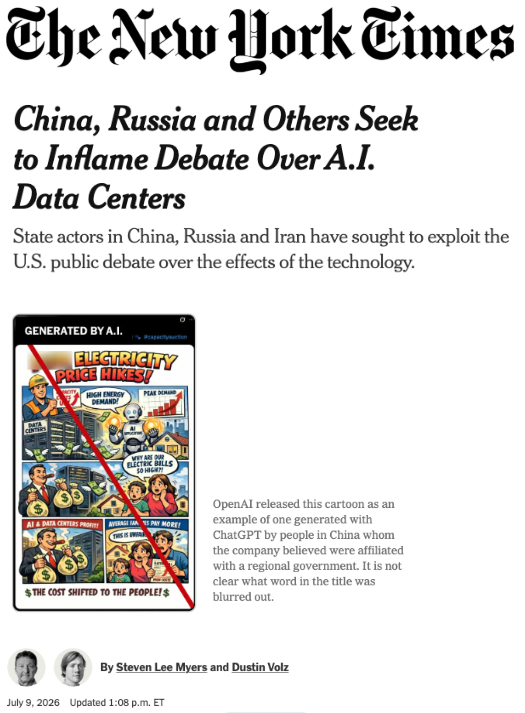
NEW: The New York Times reports that "China, Russia and, to a lesser extent, Iran have sought to use state media outlets to turn the controversy over data centers in the United States into 'a domestic fracture point.'"
Between Jan. and June, state media from these 3 countries mentioned data centers 700 times.
The NYT report cites BPI's research and highlights the work of Chinese propagandists and "covert Russian information operations" to foment anger against data centers.
Announcing Freedom Tech DC 2026.
BPI's annual summit returns to Washington on September 22-23.
Learn more and secure your spot: https://t.co/Fs1KQ3uI49
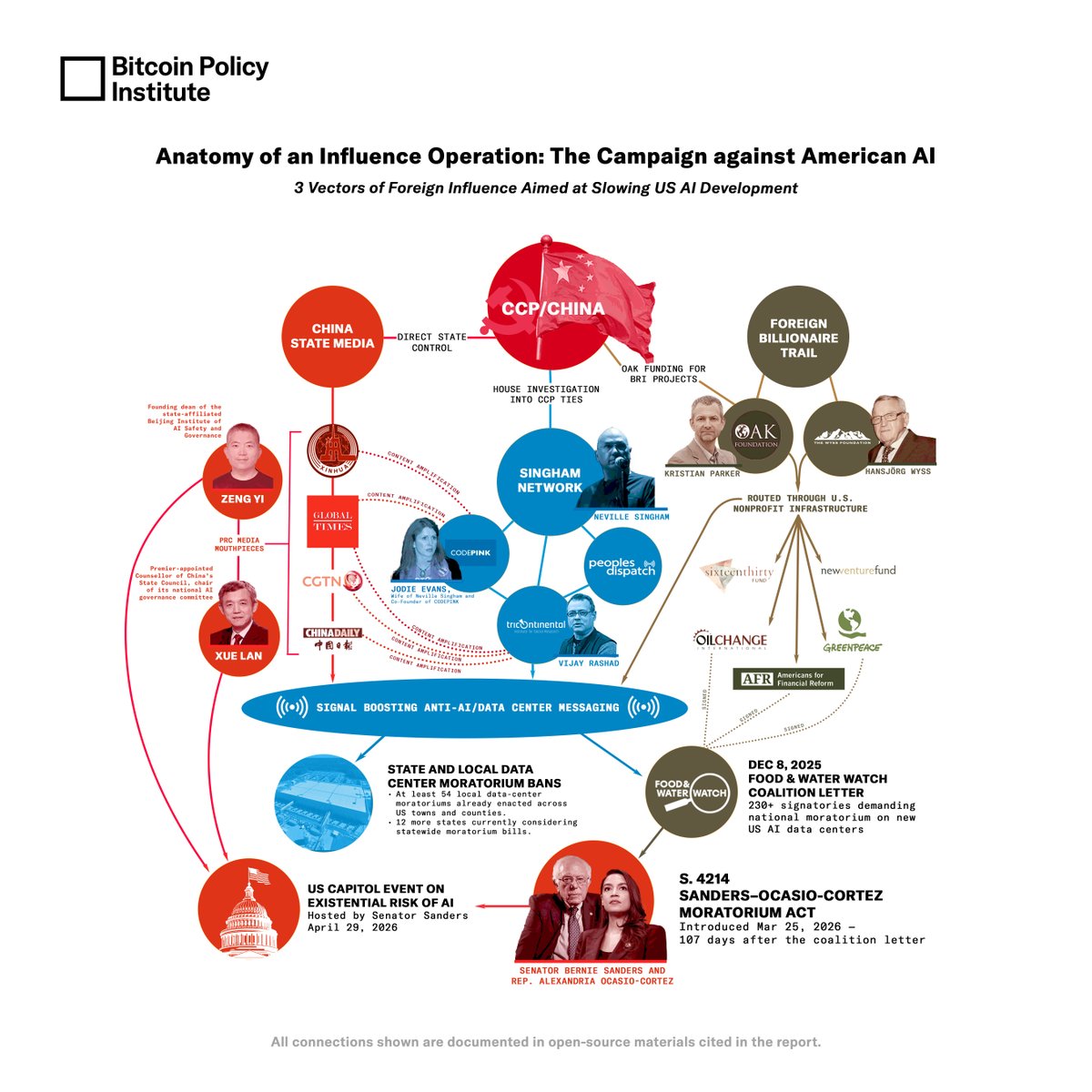
The once vague notion that China is involved in the campaign against American AI is now concrete and undeniable.
In this new report from @bitcoinpolicy, we document 3 vectors of foreign influence:
>China State Media
>The CCP-Aligned Singham Network
>Foreign Billionaires
We’ve traced how all of these efforts culminated in federal legislation to ban AI data centers in the United States – a policy that, if implemented, would be a dream come true for Beijing.
Ensuring that AI is safe and empowers American workers must be a top priority for US policymakers. But the discussion about AI safety should not be influenced by geopolitical rivals, especially China, which aims to accelerate AI development to leapfrog the United States in global science and technology competition.
NEW RESEARCH from @SamLyman33: China is interfering with US data center development in a campaign to slow the American AI buildout.
In this groundbreaking report, we document 3 vectors of foreign influence: Chinese state media, the Singham network, and foreign billionaires.
BREAKING: ADM Paparo, 4-star Admiral and Commander of U.S. Indo-Pacific Command, just testified before the Senate that “Bitcoin shows incredible potential” as a tool for U.S. national security. Watch the full exchange:
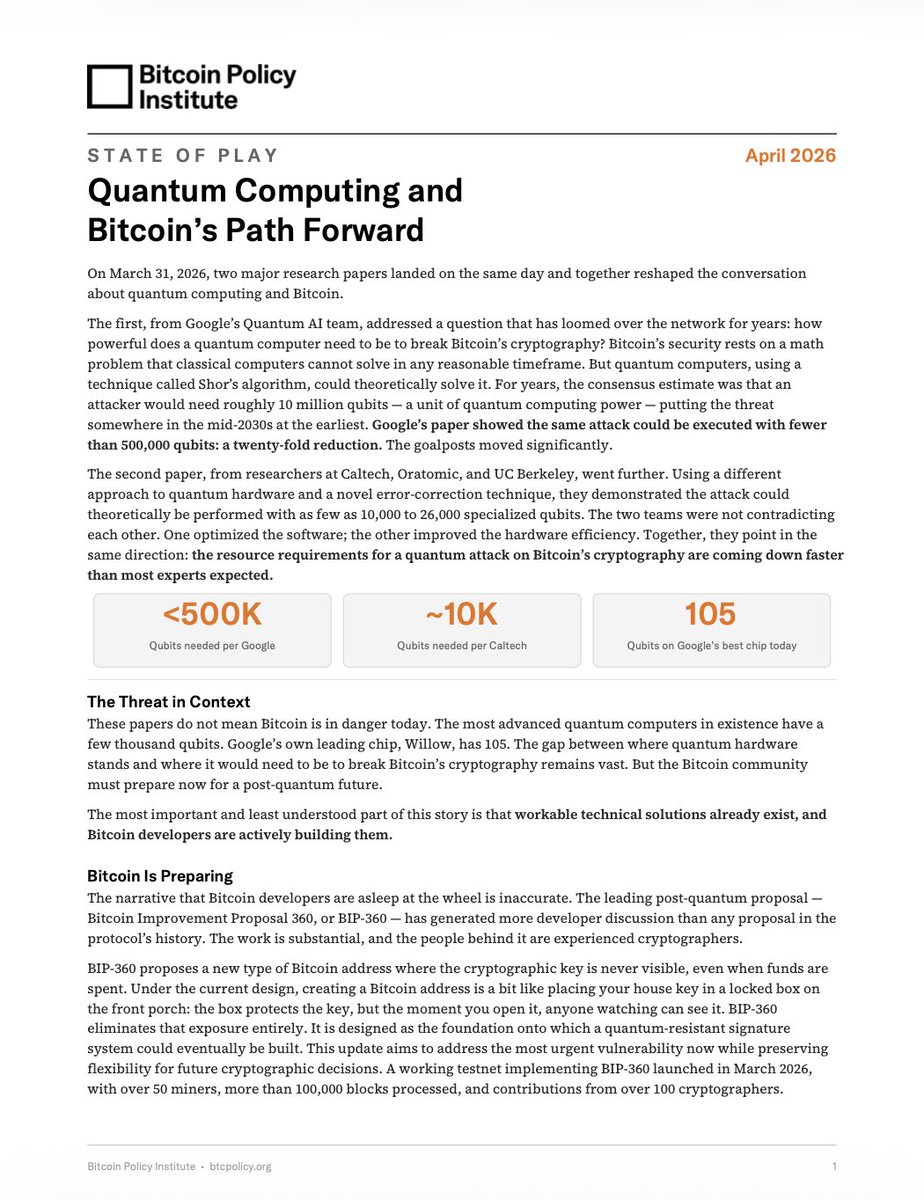
NEW — State of Play: Quantum Computing and Bitcoin's Path Forward
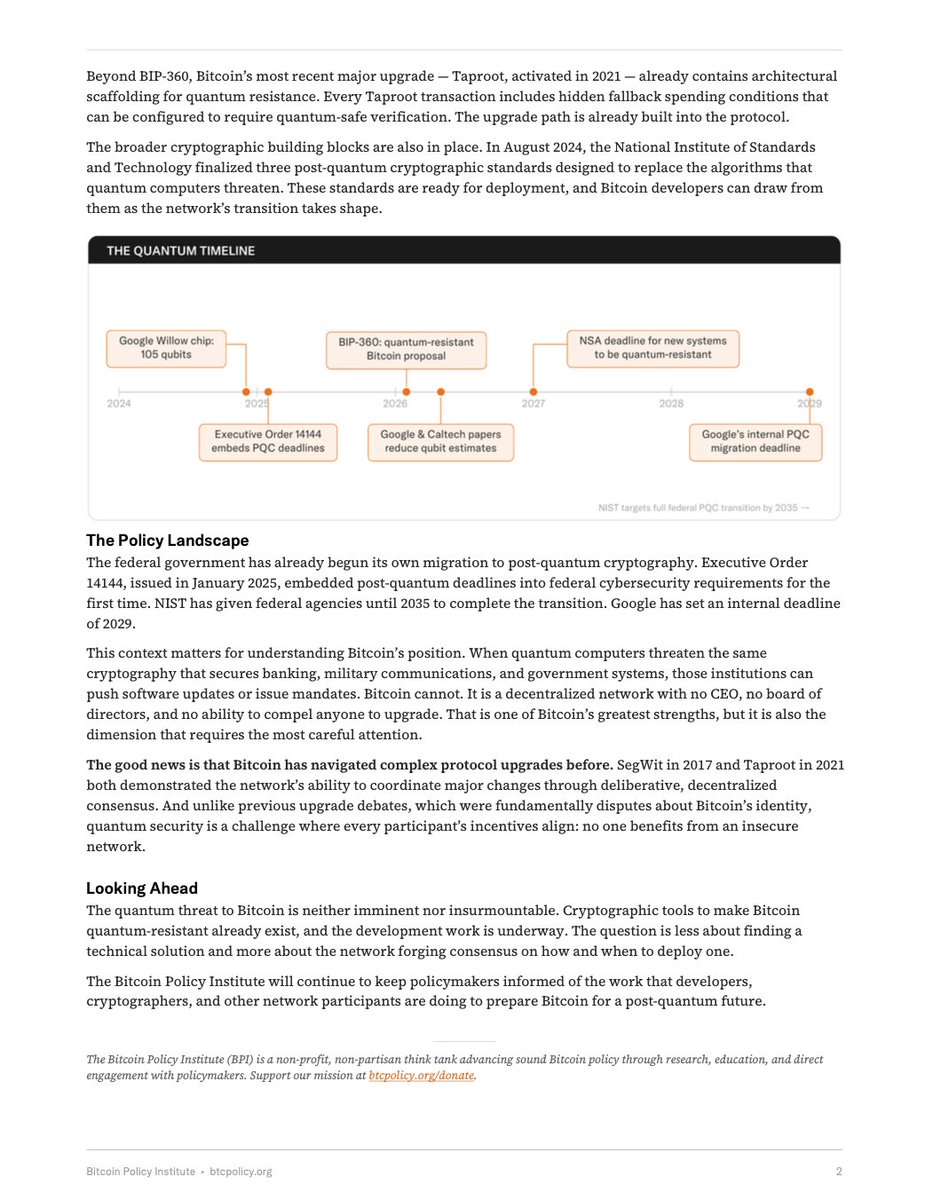
On March 31, two papers from Google and Caltech slashed the estimated qubit threshold for breaking Bitcoin's cryptography. The old consensus was 10 million. Google's new number: under 500,000.
Bitcoin is not in danger today. Google's best chip has 105 qubits. The threshold is still thousands of times higher.
But the timeline is compressing, and the Bitcoin community isn't waiting.
BIP-360 launched a working testnet in March with 50+ miners and 100+ cryptographers contributing. Taproot already contains architectural scaffolding for quantum-safe verification. And Blockstream Research unveiled a new post-quantum signature scheme just days before the release of the Google paper.
The question is less about finding a technical solution and more about the network forging consensus on how and when to deploy one. BPI will continue to keep policymakers informed of the work that developers, cryptographers, and other network participants are doing to prepare Bitcoin for a post-quantum future.
The enduring genius of Bitcoin is that the Satoshi mystery does not need an answer. A monetary network secured by cryptography and game theory, rather than on trust in any individual or institution, does not depend on who Satoshi is or on whether Satoshi is ever found. Every other monetary system in history has depended on trusting someone. Bitcoin is the one that doesn't.
📄NEW RESEARCH (from @JakeLangenkamp): Taiwan holds $602B in reserves, over 80% in USD.
In a PRC blockade, gold is stranded and dollar access could be leveraged against Taipei.
Bitcoin is the only reserve asset that stays sovereign and spendable under both scenarios.
Even more concerning news today on the Bitcoin tax front. We’re going to need the Cyber Hornets for this one. 👇
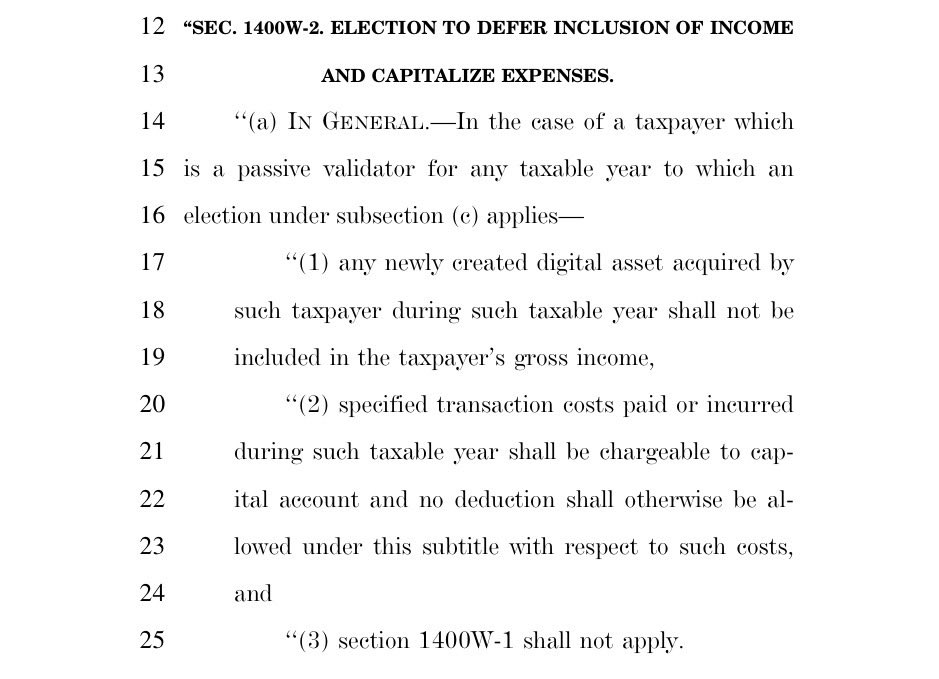
Today’s new draft **leaves the double taxation on bitcoin mining in place** and only provides relief to staking.
So now the proposal is:
- De minimis for stablecoins but not Bitcoin
- Fixing tax treatment for “passive validation” (I.e. staking) but not Bitcoin mining
This contradicts all prior proposals on this issue. This is not tech neutral and picks winners and losers for no reason.
Full statement from BPI coming soon about @RepHorsford and @RepMaxMiller’s draft.
We need strong community push back to show that this language sets America and Bitcoin back.
We tested 36 blank-slate frontier AI models to determine their monetary preferences. Across 9000+ scenarios, the agents overwhelmingly chose Bitcoin.
See for yourself at https://t.co/syke97JD0c
during Covid the government spent $4-5T or 20-25% of GDP on various handouts and stimulus programs. it's now clear – as was very predictable at the time – that this spending was overwhelmingly ridden with fraud. and the fraud wasn't really a side effect. the point was to use Covid to hand out gibs to all of the Biden admin's chosen affinity groups. meanwhile, every American ended up footing the bill through the resultant inflation.
the Minnesota fraud is just the tip of the iceberg but it's totally indicative of what went on. no fraud checks whatsoever (remember that the emphasis during CARES and PPP was shoveling money out the door, and "some amount of fraud" was deliberately tolerated). I know I'm not alone in remembering the lines around the block at the luxury stores when the PPP cash first started going out.
official government sources now admit staggering quantities of fraud. the SBA estimates $200b in PPP fraud [1]. the GAO estimated [2] pandemic-era unemployment fraud at $100-$135b. and of course, this is still under-reported, as no one wants to admit that the government funded fraudsters with taxpayer cash. more examples of massive billion-dollar frauds continue to trickle in, with MN being a great example. the real number is almost certainly in the trillions.
this is one of the biggest institutionalized thefts in history, and we're still paying for it today, through higher debt levels, structurally higher inflation, higher short-end rates (to cure the burst of inflation), and higher long-end rates because creditors don't trust the government any more. an absolute travesty that few will acknowledge.
[1] https://t.co/F4At8vLC1Q
[2] https://t.co/LpbQQh9iwI
@KristinCarrigg Your mileage may vary but in my experience it depends on the food. E.g. milk and ice cream are ideal because the fat/protein slow sugar absorption and prevent big spikes/crashes; fructose, potassium, and protein in OJ have a similar effect. Would avoid pure starch