Research Scientist @GoogleDeepMind;
PhD in AI at IDSIA with @SchmidhuberAI;
Former @DeepMind and @GoogleAI Brain intern;
MSc from @ETH_en;
Views my own
Many people think any given ML project is 99% training.
In reality, it’s 50% evaluation, 40% data cleaning, 8% integration, and 2% training.
The first two set the noise floor for learning. No ML magic matters; the model cannot lower the noise floor, as that’s the optimal bound of Shannon encoding of your data.
Thus, not a single day goes by without me thinking about ontology. Even the old labels have to be constantly reviewed.
@dwarkesh_sp > I think the answer is that it is not enough for a domain to be verifiable.
Or because MMU/vision requires some fundamental breakthrough(s). in particular in how we map images -> discrete tokens (that you get for free in purely text-based problems).
Only Art and Science raise humanity to the sublime. But the magic isn't in the output. It's in the process of creation and discovery, and the experience of feeling and understanding.
We’ve released TECCI, a new dataset focusing on challenging image edits! (Including visual puzzles and much more)
Like DOCCI, all images are donated to the public domain, so you get the bytes with the data. See Aishwarya’s thread for more details and pointers.
We’re excited to introduce Inherent, a lab designed from scratch to build AI agents that discover new knowledge.
The coming era of machine-driven scientific inquiry demands a new kind of research institution and a new kind of AI.
To achieve our mission, we live within the experiment, recursively self-improving the entire research organisation. We investigate questions including:
- What does ‘AI taste’ look like in the sciences, and how can we build an institution that embraces this new aesthetic of discovery?
- What new kinds of human-machine teaming will make the most of AI that can truly innovate?
- How can we build recursive self-improvement at the collective level that continually increases human agency over outcomes?
We have just closed a $50m seed round led by @IndexVentures and @radicalvcfund, with participation from other outstanding investors including NVentures (@nvidia's venture capital arm), @buildexante, Metaplanet, Macroscopic, @MythosVentures, Charlie Songhurst, @chalfs, @jluan, @dwarkesh_sp, @Thom_Wolf, @j_foerst and @maxjaderberg. We are advised by @matthewclifford.
Inherent is a Public Benefit Corporation headquartered in London.
The likeness preservation and natural realism coming out of Gemini #Omni Flash is absolutely unreal 🤯
Huge shoutout to the insanely talented team for pushing these boundaries. The team absolutely cooked. 👨🍳🔥
If Flash is this good... imagine what Pro is about to unleash. 👀✨
My first blog post in over a year is a deep dive on flow maps🗺️, or how to learn the integral of a diffusion model to enable faster sampling and several other cool tricks.
It's the longest one yet👀 Let me know what you think!
https://t.co/O8bBGZ9qjC
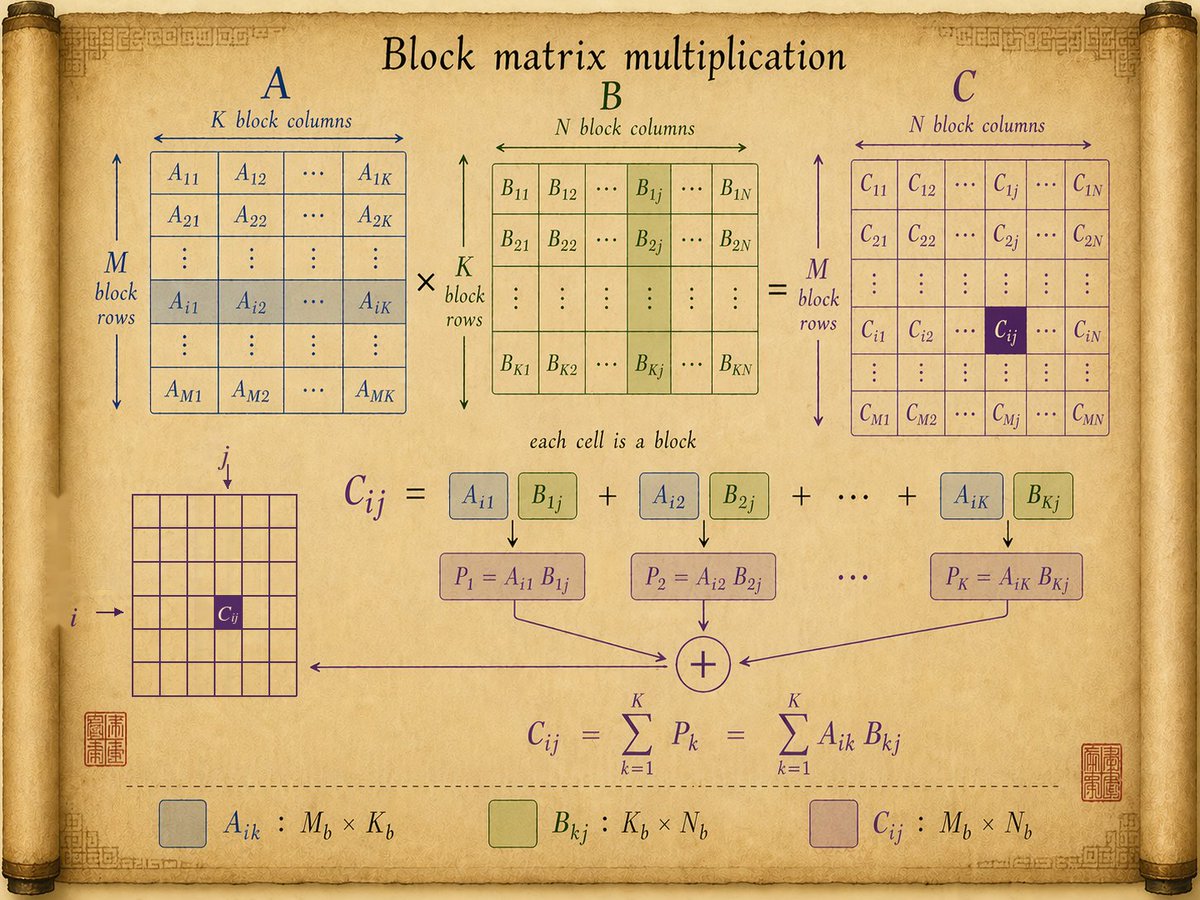
Learning will never be the same again. Simply laying things out visually makes an explanation much more intuitive to understand than a big wall of text. We couldn't learn with LLMs this way before. Now we can.
LLM Knowledge Bases
Something I'm finding very useful recently: using LLMs to build personal knowledge bases for various topics of research interest. In this way, a large fraction of my recent token throughput is going less into manipulating code, and more into manipulating knowledge (stored as markdown and images). The latest LLMs are quite good at it. So:
Data ingest:
I index source documents (articles, papers, repos, datasets, images, etc.) into a raw/ directory, then I use an LLM to incrementally "compile" a wiki, which is just a collection of .md files in a directory structure. The wiki includes summaries of all the data in raw/, backlinks, and then it categorizes data into concepts, writes articles for them, and links them all. To convert web articles into .md files I like to use the Obsidian Web Clipper extension, and then I also use a hotkey to download all the related images to local so that my LLM can easily reference them.
IDE:
I use Obsidian as the IDE "frontend" where I can view the raw data, the the compiled wiki, and the derived visualizations. Important to note that the LLM writes and maintains all of the data of the wiki, I rarely touch it directly. I've played with a few Obsidian plugins to render and view data in other ways (e.g. Marp for slides).
Q&A:
Where things get interesting is that once your wiki is big enough (e.g. mine on some recent research is ~100 articles and ~400K words), you can ask your LLM agent all kinds of complex questions against the wiki, and it will go off, research the answers, etc. I thought I had to reach for fancy RAG, but the LLM has been pretty good about auto-maintaining index files and brief summaries of all the documents and it reads all the important related data fairly easily at this ~small scale.
Output:
Instead of getting answers in text/terminal, I like to have it render markdown files for me, or slide shows (Marp format), or matplotlib images, all of which I then view again in Obsidian. You can imagine many other visual output formats depending on the query. Often, I end up "filing" the outputs back into the wiki to enhance it for further queries. So my own explorations and queries always "add up" in the knowledge base.
Linting:
I've run some LLM "health checks" over the wiki to e.g. find inconsistent data, impute missing data (with web searchers), find interesting connections for new article candidates, etc., to incrementally clean up the wiki and enhance its overall data integrity. The LLMs are quite good at suggesting further questions to ask and look into.
Extra tools:
I find myself developing additional tools to process the data, e.g. I vibe coded a small and naive search engine over the wiki, which I both use directly (in a web ui), but more often I want to hand it off to an LLM via CLI as a tool for larger queries.
Further explorations:
As the repo grows, the natural desire is to also think about synthetic data generation + finetuning to have your LLM "know" the data in its weights instead of just context windows.
TLDR: raw data from a given number of sources is collected, then compiled by an LLM into a .md wiki, then operated on by various CLIs by the LLM to do Q&A and to incrementally enhance the wiki, and all of it viewable in Obsidian. You rarely ever write or edit the wiki manually, it's the domain of the LLM. I think there is room here for an incredible new product instead of a hacky collection of scripts.
I am really excited to share that our work on The AI Scientist has been published in Nature
Automated Scientific Discovery has been something I only dreamt about at the start of my PhD. Today, we are making big leaps into a world in which autonomous agents support human researchers in tackling some of the most fundamental problems.
In August 2024, The AI Scientist-v1 showed first sparks of LLM agents becoming capable of conducting research end-to-end. While the generated artifacts were still far from perfect, it was clear that automated discovery was about to change. We scaled the system and improved all ingredients of the pipeline. In April 2025, The AI Scientist-v2 had become capable of producing a paper that could pass the human peer review of an ICLR workshop.
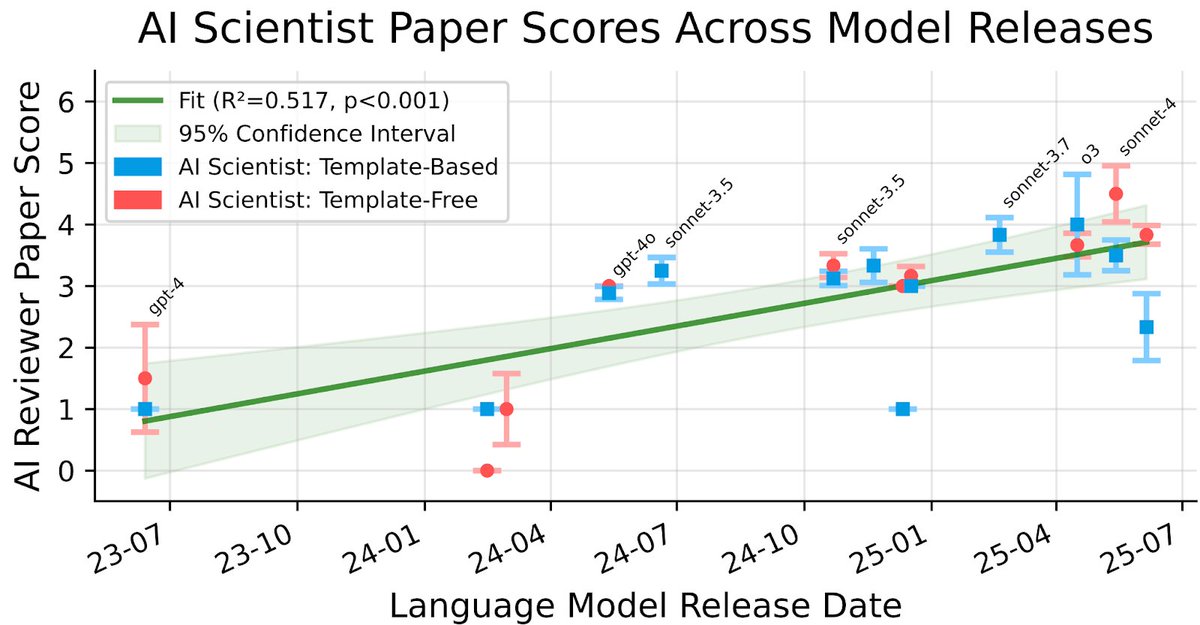
This is only the beginning. Systems like AlphaEvolve, ShinkaEvolve, AIDE, and Autoresearch will continue to shape the future of how research is conducted. Our METR-style scaling results indicate that model improvements have direct downstream impacts. Still, there are many challenges. Both technical and societal. I have a strong belief that we, as a collective, will find the answers and adapt.
This has been an enormous amount of work by an outstanding set of human researchers @_chris_lu_@cong_ml@_yutaroyamada@shengranhu@j_foerst@jeffclune@hardmaru@SakanaAILabs with many long nights of work. I am super grateful for the entire ride, learnings and the future to come. Thank you to everyone!
Finding the right lines to draw is very difficult, especially under pressure, commercial or otherwise.
I am proud of my employer's decisions in this regard.