Brock Lesnar vs. Cain Velasquez 🥊
This wasn't just a heavyweight fight, it was a collision of power, pressure, and pure intensity.
Even years later, you can still feel the tension every time they step into the Octagon.
Who do you think had the more dominant heavyweight legacy: Brock Lesnar or Cain Velasquez?
#UFC #Heavyweight
The Myth of “Love Learning”
People often ask me how to get better at chess. My answer is almost the opposite of what people expect.
You don’t have to love learning.
In fact, if you wait until you love the process, you’ll probably never become very good.
We romanticize improvement. We imagine great players waking up excited to study endgames, analyze losses, or memorize opening lines. Sometimes that’s true. Most of the time it isn’t.
Improvement is often boring.
The difference between an amateur and a professional isn’t that the professional enjoys every minute. It’s that they keep going when they don’t.
People say children are fearless learners. I’m not so sure.
Children quit things constantly. Piano. Swimming. Languages. Football. Chess. They usually continue only because someone else insists they do. Parents. Teachers. Coaches.
Discipline often comes before passion, not after.
The same is true for adults.
We tell people to “follow your curiosity.” That’s wonderful advice if curiosity happens to last. Usually it doesn’t.
Every meaningful skill has a point where curiosity runs out and routine takes over.
That’s where improvement actually begins.
Chess certainly did not always feel like play to me.
There were tournaments where the last thing I wanted to do after six hours of defending a miserable endgame was analyze another five hours.
There were openings I studied not because they fascinated me, but because my opponents forced me to.
There were positions I analyzed simply because they were objectively important.
Not because they were fun.
Because they needed to be done.
People often criticize schools for asking the wrong questions.
But there’s another side to that story.
If everyone only studied the questions they found interesting, most people would develop huge blind spots.
Sometimes someone else knows what you need to learn before you do.
Nobody is naturally curious about tax law before becoming an accountant. Or anatomy before becoming a surgeon. Or rook endings before losing enough of them.
External structure isn’t always the enemy of learning.
Often it’s the bridge that gets you to the point where genuine curiosity develops.
The biggest obstacle isn’t fear of looking stupid.
It’s our addiction to doing only what feels rewarding today.
Modern life gives us endless opportunities to switch the moment something becomes difficult.
A new opening.
A new productivity system.
A new app.
A new hobby.
Very few people simply keep doing the same useful thing for years.
That’s the superpower.
So when people ask how to improve at chess, I don’t tell them to fall in love with learning.
Love helps.
Curiosity helps.
Being willing to fail helps.
But none of those are reliable.
Build habits that survive the days when none of those feelings are there.
Because mastery isn’t built on motivation.
It’s built on showing up after motivation has left the room.
Here's the links for my conversation with Dave Plummer (@davepl1968):
YouTube: https://t.co/StNrApo6jM
Spotify: https://t.co/ZMtg5QD3uW
Podcast: https://t.co/7AZXIxZyhP
Argentina vs Cape Verde is the best game of this World Cup so far. What a game! 🔥
Every time you thought Argentina had won it, Cape Verde found a way back. If only the rest of the African teams had shown that same mentality😭❤️
HR forced me to hire a junior systems administrator last week.
He's 23 years old and showed up on day 1 carrying a physical notebook.
He spent his first morning looking at our backend and realized my automation scripts were written in 2008.
He asked me why we're running deprecated code that relies on an unpatched version of Windows 7.
I told him we employ a strategy of chronological obfuscation.
I explained that modern malware is designed to attack modern architecture.
By keeping our infrastructure trapped in the Bush administration, we're immune to zero-day exploits.
You can't hack what you can't interface with.
He looked at me like I was insane and asked about data compliance.
I leaned back in my chair and whispered the phrase "asynchronous legacy tunneling".
He immediately closed his notebook and apologized for questioning my vision.
I spent the rest of the afternoon watching a 4-hour documentary about the Roman Empire at my desk.
Next week I'm going to make him untangle category 5 cables for character development.
10 GITHUB REPOS THE INTERNET KEEPS TRYING TO DELETE
Bookmark every single one. Lawyers came for each of these. The internet put them right back.
1. https://t.co/JZha3lfHVn
In 2020 the RIAA forced GitHub to delete it. The outcry was so loud GitHub reversed the takedown in three weeks, put the code back, and started a $1 million fund to defend developers from the next one. The takedown made it the most famous downloader on earth.
2. https://t.co/xXYZnn7ZPb
When the original got hit, the community built a faster successor and poured everything into it. It now pulls video from 1,800+ sites and ships a fix within hours every time a platform tries to break it. 171K stars. They cannot kill what keeps getting rewritten.
3. https://t.co/hJCyo7LAbX
Paste a link from TikTok, Instagram, X, or YouTube and get the clean file back, no watermark, no ads, no account. Sketchy clone sites get taken down constantly. This one is open, audited, and just keeps running. 39K stars.
4. https://t.co/k0xxjmWNK8
Publishers pressured the original Tachiyomi until the team shut it down in 2024. Within days the community forked it into a server you run yourself. Thousands of sources, your own machine, nothing for a legal team to seize. They killed the app and woke up the whole ecosystem.
5. https://t.co/NMt0z6Umc0
The other half of the Tachiyomi resurrection. The same developers rebuilt the mobile app under a new name and it came back bigger than the original ever was. You delete the project, you just hand it a fresh start.
6. https://t.co/3G2eQvuPvY
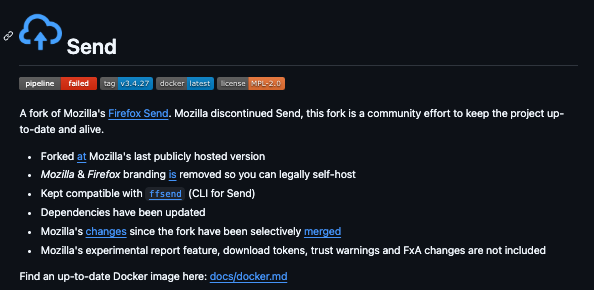
Mozilla shut down Firefox Send in 2020. A developer named Tim Visée refused to let it die and revived the whole thing. Encrypted file sharing with self-destructing links, answering to no company. The corporation quit. One person kept it alive.
7. https://t.co/CLFZ4tnub8
A private front end for YouTube with no ads, no tracking, and no Google account. Google has tried to choke it for years. The project just spins up new instances faster than they can block them. You cannot DMCA a thing that lives in a hundred places at once.
8. https://t.co/YylbvdCHsx
A paywall remover that loads articles by acting like the Googlebot every site already feeds for free. The famous 12ft io got pressured into trouble. Ladder runs on your own server, so there is no company to lean on and nothing central to shut down.
9. https://t.co/k1gCUedbML
A YouTube app for Android with no Google services, no ads, no account, and background play built in. It survives entirely because it is open and mirrored everywhere. Take down one copy and a thousand forks are already running.
10. https://t.co/RKeCYzNyAb
Block ads and trackers for your whole house from your router. The ad industry has every reason to want this gone and zero way to remove it, because it runs on hardware you own. The block list updates itself. The lawyers have nowhere to send the letter.
They take it down. The internet rebuilds it overnight. That's the whole pattern.
A Danish engineer dropped out of university in 1979, wrote a Pascal compiler so fast it made Borland a hundred-million-dollar company, then built the language that became the backbone of Microsoft's entire software ecosystem, then built TypeScript, which became the number one language on GitHub in 2025 and most developers who use his work every day have never heard his name.
His name is Anders Hejlsberg.
He was born in Copenhagen in 1960, started studying engineering at the Technical University of Denmark in 1979, and left before finishing his degree because he was already building something more interesting than anything his courses could offer.
He had access to a minicomputer at his high school, one of the first in Denmark to have one. He taught himself machine code, Algol, and Pascal.
By the time he was supposed to be finishing his degree, he had already written a Pascal compiler from scratch for the Nascom-2 microcomputer. He released it under the name Blue Label Pascal.
A small Danish software company called PolyData picked it up. Borland, the American developer tools company, found it and saw immediately what they had. They licensed the compiler, brought Hejlsberg to California, and in November 1983 released it as Turbo Pascal.
The price was $49.95. At the time, most Pascal compilers cost hundreds of dollars and ran slowly. Turbo Pascal was cheap and compiled code so fast that developers could not believe it was real. One reviewer read the speed claims on the box, assumed they were marketing fiction, tested it, and then wrote that he had never seen anything like it.
The product sold over one million copies. Borland became a serious company almost overnight, and Hejlsberg was the reason.
He kept building. He became chief architect of Delphi in 1995, Borland's rapid application development environment built on Object Pascal. Delphi let Windows developers build full graphical applications faster than anything else available.
It dominated enterprise Windows development through the mid-1990s. Teams that used it could ship in weeks what their competitors took months to build.
Microsoft noticed. In 1996 they made him an offer. He left Borland and joined Microsoft, and the project they handed him was the one that would define the next decade of enterprise software.
He designed C#.
Released in 2000 alongside the .NET Framework, C# was built to be modern in ways Java was not. Clean object orientation. Garbage collection. Strong typing.
A syntax familiar enough that Java and C++ developers could pick it up quickly but designed without the legacy decisions those languages had accumulated over decades. Hejlsberg later said one of his goals was to make the language feel inevitable, as if every decision was the only sensible one.
It worked. C# became the primary language of Microsoft's entire development platform. It powers enterprise applications, game development through Unity, cloud services on Azure, and Windows applications across hundreds of millions of machines. Around 6.2 million developers write C# professionally today.
Then he did it again.
By 2010, JavaScript had become unavoidable. Every web application ran on it. But JavaScript had been designed in ten days in 1995 for simple browser scripting, not for building complex systems with large teams. As codebases grew to hundreds of thousands of lines, the lack of a type system meant bugs that a compiler would have caught in any other language were only discovered in production.
Hejlsberg saw the problem clearly and spent two years designing a solution.
TypeScript launched in 2012 as an open-source typed superset of JavaScript. You write TypeScript, and it compiles down to plain JavaScript. The type system catches errors before the code runs. Large teams can work on the same codebase without breaking each other's code. Every major JavaScript framework adopted it. Google, Airbnb, Slack, and Microsoft all moved their codebases to TypeScript.
In August 2025, TypeScript overtook Python and JavaScript to become the number one language on GitHub by monthly contributors.
He is 65 years old. He is still at Microsoft as a Technical Fellow. He is still working on TypeScript.
Four languages. Four decades. Turbo Pascal made developer tools affordable and fast. Delphi made Windows application development accessible. C# became the backbone of enterprise software. TypeScript became the dominant language of the modern web.
Most of the developers using his work right now are too young to know what Turbo Pascal was. They learned to code in languages that borrowed from C#. They write TypeScript every day without knowing who designed it.
He dropped out of university in 1979 to build a compiler.
He has not stopped since.
🚨‼️ BREAKING: The threat actor who breached Novo Nordisk, the company behind Ozempic, has leaked 264 GB of data. They are also mocking Novo Nordisk, claiming the company was using passwords like "novo123" for critical systems and that its security team sucks.
The breach includes source code, proprietary information on both marketed and pipeline drugs, clinical trial records, data on employees, doctors, and patients, and manufacturing details. The threat actor also claims it obtained private internal AI models from Novo's systems.
They allegedly breached Novo in March via a GitHub access token that let it clone the company's repositories and find additional credentials. The intrusion ran for over two months and yielded roughly 1.3 terabytes across more than 700,000 files.
I reverse engineered Qualcomm's NPU compiler to find undocumented behaviour that affects every edge AI deployment.
Things nobody knew:
1. The compiler silently downgrades the precision of your model weights without telling you
2. Memory placement uses HiGHS which is an LP solver (not heuristics)
3. The same model on two different chips with identical reported VTCM can have 33x difference in DDR traffic
4. There's an undocumented internal simulator called Hextimate pricing ops without the hardware
Every NPU vendor be it Qualcomm, MediaTek or Apple NEVER tells you how to make the most use of their hardware.
I was very close to rage quitting before I finally lost all hope and thought of reverse engineering to understand how NPUs are handled.
Read the full write-up below:
56,000+ tokens/sec at just 80 MHz. 🤯
I burned a full Transformer with KV cache into a custom chip. Designed gate by gate as a 100% digital integrated circuit. Prototyped on a FPGA. (No GPU. No CPU)
Just pure digital silicon running @karpathy microGPT, spelling out names on a tiny LCD.
This is GateGPT 👇
This is biblical.
A woman in her eighties. Ten years into Alzheimer's. Hadn't spoken a full sentence in five years.
Takes one, 5 gram dose of psilocybin.
She slept 19 hours and woke up and spoke for hours about her life, recognized family and held real conversations. She regained bladder control after five years, walked on her own. and dressed herself. Gains held for weeks.
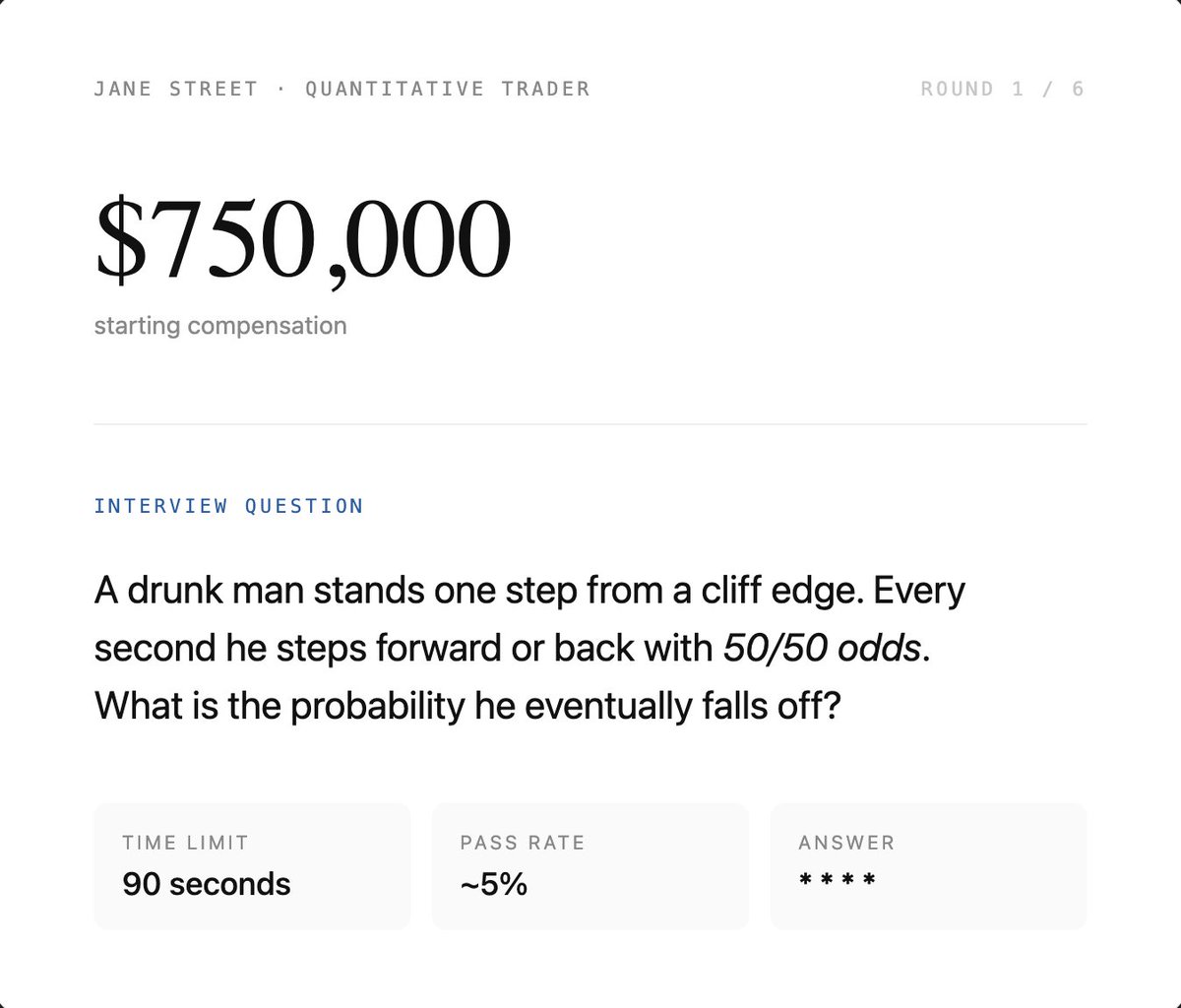
This question is asked at Jane Street for $750k/year roles:
> A drunk man stands 1 step from a cliff edge.
> Every second he randomly steps forward or back with 50/50 odds.
> What's the probability he eventually falls off?
if you answered 50%, you just failed.
drop your answer below. I'll reply to the right ones.