Went into the rabbit hole of this portfolio, here is a breakdown of every bet above:
> SpaceX: biggest position. entered ~$100B era, now valued at $800B+, IPO targeting $1.5T. likely 10x+
> Anthropic: in the $380B Series G (Feb '26). earlier entry too. still held
> OpenAI: named investor. current val: $840B post Feb '26 round. still held
> Cerebras: led Series F in Nov '21 at $4B. now at $23B. ~6x. still private
> TikTok: got a piece of the US JV in Jan '26 (ByteDance retains 19.9%, Alpha Wave among the other 80%). shrewd late entry
> Ramp: new investor, entered Nov '25 at $32B. Ramp doubled from $16B to $32B in 5 months
Aman Resorts: $360M round, Sep '23 alongside Mubadala. ultra-luxury hotels, 34 properties. the vibes bet
> MrBeast: led $300M Series C in 2024 at $5.2B. $600-700M revenue/yr. first PE bet on a pure creator empire
> Cognition (Devin): co-led round in Aug '25 at ~$4B entry → $10.2B by Sep '25. ARR: $1M → $73M in 9 months
> AG1 (Athletic Greens): led $115M round Jan '22 at $1.2B. revenue 4x since ($600M in '24). Gerson on board
> LENZ Therapeutics: Series B Mar '23 → IPO'd Mar '24 (Nasdaq: LENZ). stock down 60%+ from peak. the portfolio's rough patch
> QXO: holds 24M shares (~$525M position). Brad Jacobs building an $800B building-products roll-up. stock up 63% YoY
> Histosonics: led Series D at $102M in Aug '24 → EXITED at $2.25B acquisition Aug '25. ~4.5x in 12 months. cleanest flip
> Haldiram's: 6% stake for ₹5,600 cr (~$660M) in Mar '25. valued at $10B. betting on IPO at $11B+. SpaceX investor buying bhujiya is peak barbell
> Lenskart: entered as Falcon Edge in Jul '21 at $2.5B. IPO'd Nov '25 at ~$8B (~3x). weak listing though (listed at a 3% discount)
The investor: Rick Gerson started at Blue Ridge Capital (1996), then founded Falcon Edge in 2012 → rebranded as Alpha Wave Global (Dec '21) with a $10.7B fund close. $29B AUM today. Deeply wired into Abu Dhabi capital (Mubadala, IHC, Sheikh Tahnoon's network). In Mar '26, Abu Dhabi's new $237B holding co Judan bought a 50.1% stake in Alpha Wave itself. The portfolio is literally what happens when Gulf sovereign capital meets a Tiger Global-style operator with no sector religion - SpaceX to bhujiya, Devin to Haldiram's.
The new moats are the same as the old moats
Every few years, we fall in love with shiny new tech and forget the basic physics of consumer software.
We’re doing it again with AI.
The new moats aren't new at all. They're the exact same as the old moats: network effects, marketplaces, and platforms.
Right now, consumer AI is booming.
New agents like Instinct, Bot, and Tomo are dropping mind-blowing experiences. The underlying tech is incredible, but almost every product being built today shares the exact same challenge:
They are completely single-player.
Single-player products are 100% tied to value - and in this case mostly agent : model performance.
If a competitor drops an agent tomorrow that books travel faster, tracks habits better, or handles life admin more reliably, everyone can switch overnight because leaving is easy and has nearly zero friction. Especially when it is so easy to onboard with just a new message.
The legendary consumer tech giants didn't win because their underlying technology stayed marginally better forever.
They won because of structural lock-in:
Social Networks: You don't abandon WhatsApp for a prettier UI if your friends aren't there.
Marketplaces: Airbnb, Doordash, and Uber hold supply and demand in a tight loop.
Platforms: Apple and Android deliver you a complete device so you take advantage of the software on top of it (though this creates opportunities too)
Novelty gets you initial distribution.
Multi-user dynamics give you long-term retention.
If your consumer AI product doesn't become exponentially more valuable to User A when User B joins, you don't have a moat, just a temporarily superior feature set.
We are seeing this in the coding agents as people jump from tool to tool based on the best performance.
But… all is not lost. There are huge opportunities here. Agents will get better when more of our friends are on them and can help us coordinate and communicate to do more together. Agents that help us improve and strengthen our habits can get better as we add friends and hold each other accountable.
Data flywheels are great, but social and marketplace flywheels are what actually build enduring tech giants.
It’s time to stop building isolated AI tools and start building the platforms where people connect, transact, and coordinate together.
Speaking at Basecamp Dialogues, @mukularora made the case that Indian founders today have the biggest opportunity to build the foundational technology the country has spent decades importing.
Talent density has always been India's strength, but more of that talent is choosing to build at home, and founders are willing to take bigger risks than before.
And for the first time, the government is partnering closely with startups by providing capital, offering infrastructure support, and actively buying from them.
@basecampblr
We're opening up Grok Bot access to a small set of enterprises this weekend.
Reply if you'd like for us to swing by your office in San Francisco and onboard your team tomorrow or Monday.
As we’re seeing in case study after case study, it turns out that the amount of value that can be created between the AI model and the ultimate end-user workflow is far larger than many people assumed or realized.
Model capability is obviously doing a lot of heavy lifting in agentic products, but there’s still a lot more work to diffuse AI into the enterprise.
1. Getting agents to work well (and alongside people) in mission critical workflows tends to need to be represented differently depending on the business process. Sometimes it’s a chat experience. Other times it’s a background agent running in a deterministic workflow. And dozens of other variants. This is a mix of needing a harness that’s tuned to specific domains of work, but also making it show up in the right product experience.
2. Different workflows connect into entirely different enterprise systems and need access to very different data. Working with that data -whether it’s life sciences, financial, legal, etc.- requires contextual approaches, understanding of the data, having the right user experience for data interaction, and more.
3. The need for domain-specific change management remains critical in most verticals. The way you talk and implement technology at a bank is very different from a law firm. Having the right talent with a singular mission ends up being extremely useful for something as complex as process reengineering.
4. The ability to work with a variety of models means you can tune the workflows to different cost and performance levels. And you can eventually post train models for specific tasks to tailor the outcomes and eke out gains that aren’t coming otherwise in frontier models.
5. Evals! AI is basically not useful if it can’t be evaluated. Domain-specific evals that let you dramatically improve the performance of your harness for specific workflows just has a crazy long tail given how many tasks there are in the economy. Nearly impossible for one system to be tuned for all of them.
6. Lots of verticals and domains require pricing models that reflect relevant abstractions on top of tokens alone. The ability to price in ways that work for your industry’s consumption model ends up mattering in a variety of spaces.
This just touches on some of the things that go into the applied AI layer. But it all adds up to being a huge surface area for being able to sustainably innovate and differentiate.
ORBIT ACHIEVED. 🚀
Vikram-1 Test Flight-1 has reached orbit. India's first privately developed orbital rocket has completed its final burn and injected its payloads into a ~450 km orbit, making India the third country in the world with private orbital launch capability.
History is made. 🇮🇳
#Vikram1 #JourneyToOrbit #SkyrootAerospace
Engineers at Coinbase are getting closer to recursive self-improvement, or loops.
For instance, agents can now ingest and summarize customer feedback collected right in the app, prioritize bugs and features based on that feedback, draft the code, security review it, and provide it to a human engineer for final review. All happens automatically each day and it learns from the human edits to improve over time.
We're finding more areas to introduce loops across the company. Instead of prompting agents with what to do, you can increasingly give them a goal, and they bring back high quality work for you to review.
It’s been a minute.
2015–2018
- Exited FreeCharge. Spent time learning and investing.
- Pondered about: Why can't trust be rewarded? Started with $1M of personal capital.
- Launched CRED to reward people for paying credit card bills on time.
2019–2025
- Built a system run by a team that values ownership, judgment, and craft.
- Grew from 0 to 17M members by aligning incentives with behaviour.
- Built several products during COVID lockdowns.
- Raised $900M+ from global investors. Did 4 ESOP buybacks.
- Made Indiranagar and IPL ads slightly more interesting.
- Received a full stack of regulatory licences.
- Lost 35 kilos.
- Scaled from 0 to ~$325M ( ~₹3,200 crore) in annual revenue across payments, lending, insurance, commerce, wealth, and credit cards.
2026
- First profitable quarter (yet occasionally asked what our business model is)
- Raised another $900M from Meta in primary and secondary capital.
- Announcing our 5th ESOP buyback.
Today
CRED is ready for its next phase. I am stepping back and @miten steps in as interim CEO, partnered with an incredibly talented team. He has been heading strategy and finance and suffering me since 2020. I’m stepping away from the operating role and will continue as a shareholder. My commitment doesn’t change. Just the role.
Extremely grateful to our members, partners, regulators, and investors who made this possible. And to our board, Shailendra, Micky, Saurabh for their extraordinary conviction.
Team CRED, I’ll still expect you to be a 10x version of yourselves.
As for me, I’ll be joining Meta to lead WhatsApp globally.
Meta comes in as a minority investor in CRED. No access to member data.
While it’s come very far, the delta between WhatsApp today and its full potential is massive. I look forward to working with Mark, Chris, and the leadership across Meta for the next step in WhatsApp’s journey. Will, thank you for scaling something the world relies on quietly, and for making this transition smooth.
Onwards.
YC CEO Garry Tan: “Moat is not a noun. It’s a verb”
Popular belief says startups win because they have one big, game-changing insight.
But Varun Mohan (Windsurf CEO) argues that’s a myth.
“Every single insight we have is a depreciating insight.”
In other words: the value of your insight declines fast. Competitors catch up. Markets shift. What was once novel becomes table stakes.
He uses Nvidia as the example: Even at a trillion-dollar scale and 70% gross margins, they still have to innovate, or AMD catches up.
The real advantage?
Continuously generating new insights — and executing on them.
“It’s not about the insight you had one year ago. It’s whether you can compound that advantage over and over again.”
That’s why Varun tells his team: being wrong is fine, but being stagnant isn’t. You need to stay sharp, learn from the market, and compound your edge over time.
Or as Garry Tan (YC CEO) puts it aptly:
“Moat is not a noun. It’s a verb.”
Source: @ycombinator (May 2025)
"One of the joys of life and one of the best things in life is like to find a beautiful problem that might occupy all of your life trying to solve it."
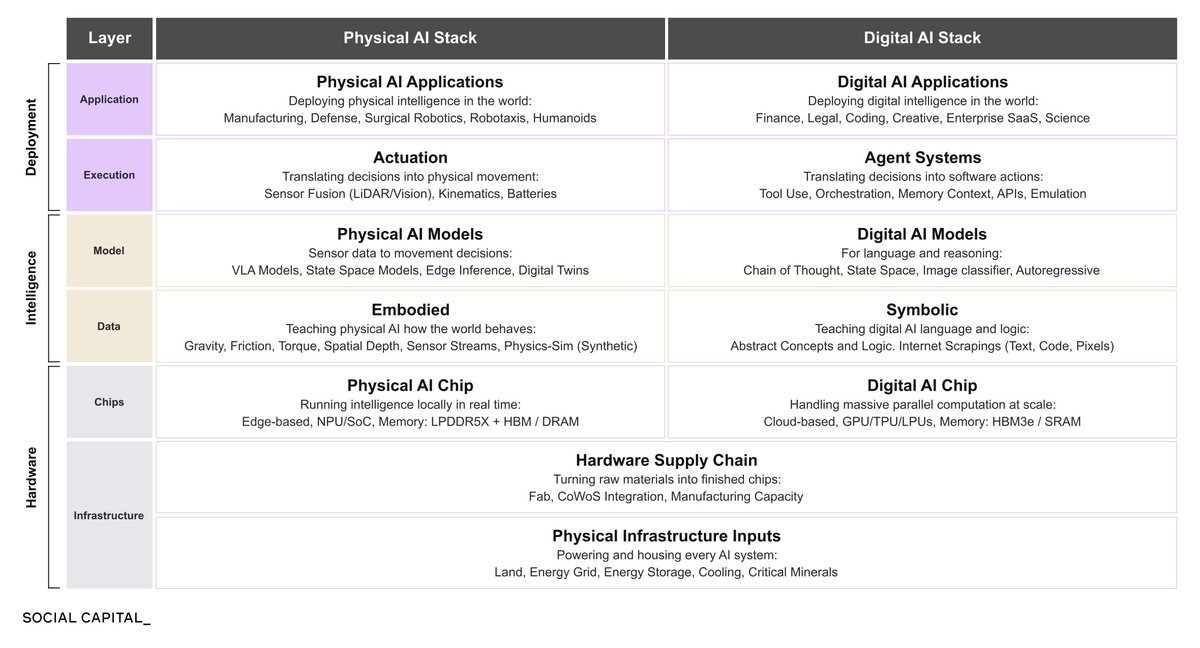
A framework to understand how value accrues across the AI stack.
This is a blueprint for understanding what builds AI into its pragmatic parts: what each layer is, where it ends, and where value is accrued. So here’s how you can think about it:
1. Layer 1 - Infrastructure
Before any AI model trains or any robot moves, an industrial foundation must exist. Land, energy grids, cooling systems, critical minerals, and fabrication facilities. Infrastructure is the constraint that all the other layers depend on.
2. Layer 2 - Chips
Transistors that are etched onto silicon wafers using extreme ultraviolet light. This is what allows both physical and digital AI to take an input, process it, and return a predictive output. The more transistors that fit on a chip, the more computation it can perform.
3. Layer 3 - Data
Both digital and physical models train on data. Digital models train on text, code, and images; physical models train on gravity, friction, depth, and sensor streams. The more accurate the data, the more accurate the output.
4. Layer 4 - Models
A model is a system that learns from examples. Feed it enough examples of inputs paired with correct outputs, and it adjusts its internal structure until it can predict correct outputs on inputs it has never seen before.
LLMs represent a specific class trained on text. They learn by processing billions of examples of human language, developing the ability to write, reason, summarize, and generate code.
5. Layer 5 - Execution
This is what lets models take actions on behalf of users. The execution layer lets models pursue objectives through sequential action: observing the environment, reasoning about the next step, acting, and looping until the goal is reached.
6. Layer 6 - Application
All of the AI Stack’s revenue originates at the application layer, then goes to the layers below.
Every dollar paid for AI is paid for an outcome, a task completed, and an answer delivered. Nobody wants H100s for their own sake. They want H100s because someone, somewhere, wants to run an application.
These are the different layers that make up the entire ecosystem of AI.
We did a full study on the AI stack. If you want to read about it, head over to my Substack (https://t.co/uaxeJk63aO)
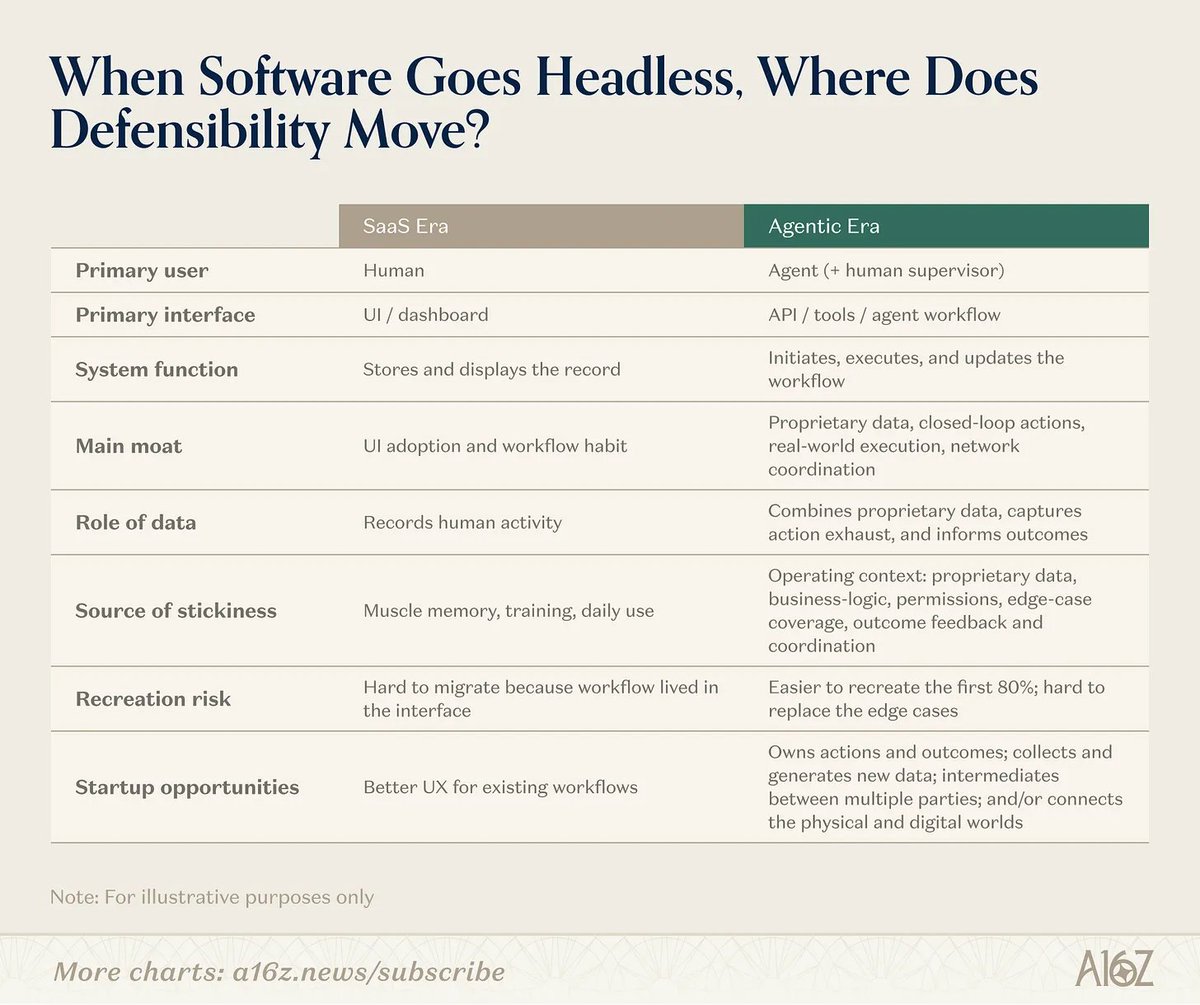
Last month Salesforce announced it would open its APIs and launch a headless product, essentially betting that in an agentic world, its value lies in the data layer, not the UI.
The announcement is a useful prompt for a more interesting question: if you strip away the UI and expose the database, what are you actually left with?
a16z's Seema Amble on where defensibility moves in the agentic era & how businesses will adapt: https://t.co/8hOj26bPuf
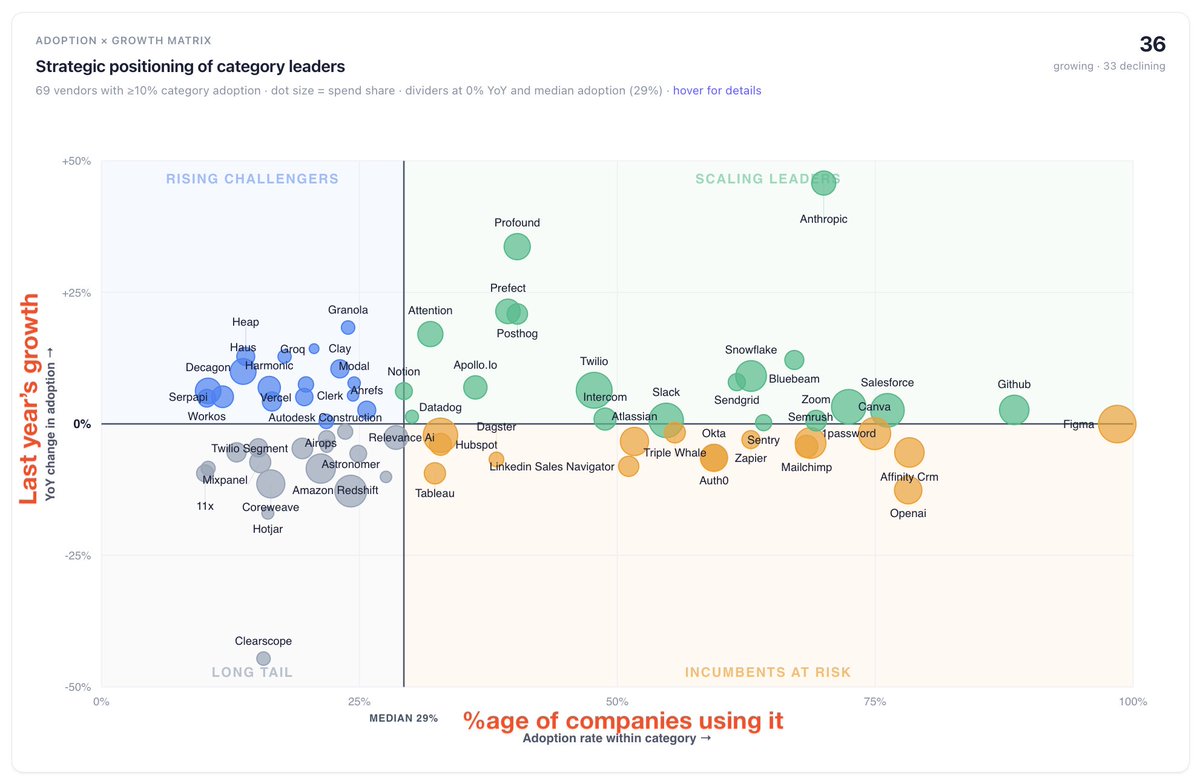
This graph of the top 69 software products by growth vs adoption is the best snapshot of the current winners and losers in tech.
— Scaling leaders (Anthropic)
— Incumbents at Risk (OpenAI)
— Rising Challengers (Granola)
— Long tail (11x)
Spend data from Ramp, up to Mar 2026.
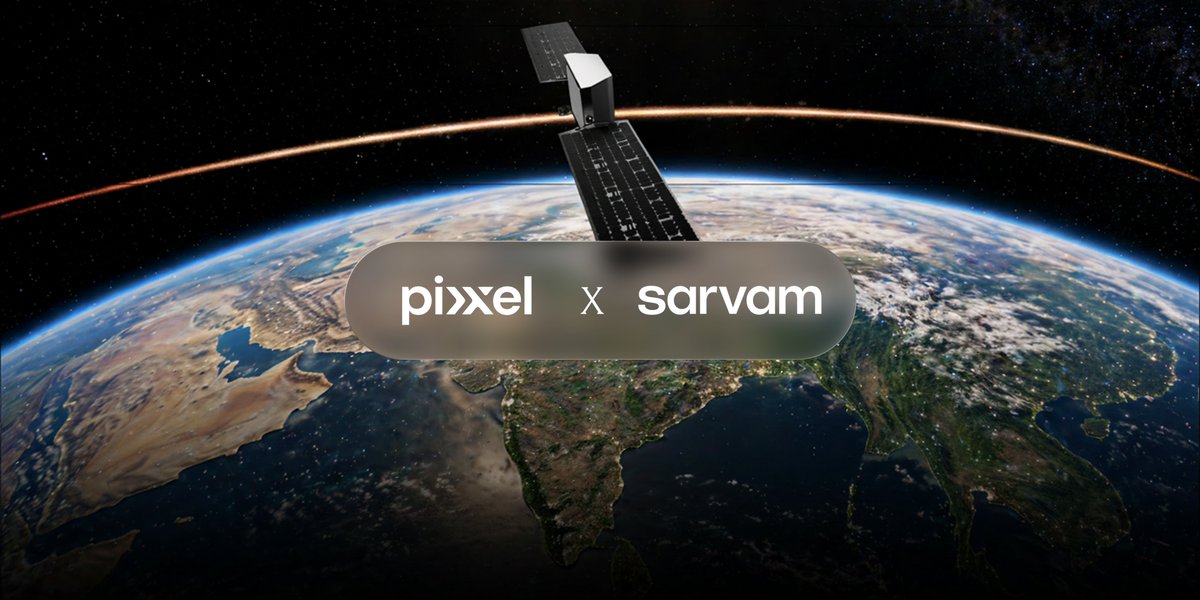
We are excited to announce that Sarvam is partnering with @PixxelSpace to power the AI backbone of India's first orbital data centre satellite.
This is a first for the country, with India-built AI models running on an India-built satellite and both training and inference happening directly in orbit, without any dependence on foreign cloud or ground infrastructure.
Content needs to be either timely or timeless — and the bar for both has gotten much higher.
Timely has to be *right now* and timeless has to be an instant classic.
Salesforce: "No browser required."
Same week: Agentforce Vibes, a VS Code-based IDE in the browser.
That is the paradox TDX is selling. Two truths at once.
On 15 April 2026 in San Francisco, Salesforce introduced Headless 360. The goal, as reported, is to make the platform callable as APIs, MCP servers, and CLI, not only through the CRM shell humans used for years.
The "experience layer" line is the real story. Slack, Teams, voice, ChatGPT, custom apps. Interfaces decoupled from one screen. That is not the same claim as "nobody opens a browser anymore."
Joe Inzerillo, president of enterprise and AI technology, told reporters builders talk to tools, and tools drive UI creation and configuration. He framed an ecosystem where, in his words, most of the code is going to be written by agents. Launch coverage also pointed agentic workflows at Salesforce through Claude Code, Codex, Windsurf, and Visual Studio Code. MCP and CLI meet builders where they already work.
Agentforce Vibes defaults to Claude Sonnet 4.5. Apex stays the default coding lane. The same launch wave includes Agent Script open-sourced and Slack Agent Kit to bring outside agents into Slack with a chat UI.
Then the fine print talks back. Agents are probabilistic, not deterministic. This is Salesforce's own framing, echoed in reporting on the launch. The same wave adds guardrails, a testing center, observability, and session tracing. You add that stack when trust has to be engineered, not assumed, because vibe speed without guardrails is a liability at enterprise scale.
The free Developer Edition is not infinite. Reporting cited 110 requests per month and 1.5 million tokens, with monthly refresh described only through 31 May. Pull current limits from Salesforce before you quote them. Madhav Thattai, EVP and GM of Salesforce AI, made the maintenance case. Expand who builds, and ask who runs what you vibe-coded from scratch.
Headless is not the death of the UI. It is the control plane shifting toward APIs and MCP. Browsers are optional on some paths and still present on others. Agents sit in the middle either way. Same week, two stories. One for the feed, one for the stack.
Welcome Salesforce Headless 360: No Browser Required! Our API is the UI. Entire Salesforce & Agentforce & Slack platforms are now exposed as APIs, MCP, & CLI. All AI agents can access data, workflows, and tasks directly in Slack, Voice, or anywhere else with Salesforce Headless 360. Faster builds, agentic everything. 🚀
#Salesforce #Agentforce #AI
https://t.co/mxySdJS7HR