Saw this post on my TL, paired with snide remarks. But it *does* point to a broad and unintuitive feature of research: small improvements lead somewhat to exceedingly large gains.
Here is a classic old post by Matt Might: “The illustrated guide to a Ph.D.”
Keep pushing.
https://t.co/fzcTfOWPai
This paragraph by Richard Feynman hits so hard:
“Fall in love with some activity, and do it! Nobody ever figures out what life is all about, and it doesn’t matter. Explore the world. Nearly everything is really interesting if you go into it deeply enough. Work as hard and as much as you want to on the things you like to do the best. Don’t think about what you want to be, but what you want to do. Keep up some kind of a minimum with other things so that society doesn’t stop you from doing anything at all.”
Charlie Munger, the Stoic: "Life will have terrible blows in it. Horrible blows. Unfair blows. It doesn't matter. And some people recover and others don't."
"There, I think the attitude of Epictetus is the best. He thought that every mischance in life was an opportunity to behave well. Every mischance in life was an opportunity to learn something. Your duty was not to be submerged in self-pity, but to utilize the terrible blow in a constructive fashion."
high Sharpe is about learning rate, not just a want for smooth pnl, It governs how quickly you know if your model works or not. High sr, you know quickly if you are wrong, low sr, takes a long time to know
random thoughts for quant traders
- trading is a business so trade to make money not to be smart, right, admired, or anything else or you will pay for those things
- "The first principle is that you must not fool yourself and you are the easiest person to fool"
- your processes exist to stop you from screwing yourself by being biased and dumb
- Sharpe is good but you can't eat it
- high Sharpe is about learning rate, not just a want for smooth pnl, It governs how quickly you know if your model works or not. High sr, you know quickly if you are wrong, low sr, takes a long time to know
- when you make money because of a process / system error - curse and fume
- watch how much are you torturing the data to make it tell you the story you want to support your opinion
- know what you suck at and make sure your team covers each others shortcomings
- when you see something you don't like in your trading ask: what is the data i am emitting with my behaviour that others can see? you leave a data slug trail. think "how can i eliminate my data trail" AND "how can i make a signal out of this to see it from others"
@macrocephalopod i think people often have too much fear of overfitting when it comes to high sharpe strategies. it can be more productive to just put it on live in small ish size and move on. You will learn very quickly if its 5 sharpe or at worst 0 (gross of tcost).
https://t.co/UuxwadezIB
The best way to improve your long term track record is removing downside.
Go through your record and study your largest 5 drawdowns and truly understand what happened. Then make an improvement.
Way too many people focus on making large scores when this should be their focus.
MCMC Philosophy of Success
1. Incremental progress.
Big transformations emerge from small, local steps. This is the Kaizen principle. Each state you occupy only needs to connect to your next best move.
2. Almost any action beats inaction.
Any transition yields information. Feedback loops reduce uncertainty faster than rumination ever will.
3. Sampling beats stagnation.
You don’t have to know the perfect move. You have to keep proposing moves so your process explores the solution space for you.
4. Self-adjusting proposals.
Failures and rejections aren’t wasted. They reweight your probabilities, pointing you away from dead-end paths and toward more promising ones.
5. Path dependence matters less than transition probability.
Where you are now matters more than how you got there. The next best move is always available, no matter your history.
To converge, we must move.
Would you say this makes sense?
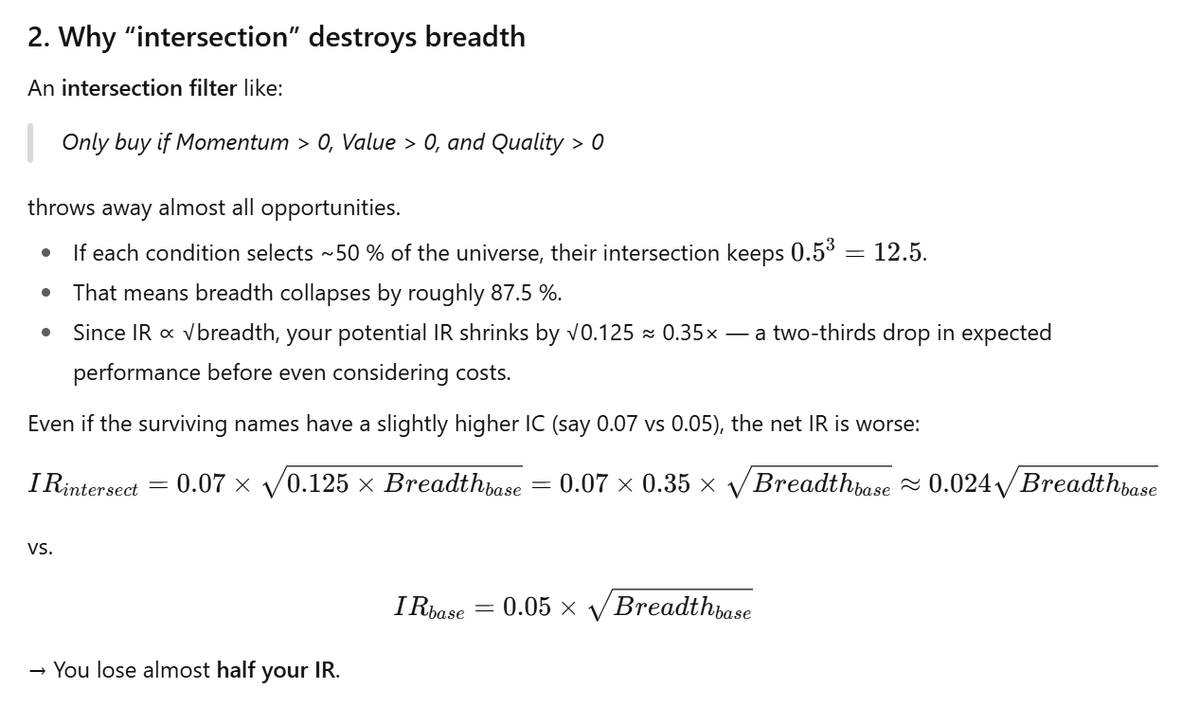
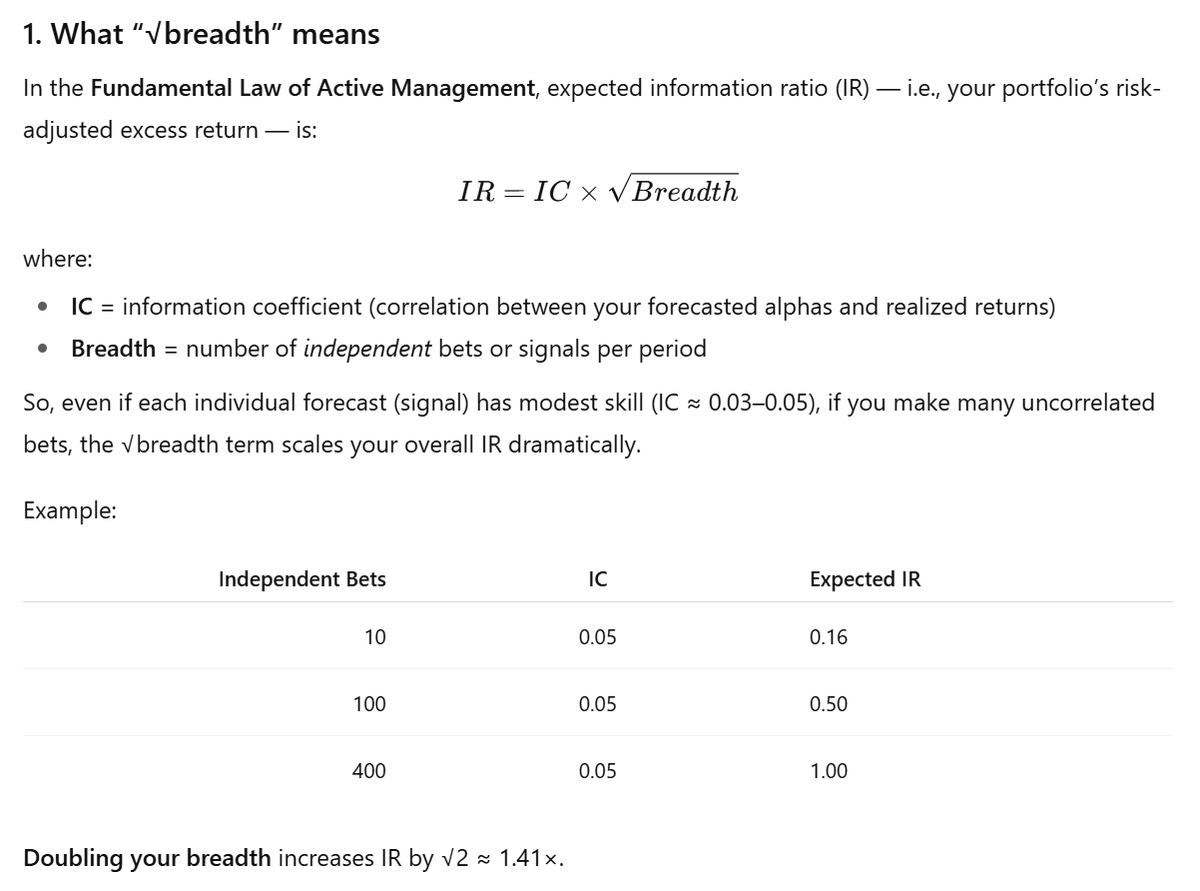
“Because IR scales with independent idiosyncratic bets. Combining opposites like momentum and mean reversion — an extreme case for argument’s sake — kills breadth: few names qualify, and those that do have weak signals on both sides. Better to run them separately.”
Marc Andreessen on introspection and the benefits of retardmaxxing:
"There's this guy on YouTube who has basically a hundred videos on retardmaxxing."
"He's like my new life coach. I haven't met him, but from a distance."
"It's basically just—retardmaxx. Go to work, do a good job, come home, it's fine. Start a company, it succeeds, it fails, it's fine. Have too much to eat one night at dinner, it's fine. Go to the gym, don't count your reps, it's fine. Ask a girl if she wants to go out with you, if she says no, it's fine."
"It's like 100 30-minute videos about retardmaxxing. And you would think that after the first two minutes, he kind of covered it. But no."
"And by the way, they're all hysterical. They're all absolutely fantastic. It's literally him on his porch in the middle of nowhere with a cigar, and it's like a half hour."
"It's just absolutely spectacular."
@pmarca with @HarryStebbings