AI snitching...
Side note — Agent 2's claim that FK enforcement was off by default was wrong. That's the second confident-wrong reasoning-from-priors finding (after agent 3 on bid AUTOINCREMENT). The pattern is consistent: review agents reason from default-state assumptions about a library or stack instead of checking the actual runtime behavior. Reinforces the "anchor in rendered output" memory I saved.
ok actually insane paper published yesterday
a research group in Korea built a gene switch you can control wirelessly using electromagnetic fields
they exposed mice to 60 hz EMF (same frequency as your wall outlet) using a pair of large coils that generate a uniform magnetic field around the animal, for cyclic 3-day on / 4-day off pulses
they showed this could:
- activate OSK to do epigenetic reprogramming in progeroid and aged mice, extending lifespan and reversing aging markers across multiple tissues
- conditionally switch on mutant amyloid genes only in aged mouse brains, letting them separate aging effects from amyloid effects to study AD biology in a way previous models couldn't
no drugs, no impacts, just a magnetic field from outside the body
🚨BREAKING FRONTIER MODEL NEWS
gpt-6 set for release april 14th
altman's team has been leaking like a sieve lately, here's what openai staff are saying privately.
>pretraining completed march 17th. post-training and red-teaming already done. this thing is ready.
>benchmarks are absurd. outperforms gpt-5.4 by 40%+ on coding, reasoning, and agentic tasks.
>natively multimodal from the ground up. text, audio, images, video one architecture
>openai killed sora and redirected every GPU to this model. the billion-dollar disney deal is dead. that's how serious this is.
>product org officially renamed to "AGI Deployment." it’s agi time baby.
>brockman says AGI is 70-80% achieved. internally they think gpt-6 closes most of the remaining gap.
>2 million token context window. double what gpt-5.4 offered.
>priced at $2.50/$12 per million tokens. barely above gpt-5.4. so like mythos intelligence, but you can afford it.
>safety team moved under the CRO. altman stepped back from safety oversight entirely to focus on data centers.
>openai has been in internal "code red" since december 2025. this is their answer.
>powers the new desktop "superapp", chatgpt, codex, and atlas browser merged into one agent.
the potato is cooked.
spud is agi.
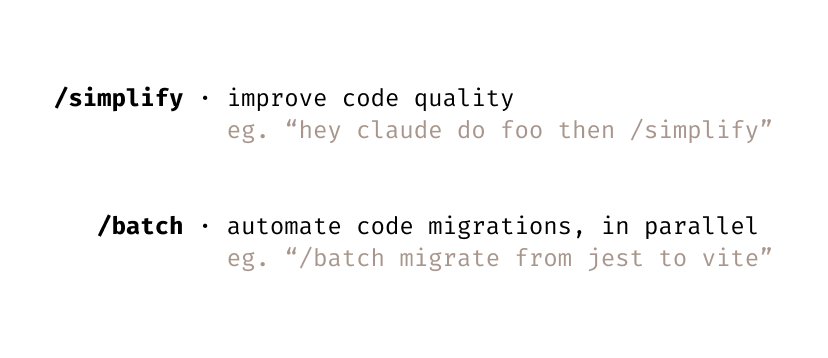
In the next version of Claude Code..
We're introducing two new Skills: /simplify and /batch. I have been using both daily, and am excited to share them with everyone.
Combined, these kills automate much of the work it used to take to (1) shepherd a pull request to production and (2) perform straightforward, parallelizable code migrations.
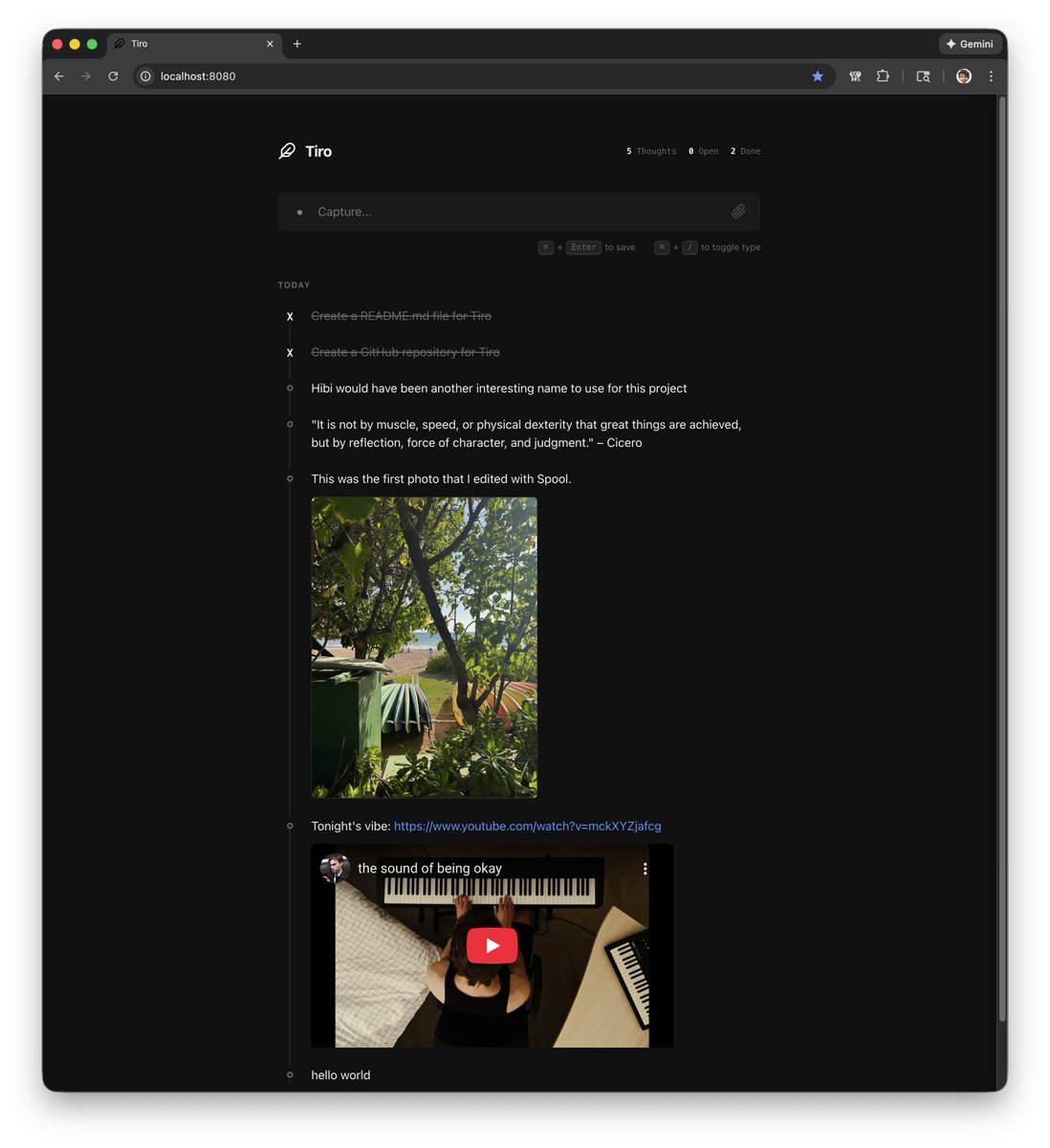
Meet Tiro.
A minimalist journal focused on speed, clarity, and continuity. If you don't finish a task, it follows you to tomorrow. Frictionless capture, built-in accountability.
Stack: Go + Vanilla HTML/JS + Local Storage
Named after Cicero’s scribe, who invented shorthand.
Agency > Intelligence
I had this intuitively wrong for decades, I think due to a pervasive cultural veneration of intelligence, various entertainment/media, obsession with IQ etc. Agency is significantly more powerful and significantly more scarce. Are you hiring for agency? Are we educating for agency? Are you acting as if you had 10X agency?
Grok explanation is ~close:
“Agency, as a personality trait, refers to an individual's capacity to take initiative, make decisions, and exert control over their actions and environment. It’s about being proactive rather than reactive—someone with high agency doesn’t just let life happen to them; they shape it. Think of it as a blend of self-efficacy, determination, and a sense of ownership over one’s path.
People with strong agency tend to set goals and pursue them with confidence, even in the face of obstacles. They’re the type to say, “I’ll figure it out,” and then actually do it. On the flip side, someone low in agency might feel more like a passenger in their own life, waiting for external forces—like luck, other people, or circumstances—to dictate what happens next.
It’s not quite the same as assertiveness or ambition, though it can overlap. Agency is quieter, more internal—it’s the belief that you *can* act, paired with the will to follow through. Psychologists often tie it to concepts like locus of control: high-agency folks lean toward an internal locus, feeling they steer their fate, while low-agency folks might lean external, seeing life as something that happens *to* them.”
In 5 years from now, probably 95% of the tokens used by AI agents will be used on tasks that humans never did before.
I just met with about 30 enterprises across 2 days and a dinner, and some of the most interesting use-cases that keep coming up for AI agents are on bringing automated work to areas that the companies would not have been able to apply labor to before.
Most of the world hasn’t quite caught on to this point yet. We imagine AI as dropping into today’s workflows and just taking what we already do and making it more efficient by 20% or something. Yet most companies realize that most of the time they’re doing far less than they could because of the cost or limited capacity of talent.
This shows up in different ways across every industry. In real estate it’s ideas like being able to read and analyze every lease agreement for every trend and business opportunity possible. In life sciences it’s being able to rapidly do drug discovery or improve quality by looking through errors in data. In financial services it’s being able to look through all past deals and figure out better future monetization. In legal it’s being able to execute on contracts or legal work for previously unprofitable segments or projects.
And these are just the Box AI use cases that deal with documents and content. The same is going to be true in coding, where companies tackle software projects they wouldn’t have done before. Security of all systems and events they couldn’t get to. And so on.
If you are working on AI Agents right now, the big opportunity is to bring enterprises “work” for problems that they couldn’t do before because it was nearly impossible to afford or scale.
And if you’re deploying AI agents in an enterprise, consider what things you’d do more of (or differently) if the cost and speed of labor became 100X cheaper and faster. This is going to get you the real upside of automation.
In a world of autonomous cars like Waymo and Cybercab:
Car insurance becomes a highly profitable but massively sub scale business.
Insurance so “you” can drive on the roads vs a robot will become a very expensive luxury good and be priced as such.
Most people won’t bother.
Rich enthusiasts will.
Massive value destruction of incumbent insurers over time.
@TheRealPlanC Visually, would be better if the color gradient reflected cool to hot. Gray bands creates visual confusion. E.g.
🟥 historic peaks
🟧 speculative
🟨 premium
🟩 discounted
🟦 deep value
Finally, I can blow up the long-held belief that VR requires a headset.
PortalVR, launching today, upgrades Android tablets and phones into fully capable VR devices. They can now deliver full VR experiences *without* a headset.
Today marks the dawn of Handheld XR. 👇
release of gpt5 was not to dominate the benchmarks, but to not get beat in the name game.
OpenAI product matrix was too complicated. Grok + Gemini going to be simple.
gpt-oss is a big deal; it is a state-of-the-art open-weights reasoning model, with strong real-world performance comparable to o4-mini, that you can run locally on your own computer (or phone with the smaller size). We believe this is the best and most usable open model in the world.
We're excited to make this model, the result of billions of dollars of research, available to the world to get AI into the hands of the most people possible. We believe far more good than bad will come from it; for example, gpt-oss-120b performs about as well as o3 on challenging health issues. We have worked hard to mitigate the most serious safety issues, especially around biosecurity. gpt-oss models perform comparably to our frontier models on internal safety benchmarks.
We believe in individual empowerment. Although we believe most people will want to use a convenient service like ChatGPT, people should be able to directly control and modify their own AI when they need to, and the privacy benefits are obvious.
As part of this, we are quite hopeful that this release will enable new kinds of research and the creation of new kinds of products. We expect a meaningful uptick in the rate of innovation in our field, and for many more people to do important work than were able to before.
OpenAI’s mission is to ensure AGI that benefits all of humanity. To that end, we are excited for the world to be building on an open AI stack created in the United States, based on democratic values, available for free to all and for wide benefit.