Transcription factors (TFs) are critical drivers of cell identity and function. We found a subset of TF encoding genes that have remained clustered together over evolutionary time. In my first paper now on @biorxivpreprint, we delve into its importance
https://t.co/UCiaI49GLf
Glad to share that my preprint "ID2 secures cDC1 specification by antagonizing E proteins at a pleiotropic Zeb2 enhancer" is out today in @NatImmunol
This represents another major piece of my PhD work.
https://t.co/Hel4BvK7HI
Preprint thread:
https://t.co/2AmaXdcBet
I am delighted to share that @YeqiaoZhou from our lab was awarded an NCI K99 grant! Her application scored in the 3% on its first submission- an outstanding achievement. @PennPathLabMed@PennEpiInst@pennbgs
So excited to see this paper from @jess_ljx out in final form! One of the most beautiful papers from our lab: shows that a single cell can learn by forming memories to adapt to new challenges.
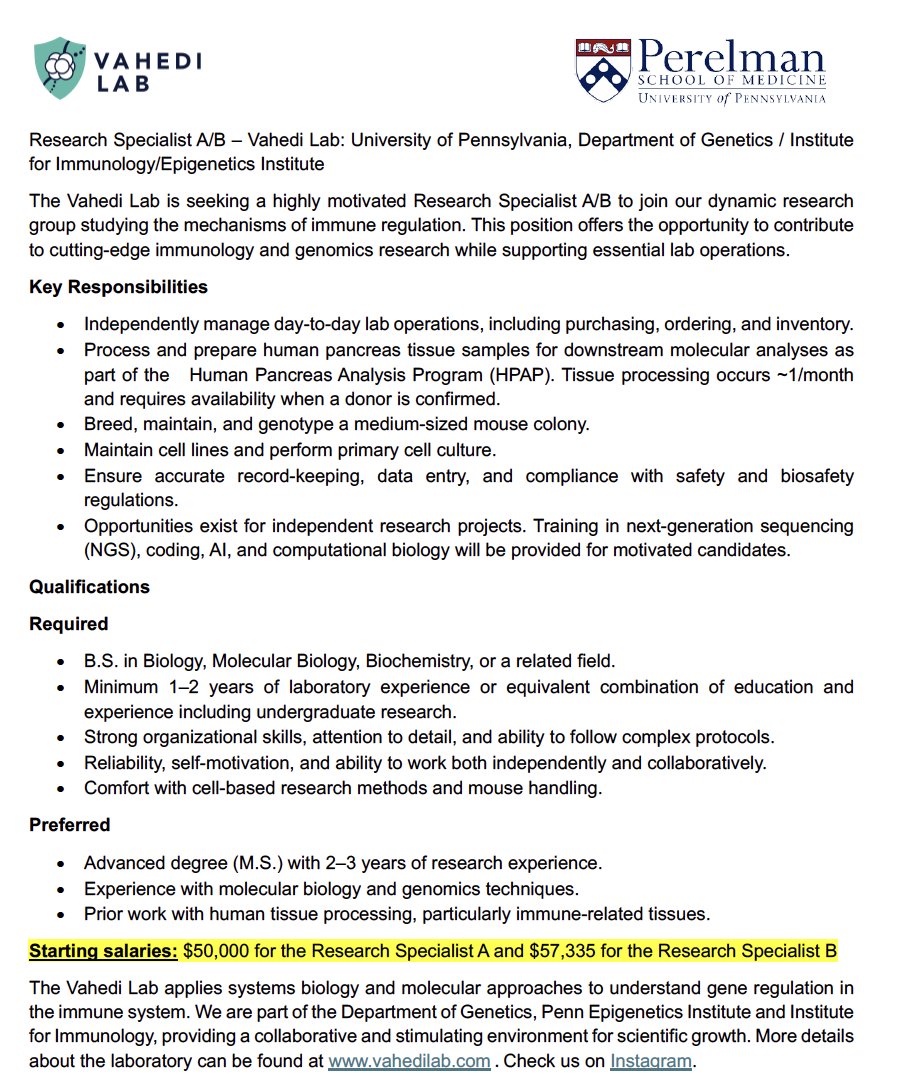
Didn’t get the grad school interview you wanted yet? Turn this year into a launchpad. The Vahedi Lab @Penn is hiring a Research Specialist A/B — ideal for undergrads & recent grads aiming for PhD/MD-PhD programs.🧬 Immunology + genomics. Apply here: https://t.co/UwqT3zpkvH
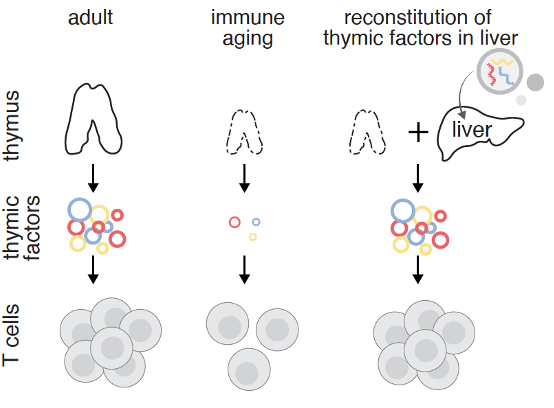
Excited to share our new work on immune aging! We explored whether the liver could serve as a temporary "factory" to produce immune factors that decline with aging, potentially helping to rejuvenate aged immunity. @mircoscopy.
We are grateful that our paper https://t.co/k2uM9DmCMv in @SciImmunology is featured at Penn Today; thanks to @bfariabi@TheHPAP and all collaborators https://t.co/ndtLRka5mV
Three new manuscripts from Faryabi and Vahedi labs on chromatin folding, ORCA, oncogene regulation and T1D immunology. Individually great, collectively unstoppable. @golnaz_v@bfariabi@atishay_jay@PennEpiInst
https://t.co/YlJ2ICmzn9
https://t.co/87krVFvJUr
https://t.co/9LAKQFzgxn
Beyond excited to share the collaborative work with
@bfariabi led by stars @YeqiaoZhou and Atishay Jay. Walking along thousands of chromosomes has shown us just how essential it is to measure chromatin fiber geometry to truly understand enhancer biology. https://t.co/OEZwCIqpl1
A study co-led by @golnaz_v, @PennGenetics, finds new clues in pancreatic lymph nodes and the spleen that could help detect—and even stop—Type 1 diabetes. @SciImmunology https://t.co/TmCk0qCyib
I am very excited to share our collaborative work on multiome profiling of gene expression and chromatin accessibility of more than 1 million immune cells in pancreatic lymph nodes and spleens in human type 1 diabetes in https://t.co/VaVoFWZnrw
Humans with active type 1 #diabetes and presymptomatic diabetic mice have a distinct subset of NFKB1-BACH2-expressing CD4 T cells in the pancreatic lymph nodes, which could inform future #biomarkers and targeted therapeutics. @bfariabi@golnaz_v
https://t.co/XRwHx0jSGt
Epigenetic editing opens new opportunities for programming T cells. CRISPRoff can also be combined with genome editing approaches to enable new cell engineering approaches. Congratulations to @LaineGoudy and everyone involved!
https://t.co/MgkM5Xa3jn
In this article, I share my perspective on leveraging AI and single-cell profiling to predict type 1 diabetes. It’s great to see the diverse insights contributed by other experts in the field: https://t.co/DGwLuxiNIc
Our RAEFISH spatial transcriptomics technology is now published in Cell @CellCellPress! RAEFISH enables sequencing-free whole genome spatial transcriptomics at single molecule resolution. This work represents the first time that transcripts from more than 23,000 genes were directly probed and imaged in situ with any technology, and the first time numerous different gRNAs were directly probed and distinguished by imaging in a high-content CRISPR screen.
The challenge:
Recent breakthroughs in spatial transcriptomic technologies, from us and others, have greatly improved our ability to profile cell types, states, cellular interactions, and the underlying gene programs within the native tissue contexts. However, these technologies have limitations. Methods based on 2D-array-capture/tagging and ex situ sequencing offer genome-scale coverage, but lack the resolution needed to accurately study fine spatial organization. In contrast, image-based methods that rely on highly multiplexed fluorescence in situ hybridization or in situ sequencing provide single-molecule resolution and resolve fine spatial organization, but require pre-selecting a limited set of target genes (typically hundreds to a few thousand genes), which limits discovery and sometimes leads to only validations of prior knowledge due to the pre-selected targets being well studied in the context.
The solution:
RAEFISH, our lab's new flagship image-based spatial transcriptomics technology, simultaneously enables single-molecule spatial resolution and whole-genome level coverage of long and short, endogenous and engineered RNA species in cell cultures and intact tissues.
The results:
🔥 We performed RAEFISH targeting 23,312 human genes in cell cultures, and demonstrated hypothesis-free discovery of cell cycle associated genes and subcellular localization patterns of transcripts, including nearly the entire protein coding transcriptome and additional long noncoding RNAs.
🔥 We performed RAEFISH targeting 21,955 mouse genes in mouse liver, placenta, and lymph node tissues. Our analyses on immediately neighboring cells uncovered intriguing cell-cell interactions and previously unknown gene expression programs underlying the interactions, such as those between cholangiocytes and immune cells.
🔥 Finally, we further developed RAEFISH to directly read out guide RNAs (gRNAs), demonstrating Perturb-RAEFISH in an image-based high-content CRISPR screen. The capacity of Perturb-RAEFISH to directly read out gRNAs addresses a crucial limitation of previous techniques that read out a barcode/identifier sequence paired with each gRNA species, as the pairing can be shuffled due to RNA recombination intrinsic to lentivirus used in such screens, which limits screen sensitivity and accuracy.
In summary, RAEFISH provides the biomedical research community with a generalizable research tool, which will bring more spatial and mechanistic insights across health and disease.
This work was co-led by my postdocs Drs. @ChengYubao, Shengyuan Dang, and Yuan Zhang, and was supported by the @NIH, @genome_gov, @sennetresearch, and @psscra. I would like to thank our co-authors, funding agencies, editor, reviewers, and my whole lab @YaleGenetics@YaleCellBio@YaleCancer@YaleMed@Yale.
Link to paper:
https://t.co/6HtwylwjdN