Earlier this summer, we raised $50M from Google Ventures for our Series A. This is a unique moment (for 🇺🇸) for two reasons:
1️⃣ This is the fist time U.S. shipbuilding as an industry has a new company, focused on building a ship product, with the capital and team to do so.
2️⃣ Google Ventures’ entry reminds us that, in the defense tech renaissance, much of democracy’s best talent and capital has remained on the sidelines. No longer.
We owe a ton of thanks to our existing investors - all of whom participated in the Series A - the rapidly growing Blue Water Team, and to our very understanding families.
We will work relentlessly.
Now check out this dope picture of our hardware on the salt water - more content coming soon.
We are proud to announce our Series A. @GVteam and @davemuni - with all Blue Water insiders joining - have led a $50M round that allows us to deliver for our customers and our country. 🇺🇸
We are not slowing down.
We have used the last year to hire the best robotics engineers in Boston, build a team of veteran shipbuilders, and open a third office in Washington D.C. We are testing on the salt water on ship-scale hardware. We are building capability to attack America's shipbuilding crisis at its core.
This round allows us to build our first full ship and keep pace with a Navy customer that demands speed. We will double down on our fully autonomous design, deepen relationships with our 50+ suppliers, and deliver mass-producible ships to the U.S. Navy and future customers.
Thanks to our incredible employees, their families, and to our investors. All of us know this is only an early chapter in the story of America's maritime industrial renaissance. Much work lies ahead. 🛠️
Damn the torpedoes.
@Sethwinterroth@smarcus@rylanhamilton@Turnip #shipbuilding
Cheap drones will not replace big warships in the North Atlantic, where navies must stay at sea for months and carry heavy striking power, Norway's top operational commander says.
https://t.co/QdEqBOr8bh
3 interesting things about Military Sealift Command:
1. A John Lewis-class fleet replenishment oiler can carry about 162,000 barrels of fuel. That's roughly 6.8 million gallons.
"Jones Act Waiver Extended Another 90 Days as U.S. Maritime Groups Sound Alarm"
I am beginning to think that the @POTUS administration do not know what they want out of their maritime/naval strategy.
Here you see the influence of Stephen Miller and Kevin Hassett who hate the cabotage provision of the Jones Act. They hope that by waiving it, they can magically reduce the cost of gas, diesel and aviation fuel in the U.S.
But the truth is more complex and what the waiver is actually doing is demonstrating some market demand - in particular between the Gulf Coast and California and Puerto Rico.
In both of these cases, instead of extending the waiver, we should be addressing the issue.
1️⃣The initial waiver was under the @DeptofWar and they had ZERO visibility or knowledge if the cargos requesting the waiver could be covered by American ships, so they just rubber stamped them. The new authority in August requires @DOTMARAD to at least determine if there are American ships available.
2️⃣There is no evidence what the cost of the foreign charters are compared to the domestic ones. During this peak season, it is questionable whether there is actual savings in the cost of these charters. Also, there is an issue about taxes for the companies and crews earning money in US coastal waters. Some companies are not wanting to take on such charters due to the uncertain liability.
3️⃣The flow of cargo to Puerto Rico and the West Coast indicate that there is demand. Puerto Rico is pulling from the Gulf coast because of issues of supply throughout the Caribbean basin. But the number of voyages means that we should be reflagging some ships into the US registry, temporarily waiving the build requirement, to handle the flow of diesel, gas, jet fuel and LPG to Puerto Rico.
4️⃣California and the West Coast are more of a mess due to the reduction in refinery capacity there and disruption of production in East Asia. This has more to do with the energy strategy and the lack of a pipeline from Texas to California.
5️⃣Finally, what no one wants to discuss is the fact that the US has a robust and large coastal and inland fleet that would be lost should cabotage be waived. Plus, the crews needed to man the ships in the strategic sealift fleet and support US military forces overseas would be lost as we rely on foreign mariners.
What is needed is a discussion about the Jones Act and not just another waiver.
https://t.co/Za516K7Lxd
Writing is a superpower. It is an exceedingly difficult skill to master. Winston Churchill has some notes to assist us. If you're like me, you didn't learn to write well in primary school. It's not an excuse. The greats show us the way.
What are the implications of @anduriltech's Arsenal-2 shipyard that will be built at Sparrows Point in Baltimore?
This week's #Midrats Podcast brings Anduril's President and Chief Strategy Officer, Chris Brose, on to discuss.
https://t.co/it7aXPyxPF
Everyone seems to care about autonomous drones. The Pentagon has requested record funding for them and is trying to rapidly field them at scale. AI safety researchers are worried they’ll make the world far more dangerous, either through bad actors or rogue AI controlling them.
These systems will likely play a major role in shaping global military power, and we need as much grounded analysis as possible to forecast how and when that might happen. That’s what I tried to do with this paper.
Many more insights in the full paper, including a mapping of the landscape for the types of chips, models, and military platforms that might be used for drone autonomy.
https://t.co/eiTWhtRHRQ
/10
Takeaway 5: If general-purpose AI drives progress in drone autonomy, smaller open-weight systems will likely be the relevant class of model. China currently leads the US in this field.
Open models are easier to work with for drone developers than closed systems: they can easily fine-tune them on military data, “abliterate” them to remove guardrails, etc. These models are also far easier to compress than closed models (and there are many small models to begin with), which makes them better suited for edge deployment. And they don't come with the same concerns of model weight theft.
On every platform I examined, from small drones to vehicle-mounted servers, the best open-weight LLM (in terms of general capabilities) that fits is Chinese – as depicted in the figure below. This means, unless something changes, the US military and drone developers are left to choose between adopting / building on Chinese models and using potentially inferior American systems.
This leads me to my recommendations:
6/
🤔 It's true that small drones don't have the compute or the SW&P for more compute.
However, big drones are here.
Any drone with megawatt-scale power can carry the compute & memory to run these models. As an example, our Liberty-class ship has the same power as a small data center.
Most bigger drones can handle the compute load. They're also expensive enough - tens of millions $$ - that it's worth making them smarter with an extra server rack or half rack.
Takeaway 3: The biggest and best models are far too big to be run on the edge, either with onboard compute or from a small command and control node.
Frontier LLMs have memory requirements* that could only be met with multiple GPU servers. Supporting them would be resource-intensive for military units to move and operate, and they'd likely be easy for enemies to geolocate – and therefore not ideal for military units operating near or on the frontlines.
Smaller models can fit on a variety of edge chips that various sized platforms could run (from laptops to large, medium, and small drones, depending on model size). These models would likely be less capable, however.
VLAs are much smaller, which makes them promising candidates for onboard use. But again, they have not yet proven reliable and robust enough for real missions.
See the chart below for a breakdown in memory requirements and where models could fit.
*Note the sizes for closed models are based on unconfirmed estimates of their parameter counts, since these numbers are not made public. This analysis is just meant to show a general range of how big these models might be, not to serve as precise estimates of how much memory they demand.
4/
Takeaway 2: Today’s LLMs aren't yet good enough for most drone tasks, and they're far too slow.
For autonomous attack drones to perform reliably on the battlefield, they’d have to do a variety of things that require a combination of low- and high-level reasoning. They’d have to avoid obstacles, track targets, verify that those targets meet mission criteria, and do a variety of planning tasks like changing a mission when unexpected conditions arise.
Frontier LLMs can't yet reliably accomplish these tasks, and even with ample compute from data centers, they're are much too slow for anything except the most time permissive tasks, such as planning, as you can see in the chart below.
Much smaller LLMs, when run with less-powerful onboard compute, are still too slow. Many tasks like flight control and obstacle avoidance would likely be passed to lower-level controllers using more traditional robotics policies, but if general-purpose AI models are involved, they’ll likely be a rate limiter regardless.
Vision-language-action (VLA) models offer another possible approach beyond LLMs, and they can currently run much faster than LLMs. But these models have also not yet shown the requisite capabilities (especially in real-world conditions), and they are still not quite fast enough for the most time constrained tasks.
3/
Takeaway 1: There are two broad approaches militaries can take to drone autonomy.
Autonomy is attractive to militaries because it would allow them to field systems at an otherwise impossible scale, and to maintain combat power in environments that are contested in ways that make it difficult for human operators to have continuous control of unmanned systems.
They could achieve autonomy through:
1. AI models running onboard the drones themselves
2. AI models running from a command and control node, orchestrating drones with offboard compute
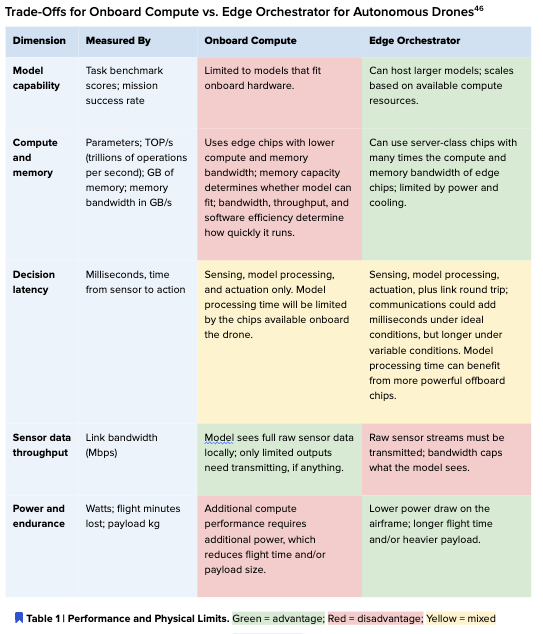
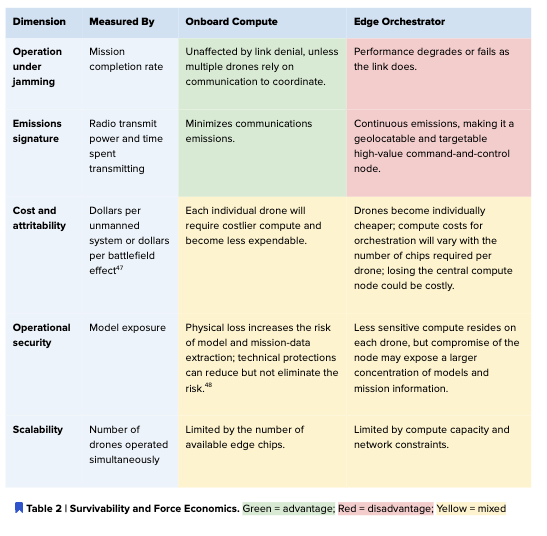
Many tradeoffs exist between these options, which I've broken down in the below two tables. An orchestrator allows access to more compute, and bigger, more capable models. But it makes drones dependent on unreliable communications links that can be disrupted by adversaries in a variety of ways.
Running AI onboard drones, meanwhile, eliminates many of these vulnerabilities, but limits the size and capabilities of the model that can be fielded. And it might give militaries less ability to intervene in the actions of those drones.
2/
This is a very thoughtful, deeply researched and reasoned piece about how AI models ACTUALLY work on drones.
@JakeASteckler has done the heavy intellectual lifting for years from front-line service in US Army and Ukraine to policy & academic circles at MIT / Harvard / Beltway.
Must read. Will RT / comment in a few specific points where I have slightly different takes than Jake
Rapid AI progress has many people imagining a world where general-purpose AI models autonomously control military drones at scale. But there’s little analysis on what this would look like in practice, and how soon it might be feasible.
My latest paper at @GovAIOrg asks what it would take to make this vision a reality, and what the path there means for AI policy.
Read it here: https://t.co/eiTWhtRHRQ
The AI-enabled drones widely fielded today use narrow AI, not general-purpose models like LLMs. AI is typically only used to handle limited portions of a flight when the link to a pilot is broken, and these models are brittle in unpredictable conditions on real-world battlefields. Because of this, today’s drones still require significant pilot involvement to be most effective.
General-purpose AI models might make it possible to field autonomous systems that can receive plain language commands and make complex decisions in unpredictable environments without human control. Many people see frontier LLMs as a path toward this end - and rapid progress in robotics capabilities by frontier models like GPT-6 Astra and most recently Claude Fable 5.2 supports this case.
But two things currently stand in the way:
- The biggest and most powerful models are still not capable enough even in controlled environments without compute and latency constraints
- Military drones will have to operate “on the edge” in contested environments without consistent cloud compute access - which makes these constraints even more severe
If and when general-purpose AI plays a major role in drone autonomy, it’ll likely be through models that are far smaller than today’s frontier, and those that militaries can rapidly modify. And, notably - when it comes to these types of small open-weight models, China currently dominates.
This has a variety of implications for the US military, frontier AI developers, and US policymakers.
Thread below with my key takeaways and recommendations.
1/
After some recent trends, I finally decide to read the Harry Potter books.
And I came away with something I didn't expect.
I came away with an understanding of what makes a generationally beloved classic.
It isn't authorial skill. Rowling is certainly talented, but, at least at the time, she was also relatively unpolished, and the series has plenty of rough patches. Uneven pacing, awkward plots, exposition dumps, two-dimensional secondary characters. I could write quite a few lines about what might be fixed. And I probably will at some point.
But none of that matters.
Because a generationally beloved classic is almost never the best book of a generation. A generationally beloved classic is the book that most perfectly captures what that generation yearns for.
Hogwart's School of Wizardry did that for millennials, just as the quest to destroy the One Ring did so for the boomers.
Boomers grew up hearing tales of recent history, and the heroism of previous generations, who got us through the great depression, and the great war. Their father, or grandfathers, or both, were heroes. But they were left growing up in the 1950s, a near-ideal time of growth, happiness, and prosperity.
Near-ideal isn't ideal. Humans need goals. The boomers were left with no great struggles to fight, no great tasks to do, nothing that could make them feel like they measured up.
So they invented something. A new struggle. A moral struggle. They decided that, because the great depression, and the great war, had happened when the institutions of Western Civilization existed, therefore those institutions were responsible. That those institutions needed to be torn down, gutted, and rebuilt in the new Boomer Morality.
This was their great quest, what allowed them to imagine themselves heroes. As an added bonus, it allowed them to imagine that the men who fought WW2 were not. They were, after all, adherents of the old creed.
When the hippies took to the streets, chanting "fascist scum, your time has come", they meant the very same people who had fought the Nazis.
Lord of the Rings dovetailed perfectly into this narrative. Its central struggle, its great quest, is not a martial struggle or a political struggle, but a moral struggle... the quest not to seize an object of power, but to destroy one.
Frodo was not some great warrior, or wise wizard. He was an innnocent, whose virtue was moral worth. The young, unaccomplished, and very small man had to resist the temptations of power, and to destroy it, because it was wicked.
Is it any wonder that the boomers decided to tear down and hollow out the institutions of society, rather than inherit and incrementally improve them?
Even to this day, any younger person who seeks power, wanting to improve the world, is subjected to any number of brain-dead aphorisms about Boromir and the Ring.
Never mind that Tolkien never intended any of this. Never mind that the Ring wasn't a symbol of anything. It was a ring. It was evil not because it represented power... it was simply evil because it was made by evil for evil purposes, and possessed a malign will of its own.
LOTR, the way the boomers read it, fit perfectly into their worldview, and they imagine themselves perpetual revolutionaries, always fighting the evils of power, even now when they are 70 years old and own everything.
Which brings us to millennials. They grew up in the world that the gutting of Western institutions left us. They went to government schools run by characters straight out of a Franz Kafka novel, sent there by parents who inexplicably hated them from the time they were old enough to talk.
When they yearned, they didn't yearn for a great moral struggle, or to tear anything down, or to be revolutionaries.
They yearned for a society that cared about them, for parents who loved them, for a civilization that saw them as the future, and invested in them accordingly.
They wanted to go to Hogwart's. They wanted get a letter by owl, telling them that the reason they didn't quite fit wasn't because they were inadequate, but because they were special.
They wanted to be the special ones, the chosen ones, the boys and girls who lived. And that last sentence may sound a bit conceited... until you realized that when they wanted to be special, they wanted to be special in precisely the way that Harry Potter was special, the way that every child in a healthy family is naturally special... not because he is talented or great, but because his mother loved him.
This is what saved Harry Potter in the inciting incident of his young life. This is what millennials wanted for themselves. Not to be astronauts and war heroes and rock stars, but to fit into a place like Hogwarts. To be mentored by wise and caring elders like Dumbledore. To be part of a community. To have mothers who loved them.
To write a story like this isn't necessarily to understand a generation, because it never seems to happen except by accident.
It is, rather, to help a generation understand itself.
That's why fan fiction, with visions like this picture, matters. Not because it has so large a footprint as to change the world, perhaps, but because it represents the spirit of an age.
It tells us what people want. And if we look carefully, it tells us why.
$700M Series A. Take note fellas.
Particularly government involvement: UK National Wealth Fund and US/Ukraine Reconstruction Fund (US Development Finance Corp partnered with Ukraine through URIF intermediary).
Nice to have your customer on your cap table. But they may have a golden share to veto selling to certain buyers, moving manufacturing offshore, or licensing IP.
Today is Veterans Day, and we’re honoring everyone who has served, including the two people who started this company.
Before they built ships, Austin and Rylan both served in the U.S. Navy. They know what we ask of sailors: months at sea, far from home, with real risk on every deployment. That experience is why Blue Water exists. We build autonomous ships for long, demanding missions on the open ocean, with no crew aboard, so fewer sailors have to stand in harm’s way to get the job done.
To every veteran, including the veterans on our own team: thank you for your service.
Read our story: https://t.co/RQt0hxwz5o
#VeteransDay
Twenty-one companies. Two countries. A shared stake in the future of sea power.
Yesterday the Embassy of Japan brought the whole maritime value chain into one room for the Japan-US Maritime Innovation Seminar in Washington, DC.
In the Autonomous Vessel System session, Rylan shared our approach to ships that cross oceans with no crew aboard. That’s Liberty: designed unmanned from the keel up, built to operate on the open ocean for months at a time, and taking shape in steel at Conrad Shipyard today. In the shipbuilding session, our production partner @ValstadShip showed how autonomous fabrication lets shipyards build more ships with today’s team. That’s the kind of production strategy a ship like Liberty is designed for.
Four themes shaped the afternoon:
> Autonomous vessels
> Advanced shipbuilding
> Port optimization
> Next-generation fuel
Thank you to the Embassy of Japan for hosting and to Marad for opening the day.
Sea power isn’t built by any one company. Yesterday showed what the ecosystem looks like in one room: builders, robotics, ports, fuel, and autonomy, from both sides of the Pacific. That ecosystem, working together, is what will bring shipbuilding into the modern era.
On honeypots - in my 1st counter-intel training, the briefer looked at all of us and said, “you’re not 10’s. If you’re approached by a 10, remember that you’re not a 10”. Message received.
Kongsberg Maritime has reportedly unveiled the Arctic Hunter USV for hybrid fleets and anti-submarine warfare in the High North, Naval News reported.
The design is based on a proven Arctic commercial vessel adapted for the UK Royal Navy’s Type 92 ASW requirement. It features Kongsberg’s remote and autonomous technologies, which have received flag-state approval, plus Thales UK submarine-hunting sonar and secure communications.
Ships are planned for delivery from Balaena Maritime’s Birkenhead yard by the end of the decade. “Atlantic security is an absolute priority,” said Lisa Edvardsen Haugan, CEO of Kongsberg Maritime.
#Kongsberg #ArcticHunter #USV #ASW
Germany plans to spend a massive 730 billion Euros on defence by the end of 2030 making it the most powerful military in Europe and one of the most powerful in the world-FT
Insane amount of militarisation...