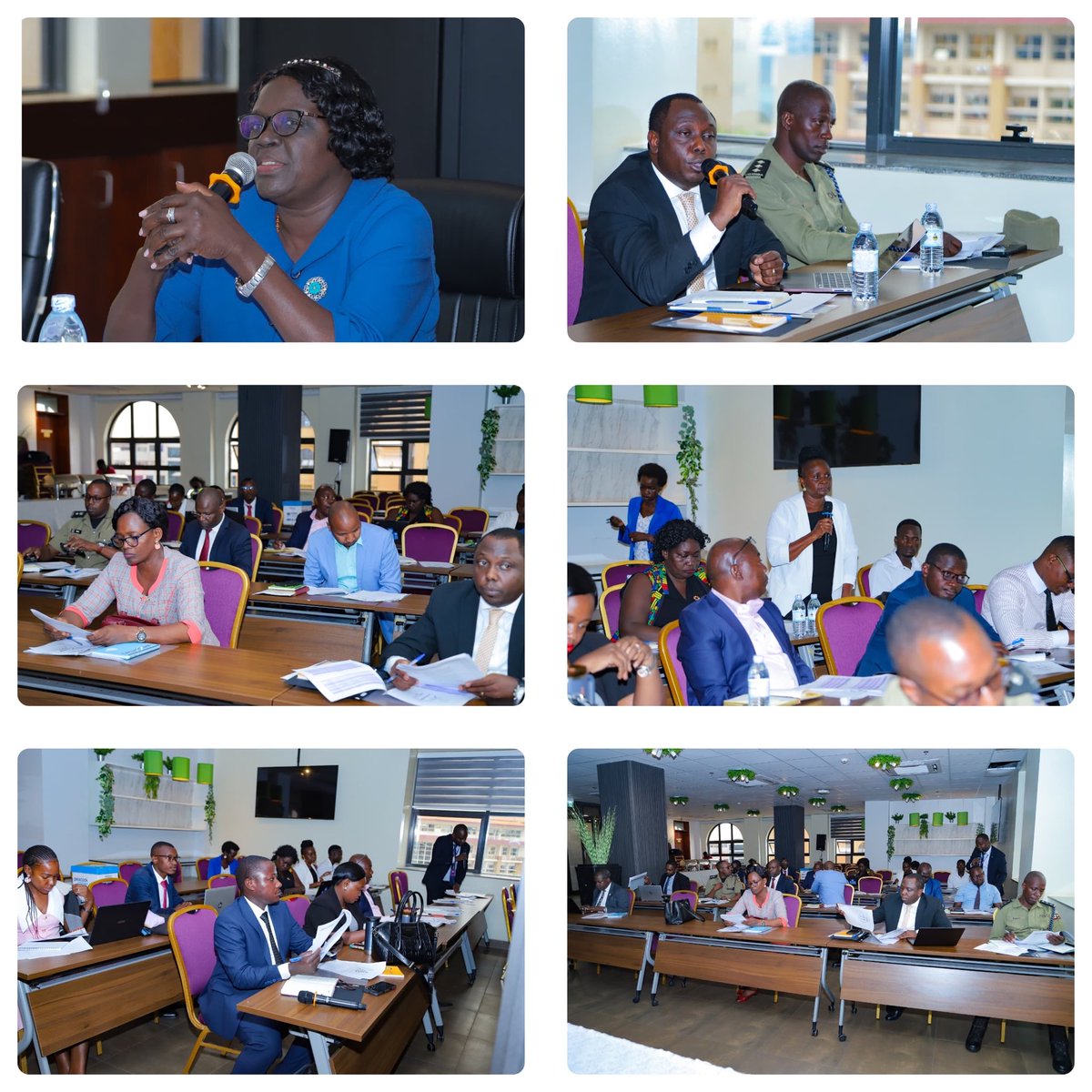
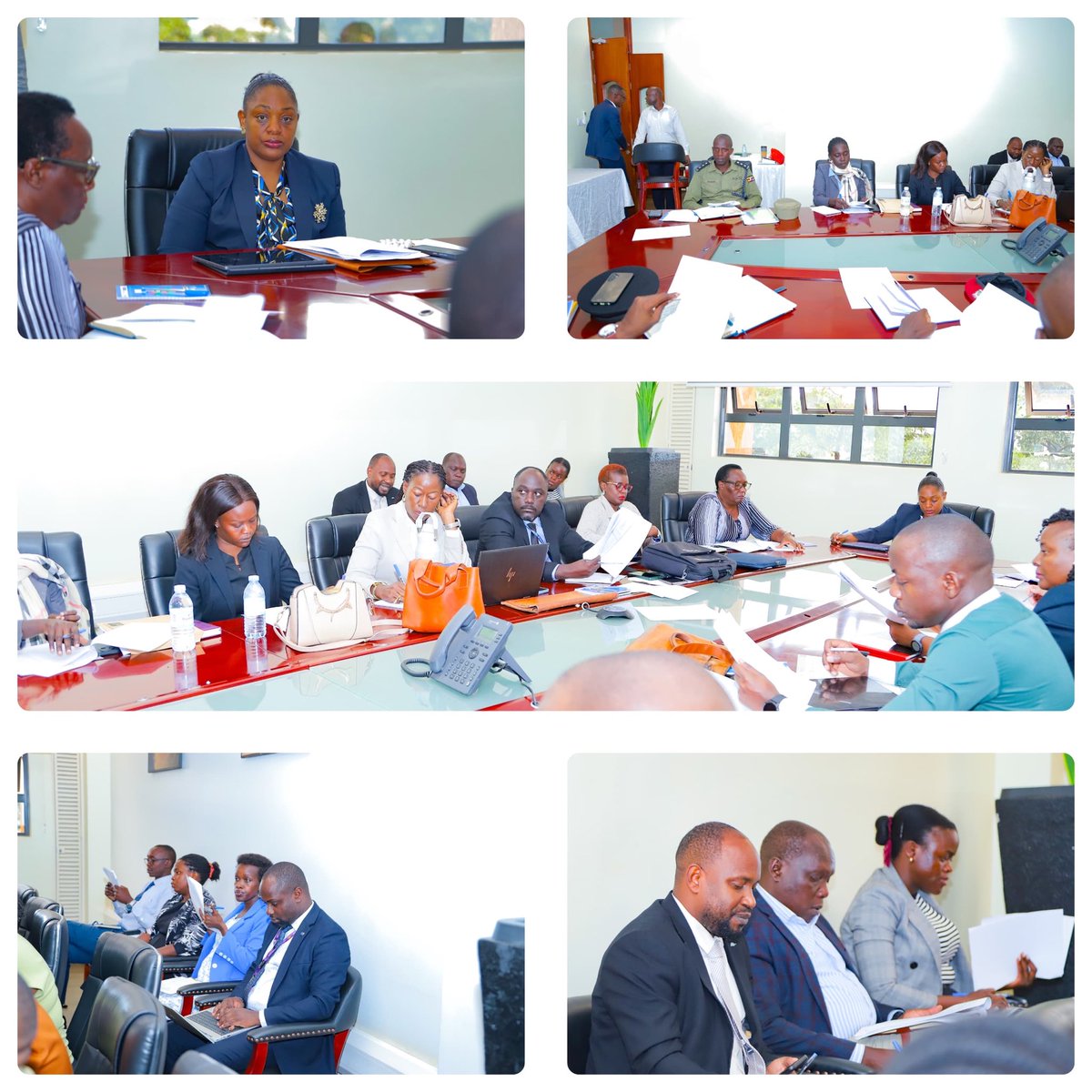
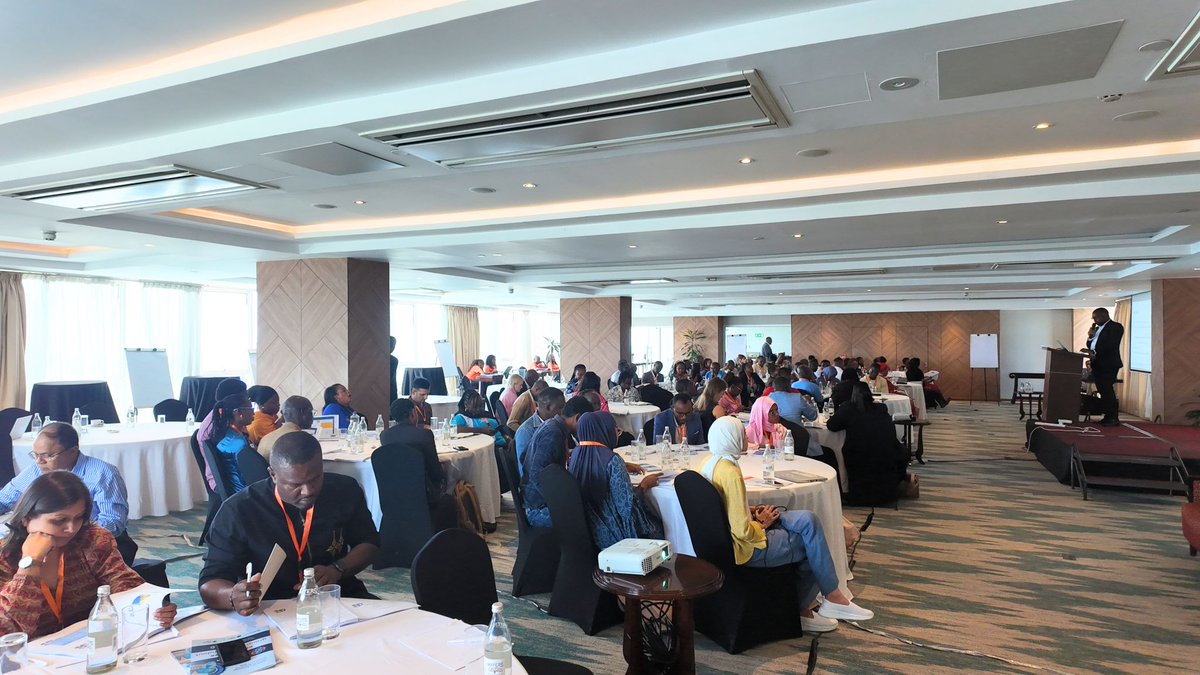
The Administration of Justice Programme (AJP) Institutional Coordination Technical Working Group (TWG) yesterday met at the Court of Appeal Building in Kampala to discuss the Terms of Reference for the Institutional Coordination Technical Working Group and review reforms in public investment management, including the regulatory effectiveness of institutional development projects.
The Institutional Coordination TWG brings together senior technical officers nominated by Programme institutions to provide technical expertise in supporting the implementation of result areas on institutional effectiveness under the Administration of Justice Programme Implementation Action Plan of the Fourth National Development Plan (NDP IV).
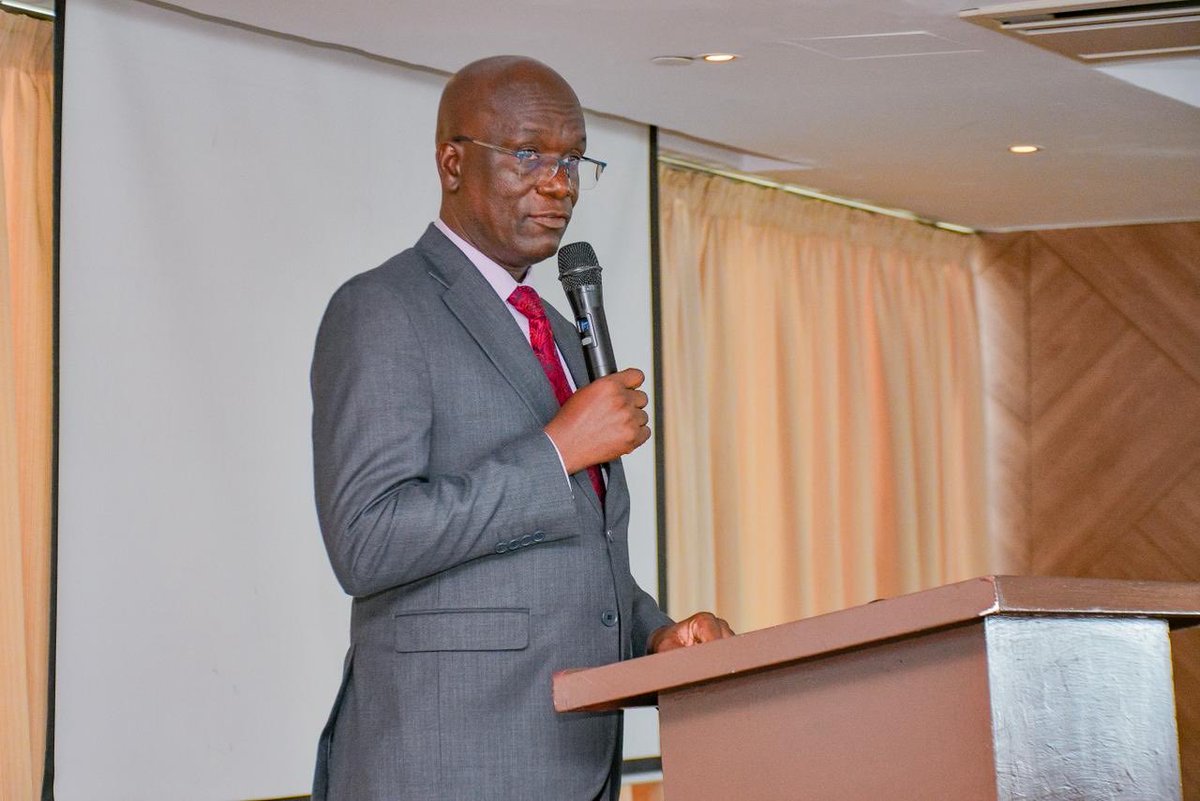
In her remarks, the Co-Chairperson of the TWG and Under Secretary of the Judicial Service Commission, Ms. Jane Margaret Akurut, emphasized the importance of strengthening coordination among institutions under the Programme in line with Government guidelines.
She noted that quarterly meetings would be held for the different working groups to enhance coordination, collaboration, and progress towards the achievement of the set NDP IV targets.
Ms. Akurut also informed members that a calendar for the Administration of Justice Programme activities would be developed and shared with all institutions to facilitate proper planning and coordination of meetings and Programme activities.
She further recalled that during the previous Joint Technical Working Group meeting held on 25th September last year, several issues aimed at improving institutional performance were raised and required action from member institutions. Ms Akurut stressed the importance of reporting on the progress made in implementing the agreed recommendations.
During the meeting, members reviewed the Terms of Reference and agreed on several amendments, including the incorporation of sub-technical working groups on ICT, Infrastructure, Statistics, Monitoring and Evaluation.
A presentation on the regulatory effectiveness of institutional development projects was delivered by Ms. Christine Mataka Oluka from the Ministry of Finance, Planning and Economic Development. She advised Programme institutions to revise and resubmit their institutional development projects after incorporating regulatory interventions aimed at strengthening the implementation of their mandates.
The meeting further resolved to include Development Partners and other non-state actors in the Institutional Coordination Technical Working Group in line with the guidelines for the implementation of NDP IV. Members also agreed to activate all sub-technical working groups that support institutional effectiveness, revise and submit institutional development projects, and share the calendar for Administration of Justice Programme activities.
The meeting was attended by representatives from the Ministry of Justice and Constitutional Affairs, Ministry of Gender, Labour and Social Development, Ministry of Internal Affairs, Office of the Prime Minister, Office of the Director of Public Prosecutions, Judicial Service Commission, Uganda Prisons Service, Uganda Police Force, Law Development Centre, Government Analytical Laboratory, Kampala Capital City Authority, Inspectorate of Government, and the United Nations Development Programme (UNDP).
Also present at the meeting were the Registrar Planning, Research and Development, HW John Paul Edoku; Head of Engineering and Technical Services, Ms. Priscilla Nakiboneka; Head of ICT, Mr. David Kikabi; Principal Policy Analyst, Mr. Caesar Kagoro; and Secretariat staff from the Policy and Planning Department
The Administration of Justice Programme (AJP) Criminal Justice Technical Working Group yesterday, held a meeting at the Court of Appeal Building to discuss prison decongestion and the Terms of Reference for this particular Technical Working Group.
The meeting was chaired by the Registrar High Court, HW Prossy Katushabe.
In her remarks, HW Katushabe emphasized that effective coordination remains one of the key pillars in maintaining fairness within the justice system as highlighted under the National Development Plan. “It is imperative that the programme maintains cohesive and functional coordination structures in order to achieve safe, fair and equitable outcomes,” she said.
The Registrar High Court noted that Uganda’s criminal justice system brings together institutions including the Uganda Police Force, the Office of the Director of Public Prosecutions, the Judiciary, Uganda Prisons Service, Directorate of Government Analytical Laboratory, Ministry of Gender, Labour and Social Development, Ministry of Internal Affairs ( Community Service)and the Law Development Centre- Legal Aid Clinic, Justice Centres Uganda ( JCU) among others.
HW Katushabe explained that the Technical Working Group plays a central role in coordinating interventions under the programme to ensure successful implementation of criminal justice reforms.
She further revealed that the Financial Year 2025/2026 will mark the second year of implementation of the National Development Programme, adding that the Technical Working Group intends to hold at least one meeting every quarter before programme working group engagements.
The meeting also heard that Uganda’s growing population continues to exert pressure on the criminal justice system, increasing the need for reforms and improved coordination.
On requests for audio-visual court links, HW Katushabe advised stakeholders to submit details of prison facilities with electricity to facilitate implementation.
During the meeting, Uganda Prisons Service Senior Superintendent of Prisons Mr. Onan Kusasira delivered a presentation on prison congestion and interventions aimed at addressing the challenge.
Mr. Kusasira noted that the rate at which the prison population is increasing overlaps the rate of expansion of prison facilities.
He explained that prison congestion remains a function of both the prison population and available accommodation space.
According to Mr. Kusasira, slow case completion rates caused by limited personnel within the criminal justice system, including prosecutors, judges, magistrates, police officers,Legal Aid Service Providers, Community Service Officers and prison staff, continue to contribute heavily to congestion.
He emphasized the need to increase prison accommodation capacity while controlling the growth of the prisoner population.
Mr. Kusasira revealed plans to construct a regional mini-maxi prison modeled on Kitalya Prison with a capacity of 4,000 prisoners, alongside the construction of three low-security prisons annually using in-house labour and resources.
He further noted that the Community Service Programme remains underutilized, explaining that community service officers currently cover less than 20 percent of courts across the country.
On parole reforms, Mr. Kusasira said Uganda Prisons Service is developing parole rules and regulations that will provide guidelines and processes for granting parole to eligible prisoners.
“With the current population of 28,860 convicted prisoners serving sentences of three years and above, about 4,000 prisoners remaining with six months to complete their sentences are eligible to apply for parole,” he said.
He added that releasing eligible prisoners through parole would significantly reduce congestion levels currently standing at 351 percent.
Members also discussed the importance of holding regular engagements, preparing reports and memoranda arising from discussions and strengthening collaboration among institutions.
The Department of State is coordinating a comprehensive response to the Ebola outbreak in the Democratic Republic of the Congo (DRC) and Uganda. Within 48 hours, the Department activated a response plan and mobilized an initial $13 million in foreign assistance for immediate response efforts, and we are leveraging the Department’s historic investment in OCHA pooled funds for the DRC and Uganda to ensure the rapid deployment of additional humanitarian assistance on the ground and close coordination with the UN system. American leadership remains indispensable in confronting global health threats.
The Chief Justice, Justice Dr. Flavian Zeija, today presided over the 23rd Graduation Ceremony of Uganda Management Institute (UMI) in Kampala, urging graduands to embrace integrity, accountability and continuous reskilling in order to remain relevant in a changing job market.
The ceremony saw 11 PhD candidates, 801 Master’s students and more than 3,000 postgraduate students graduate in different disciplines.
Justice Dr. Zeija congratulated the graduands and commended parents, spouses and guardians for supporting their academic journeys. He said Uganda needs leaders who can manage complexity, ambiguity and change, noting that national challenges require practical solutions that improve the lives of ordinary citizens.
“As you graduate today, you must never lose focus of the need for constant reskilling in order to remain relevant to the ever-changing job market,” he said.
Citing the 2025 Future of Jobs Report, the Chief Justice noted that 59 per cent of the global workforce will require reskilling by 2030 due to technological, economic, demographic and environmental shifts.
He commended UMI for its contribution to management, leadership and public administration, noting that the Judiciary values staff who continue to sharpen their skills at the Institute.
Justice Dr. Zeija said reforms such as the Electronic Court Case Management Information System (ECCMIS) and Alternative Dispute Resolution (ADR) require professionals with strong skills in performance management, ICT and change leadership.
“The gown you wear today is not a cape. It will not make hard decisions easy. But it is a reminder that you have been trained to think, to lead and to serve,” he said.
He added: “Uganda does not need perfect managers. It needs honest ones. It does not need managers who know everything. It needs managers who are willing to learn, to listen and to be held accountable.”
The Judiciary was represented by Lady Justice Florence Nakachwa Dollo of the Court of Appeal and Dr. Pius Bigirimana, Permanent Secretary/Secretary to the Judiciary.
Several Staff of the Judiciary; both Judicial and non-judicial were among the graduands, including HW Kosia Kasibayo, Deputy Registrar of the Family Division; Chief Magistrates; HW Alleluya Glory, (Kalangala); HW Doreen Karungi Olga (Kajjansi); HW Christine Nantege (Second Chief Magistrate Nakawa), HW Basemera Sarah (Makindye) and Nantaawo Shelagh Agnes (Ibanda). HW Herbert Arinda Kainlawren, Senior Magistrate Kalangala; HW Sumaya Kasule-Rutahwire, Principal Magistrate Grade I attached to Justice Asa Mugenyi; HW Isingoma Shamila Tindikahwa attached to the chambers of Justice David Matovu, HW Ogwal Smith and HW Tibenkana Ali, Magistrate Grade I Iganga, equally graduated today
Others included Ms Suzan Akello, Principal Human Resource Officer, Mr Caesar Kagoro, Principal Policy Analyst, Ms Sheila Wamboga, Principal Communications Officer, and Ms Loyce Akello, Senior Personal Secretary to the Permanent Secretary, Mr Ivan Twabagye, Assistant Secretary and Ms Gift Owembabazi, Systems Administrator, Mukono
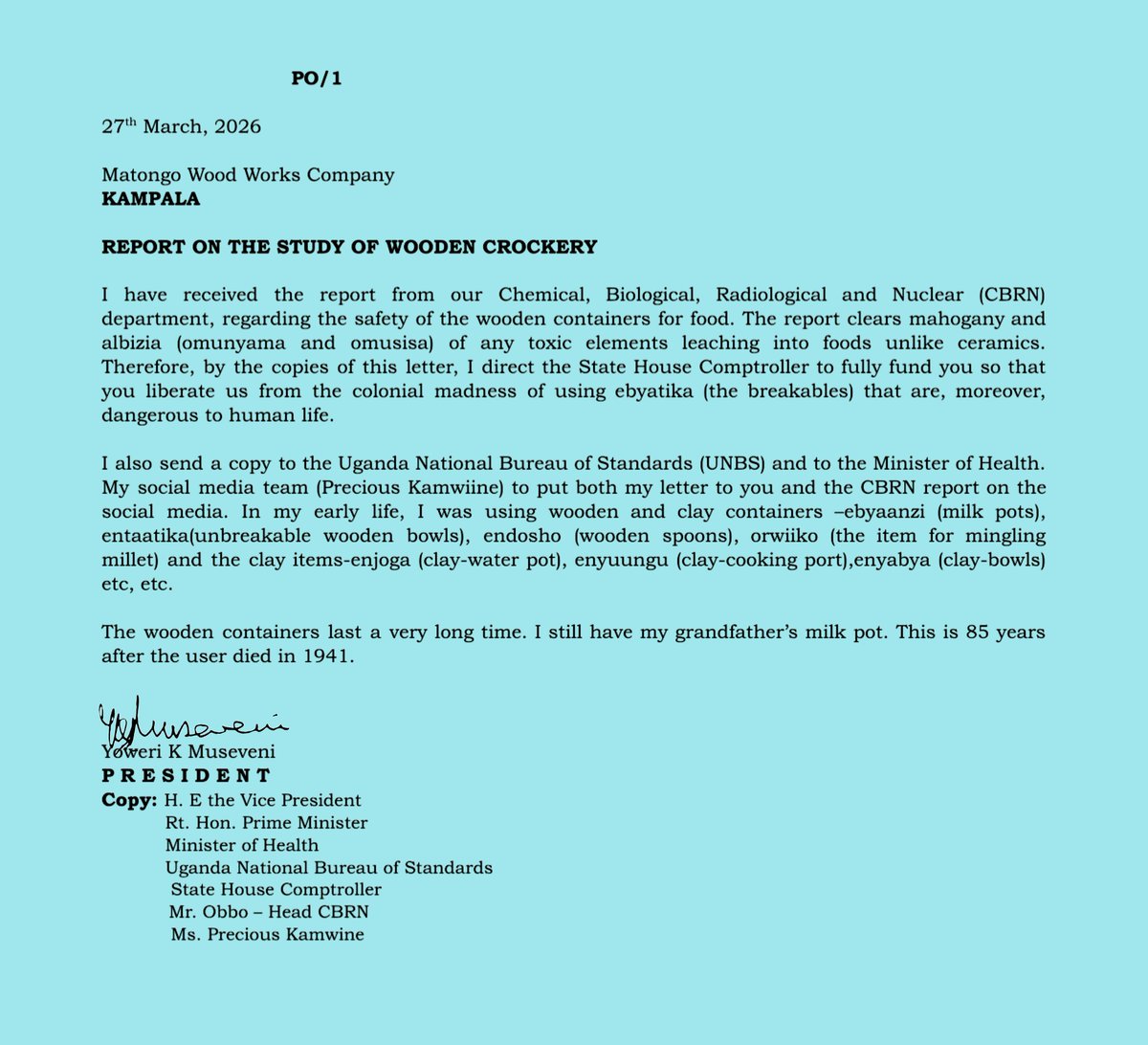
We used to take water from esiongo (pot), my jaja namulundu used to cook smoked beef in enungiro. We would grind flour using esio (grinding stone). All these things have disappeared. I will hold a household meeting and start bringing back these indigenous tools.
Fellow Ugandans, especially the Bazzukulu, following a scientific assessment by our CBRN team, I have written to Matongo Wood Works Company confirming that traditional wooden food containers made from omunyama (mahogany) and omusisa (albizia) are safe and durable. I have directed support for this initiative so that we free ourselves from the colonial habit of relying on fragile and unsafe ebyatika (the breakables).
Our indigenous knowledge systems served our people well for generations. It is time to consciously revive and promote them as part of building a self-reliant and modern Ugandan economy.
@martinssempa My pastor, you are talking about developing a theory of change of marriage. We use ToC to illustrate how results of a project or program flows to attain expected outcomes and impact.
Asante sana
Happening this week!
The Intl. Program for Development #Evaluation Training (IPDET) launches its first regional program in #Africa.🌟
From Nov. 3–7, 98 participants from 28 countries are joining #IPDETNairobi for a week of shared learning & collaboration.
Stay tuned for more!
It is my honour to welcome you to the launch of the Judiciary Annual
Performance Report for FY 2024/25. I acknowledge, with boundless
gratitude, the dedication and hard work demonstrated by the staff of the
Judiciary throughout the Financial Year.
This Report represents our commitment to enhancing access to justice to
the people of Uganda. It provides valuable insights into the outcomes we
have achieved, the progress we have made, and the areas which we
undertake to make further improvements.
The Report presents a comprehensive account of all activities of the
Judiciary during the Financial Year 2024/25. The strategic objectives,
interventions, outputs, indicators and associated targets set out in the
Fifth Judiciary Strategic Plan FY 2020/21 – FY 2024/25 (JSP V) provide a
framework for analysis of the performance.
The seven strategic objectives are: Enhancing equitable access to
judicial services; Improving court processes and case management;
Strengthening the application of ICT in justice administration;
Developing and empowering the Judiciary workforce and institutional
capacity; Improving coordination, partnerships, and accountability;
Enhancing public awareness and the Judiciary’s image; and
Strengthening resource mobilization and management- CJ Alfonse C Owiny-Dollo