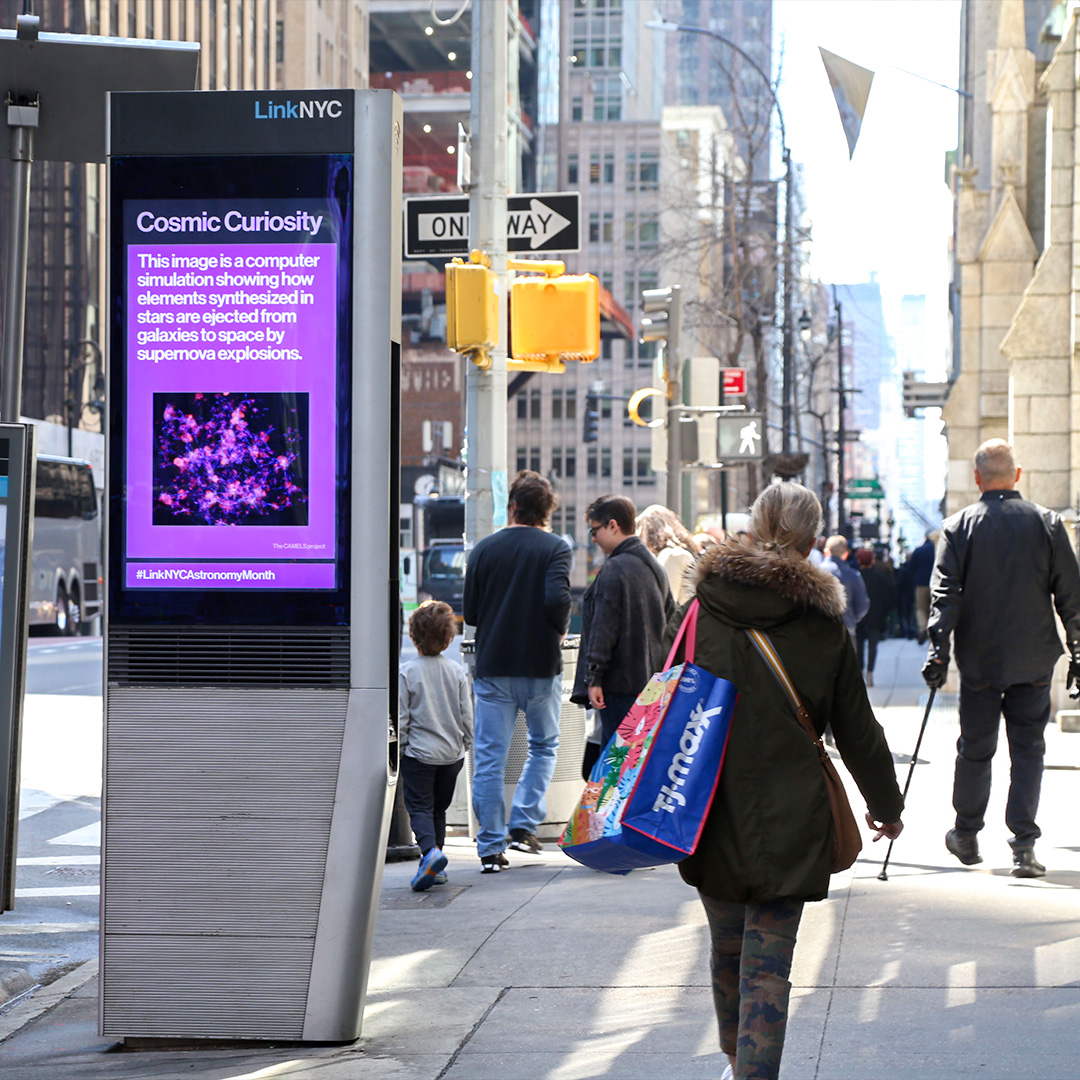
The newest ‘hump’ of the CAMELS project is live! We present and make publicly available 768 hydrodynamical zoomed-in simulations of massive halos varying 5 cosmological parameters and 23 astrophysical parameters within the IllustrisTNG model. Check out https://t.co/MxBiGC2fXL
to see how they were made, utilizing our new CARPoolGP method and by running base+surrogate simulations. All data from CAMELS-zoomGZ can be accessed via Globus or Binder at @FlatironInst. Work led by Max Lee at Columbia!
Paper day: https://t.co/yZjp1g68yL. We are measuring the impact of systematics training GNNs to perform field-level simulation-based inference with galaxy catalogs from @camels_project. We do not have and cut on scale and the models are robust. First steps before using real data!
The CAMELS project keeps growing. We have made publicly available 2,124 hydrodynamic simulations of CAMELS-ASTRID; a new suite run with the MP-Gadget code using the ASTRID subgrid physics model. All the data is accessible through globus and binder at @FlatironInst
In our new PNAS paper, we use machine learning to discover novel equations for deriving masses of clusters of galaxies from observational quantities! (1/10)
https://t.co/WXARcecsX8
with @MilesCranmer @paco_astro@jcolinhill @DavidSpergel@cosmo_shirley,Leander,Nick,Daniel,Lars.
Paper day: https://t.co/4Zzdguexl5. We train GNNs to perform field-level likelihood-free inference using galaxy catalogs from @camels_project. Our models have no scale cutoff, achieved a precision of ~12% when inferring Ωm, and it is robust for 5 != subgrid models! Check it out!
Really proud of our latest paper: "Robust field-level inference with dark matter halos". We study the robustness of field-level inference to differences in N-body codes, hydrodynamics, and astrophysics using thousands of N-body and hydrodynamic simulations. We have developed a
Many thanks to Yueying Ni and all Astrid team for the amazing and hard work. CAMELS-Astrid contains more than 1,000 simulated Universes with different cosmologies and value of the astrophysics parameters. Check https://t.co/6m8cyT0797 for more details.
Feeling frustrated because CAMELS "only" contains 4,233 simulations? If so, we have good news; we have added 2,092 new simulations: 1) 1,092 state-of-the-art hydrodynamic simulations run with MP-Gadget using the Astrid subgrid model and 2) all their N-body counterparts.
The video shows the spatial distribution of gas density (blue) and gas temperature (red) as a function of time for three simulations run with the same initial conditions but different codes. The high-resolution video available in https://t.co/jtrOxWUpyy. Differences are striking!
Happy to announce a new paper with @paco_astro !
We apply deep learning methods to infer clustering and cosmological parameters on galaxy catalogues from CAMELS simulations @camels_project. (1/4)
https://t.co/Vkmdg8ljal
More features for real-time rendering using #Python. Proud to show the use interactive keyframes to produce videos of simulations in just a few minutes. This feature opens up new opportunities for #science and #outreach. Thanks to @camels_project for data. https://t.co/pTNbTWTIwN
What is the relation between volcanos, climate, galaxies, and the cosmic microwave background? Leander Thiele tells us about it in a new CAMELS blog:
https://t.co/JfAscaiLnM. Check it out!
Check out our new post where Emily Moser explains how to use Sunyaev-Zeldovich observations of the circumgalactic medium to learn about galactic physics.
https://t.co/JfAscaiLnM