Practise kindness | Fulbrighter | PDF: Advanced Clinical Biosystems Research Institute, Cedars-Sinai | proteomics and heart function | precision medicine
Thanks @IonOptix for highlighting our recent @JPhysiol paper. TAKEHOME: Hearts get stiff as cardiomyocytes get stiff in cardiometabolic disease. Pathology does not always manifest in non-loaded CMs!!
Mechanical loading reveals hidden cardiomyocyte stiffness in cardiometabolic disease. Using IonOptix MyoStretcher and Calcium & Contractility systems, researchers found HFSD-fed mice had stiffer cells and slower Ca²⁺ decay—signs of diastolic dysfunction. https://t.co/63siEAtxtL
AlphaFold predictions are valuable hypotheses and accelerate but do not replace experimental structure determination | Nature Methods https://t.co/CBsyhmy3VH
𝐏𝐫𝐨𝐭𝐞𝐢𝐧 𝐟𝐨𝐥𝐝𝐢𝐧𝐠 𝐢𝐬 𝐧𝐨𝐭 𝐚 𝐬𝐨𝐥𝐯𝐞𝐝 𝐩𝐫𝐨𝐛𝐥𝐞𝐦.
1. Models fail on proteins with multiple stable folds (fold-switchers).
> AlphaFold 2 (AF2) captured one conformation but missed the alternative in ~94% of cases, often with high internal confidence showing AF2 selects a single dominant fold rather than modeling conformational heterogeneity.
2. Memorization vs. physics for some successes on switchers.
> Follow-up work shows AF2’s apparent wins on certain switchers can come from training-set memorization, not learning folding thermodynamics, evidence that AF2 has not internalized the full energetics of folding.
3. Not trained to predict mutation effects (stability/function).
> A systematic test concludes AF predictions cannot be used directly to estimate ΔΔG or functional impact of single variants; the task is orthogonal to AF’s training objective.
4. Fails to account for ligands and modifications
> AF models do not account for ligands, covalent modifications or other environmental factors, and accuracy varies: they’re valuable hypotheses, not final truth.
5. Limits around disorder and ensembles.
> Multiple analyses note that intrinsically disordered regions (IDRs) and proteins that require structural ensembles remain challenging; AF often assigns low confidence and cannot on its own recover the conformational distributions needed for biology.
Take-home: Deep learning models, such as AlphaFold, resulted in a major advance for predicting static single-state structures.
◼️ These predictions still fall short in multiple ways. What are your examples ?
Many people think of proteins as having a biological function — catalyze reactions, detect pathogens, etc.
At a higher level, though, proteins are programmable materials. They are an advanced form of nanotechnology, made from templates that we can read and write and understand.
And because proteins are programmable, we can use them to build physical logic gates or “smart” drugs.
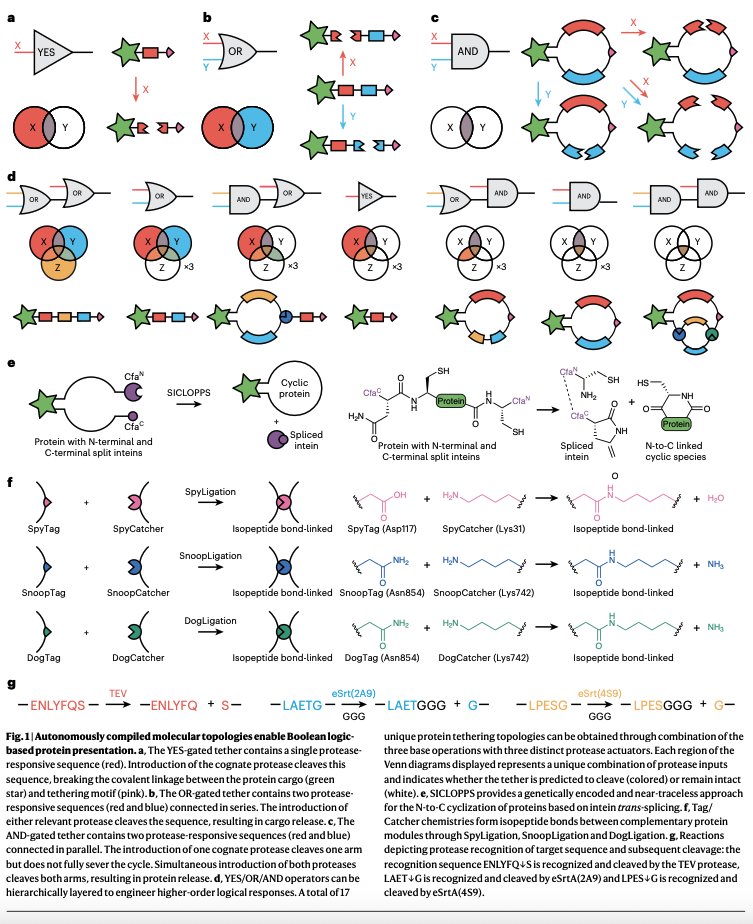
Say you wanted to make a protein that acts as a YES gate. That is, the protein releases some cargo (like a drug or other signal) only when a specific input is received.
You could build this YES gate by synthesizing a short protein (called a peptide) that has a particular sequence which is uniquely recognized by another protein, called a protease. There are many proteases found in nature. Each protease type recognizes a unique protein sequence and cleaves it, thus splitting the target in two.
A YES gate, then, can be made by building a peptide that has a protease recognition site. One end of the peptide is attached to a drug. The drug is only released when exposed to the protease.
An OR gate is also simple to make. Just create a peptide carrying two different protease sites in series, such that the addition of either protease will cleave the peptide and release the drug.
An AND gate is more difficult. To make it, you can instead attach the drug to two different peptides, each carrying a different protease recognition site. Then, anchor the ends of these two peptides to a scaffold. In this case, the drug will only be released if BOTH proteases are added.
Why am I writing about this? Because you can use these basic logic gate architectures to build all kinds of wonderful, “smart” materials and drug delivery vehicles. For a recent study, researchers built each of these logic gates, and also nested or stacked them together to build even more complex circuits (17 different logic architectures in total.)
They embedded these protein logic gates onto magnetic beads, hydrogels, and even living mammalian cells. These logical proteins are genetically encoded, modular, and could in principle respond to other signals, too; not just proteases but also light, small molecules, or mechanical forces.
Imagine a therapy for metastatic cancer that only releases its drug when two tumor-specific proteases, like MMP-9 and cathepsin B, are active. Or engineered immune cells that secrete cytokines only when both an infection marker and a metabolic stress signal are present.
Interesting to think about.
Our protein MRM preclinical assay performs!! Take a look.
A targeted LC MS/MS assay of a health surveillance panel and its application to chronic kidney disease https://t.co/Ta2tTdigGS
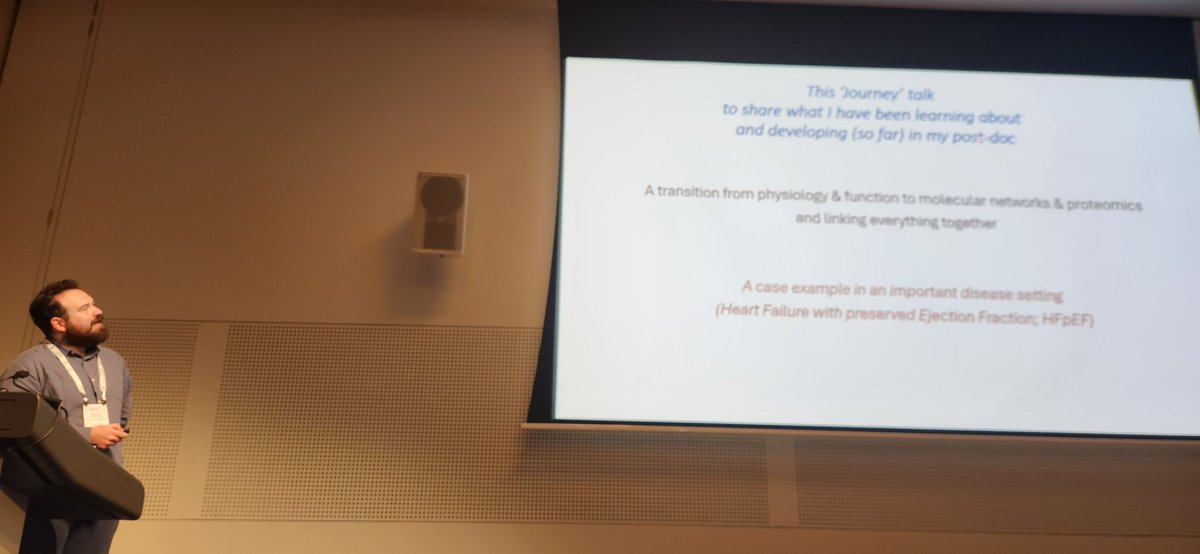
Awesome to present at #BMH2024 about linking heart function with the proteome in HFpEF, one of the projects I’m working on with @1jvaneyk and @DelbridgeLea
Looking for some weekend reading? 📜
Check out the latest paper from Wells et al with contributions from the @LabBell@DelbridgeLea@PavlovicDavor and @k8weeks
Is the electrophysiological response to sex steroids in the atria sex specific ?
https://t.co/6KW7egssJ1
Proud to share our latest paper in @CircRes. @thorplab and I review how metabolism drives immune cell functions and influences CVD. Metabolism isn't scary and hopefully this article helps others. https://t.co/398Ys1VpWT @CedarsSinai 🫀🤧
Delighted that the great @1jvaneyk was awarded the @CedarsSinaiMed PRISM prize, recognizing important contributions that have changed our understanding of medicine. Go Jenny!! 👍🍾🎊
A Fulbright Scholarship enables Australians and Americans to build stronger relationships and share knowledge. To help prepare, AFAA has created the “I wish I had known” guide, contact us at [email protected] to request your copy.
#Fulbright#AFAA
Were you just wondering, "what is known about glycation in the cardiomyocyte"? I bet you were. So its great timing that we just published a review called "Glycation in the cardiomyocyte". What a coincidence!
https://t.co/7wyComkvmn
Interesting @ajpheartcirc Review on pathobiology of #PulmonaryHypertension in #HFpEF👍
Recommended Review in @physiolrev
👉Pathophysiology and pathogenic mechanisms of pulmonary hypertension: role of membrane receptors, ion channels, and Ca2+ signaling
https://t.co/IucA8mdcDZ