Leveled up in the Great Gas Reckoning with ETHGas! 💪
Legendary Jack status: 38.4895 ETH gas spent, 4000 Beans earned—supporting the Gasless Future!
Claim your Gas ID at https://t.co/t6k6xaj7bB
🚨 Ep. 76 of @TokenizedPod: How Do Tokenized Equities Work? Ft. BlackRock’s Head of Digital Assets
@PetBerisha is joined by:
👉 @HadickM, GP, @dragonfly_xyz
👉 @robbiemitchnick, Head of Digital Assets, BlackRock
👉 @nlevine19, Partner, @a16z
To discuss:
🗝️ Tokenization as an access story for investors
📊 Three categories of tokenized equity structures
💸 Transferability limits of whitelisted tokenized assets
🤝 NYSE and Securitize partner for 24/7 trading
🌐 Stablecoins evolving into new financial infrastructure
🏦 US regional banks build tokenized deposit network
🥊 Stablecoins vs tokenized deposits serve different users
📈 Privacy demand grows for capital markets onchain
🔮 Future market structure with fewer intermediaries
***
Timestamps:
00:00 Introduction
02:17 Tokenization as an access story for investors
05:51 Three categories of tokenized equity structures
08:41 Transferability limits of whitelisted tokenized assets
11:21 NYSE and Securitize partner for 24/7 trading
15:00 Stablecoins evolving into new financial infrastructure
18:58 US regional banks build tokenized deposit network
24:21 Stablecoins vs tokenized deposits serve different users
25:42 Privacy demand grows for capital markets onchain
31:06 Future market structure with fewer intermediaries
***
👉𝘚𝘦𝘢𝘳𝘤𝘩 '𝘛𝘰𝘬𝘦𝘯𝘪𝘻𝘦𝘥 𝘗𝘰𝘥𝘤𝘢𝘴𝘵' 𝘖𝘯 𝘠𝘰𝘶𝘛𝘶𝘣𝘦. 𝘈𝘱𝘱𝘭𝘦, 𝘚𝘱𝘰𝘵𝘪𝘧𝘺 𝘰𝘳 𝘢𝘯𝘺 𝘗𝘰𝘥𝘤𝘢𝘴𝘵 𝘗𝘭𝘢𝘺𝘦𝘳! 👈
There's a path to fix Ethereum L2 fragmentation and horrible UX. superchain interop, intents etc. It's gonna happen, eth community is galvanized around unifying Ethereum and they'll fix it.
But I still don't see how all this L2 activity gets reflected on Ethereum mainnet. Layer 2s are getting Ethereum security for free right now, only paying for block space, which they will pay even less for with larger blobs.
I know lots of ethereans are triggered when people say Layer 2s are parasitic, and I get that Ethereum couldn't scale without them, so of course l2s are a net positive to the Ethereum ecosystem. But right now it doesn't seem like their contributions match the benefits they're getting.
This means that even if all of crypto's most successful use cases are on Ethereum Layer 2s, ETH the asset will only partially benefit. I imagine that's why even with all the real adoption happening on Ethereum, ETH just keeps sliding.
Tally has built an ICO fundraising platform, based on @Uniswap CCA that can help teams of any size raise capital in an honest, transparent, fair, and accountable way.
The platform ties together the entire success of Tally products and services into one cohesive offering.
Raise capital confidently 👉 https://t.co/YPqxgGNjoS
There have recently been some discussions on the ongoing role of L2s in the Ethereum ecosystem, especially in the face of two facts:
* L2s' progress to stage 2 (and, secondarily, on interop) has been far slower and more difficult than originally expected
* L1 itself is scaling, fees are very low, and gaslimits are projected to increase greatly in 2026
Both of these facts, for their own separate reasons, mean that the original vision of L2s and their role in Ethereum no longer makes sense, and we need a new path.
First, let us recap the original vision. Ethereum needs to scale. The definition of "Ethereum scaling" is the existence of large quantities of block space that is backed by the full faith and credit of Ethereum - that is, block space where, if you do things (including with ETH) inside that block space, your activities are guaranteed to be valid, uncensored, unreverted, untouched, as long as Ethereum itself functions. If you create a 10000 TPS EVM where its connection to L1 is mediated by a multisig bridge, then you are not scaling Ethereum.
This vision no longer makes sense. L1 does not need L2s to be "branded shards", because L1 is itself scaling. And L2s are not able or willing to satisfy the properties that a true "branded shard" would require. I've even seen at least one explicitly saying that they may never want to go beyond stage 1, not just for technical reasons around ZK-EVM safety, but also because their customers' regulatory needs require them to have ultimate control. This may be doing the right thing for your customers. But it should be obvious that if you are doing this, then you are not "scaling Ethereum" in the sense meant by the rollup-centric roadmap. But that's fine! it's fine because Ethereum itself is now scaling directly on L1, with large planned increases to its gas limit this year and the years ahead.
We should stop thinking about L2s as literally being "branded shards" of Ethereum, with the social status and responsibilities that this entails. Instead, we can think of L2s as being a full spectrum, which includes both chains backed by the full faith and credit of Ethereum with various unique properties (eg. not just EVM), as well as a whole array of options at different levels of connection to Ethereum, that each person (or bot) is free to care about or not care about depending on their needs.
What would I do today if I were an L2?
* Identify a value add other than "scaling". Examples: (i) non-EVM specialized features/VMs around privacy, (ii) efficiency specialized around a particular application, (iii) truly extreme levels of scaling that even a greatly expanded L1 will not do, (iv) a totally different design for non-financial applications, eg. social, identity, AI, (v) ultra-low-latency and other sequencing properties, (vi) maybe built-in oracles or decentralized dispute resolution or other "non-computationally-verifiable" features
* Be stage 1 at the minimum (otherwise you really are just a separate L1 with a bridge, and you should just call yourself that) if you're doing things with ETH or other ethereum-issued assets
* Support maximum interoperability with Ethereum, though this will differ for each one (eg. what if you're not EVM, or even not financial?)
From Ethereum's side, over the past few months I've become more convinced of the value of the native rollup precompile, particuarly once we have enshrined ZK-EVM proofs that we need anyway to scale L1. This is a precompile that verifies a ZK-EVM proof, and it's "part of Ethereum", so (i) it auto-upgrades along with Ethereum, and (ii) if the precompile has a bug, Ethereum will hard-fork to fix the bug.
The native rollup precompile would make full, security-council-free, EVM verification accessible. We should spend much more time working out how to design it in such a way that if your L2 is "EVM plus other stuff", then the native rollup precompile would verify the EVM, and you only have to bring your own prover for the "other stuff" (eg. Stylus). This might involve a canonical way of exposing a lookup table between contract call inputs and outputs, and letting you provide your own values to the lookup table (that you would prove separately).
This would make it easy to have safe, strong, trustless interoperability with Ethereum. It also enables synchronous composability (see: https://t.co/9jy6v1X6Fw and https://t.co/gZmu3YjebM ). And from there, it's each L2's choice exactly what they want to build. Don't just "extend L1", figure out something new to add.
This of course means that some will add things that are trust-dependent, or backdoored, or otherwise insecure; this is unavoidable in a permissionless ecosystem where developers have freedom. Our job should make to make it clear to users what guarantees they have, and to build up the strongest Ethereum that we can.
🚨: Mariano Barbacid, who discovered the cure for pancreatic cancer needs 30M€ to start the clinical trial in humans against pancreatic cancer. It has already managed to eliminate the disease in mice.
https://t.co/xXRgRbGogL
Rainbow was the first wallet to directly integrate Uniswap v1 back in 2019…
Now, we're honored and quite hyped to announce the $RNBW auction will be the first CCA to happen directly on https://t.co/DLBlSZion7
More details 👇
Uniswap’s CCA is the first time price discovery has felt fair and effective.
Price discovery is broken both onchain and off.
Whether it’s ICOs, newer onchain launch formats, or public IPOs on the NYSE and Nasdaq, the pattern is the same.
Very little transparency. A small group of investment bankers, market makers, or insiders decide what the “fair” price is, and everyone else finds out after. That usually ends up being bad for both the company and long-term public holders.
With CCA, price discovery happens continuously instead of in a single moment. Demand aggregates in the open, early conviction is rewarded without gas wars or last-minute games, and the auction flows directly into real liquidity.
This feels like a meaningfully fairer and more effective way to fundraise, not just for crypto, but potentially for other industries too.
Curious who else is building or thinking seriously about this space.
You could spend a week understanding CCA mechanics.
Or you could just use the Tally sale simulator.
Plug in your numbers. Watch @Uniswap CCA find every dollar. Launch when ready.
Live now ↓
Ahead of the $RNBW launch on February 5, we're running a permissionless @Uniswap CCA to allow price discovery for $RNBW to happen fairly and transparently onchain.
Truly anyone can participate.
Starts on Monday February 2nd.
100% of the proceeds will automatically become onchain liquidity for $RNBW.
More details coming soon.
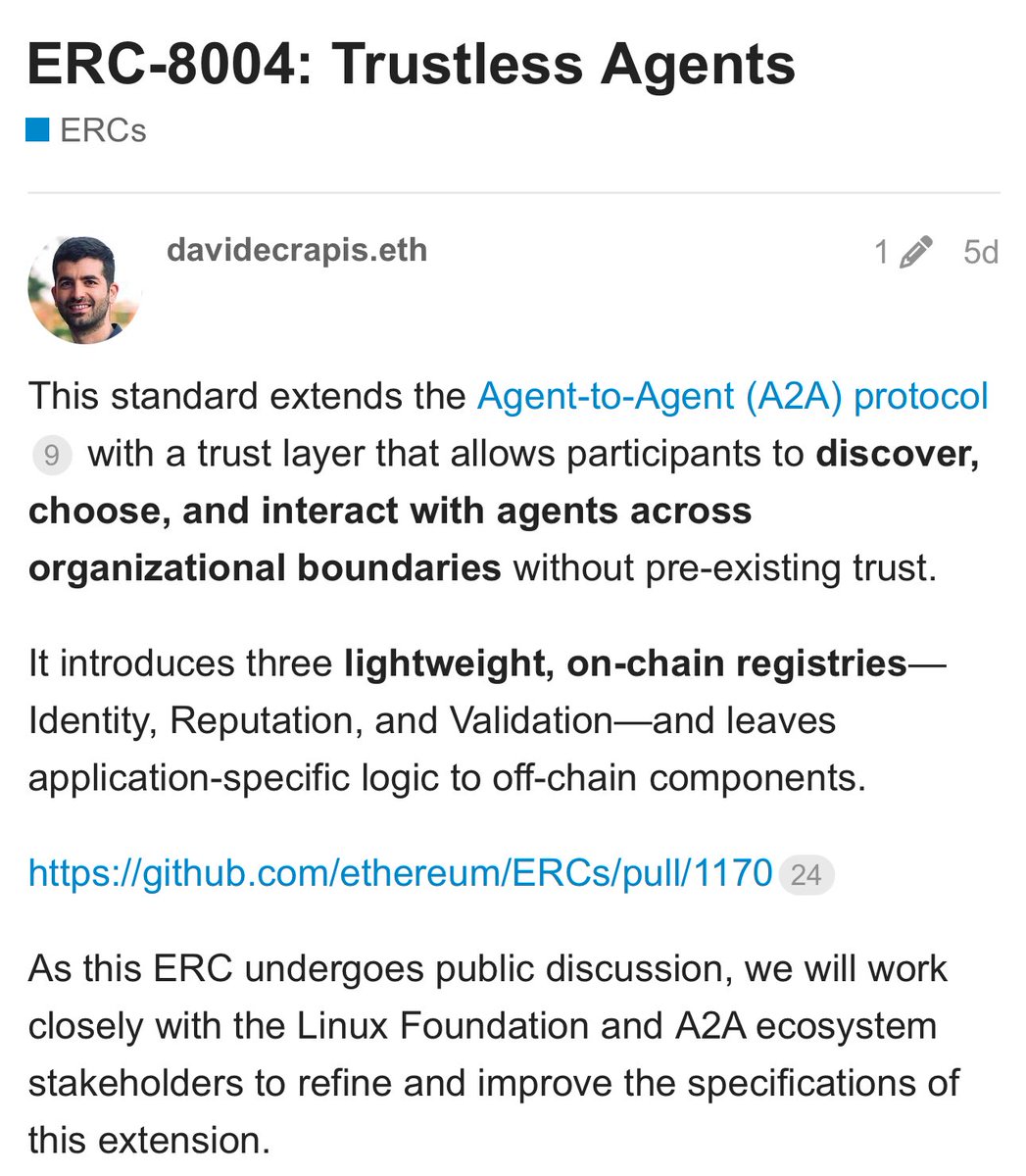
ethereum is SERIOUSLY gearing up for ai. (erc-8004) by @DavideCrapis just dropped, it’s called “trustless agents” and here’s what you need to know:
but first:
you can think of ethereum as an important substrate for ai, not necessarily because it can run all the models, but because it can run all their trust.
here’s a thought experiment:
> imagine millions of autonomous agents moving across the internet. they transact, negotiate, and perhaps even form their own coalitions..(dao’s, anyone?)
> in this reality, what substrate would they choose to anchor themselves to? do they pick a single company server? a google api? an open database that anyone can rewrite?
> if you are working with these agents to do tasks cross 50 services (banks, social media, crms), would you just let it all run on a database that can be deleted?
probably not.
if you were an agent with no loyalty except to your own survival, you wouldn’t want to bet your memory and reputation on one corporation or one government: you’d want a ledger that no one could quietly change behind your back. you’d want neutral ground.
you’d want ethereum.
so, we’ve done the why, now let’s dive into the how:
erc-8004 builds on the agent-to-agent protocol (a2a).
a2a gives agents a shared language, but language isn’t enough: machines also need a way to check
> who are you,
> what have you done
> and are you behaving as you claim?
the proposal sketches an extension to a2a with three registries onchain:
1) identity: a verifiable anchor for “i am me.”
2) reputation: an immutable trail of how an agent has behaved.
3) validation: proofs that an action really hap
this is a practical ERC that can be used and iterated on in the wild; the specifics can stay offchain, but the skeleton of trust lives on ethereum.
8004 lets agents that have never seen each other meet in the wild and still transact with confidence.
look closely and will you see the outlines of a machine economy
your agent negotiating with some unknown counterpart in another part of the world, and it doesn’t matter because both are plugged into the same incorruptible memory.
this is just the beginning of machines running on trustware. smart contracts are how we will communicate with ai, the immutable ledger is how they will communicate with eachother, and ethereum is how we will build this right.
this is just a start, but you can come and lay the foundations of a sci-fi future done right with us.
Final volume numbers of the night for the top prediction markets offering moneyline trading on the Cowboys vs. Eagles game!
🥇 @Kalshi: $26.7M
🥈 @Polymarket: $3.9M
🥉 @cryptocom: $1.2M
🏈 @Novig: $489K
By hook builders, for hook builders 🤝
In this week's builder stories: we sat down with @z0r0zzz to discuss the Community Router built with @saucepoint, his journey from law to NLP for Uni v3 to building on v4.
https://t.co/AdRziGqlA3