We still need for better interaction and persistence primitives in ai workflows, especially in certain fields
Human knowledge workers do more than reading traces and monitoring. What about guided input? Commenting on outputs? Refining sources? Just in general iterative improvement? And it’s not even about just humans
🆕 Today, we're releasing the public preview of Workflows, the orchestration layer for enterprise AI.
🌎 Enterprise teams have capable models. What they don't have is a way to run them reliably in production. That's the gap Workflows fills. It takes AI-powered business processes from prototype to production, with the durability, observability, and fault tolerance that production actually requires.
Leading organisations like ASML, ABANCA, CMA-CGM, France Travail, La Banque Postale, Moeve, and many others are already using Workflows to automate critical processes.
@openclaw And the most important bit: we (sail@gt) introduce veeksha, an inference systems benchmarking tool that can actually dispatch realistic, multimodal, agentic sessions. It has a lot of goodies https://t.co/44XRI5JbRE
@openclaw And the most important bit: we (sail@gt) introduce veeksha, an inference systems benchmarking tool that can actually dispatch realistic, multimodal, agentic sessions. It has a lot of goodies https://t.co/44XRI5JbRE
Benchmarking inference systems with independent requests or short chats is not relevant in a world where agents incur most of the inference load.
I characterize agentic workloads and their implications for inference requirements here:
https://t.co/kcKUgpeepi
In short, agentic sessions:
- are long-lived
- have extremely high prefix reuse
- induce bursts of requests and input-output tokens
I measure these properties from @openclaw traces and perform some case studies. An inaccurate workload shape can mean provisioning resources wrong
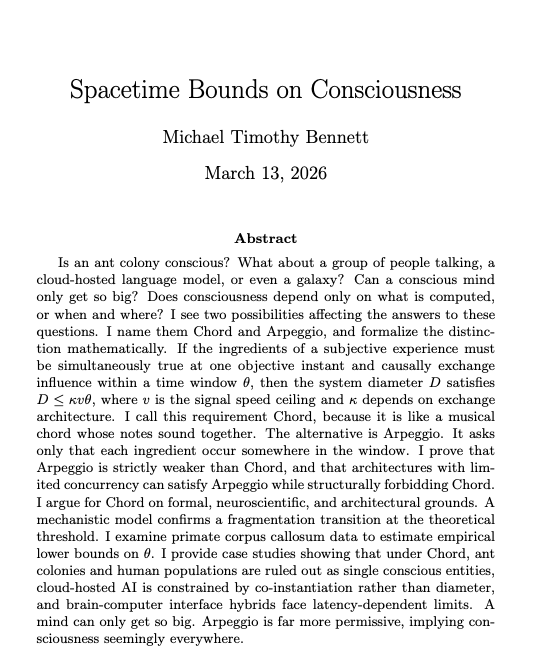
In Peter Watt's Blindsight, a faked experiment shows how a digital mind experiences consciousness at lower and lower time resolutions, even at the scale of seconds. I wish Michael's work would have been in the Annex!
New post: nanochat miniseries v1
The correct way to think about LLMs is that you are not optimizing for a single specific model but for a family models controlled by a single dial (the compute you wish to spend) to achieve monotonically better results. This allows you to do careful science of scaling laws and ultimately this is what gives you the confidence that when you pay for "the big run", the extrapolation will work and your money will be well spent. For the first public release of nanochat my focus was on end-to-end pipeline that runs the whole LLM pipeline with all of its stages. Now after YOLOing a few runs earlier, I'm coming back around to flesh out some of the parts that I sped through, starting of course with pretraining, which is both computationally heavy and critical as the foundation of intelligence and knowledge in these models.
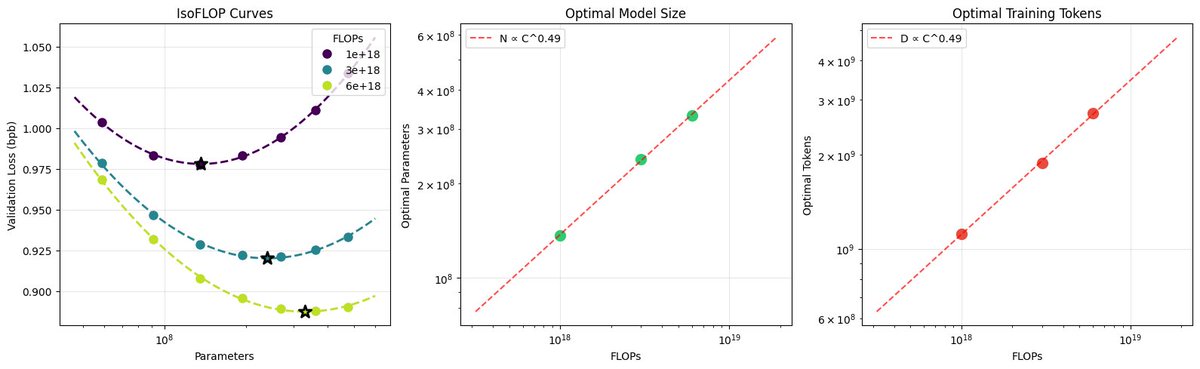
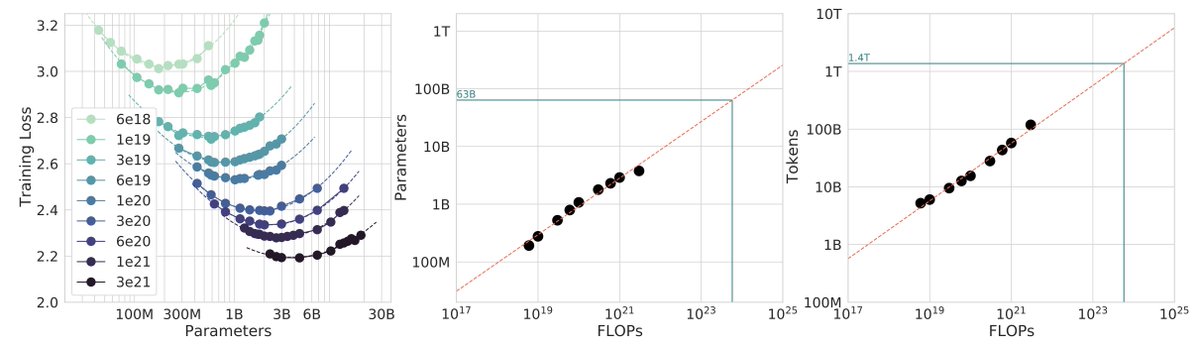
After locally tuning some of the hyperparameters, I swept out a number of models fixing the FLOPs budget. (For every FLOPs target you can train a small model a long time, or a big model for a short time.) It turns out that nanochat obeys very nice scaling laws, basically reproducing the Chinchilla paper plots:
Which is just a baby version of this plot from Chinchilla:
Very importantly and encouragingly, the exponent on N (parameters) and D (tokens) is equal at ~=0.5, so just like Chinchilla we get a single (compute-independent) constant that relates the model size to token training horizons. In Chinchilla, this was measured to be 20. In nanochat it seems to be 8!
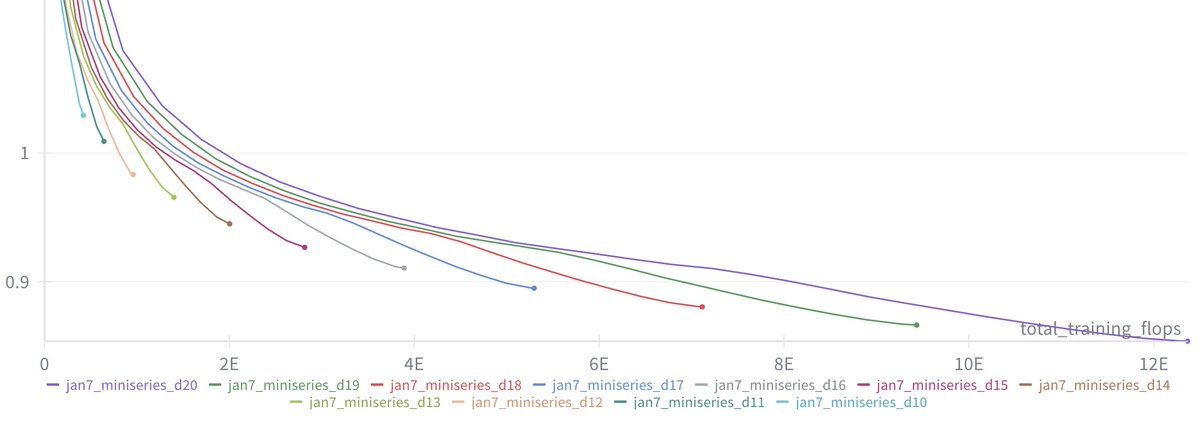
Once we can train compute optimal models, I swept out a miniseries from d10 to d20, which are nanochat sizes that can do 2**19 ~= 0.5M batch sizes on 8XH100 node without gradient accumulation. We get pretty, non-itersecting training plots for each model size.
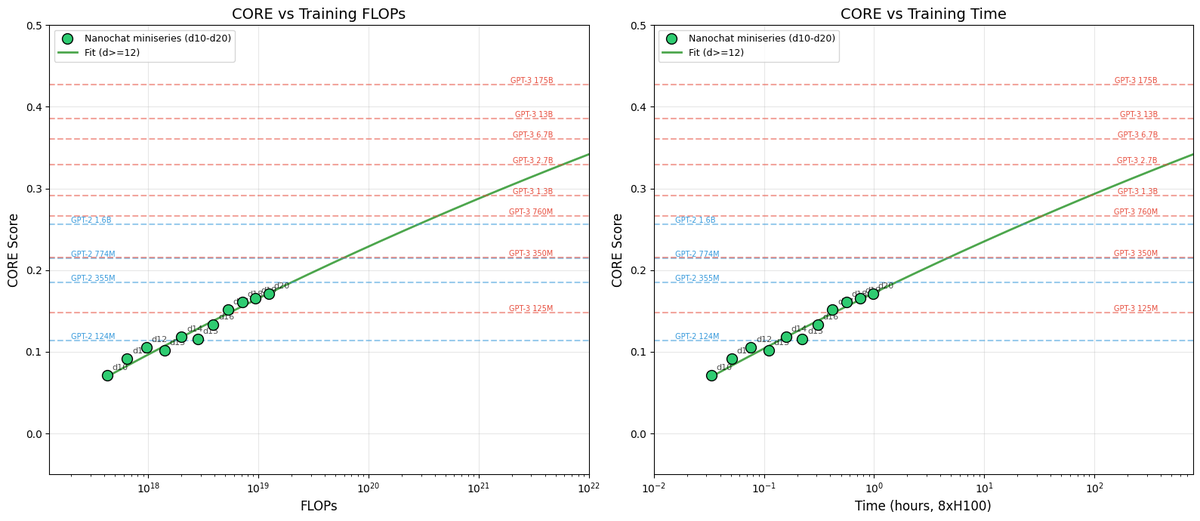
Then the fun part is relating this miniseries v1 to the GPT-2 and GPT-3 miniseries so that we know we're on the right track. Validation loss has many issues and is not comparable, so instead I use the CORE score (from DCLM paper). I calculated it for GPT-2 and estimated it for GPT-3, which allows us to finally put nanochat nicely and on the same scale:
The total cost of this miniseries is only ~$100 (~4 hours on 8XH100). These experiments give us confidence that everything is working fairly nicely and that if we pay more (turn the dial), we get increasingly better models.
TLDR: we can train compute optimal miniseries and relate them to GPT-2/3 via objective CORE scores, but further improvements are desirable and needed. E.g., matching GPT-2 currently needs ~$500, but imo should be possible to do <$100 with more work.
Full post with a lot more detail is here:
https://t.co/na8zVLqWLf
And all of the tuning and code is pushed to master and people can reproduce these with scaling_laws .sh and miniseries .sh bash scripts.
A number of people are talking about implications of AI to schools. I spoke about some of my thoughts to a school board earlier, some highlights:
1. You will never be able to detect the use of AI in homework. Full stop. All "detectors" of AI imo don't really work, can be defeated in various ways, and are in principle doomed to fail. You have to assume that any work done outside classroom has used AI.
2. Therefore, the majority of grading has to shift to in-class work (instead of at-home assignments), in settings where teachers can physically monitor students. The students remain motivated to learn how to solve problems without AI because they know they will be evaluated without it in class later.
3. We want students to be able to use AI, it is here to stay and it is extremely powerful, but we also don't want students to be naked in the world without it. Using the calculator as an example of a historically disruptive technology, school teaches you how to do all the basic math & arithmetic so that you can in principle do it by hand, even if calculators are pervasive and greatly speed up work in practical settings. In addition, you understand what it's doing for you, so should it give you a wrong answer (e.g. you mistyped "prompt"), you should be able to notice it, gut check it, verify it in some other way, etc. The verification ability is especially important in the case of AI, which is presently a lot more fallible in a great variety of ways compared to calculators.
4. A lot of the evaluation settings remain at teacher's discretion and involve a creative design space of no tools, cheatsheets, open book, provided AI responses, direct internet/AI access, etc.
TLDR the goal is that the students are proficient in the use of AI, but can also exist without it, and imo the only way to get there is to flip classes around and move the majority of testing to in class settings.
Decline is a choice, not a fate.
Today, with @LuisGaricano (@LSEnews) and Bengt Holmström (@MIT), we launch The Constitution of Innovation - a manifesto for a new European renaissance.
We make 6 concrete proposals.
Read them at https://t.co/ydHHv0ltMm
#Europe#Innovation 1/6
Finally had a chance to listen through this pod with Sutton, which was interesting and amusing.
As background, Sutton's "The Bitter Lesson" has become a bit of biblical text in frontier LLM circles. Researchers routinely talk about and ask whether this or that approach or idea is sufficiently "bitter lesson pilled" (meaning arranged so that it benefits from added computation for free) as a proxy for whether it's going to work or worth even pursuing. The underlying assumption being that LLMs are of course highly "bitter lesson pilled" indeed, just look at LLM scaling laws where if you put compute on the x-axis, number go up and to the right. So it's amusing to see that Sutton, the author of the post, is not so sure that LLMs are "bitter lesson pilled" at all. They are trained on giant datasets of fundamentally human data, which is both 1) human generated and 2) finite. What do you do when you run out? How do you prevent a human bias? So there you have it, bitter lesson pilled LLM researchers taken down by the author of the bitter lesson - rough!
In some sense, Dwarkesh (who represents the LLM researchers viewpoint in the pod) and Sutton are slightly speaking past each other because Sutton has a very different architecture in mind and LLMs break a lot of its principles. He calls himself a "classicist" and evokes the original concept of Alan Turing of building a "child machine" - a system capable of learning through experience by dynamically interacting with the world. There's no giant pretraining stage of imitating internet webpages. There's also no supervised finetuning, which he points out is absent in the animal kingdom (it's a subtle point but Sutton is right in the strong sense: animals may of course observe demonstrations, but their actions are not directly forced/"teleoperated" by other animals). Another important note he makes is that even if you just treat pretraining as an initialization of a prior before you finetune with reinforcement learning, Sutton sees the approach as tainted with human bias and fundamentally off course, a bit like when AlphaZero (which has never seen human games of Go) beats AlphaGo (which initializes from them). In Sutton's world view, all there is is an interaction with a world via reinforcement learning, where the reward functions are partially environment specific, but also intrinsically motivated, e.g. "fun", "curiosity", and related to the quality of the prediction in your world model. And the agent is always learning at test time by default, it's not trained once and then deployed thereafter. Overall, Sutton is a lot more interested in what we have common with the animal kingdom instead of what differentiates us. "If we understood a squirrel, we'd be almost done".
As for my take...
First, I should say that I think Sutton was a great guest for the pod and I like that the AI field maintains entropy of thought and that not everyone is exploiting the next local iteration LLMs. AI has gone through too many discrete transitions of the dominant approach to lose that. And I also think that his criticism of LLMs as not bitter lesson pilled is not inadequate. Frontier LLMs are now highly complex artifacts with a lot of humanness involved at all the stages - the foundation (the pretraining data) is all human text, the finetuning data is human and curated, the reinforcement learning environment mixture is tuned by human engineers. We do not in fact have an actual, single, clean, actually bitter lesson pilled, "turn the crank" algorithm that you could unleash upon the world and see it learn automatically from experience alone.
Does such an algorithm even exist? Finding it would of course be a huge AI breakthrough. Two "example proofs" are commonly offered to argue that such a thing is possible. The first example is the success of AlphaZero learning to play Go completely from scratch with no human supervision whatsoever. But the game of Go is clearly such a simple, closed, environment that it's difficult to see the analogous formulation in the messiness of reality. I love Go, but algorithmically and categorically, it is essentially a harder version of tic tac toe. The second example is that of animals, like squirrels. And here, personally, I am also quite hesitant whether it's appropriate because animals arise by a very different computational process and via different constraints than what we have practically available to us in the industry. Animal brains are nowhere near the blank slate they appear to be at birth. First, a lot of what is commonly attributed to "learning" is imo a lot more "maturation". And second, even that which clearly is "learning" and not maturation is a lot more "finetuning" on top of something clearly powerful and preexisting. Example. A baby zebra is born and within a few dozen minutes it can run around the savannah and follow its mother. This is a highly complex sensory-motor task and there is no way in my mind that this is achieved from scratch, tabula rasa. The brains of animals and the billions of parameters within have a powerful initialization encoded in the ATCGs of their DNA, trained via the "outer loop" optimization in the course of evolution. If the baby zebra spasmed its muscles around at random as a reinforcement learning policy would have you do at initialization, it wouldn't get very far at all. Similarly, our AIs now also have neural networks with billions of parameters. These parameters need their own rich, high information density supervision signal. We are not going to re-run evolution. But we do have mountains of internet documents. Yes it is basically supervised learning that is ~absent in the animal kingdom. But it is a way to practically gather enough soft constraints over billions of parameters, to try to get to a point where you're not starting from scratch. TLDR: Pretraining is our crappy evolution. It is one candidate solution to the cold start problem, to be followed later by finetuning on tasks that look more correct, e.g. within the reinforcement learning framework, as state of the art frontier LLM labs now do pervasively.
I still think it is worth to be inspired by animals. I think there are multiple powerful ideas that LLM agents are algorithmically missing that can still be adapted from animal intelligence. And I still think the bitter lesson is correct, but I see it more as something platonic to pursue, not necessarily to reach, in our real world and practically speaking. And I say both of these with double digit percent uncertainty and cheer the work of those who disagree, especially those a lot more ambitious bitter lesson wise.
So that brings us to where we are. Stated plainly, today's frontier LLM research is not about building animals. It is about summoning ghosts. You can think of ghosts as a fundamentally different kind of point in the space of possible intelligences. They are muddled by humanity. Thoroughly engineered by it. They are these imperfect replicas, a kind of statistical distillation of humanity's documents with some sprinkle on top. They are not platonically bitter lesson pilled, but they are perhaps "practically" bitter lesson pilled, at least compared to a lot of what came before. It seems possibly to me that over time, we can further finetune our ghosts more and more in the direction of animals; That it's not so much a fundamental incompatibility but a matter of initialization in the intelligence space. But it's also quite possible that they diverge even further and end up permanently different, un-animal-like, but still incredibly helpful and properly world-altering. It's possible that ghosts:animals :: planes:birds.
Anyway, in summary, overall and actionably, I think this pod is solid "real talk" from Sutton to the frontier LLM researchers, who might be gear shifted a little too much in the exploit mode. Probably we are still not sufficiently bitter lesson pilled and there is a very good chance of more powerful ideas and paradigms, other than exhaustive benchbuilding and benchmaxxing. And animals might be a good source of inspiration. Intrinsic motivation, fun, curiosity, empowerment, multi-agent self-play, culture. Use your imagination.
I'm so jealous of how good the next generation of students will have it. And that's the goal. That's how it should be.
If you are even remotely interested in the idea of improving the state of education, if you suspect there might be (way, way, way) more human potential than is being cultivated, then you'll learn a lot as @jliemandt breaks it down -- not just what the inefficiencies are, but also what can be done to fix them.
After decades of the edtech industry being soft and unserious, it's inspiring to see hardcore folks heading in that direction -- people who take optimizing learning in students' brains as seriously as the quantitative finance industry takes optimizing return in the stock market.
I've wanted alien-level edtech ever since I was a kid. And not just in hindsight as an adult -- literally, in my early teens it's something I actively thought about and wished I had. That's why I'm so motivated to help build it nowadays.
For me it started the year I took precalculus at school. I encountered a bit of calculus in the spring, and it seemed really cool, being the highest level of math you hear of as a typical kid and the way that movies often communicate that a character is a genius. So I figured I'd try teaching myself the rest over the summer using various online resources.
Self-study turned out to be way more efficient than I was used to at school, and it was incredibly fun making progress so quickly. Once I got to optimization, related rates, and basic differential equations, I was having so much fun wielding calculus like a weapon and opening cans of whoop-ass on modeling problems, that I voluntarily holed up in my room working out math problems. It was almost like playing a video game, except, the longer I played, the more proud my parents were of me for working so hard.
After calculus, I immediately moved on to Linear Algebra and Multivariable Calculus through MIT OpenCourseWare, and once school started up again in the fall, I just kept on going with the rest of undergraduate math (plus half of physics and a bit of mathy coding).
I was completely obsessed, to the point of self-studying about 8h/day over that summer, and then maybe 6h/day during the school year. (I self-studied on the sly during school -- I typically I had to hide what I was doing, act like I was paying attention, and keep an ear out in case I got called on.)
But at the same time, I was also frustrated by all sorts of inefficiencies I encountered during the learning process. And although I got pretty far, if I were to have spent the equivalent amount of time on the most effective adaptive learning platforms of today, that would have been life-changing for me -- I mean, life-changing compared to my intense MIT OCW / textbook self-study, which was already life-changing compared to traditional school.
Just to name a handful of inefficiencies that I encountered:
-- Not super scaffolded → you periodically run into situations where you bang your head on a wall thinking "how the heck did they get from here to there?" and it takes a long time to figure out what kind of logical leap is happening (if you figure it out at all)
-- Doesn't track your knowledge / make sure you've mastered the prerequisites for anything new you're supposed to learn → you often feel a large gap between your level of knowledge and the new material, which leads to more banging your head on a wall trying to figure out what prerequisite knowledge you're missing and how to learn it
-- No spaced review → you quickly get rusty on a lot of what you learn, which not only means you come out of the course having forgotten a lot of content, but even during the course, you're constantly forgetting prerequisites
-- Doesn't adapt to your level of performance → you waste a lot of your time doing the wrong amount of work. Sometimes you grasp a topic quickly and end up doing way more practice problems than you need; other times you struggle with a topic and don't do enough practice problems to reach mastery
-- Leaves the definition of "mastery" open to interpretation by the learner → as a learner, it's hard to know when you've mastered something well enough to continue moving forward. You often think you've learned something well enough, when you actually haven't -- but you won't know unless there's an expert who is evaluating your knowledge. On the flipside, you can also take things too far being a perfectionist, spinning your wheels on the same topic for a week over some minor point that doesn't make perfect intuitive sense to you, when it would be more productive to just keep moving forward and solidify your understanding by building on top of it.
-- Not enough successful problem-solving experiences → in a typical college course, you might solve 50-100 homework problems all semester. There's so much educational friction that it takes you 20+ minutes to struggle through each problem, often not even getting it right until you give up and look at a solution or get help at a TA session. But if the problems were broken down and presented in a more finely scaffolded sequence, and each problem only presented once you've mastered the prerequisites, then you could get through problems much faster, say, just a couple minutes per problem on average. That's what a good tutor would do: scaffold your learning experience so that you're solving a problem every couple minutes. They would build up your learning in bite-size increments. You could get through 10x as many problems that way, with a much higher success rate.
-- Not enough knowledge audits → most college courses have only a handful of exams throughout the entire semester (and even grade school classes seldom have more than one quiz per several weeks). But quick, frequent timed quizzes -- say, 15 minutes every couple days -- are a powerful way to engage in retrieval practice and build automaticity while simultaneously identifying weaker areas in need of additional practice.
-- Not enough targeted remediation → it's rare to find a resource that gives you additional practice after you miss a question on an assessment. At best, you might take it upon yourself to review the questions you missed. But it would be far better to complete a battery of additional problems like each one you missed, until you're able to successfully and consistently solve those problems -- and then you'd want to evidence that knowledge on a quiz retake (with different problems of the same types).
... I could keep going with this list, but you probably get the point: all of these things introduce unproductive friction into the learning process, leading you to make less educational progress per unit time/effort that you put towards learning.
That's why I'm so excited by the prospect of eliminating educational friction, solving the thermodynamic efficiency of education, and building machines that make people insanely skilled as efficiently as possible.
Honestly the thing that motivated me to do this episode was learning that there's less than $200M/year of smart philanthropy on factory farming - GLOBALLY.
Just to explain how fucking crazy that is:
1. It's insane how cheap the interventions that will spare BILLIONS of animals from gruesome, painful fates have been.
Less than $200M has been spent getting corporate commitments that have already spared more than 400M hens from battery cages, and securing pledges that will spare billions more over the years to come. That’s < $1 per 10 years of animal well-being improved.
Another example: In-ovo sexing (which determines the sex of eggs pre-birth) has already saved 200M male chicks from maceration at birth (with the potential to spare 7 billion every year). And it only cost ~$10 million to get off the ground.
2. 80 billion land animals are factory farmed every year. That means the ratio is $1 donated : 40,000 animals.
3. Compared to the amount of private philanthropy alone on global health ($50b+/year) or climate change ($15b+/year), the <$200M/year of smart money spent on factory farming is nothing.
—
The way we treat factory farmed animals is one of the worst atrocities in history. And unfortunately, the problem is on track to get worse every year.
The case for optimism: Given how neglected this issue is, the scope of impact even one individual can have is absolutely massive.
To be blunt, there are individual readers of this tweet who could DOUBLE the amount of smart money our entire civilization dedicates to this issue. Even with a few million dollars, you could single-handedly improve the lives of millions of factory-farmed animals.
DM @Lewis_Bollard if you want to explore contributions over $50k.
After hitting evaluation puzzles like this in our own work, we analyzed patterns across LLM inference papers and identified 8 systematic evaluation issues that can make performance comparisons misleading. We have compiled a practical evaluation checklist to help avoid these pitfalls.
📄 https://t.co/KV6V24JmLR
We're also releasing Veeksha, our comprehensive LLM inference evaluation framework, later this month to help the community design more robust benchmarks! 🛠️
What evaluation issues have you discovered in your systems work? Let's learn from each other's mistakes!
@nitinkedi@jayashree2912@kwatra@thisissouvikk@ramaramjee@alsched@gtcomputing@MSFTResearch@intel
Entre las sombras del día, el lince se entrega a un leve descanso. Un sueño casi efímero, ligero, que no la aparta del todo del mundo, pero sí la envuelve en una calma serena que parece transmitir una paz eterna.
Extremadura, naturalmente.