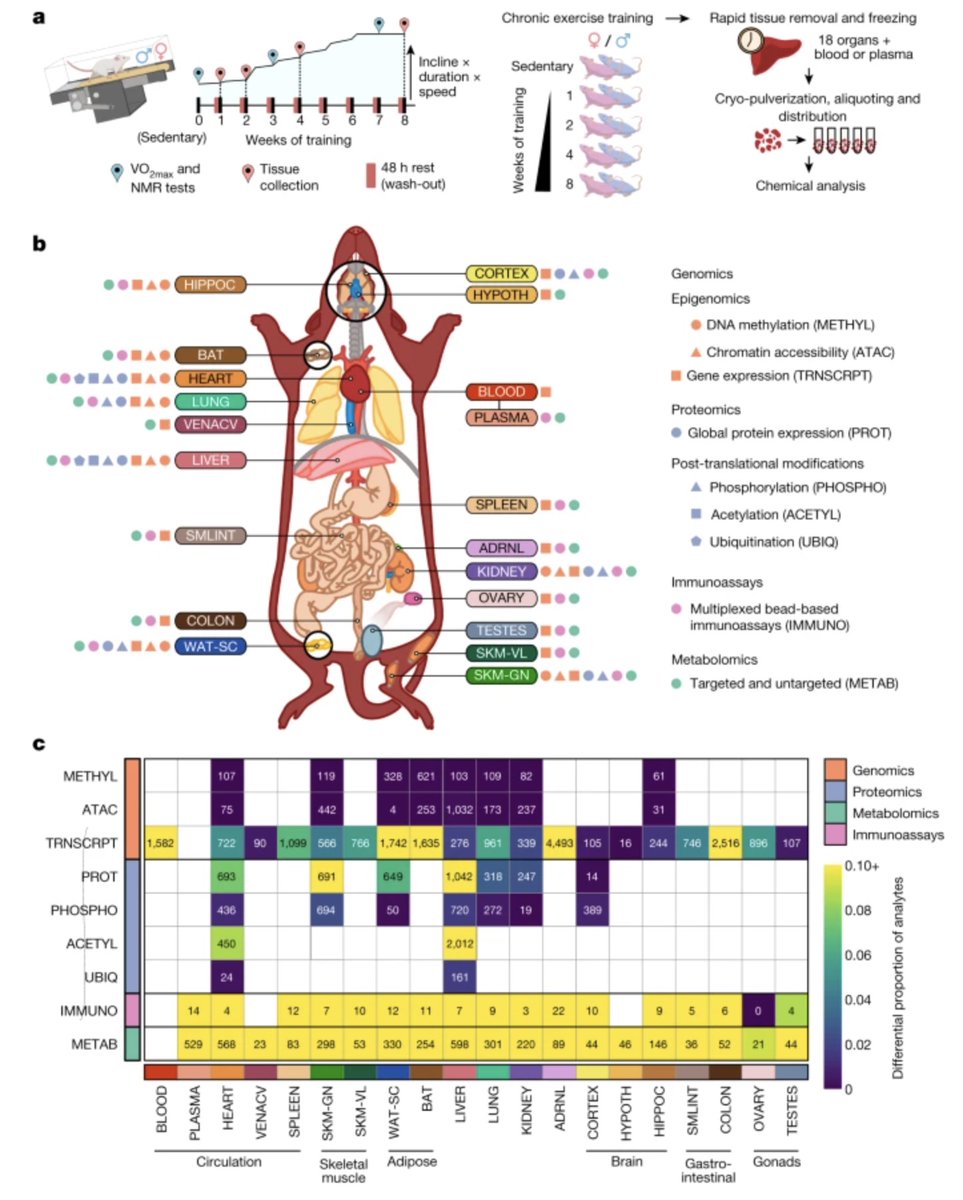
Exercise may be the single most potent medical intervention ever known. Its benefits in prevention outstrip any known drugs: 50% reduction in the risk of cardiovascular disease, 50% reduction in the risk of many cancers, positive effects on mental health, pulmonary health, GI health, bone health, muscle function. You name it. Exercise helps. In fact, the ability to exercise over long distances was likely key to our evolution as a species because the availability of densely caloric foods due to persistence hunting allowed our energy-avid brains to enlarge. And yet, we have had very little insight into the molecular basis of these magical effects...until now!
Published in yesterday's Nature and featured on the cover was work from our consortium that represents the culmination of a couple of decades of pitching ideas to the NIH, forming a consortium, planning experiments, executing those experiments, and analyzing data at unprecedented scale, all aimed at enhancing our understanding of the molecular transducers of exercise.
It was a major effort from so many in our consortium (playfully named MoTrPAC) and is the first landmark paper of many more to come. This first paper focused on the multi-tissue, multi-omics of treadmill exercise in rats. Specifically, we report the effects of eight weeks of treadmill running on the transcriptome, the epigenome, the proteome, the metabolome, the lipidome and the immunome of a broad range of tissues (in fact, 9,466 assays across 19 tissues, 25 molecular platforms, and 4 training time points).
The result is the most comprehensive molecular map of exercise ever created. At Stanford, my colleague @MWheelerMD and I co-lead the bioinformatics center and it was our team's duty and privilege to ingest the data, QC the data, help analyze the data, and make the data available to the world. Various tools available at our data hub allow you to explore the data, visualize it, and download it for your own use.
Have fun! And stay tuned for human data that will be coming.
So many people to thank who made this possible (see the paper for details). Special shout out to the primary analysts and authors: David Amar, Nicole Gay, & Pierre Jean Baltran.
Paper: https://t.co/0nhXdfhxx0
Data hub: https://t.co/NxTHsVdfRp
@hubermanlab What can we do during the perimenopause time period to help with symptoms (brain fog, interrupted sleep, weight gain and fatigue) besides optimization of diet, exercise, sleep, mental health.
@businessbarista AI support for case management/ social work. Identifies appropriate programs/ referrals for patients scrubs city website for up to date programs.
@hubermanlab Prevention of UTIs other than “proper hygiene” in individuals on/ not on certain medication classes (SGLT2i Dapagliflozin/ Empagliflozin) known to increase risk of UTIs.
@MrJonesSTRs@Levijameshere Pool companies/ pool cleaners will be main referral/ Yelp. Everyone in flip flops hangs out together :) Pool detection then refers out to another company for repair. Parter up/ Invest in repair company and it’s a win-win.
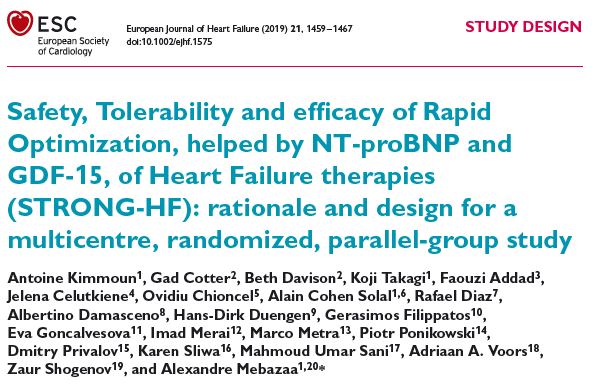
🚨STRONG-HF #RCT
-rapid sequence, high-intensity initiation/titration of #GDMT in combo with NTproBNP testing
vs
-usual care.
‼️ Terminated early for efficacy (180d☠️or HF🏥)!
Huge day for #GDMTworks & rapid sequence/simultaneous initiation. Congrats @AlexMebazaa & team!
Gaps in #GDMT for #HFrEF well documented.
Multiple reasons debated. Yet, concrete data on *WHY* remain elusive.
‼️ What if we had cardiologists review charts of their own patients, and report main reason *WHY* they didn’t prescribe a change in GDMT?
https://t.co/YSoe90JJI5
#FunctionNotFailure#HeartSuccess colleagues, what interventions/programs have been implemented in your center to increase #GDMT prescribing in-patient/ outpatient setting. What’s working? What didn’t? What have you learned along the way?