A thoughtful virtual tumor board tackles a problem we will see more often: UIR prostate cancer with Decipher 0.94/high risk but Artera low prognostic risk and a negative ST-ADT predictor. It frames the problem very well—but does not resolve it (and unlikely the authors' intention).
“Discordant” may be the wrong frame. Decipher is a 22-gene prognostic assay; Artera is a pathology-clinical AI platform with prognostic and predictive components. They estimate different things. A high-risk tumor can still be relatively ADT-insensitive.
The key inferential bridge is that high Decipher risk supports ADT because higher baseline risk yields greater absolute benefit if ADT’s relative effect is constant. The authors explicitly acknowledge that assumption. Artera sought to challenge that assumption.
So this is not simply Decipher versus Artera. It is (A) a risk model plus an assumed treatment effect versus (B) a treatment-effect model. The outputs should be translated into expected absolute benefit—with uncertainty—not compared as “high” versus “negative.”
The Artera result should not be overread. A negative predictive result means no clear average benefit was detected in that subgroup—not proof this patient receives zero benefit. Calling the subgroup “insensitive” is stronger than a probabilistic model supports.
The paper advises reviewing the raw Decipher score, not just its category. Yet the Artera treatment prediction is presented as binary. Without its continuous score, distance from threshold, interaction estimate, and CI, adjudication is inherently asymmetric.
The reports on pp 2–3 are prognostically worlds apart: 10-year DM 17.4% with Decipher versus 1.3% with Artera.
Also missing and key issue: were both assays performed on the same lesion, core, and tissue block? With multifocal disease and 7/12 systematic plus 2/3 targeted cores positive, spatial sampling could create apparent discordance.
The case is clinically tilted toward ADT: cT2b, GG3, ~60% pattern 4, ≥50% positive cores, plus substantial recurrence anxiety. A safety-first recommendation is understandable—but this is not a neutral stress test of biomarker-guided de-escalation.
To their credit, the authors default to randomized evidence. RTOG 0815 showed 10-year absolute differences of ~8% in biochemical failure, 4% in DM, and 2% in PCSM, without an OS benefit. That is the counseling frame: absolute benefit versus ADT burden.
Figure 3 is intuitive but causally hazardous. Population cumulative-incidence curves cannot identify which individuals were “overtreated,” “benefited,” or remained “undertreated.” Those are counterfactual response categories, not observed patient strata.
Simon level 1B and guideline recognition support validation, not prospective clinical utility. We still need paired testing, same-block analyses, UIR calibration, decision curves, and ideally randomized evidence that biomarker-guided care improves net benefit (RCTs in progress).
Bottom line: excellent paper for separating prognosis from prediction. But the answer is not to pick a winner. Until risk, treatment effect, uncertainty, and preferences are integrated quantitatively, more testing may yield more data—not better decisions.
This weekend's #ASCO26 sessions put a spotlight on key advances in urologic cancers. Here's a recap from a session, where Christopher Sweeney, M.B.B.S., Adelaide University, presented new data from the #ENZAMET phase 3 trial.
The talk explored whether the Decipher® Prostate Genomic Classifier can identify which patients with metastatic prostate cancer may benefit from adding the chemotherapy docetaxel to androgen deprivation therapy (ADT) plus enzalutamide (also known as triplet therapy), and which may safely avoid it.
| Primary Takeaway |
🔹 The #DecipherProstateTest identifies which metastatic prostate cancer patients may benefit from treatment intensification, and which can be safely spared chemotherapy, giving clinicians an actionable, evidence-based answer.
🔹 The ENZAMET findings build on prior validation in the STAMPEDE and CHAARTED trials, where Decipher Prostate identified patients most likely to benefit from adding docetaxel to ADT alone.
🔹 ENZAMET advances that evidence with the first demonstration that the test predicts chemotherapy benefit when added to doublet therapy (ADT plus an androgen receptor pathway inhibitor, like enzalutamide).
| Some Thank You's |
💙 We're grateful to Dr. Sweeney for sharing these important findings with the oncology community and for an ongoing commitment to improving care for the millions of men living with prostate cancer worldwide, including about 30,000 in the US who present with metastatic disease at diagnosis.(1,2)
💙 Thank you to everyone who joined the session and to the investigators, site teams, and participants whose contributions made this research possible.
| Additional Resources |
Learn more about the Decipher Prostate Genomic Classifier - https://t.co/6VCW4sx9ni
ENZAMET Trial Information - https://t.co/lNVWqagngG
STAMPEDE Trial Information - https://t.co/L8BeRIGLwU
CHAARTED Trial Information - https://t.co/iLkF5W8YOM
| References |
(1) https://t.co/Q5XE5pcH6e; https://t.co/IiAknUacvv
(2) https://t.co/XdMlZgAoet
Note: This article contains forward-looking statements, which involve risks and uncertainties. For more information visit: https://t.co/fQcKkGFugi
#DecipherUrologicCancers #ProstateCancer #PrecisionMedicine #ClinicalTrials #TeamVeracyte
🧪 This Bladder Cancer Awareness Month, discover STARBURST 1 (EORTC-2418), advancing precision research in muscle-invasive bladder cancer under the SPECTA platform.
Many thanks to the supporters contributing to this important research.
#EORTCgenitourinary#BladderCancer
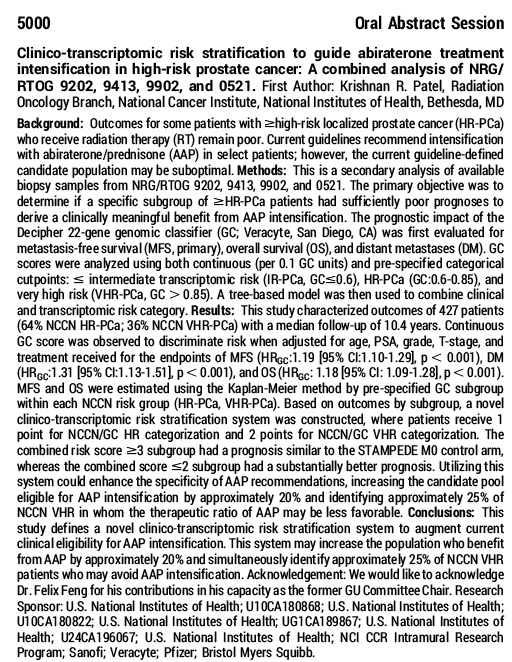
Fantastic podcast on a potentially practice-changing study evaluating doublet therapy for patients who meet high-risk, but not very-high-risk, criteria.
Congrats to @krishnan_patel and co-authors. Looking forward to the full publication! #PCSM#ASCO26#OncTwitter
#ASCO26 GU Oncology Spotlight 🚨
🔬 ENZAMET + Decipher | Part 2
Can genomics guide docetaxel intensification in mHSPC?
Outstanding presentation by @ChrisSweeney1.
@OncoAlert@ASCO
After Part 1, the key question was:
➡️ Can a genomic classifier identify which patients with mHSPC benefit most from adding docetaxel to ADT + enzalutamide?
🟦 Key result
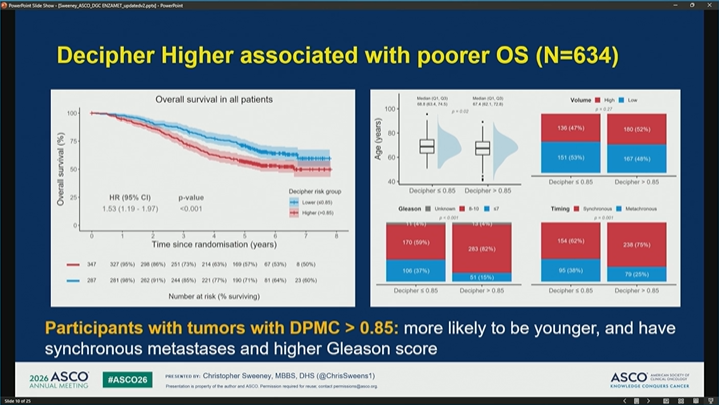
Patients with Decipher / genomic classifier >0.85 had worse outcomes with ADT + enzalutamide alone.
This suggests that high genomic risk captures a biologically aggressive subgroup not fully explained by clinical variables alone.
🟩 Docetaxel signal
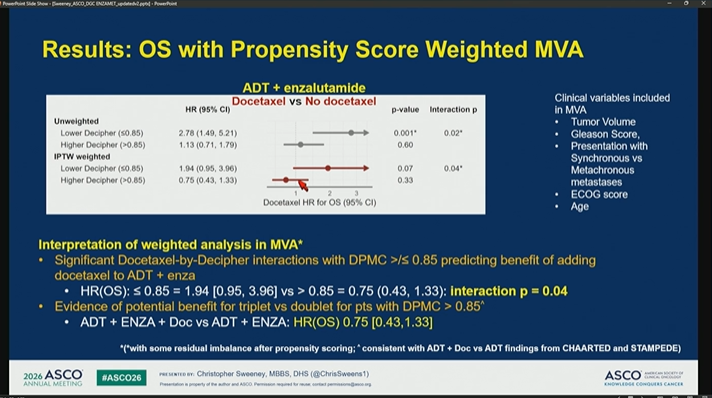
In propensity score–weighted analyses:
🔹 Decipher ≤0.85
Less evidence of benefit from adding docetaxel to ADT + enzalutamide
🔹 Decipher >0.85
Evidence of benefit from adding docetaxel to ADT + enzalutamide
Reported interaction signal supported a docetaxel-by-Decipher effect, suggesting Decipher may help identify who is more likely to benefit.
🟨 Low-volume disease matters
This is especially relevant because treatment intensification in low-volume mHSPC is often nuanced.
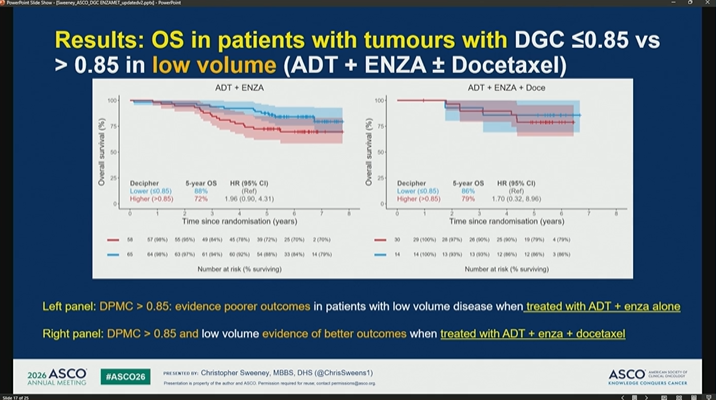
In the low-volume subgroup:
• Decipher >0.85 identified patients with poorer outcomes on ADT + enzalutamide alone
• outcomes appeared better when docetaxel was added
This could help refine a space where clinical decision-making is often individualized.
🟧 Secondary endpoints
The signal appeared consistent across several endpoints, including:
✓ progression-free survival
✓ PSA progression-free survival
✓ prostate cancer–specific survival
This strengthens the biological plausibility of the finding.
🟥 Important limitations
This is not a simple “test says yes/no” rule.
Caveats include:
• no randomization to docetaxel
• subgroup sample sizes are limited
• propensity weighting helps but cannot remove all bias
• global access to genomic testing remains an issue
• treatment decisions still require clinical context
💬 Clinical interpretation
Decipher >0.85 may identify patients with mHSPC who have:
➡️ poorer prognosis with ADT + enzalutamide alone
➡️ greater likelihood of benefit from adding docetaxel
Decipher ≤0.85 may identify patients with less evidence of docetaxel benefit — where avoiding chemotherapy could be reasonable in selected cases.
My take:
This is exactly the direction prostate cancer care needs to move:
Not just intensification for all.
But biology-informed intensification.
The future of mHSPC algorithms will likely combine:
✓ disease volume
✓ timing of metastases
✓ clinical risk
✓ genomic risk
✓ patient fitness
✓ toxicity tolerance
✓ access and preferences
The goal is to avoid both undertreatment and overtreatment.
#ASCO26 #GUOnc #ProstateCancer #mHSPC #PrecisionOncology #Genomics #Decipher #Docetaxel #Enzalutamide
Pleased to share our next #ASCO26@JCO_ASCO Simultaneous Publication
Neoadjuvant Sacituzumab Govitecan in Patients With Muscle-Invasive Bladder Cancer #SURE-01 Trial following our previous #SURE02
29% pCR rate with monotherapy supports TROP2 as a reliable target in MIBC
Biomarkers point to the Payload TOP1 effect rather than the Ab target @SanRaffaeleMI@MyUniSR@BrigidaMaiorano@vale_tateo@Anto_cigliola@CMercinelli@GiorgioBre et al.
https://t.co/598YYHHrPY
#ASCO26 GU Oncology Spotlight 🚨
🔬 ENZAMET + Decipher Prostate Classifier
Genomics to refine docetaxel intensification in mHSPC
As always, an outstanding and very clear presentation by @ChrisSweeney1.
Thank you, Dr. Sweeney.
@OncoAlert@ASCO
In metastatic hormone-sensitive prostate cancer, treatment intensification has changed outcomes.
But one of the hardest clinical questions remains:
➡️ Who truly needs more intensification?
➡️ Who benefits from adding docetaxel to ADT + enzalutamide?
➡️ Can biology help us avoid both undertreatment and overtreatment?
🟦 Why ENZAMET matters here
ENZAMET was an investigator-sponsored study evaluating:
• ADT + standard non-steroidal antiandrogen
vs
• ADT + enzalutamide
Importantly, the study later allowed planned early docetaxel after CHAARTED, creating a unique opportunity to explore:
🧬 ADT + enzalutamide ± docetaxel
This is highly relevant to modern mHSPC decision-making.
🟩 Why Decipher is important
The Decipher Prostate Genomic Classifier uses a 22-gene mRNA signature.
It is designed to capture biologic features linked to:
🔹 metastatic potential
🔹 prognosis
🔹 disease aggressiveness
🔹 pathways such as DNA replication/repair, cell motility, and growth biology
In this analysis, higher Decipher scores were associated with poorer overall survival.
🟨 The key hypothesis
Patients with tumors showing Decipher >0.85 may represent a biologically higher-risk group.
The study asked:
➡️ Could this group derive greater survival benefit from adding docetaxel to ADT + enzalutamide?
And conversely:
➡️ Could patients with Decipher ≤0.85 avoid docetaxel without losing meaningful benefit?
🟧 Why this question matters clinically
Docetaxel can be effective.
But it also adds:
• toxicity
• clinic visits
• supportive care needs
• neuropathy risk
• infection risk
• quality-of-life impact
• access and feasibility issues
So the goal is not simply to add docetaxel to everyone.
The goal is to use clinical + genomic risk to better personalize treatment.
🟥 Take-home from Part 1
This is exactly where prostate cancer care is heading:
Not only asking:
“Can we intensify?”
But asking:
“Who needs intensification most — and who can safely avoid it?”
Part 2: results + clinical interpretation 👇
@DrChoueiri 🇺🇸@hoperugo 🇺🇸 @matteolambe 🇮🇹 @TiansterZhang 🇺🇸 @CathyEngMD 🇺🇸 @stolaney1 🇺🇸 @montypal 🇺🇸 @tompowles1 🇬🇧 @brian_rini 🇺🇸 @cdanicas 🇪🇸 @NiuSanford 🇺🇸 @amerseburger 🇩🇪 @GlopesMd 🇺🇸 @Icro_Meattini 🇮🇹 @PGrivasMDPhD 🇺🇸 @DrYukselUrun 🇹🇷
#ASCO26 #GUOnc #ProstateCancer #mHSPC #PrecisionOncology #Genomics #Decipher #Docetaxel #Enzalutamide
Veracyte is proud to announce new findings from an analysis of patient samples from the ENZAMET trial, an international, randomized Phase III study conducted by the Australian and New Zealand Urogenital and Prostate Cancer Trials Group (ANZUP).
The analysis demonstrates that the Decipher® Prostate test identifies which men with metastatic prostate cancer may benefit from adding the chemotherapy docetaxel to standard hormonal therapy (also known as triplet therapy), and who may safely avoid it, providing the first Level 1B evidence for a genomic test guiding this decision.
| Key Findings |
The new ENZAMET trial results provide evidence for genomic-guided decisions on triplet therapy in advanced disease:
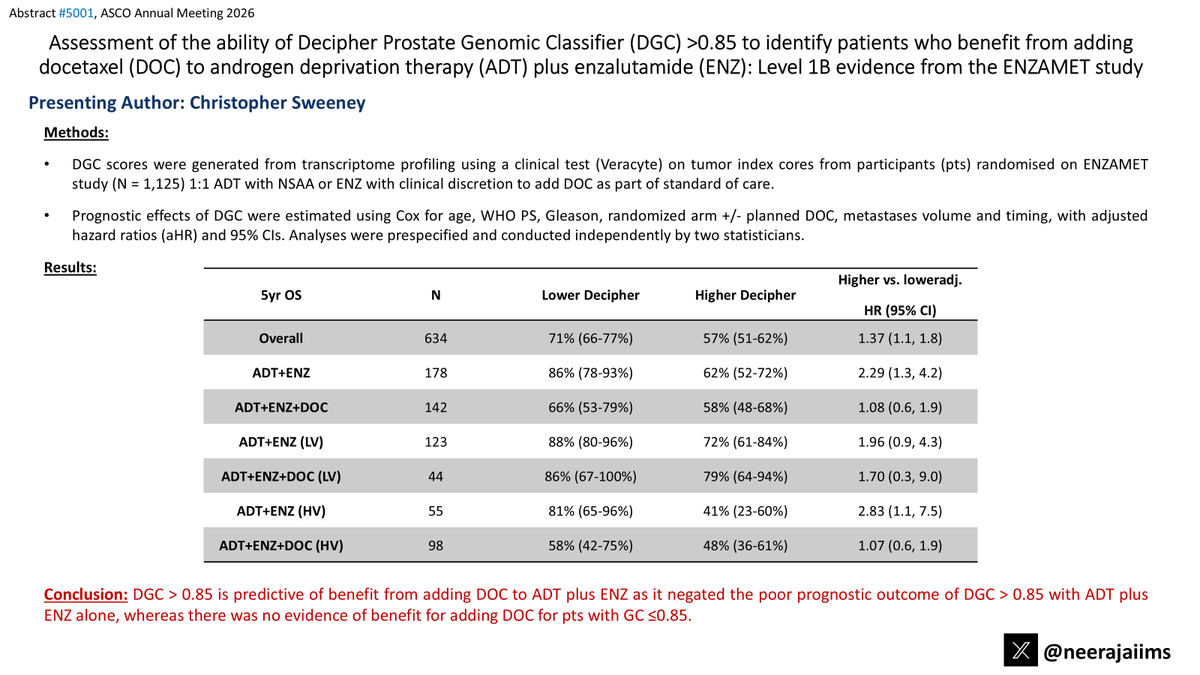
🔹Improved outcomes guided by Decipher Prostate: Patients with higher Decipher scores (>0.85) who received triplet therapy had clinically meaningful better survival compared to those on standard hormonal therapy alone.
🔹Patients can be spared from chemotherapy: Patients with lower Decipher scores showed no benefit from adding chemotherapy, suggesting it may be safely avoided.
🔹 Overcoming aggressive disease: Patients with higher Decipher scores who received triplet therapy had more aggressive disease features, yet achieved comparable survival to lower-risk patients on doublet therapy, suggesting chemotherapy offset the poor prognostic effects of aggressive disease biology.
Prof. Christopher Sweeney, MBBS, South Australian Immunogenomics Cancer Institute, Adelaide University, will present the ENZAMET trial results at the #ASCO26 Annual Meeting.
| Presentation Details |
📅 Date: Saturday, May 30 ⏰ Time: 1:15 PM CDT
📍 Location: Prostate, Testicular, and Penile, Hall D1, Abstract 5001
| Resources |
🤝 Visit Booth 13069: Stop by to connect with #TeamVeracyte and learn how the Decipher Prostate Genomic Classifier test can assess risk of metastasis or metastatic progression in patients with localized or advanced prostate cancer.
🔗 Event information - https://t.co/ctQ66JYGC8
📄 Read full press release - https://t.co/jkoowOJJL5
🧬 More on the ENZAMET trial - https://t.co/lNVWqagngG
#DecipherUrologicCancers #ProstateCancer #PrecisionMedicine #ClinicalTrials #CancerDiagnostics
Note: This article contains forward-looking statements, which involve risks and uncertainties. For more information visit - https://t.co/fQcKkGFugi
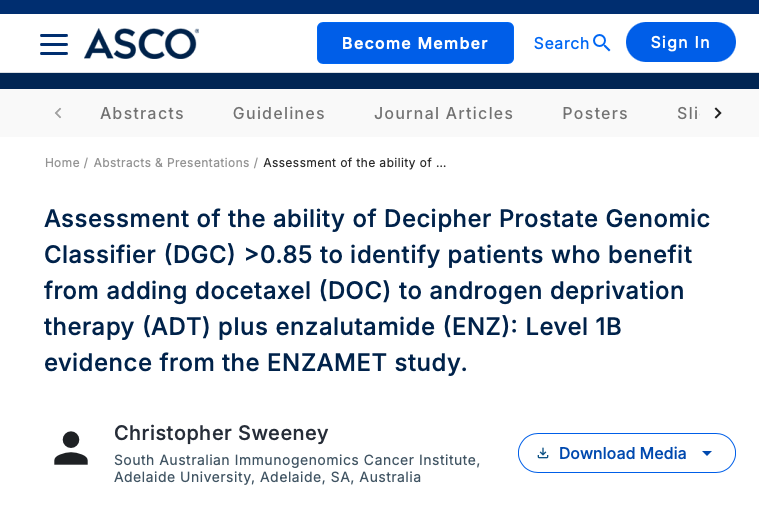
Assessment of the ability of Decipher Prostate Genomic Classifier (DGC) >0.85 to identify patients who benefit from adding docetaxel (DOC) to androgen deprivation therapy (ADT) plus enzalutamide (ENZ): Level 1B evidence from the ENZAMET study. #ASCO25 Abstract
https://t.co/ZzIAEeM3F3
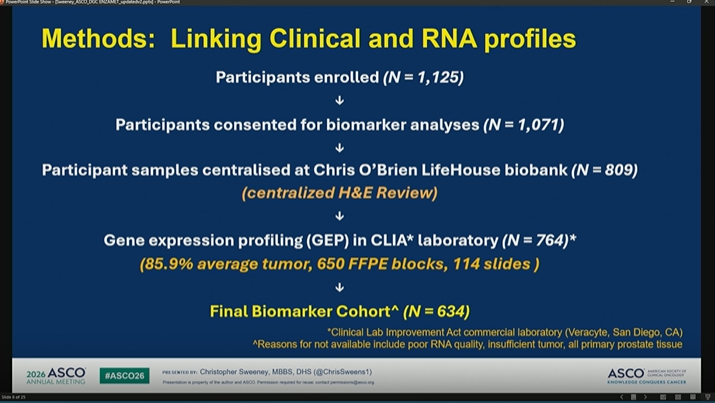
This ENZAMET biomarker 🎯analysis evaluated whether Decipher Genomic Classifier (DGC) scores predict benefit from adding docetaxel💊 (DOC) to androgen deprivation therapy (ADT) plus enzalutamide (ENZ) in metastatic hormone-sensitive prostate cancer. Among 634 patients, high DGC scores (>0.85) were associated with worse overall survival on ADT plus ENZ alone, but this adverse prognosis was negated by adding DOC.
Findings suggest DGC may identify patients most likely to benefit from triplet therapy, particularly in high-volume disease.
@ChrisSweens1@ChrisSweens1@MartinStockler@anis_a_hamid@AzadOncology@Davicioni@AttardLab@Prof_IanD@OncoAlert 🚨
@Silke_Gillessen@AOmlin@weoncologists
We received Medicare coverage for our #TrueMRD Monitoring Test for patients with muscle-invasive bladder cancer (MIBC).
Available for clinicians to order on June 1, 2026, this marks the commercial launch of Veracyte's first molecular residual disease (#MRD) offering and the only commercially available truly whole-genome MRD test to come to market.
🔗 Read the full press release - https://t.co/AoRjV488BX
🔗 Learn about the TrueMRD Monitoring Test for MIBC - https://t.co/THT5ejW7Nn
#MuscleInvasiveBladderCancer #BladderCancer #WholeGenomeSequencing $VCYT
Disclaimer - https://t.co/fQcKkGFugi
Looking forward to presenting our work at the podium #AUA2026@AmerUrological exploring how TGFβ activity may shape fibroblast infiltration & immune exclusion in MIBC with implications for therapeutic strategies.
Grateful for our collaboration with
@snseyedinMD@Decipher_VCYT@Veracyte@Davicioni@JoepJdeJong@CleClinicMD
📅 Saturday, May 16
🕞 3:30–5:30 PM
🚪 Room 206
👉 PD15: Bladder Cancer Invasive 3
Neoadjuvant Sacituzumab Govitecan plus Pembrolizumab, Followed by Adjuvant Pembrolizumab, in Patients with Muscle-Invasive Bladder Cancer (SURE-02): A Single-Arm, Phase 2 Study - Beyond the Abstract https://t.co/RhGDgqRxPt
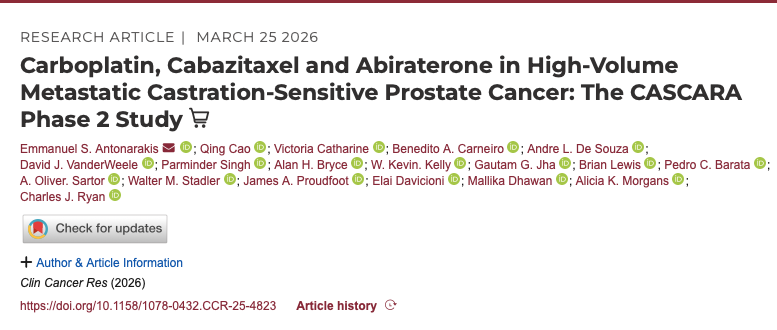
Carboplatin, Cabazitaxel and Abiraterone in High-Volume Metastatic Castration-Sensitive Prostate Cancer: The CASCARA Phase 2 Study
https://t.co/HdA6e7JSYz
This multicenter phase 2 trial evaluated a quadruplet regimen of cabazitaxel, carboplatin, abiraterone, and ADT in high-volume mCSPC. Among 61 patients, 12-month PSA progression-free survival was 84.6% and overall survival 94.8%, with a 66.7% complete PSA response rate. Toxicity was manageable. Unexpectedly, HRR-mutated patients had poorer outcomes.
The regimen appears feasible and active, supporting further evaluation in randomized trials. #ProstateCancer
@EAntonarakis@AlanBryce9@PBarataMD@Davicioni@CaPsurvivorship@charlesryanmd@OncoAlert 🚨
@Silke_Gillessen@AOmlin@weoncologists