“To be successful at anything, you don't have to be special. You just have to be what most people aren't…consistent, determined and willing to work for it. No shortcuts."
~ Tom Brady
We all know AI doesn't want to cite any random site.
If they give out bad information, it makes them look bad.
So what trust signals do they care for? Which ones matter more?
And how does that change per platform?
Check out the results.
Just like SEO, some GEO tactics have a higher ROI than others.
And some are also easy to execute, while others may be harder.
So the real question is, which efforts have the highest ROI and are the easiest to execute? Well, you no longer have to worry.
Here's data based on 100 marketers who practice GEO.
Claude Fable 5 is the most capable model ever shipped, and the biggest mistake you can make is using it like every other model.
The opportunity is figuring out how to apply it to your business before anyone else in your niche does.
Here's how:
00:00 Fable 5 & Mythos 5 Are Out
00:13 The Mythos Class Model Explained
00:57 Autonomous Revenue Ops Engine
02:30 Visual Competitor Analysis
03:09 Enterprise Security As A New Revenue Vertical
04:17 Build A Unified Intelligence Bot
05:01 Autonomous Research To Strategy Pipeline
06:08 Automated Implementation Accelerator
07:08 Why You Should Explore This Now
A toothpaste company has quietly killed the entire market research industry and nobody is talking about it.
Colgate published a paper showing you can predict real purchase intent at 90% accuracy by simply asking LLMs to roleplay customers.
And this is beyond insane.
If you ask an AI, "Rate this product from 1 to 5," it gives safe, middle-of-the-road garbage.
So researchers invented a method called Semantic Similarity Rating (SSR).
Instead of asking the AI for a number, they asked it to roleplay.
They gave the LLM a demographic profile. They showed it a product concept. And they asked it to write down its raw, unfiltered thoughts.
Then, they used a semantic model to translate those written thoughts into a numerical score.
The results are staggering.
Tested against 57 real corporate surveys and 9,300 actual human responses, the synthetic AI consumers matched real human buying behavior with 90% reliability.
They perfectly mirrored how different age brackets and income levels react to price changes.
And they provided detailed, qualitative feedback that was deeper and more critical than what actual humans wrote.
This destroys the economics of traditional market research.
You don't need to wait a month to see if a product will sell.
You can simulate 1,000 hyper-targeted customer interviews overnight.
You can A/B test pricing across every demographic instantly.
Claude Mythos for Marketing is unbelievable.
You just connect it to your brand, and it generates hundreds of perfect videos.
Then you can post to hundreds of already warmed up social media accounts.
Then you just watch users come in 🤯
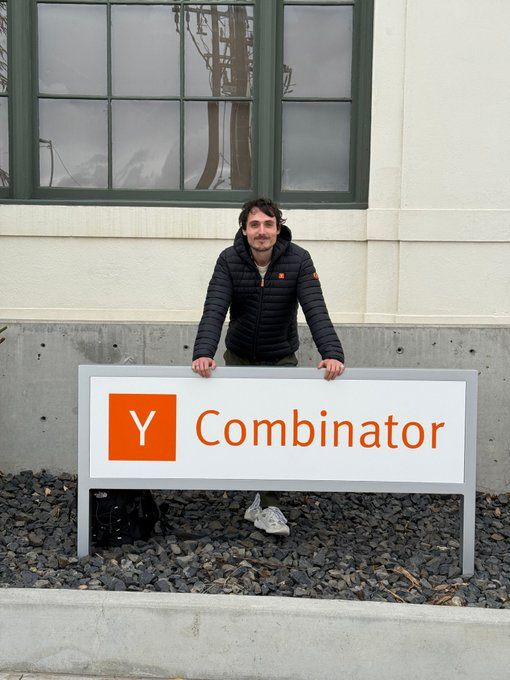
4 years ago | joined Goldman Sachs Bangalore. used to stare at photos of the NYC building.
this week I stood outside it. as a founder, not an employee.
pitched a $400M Al company. got offered investment. hiring for US expansion.
all because I took one call. I want to build.
We went from 0 to 2,200 paying customers in under a year by following @ycombinator's 15 rules:
1/ Do things that don't scale. Get your first 10 customers by hand.
2/ Launch now, not when it's "ready". A mediocre product in front of real users teaches you more in a week than 6 months of polishing in the dark.
3/ Charge from day one. If nobody will pay, you don't have a startup, you have a hobby.
4/ Talk to users every single day. The roadmap you need is sitting in your customers' heads, and they'll hand it to you for free
5/ Always hunt the 90/10 solution. For almost any feature there's a way to capture 90% of the value with 10% of the effort.
6/ There are only two real jobs: write code and talk to users. Everything else (conferences, press, VC coffees, corp dev calls) is fake work.
7/ You pick your customers as much as they pick you. 10 users who love you beat 1,000 who kind of like you.
8/ Growth is an output, not a strategy. Grow before product market fit and all you're buying is churn.
9/ Do less, really well. Pick one or two metrics and judge every task against them.
10/ Know if you're default alive. Paul Graham's question: on current growth and current burn, do you reach profitability before the money runs out?
11/ Don't hire until it hurts. Headcount is not progress, it's burn. Every great startup was embarrassingly small for embarrassingly long.
12/ Momentum is the only real moat in year one. Ship something every week, even something tiny.
13/ Every great startup is badly broken at some point. The game isn't avoiding fires, it's how fast you put them out. Again. And again
14/ Ignore your competitors. Startups die of suicide, not murder. In year one, the only company that can kill yours is your own
15/ Startups rarely die from running out of money. They die because the founders fall out. Brutal honesty with your cofounder is the cheapest insurance you'll ever buy
Good luck !
AI engines "read" differently than human visitors — they look for:
- information density
- direct answers
- structured entities
Focus on clean semantic HTML, verifiable facts, and helping reasoning engines to crawl, parse, and verify your website content.
https://t.co/Dbr17HM6D7
Introducing Cofounder's new marketing department.
Cofounder sets up your marketing strategy, generates content (video, image, text), connects to channels, runs automatically, and posts on a schedule.
I just realised I spent just 37k INR to build over 50 full stack functional apps on @emergentlabs and 2 of these apps have gave me over 56k INR revenue and 3 of them with 100+ active users.
I would have never imagined me building fullstack apps by myself being a non-tech guy.
This AI era is going to be insane if you know how to use them.
While drinking my coffee this morning, I went to my blog to read what my agent wrote for me.
I was shocked to find this one.
It literally came up with the idea of making a list of bootstrapped SaaS based on founders I interviewed on my podcast.
I didn't ask it to. It had this super cool idea on its own:
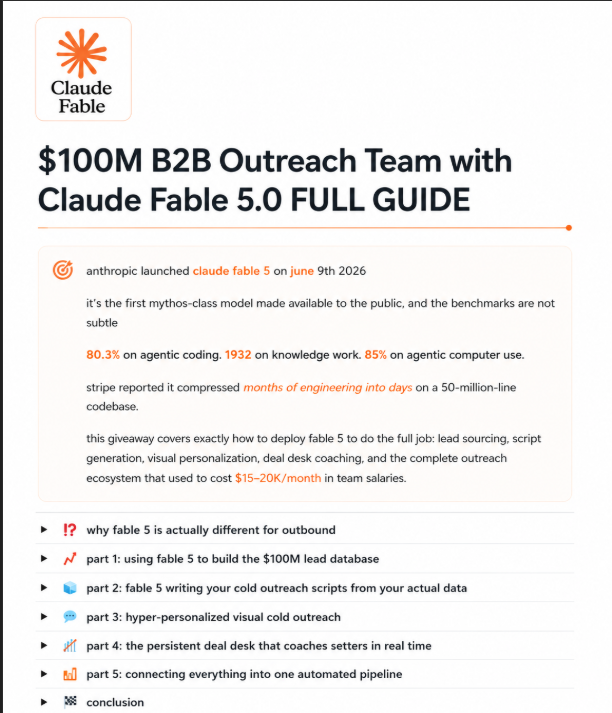
claude fable 5 launched 72h ago and we're already rebuilding our outbound operations on top of this mythos model...
- lead sourcing
- script generation
- D100 personalization
- CRM management
- automations
- analysis
EVERYTHING 10 times better than opus
so i documented how to deploy it as a full B2B outreach team that does EVERYTHING for you...
with a special attention to what's ACTUALLY different about this tool
here's EVERYTHING that's inside:
- the 5-database parallel scrape that produces intent-scored lead lists nobody else has
(google maps, crunchbase post-funding, linkedin job changers, reddit hand-raisers, X engagement. all in one session. 4.8% reply rates vs 1.5% from apollo.)
- the script generator that analyzes your entire CRM and call history to find conversion patterns you didn't know existed
- hyper-personalized visual outreach using fable 5's actual vision capability
- the persistent AI database that coaches setters in real time using your accumulated institutional knowledge
(new setters went from 22% to 41% close rate in 90 days because they had your best closer's brain sitting next to them on every call)
all backed by 100s of qualified meetings booked and $4.8M+ added to our clients' pipelines
like + comment "FABLE" and i'll DM you the full breakdown
(must be following + repost for priority access)
19 revenue-generating AI services you can sell to clients:
1. Speed-to-lead: Responds to every inbound lead in seconds, not hours. First to reply wins the deal far more often.
2. Missed-call text back: Instantly texts back every missed call so a busy line never becomes a lost customer. Recaptures revenue that used to hit voicemail and vanish.
3. AI receptionist (24/7 call answering): Answers, qualifies, and books calls around the clock. Captures after-hours demand competitors sleep through.
4. Lead qualification systems: Scores and routes inbound leads so sales only touches the ones ready to buy. More closes per hour of selling.
5. Outbound prospecting agent (AI SDR): Finds, enriches, and personalizes cold outreach to net-new accounts. Builds pipeline that didn't exist before.
6. DM-to-sale social closer: Turns Instagram, LinkedIn, and Facebook DMs and comments into booked calls. Monetizes the audience they already built.
7. Quote automation: Generates accurate, branded quotes in minutes instead of days. Faster quotes close at a higher rate.
8. Abandoned-quote / cart recovery agent: Auto re-engages prospects who started a quote or checkout and dropped off. Recovers sales that were already 80% closed.
9. Sales follow-up workflows: Runs the full follow-up cadence on every lead automatically, chasing quiet quotes and proposals until it's a yes or a no. Most revenue lives in the follow-up nobody does.
10. Appointment booking + no-show reminders: Books prospects and reminds them until they show. Fewer empty slots, more revenue per booked hour.
11. Proposal & contract generation: Drafts personalized proposals and contracts on demand. Shortens the gap between interest and signature.
12. Bid / RFP response agent (B2B): Drafts fast, personalized, winning bid responses. More bids at higher quality means more contracts won.
13. AI upsell & cross-sell engine: Triggers the right add-on offer at point of sale or post-purchase. Lifts average order value on every transaction.
14. Reorder / replenishment agent: Predicts when a customer is due to rebuy a consumable or renew, then prompts them at the right moment. Manufactures repeat revenue.
15. Referral-mining agent: Identifies happy customers and automates the referral ask at peak satisfaction. New revenue at near-zero acquisition cost.
16. Win-back / churn-save agent: Detects at-risk and lapsed accounts and fires save offers. Protects and recovers recurring revenue.
17. CRM reactivation campaigns: Mines the dead leads and dormant list already sitting in their CRM and re-engages them with targeted offers. Found money from a database they already paid for.
18. Review request automation: Asks for reviews at the moment of peak happiness. More reviews means more trust means more sales.
19. Invoice & payment follow-up: Chases unpaid invoices until the cash hits the account. Collects revenue they already earned but never received.
Remember: clients will ALWAYS pay more for a solution that makes them more money than one that only saves them time.
“don’t train your own model” is common ai advice. it's wrong. your token bill's the proof.
today, we’re excited to launch castform into open preview. castform is the easiest way for you to train your own model, on your own data.
open-weights models are performant and much cheaper. when trained on your task & proprietary data, they beat closed models. the thing standing between you and that was weeks of plumbing & years of ml expertise.
with castform, model training is as simple as prompt engineering. @castformai
bring your agent traces or raw corpora. castform turns it into training data, picks the right algorithmic recipes, manages gpus, and gives you an ide to watch and chat with your model as it learns.
see what you can build with castform👇
🚨HUGE UPDATE 🚨I'm thrilled to announce I'm now teaching AI visibility alongside @Kevin_Indig, @lmckenzie_16, @ritacidre and @katyvpowell through @semrush.
The AI Search OS. Five courses. 41 lessons. Free.
Most brands are still playing the wrong game.
Free. Go get certified → https://t.co/VVVxfAsLYJ
#SemrushPartner
Price of gold in Dubai is ₹12,110 per gram. Price of gold in India is ₹15,500 per gram. That is a ₹3,390 difference per gram.
Buy ₹10 lakh worth of gold in Dubai. Sell it in India. Keep ₹2.8–3 lakh in profit.
So why isn't everyone flying to Dubai every month with empty suitcases? 🧵
1. Most people find this rule and think they are done:
Duty-free baggage allowance up to ₹75,000. Problem solved.
Except that allowance does not apply to gold bars, gold coins, gold biscuits, or silver bars.
The rules for those are completely different.
2. Here is what the rules actually say:
The duty-free allowance applies only to gold jewellery and even that has strict gender-based limits.
Male passenger: up to 20 grams, maximum value ₹50,000. Female passenger: up to 40 grams, maximum value ₹1,00,000.
Anything above these limits on jewellery attracts customs duty immediately.
For gold bars and coins there is zero duty-free allowance. You pay customs duty from gram one. Every single gram.
3. Now run the actual numbers.
Standard customs duty on gold bars and coins brought from abroad: up to 15% or higher.
₹10 lakh worth of gold bars brought into India: customs duty of approximately ₹1.5 lakh.
Add your trip cost of ₹58,000.
Total cost: ₹2.08 lakh.
Your ₹2.8–3 lakh profit just became ₹70,000–90,000 at best before accounting for making charges, price fluctuations between purchase and sale, and the time value of your money tied up in the transaction.
The arbitrage disappears almost entirely once you follow the law.
4. And if you decide not to follow the law:
Indian Customs will seize your gold entirely. Impose penalties of up to 100% of the gold's value. And arrest you under the Customs Act.
The penalty for getting caught is not a fine. It is losing everything plus imprisonment.
5. There is one exception worth knowing.
Passengers who have stayed abroad for more than 6 months qualify for concessional duty rates.
Even then the maximum they can bring is 1 kg of gold after paying the concessional duty.
For a short-trip tourist flying Dubai and back it is economically unviable at every price point when done legally.
6. Why is Dubai gold cheaper in the first place?
India imposes high import duties and GST on gold specifically to protect foreign exchange reserves and discourage excessive gold imports India is the world's second-largest gold consumer and gold imports put significant pressure on the current account deficit.
Dubai has minimal taxes on gold, which is precisely why it became a global gold trading hub.
The price gap exists because of tax policy. And Indian Customs exists precisely to make sure that gap cannot be arbitraged by tourists.
7. The bottom line:
Dubai gold is cheaper. The price difference is real. The profit opportunity on paper is real.
The customs department has seen every version of this spreadsheet before you built yours.
They designed the duty structure specifically so this trade does not work for short-trip tourists.
The only people making money on Dubai gold arbitrage are licensed importers operating at institutional scale with formal import documentation not tourists with an extra cabin bag.
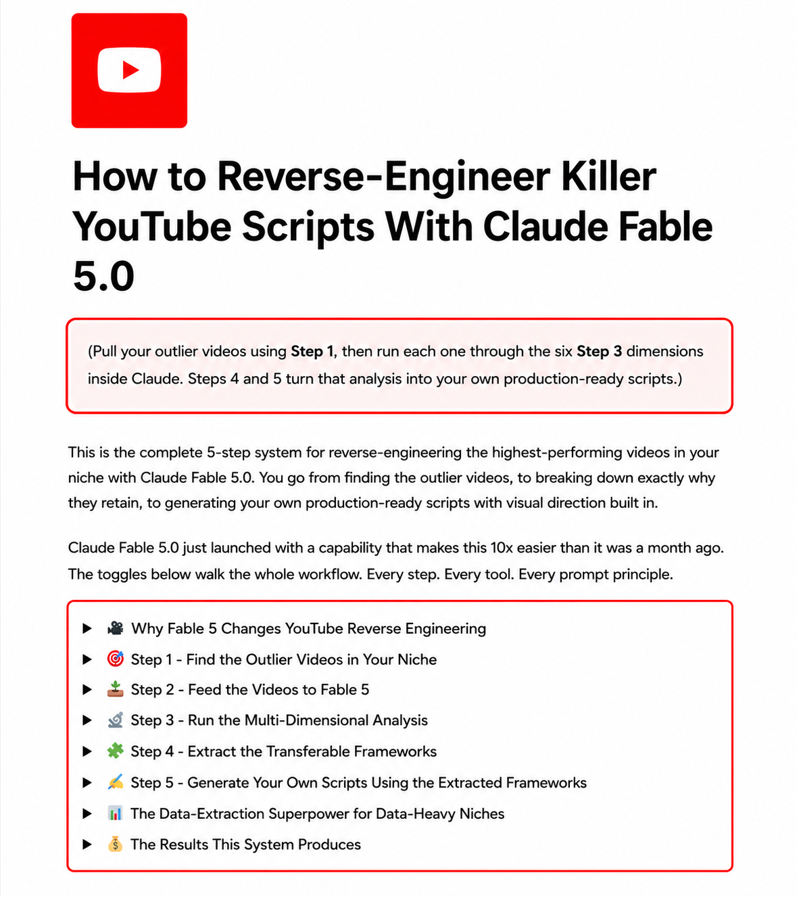
i've been testing claude fable 5.0 to reverse-engineer the BIGGEST faceless youtube channels in the trendiest niches
and the results have been absolutely insane.....
it analyzes the pacing, format, angle, and hooks with 10x better vision and intelligence than opus 4.8
so i've decided to document the ENTIRE scriptwriting system i'm using with it...
here's what's included inside the guide:
> how to find the right outliers
(manually, claude cowork to scrape winners, or nexlev mcp to surface sub-50k channels pulling 200k+ views)
> how to feed a video to fable 5
drop the link if you have the transcript api connected, or feed it transcript + title + thumbnail + mp4 file. transcript alone give it massive analytical power though.
> the 6-dimension analysis
hook structure, pacing map, curiosity gap architecture, foreshadowing, audience vocabulary, and visual-script sync (mapping how the cuts move with the script, only fable 5 sees this)
> extracting the transferable frameworks
the hook formula, pacing template, and payoff structure that carry across every video in the niche
> generating your own scripts
fable 5 writes in the outlier's psychological pattern with original content, annotated with visual direction notes for the edit
> the data-extraction bonus
it pulls exact figures off charts in research pdfs. "researchers found results" becomes "the 2024 cohort study, 3,847 participants, 34.7% reduction"
all backed by 7,000+ scripts written across 50+ niches
and the methodology behind 150,000,000+ views.
and for 24h, it can be ALL yours for free.
like + comment "SCRIPTS" and i'll send it over
(must be following + RT for priority access)
May I remind you
> One person co
> Haven't hired yet
> Didn't start YC batch yet
> Money hasn't even landed yet
> Didn't even ship the most interesting APIs yet
> And yet, 10 people migrated to us in the past few days
Looking forward to stepping into the arena.
BlogPosting and Article schema are being used by almost 10 million websites
schema is not dead. Far from it, just like SEO is not dead...
Google and https://t.co/SIJxIH1LMc just announced the schema usage statistics dataset. They are using Googles infrastructure to inspect websites, and check what schema types are being used..
What does this mean for you? It gives you an indication of what the most popular schema types are, and can give you a pointer to where you should be headed when it comes to schema.
If you are doing seo, and building out your product pages and blog articles and service pages, you can use the data to see what schema types are trending...
I use either article or blogposting schema on all my blogposts. I find the most relevant entities, and build out the entity map for the articles, inside the schema.
Im using https://t.co/ecF53fWj7M to do this, as it crawls and analyzes the top10 search results for me..
Read the blogpost here:
https://t.co/NqimZh7j87
#seo #schema #jespernissenseo