@synth@spaceship 🚨 Due to a technical glitch on your end (confirmed by support), 1200–1400 of my domains were pushed into redemption. Websites & services are down, massive trust & business loss. I moved 100s of premium domains to Spaceship (even bought one at $6K).
The difference between profitable domain investors and strugglers isn't picking better domains.
It's portfolio management.
Research reveals that systematic approaches consistently outperform gut instinct.
Full analysis: https://t.co/NEQED9lZAa
Today, we're announcing the launch of our Pending Review self-serve system, a powerful tool designed to simplify the domain review process.
Quickly and independently process pending review domain names! Here's how it works...
https://t.co/sFHcuemYhr
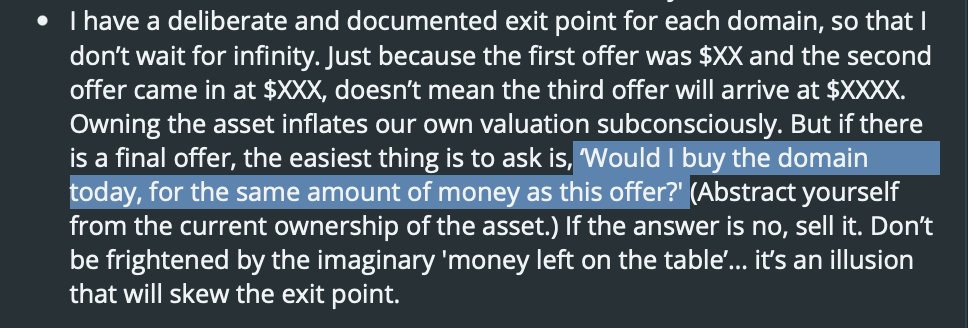
Just spotted something I wrote back in 2017. It took me a while to wrap my head around this back when I first started investing...
"But if there is a final offer, the easiest thing to ask is, ‘Would I buy the domain today, for the same amount of money as this offer?"
Most of us think about opportunity cost when buying a domain, but rarely when it comes to a potential sale (having an offer on the table).
Yet when it comes to opportunity cost of capital, rejecting a legitimate purchase offer is equivalent to acquiring the name again at that offered price - because in that decision, you have chosen the name over having that amount of money.
So here's an example:
Your domain is priced at $15k BIN - and an offer comes in for $10k. (Let's assume commission is 15% at this particular marketplace)
The buyer says they are maxed out, can't go any higher and it's their final offer. So you assess the probability that they are bluffing or think maybe they could go higher. Maybe you'll feel that you don't mind losing the sale as there is potential for a similar offer in the future.
But then you ask yourself: right now, would I pay $8500 ($10k less 15% commission) for this domain myself?
Because if you flat out decline that offer, that's effectively what you're doing - choosing to keep the capital locked in the domain, with the hope that it will reach $15k in the future. It's like placing a bet that this particular name will make the additional $5k in a shorter time span than could be achieved through reinvestment.
It's also a bet against other opportunities, such as replacing it with 5-10 other similar domains - or even against having $8500 in an alternative investment such as bitcoin.
There's obvious nuances when it comes to making a decision to accepting an offer on a domain:
- As a seller, you have an inside perspective on previous offers, inquiries, traffic and potential demand of the domain.
- You might have an understanding of the current bidder's situation/finances - and you'll make a probabilistic assessment of a higher potential offer within current negotiations or the near future.
- There's likely no way to buy back the same name once you've sold it, as it's a unique item and a retail buyer will have bought it to use it.
- Your rejection might be strategic, because you believe the domain is riding a market trend and patience will work in your favour.
- There is a time cost to replacing the inventory, especially if you don't have other purchases lined up.
- The domain might have been extremely hard to obtain, and replacing it like-for-like has a financial cost/value in itself.
- You might be attached to your best domains as trophies and have emotional/strategic goals set for specific price targets.
- You have more cash-flow than you need - and more capital than you can deploy into other names.
But rejecting an offer on any domain is a choice, and it impacts the opportunity cost of your capital:
- Your capital stays stuck in the domain (the amount of the rejected offer minus any commissions)
- In that moment, you make a bet for a higher price in the future - and can't reallocate that rejected capital to buy more domains.
- The money you receive today is also more useful and valuable than receiving the same amount in the future (I have written about this before regarding LTOs).
- Future offers aren't guaranteed and sometimes end up coming in lower - something I've regretted many times in the past.
And yet, I'm sure that this strategy will divide opinions in the investment community...
Not everyone will agree with accepting offers. Many will only use BIN or set rigid minimums - negating the need to deal with decisions like these. And other investors have an investment-thesis to extract the maximum possible value from each domain - whatever the cost to their wider portfolio.
And the aesthetics aren't great. Accepting offers (based on opportunity cost) won't allow you to break any records... or receive the same praise as a successful moonshot. It might even do the opposite and leave your ego feeling deflated - and many will call you paperhanded or weak. They'll tell you that you undersold. Future buyers might also weaponise this flexibility against you if they find out.
But keeping capital tied up stops it from compounding and being redeployed into more domains. And retail price-level offers are rare for most domains - you might be able to get quick liquidity at wholesale, but domains are largely illiquid assets when it comes to achieving retail prices. Taking offers on inventory-level names will allow you to reinvest and compound faster (both capital and learning) - which is especially important for new domainers.
This game is all about risk and there's no perfect way to play it. It's hard to find a balance between maximising upside on an individual sale whilst maintaining wider portfolio performance. I am also a lot more aggressive with the top 10% of my names today vs. 7 years ago. But when I have a reasonable offer for one of the remaining 90% of my domains, I still always ask myself: Would I pay this price right now to keep it - and is that the optimum choice for my portfolio?
@ppcbz That’s because your traffic, and data is being diverted to sell cheaper names or gtlds, why would I give you $48k when I can buy same keyword different extension for $1.99. The path is being exploited to upsell internal services, you signed away your traffic, and data.
GoDaddy is the biggest business risk for domainers now
So many people reporting low sales due to many known issues and they don't give a hoot.
Look at this now. You try to buy a domain on GDD.
And now it can't be bought on other AN partners too
Why You Hate Us So!!
Hi @afternic, lack of sales in last 30 days is quite baffling. Industry leaders like @abmakrani @Rightbrandcom@domain_junction and starters like myself and @nikhil_r17 are all concerned at this.
Domain Investors, please share your last 30 day sales experience.