New research published in @Nature with @GoogleDeepMind shows how AMIE utilizes long-context capabilities of Gemini models to ground its clinical reasoning in authoritative medical knowledge.
In a multi-visit study with patient actors, AMIE demonstrated physician-level capabilities in longitudinal management reasoning, while scoring significantly higher in plan preciseness and guideline alignment.
See the full story from @GoogleForHealth below 🧵↓
Our paper "Towards autonomous medical artificial intelligence agents" is out in @Nature today! It was led by @Dykex6 who did the real work here.
We present MIRA, an autonomous AI agent that runs end to end through a clinical patient case. We build it on top of LLMs and provide it with scaffolding, tools, and most importantly, a thorough evaluation against human doctors. We show that our agent can solve a clinical case in a multistep process. It takes the history, orders labs and scans, selects medications, decides on procedures, and triages for admission.
For me the most important part is that we can now benchmark humans against AI for the whole decision pathway, not just the end result. Our evaluation shows very good results, almost no severe errors, these AI agents perform just really well on difficult medical cases.
As we move now to implement this in real clinical routine, and run clinical trials about it, we must first fix the infrastructure in our hospitals (and also ensure we still have access to the underlying LLMs...).
Kudos also to our colleagues from Google and Deepmind who published a very similar study back-to-back with us! (https://t.co/mnCsdMCEyE) We are happy that with <<0.01% of Google's R&D budget we can contribute to this space together.
Thanks to all co-authors, our institutions @UniHeidelberg@tudresden_de and also the great @EricTopol for covering us in his newsletter. Congratulations to Dyke and the whole team!
Full text link: https://t.co/eyzKZYYFSs
@beffjezos I had it solve an IPDfromKM R to python port that I’ve been trying to get to work for a long time. Glad I got it through before it was taken offline
Artificial intelligences do not undergo experiences, do not possess a body, do not feel joy or pain, do not mature through relationships, and do not know from within what love, work, friendship or responsibility mean. Nor do they have a moral conscience, since they do not judge good and evil, grasp the ultimate meaning of situations, or bear responsibility for consequences. They may imitate or even simulate, but they do not understand what they produce, for they lack the affective, relational, and spiritual perspective through which human beings grow in wisdom. #MagnificaHumanitas
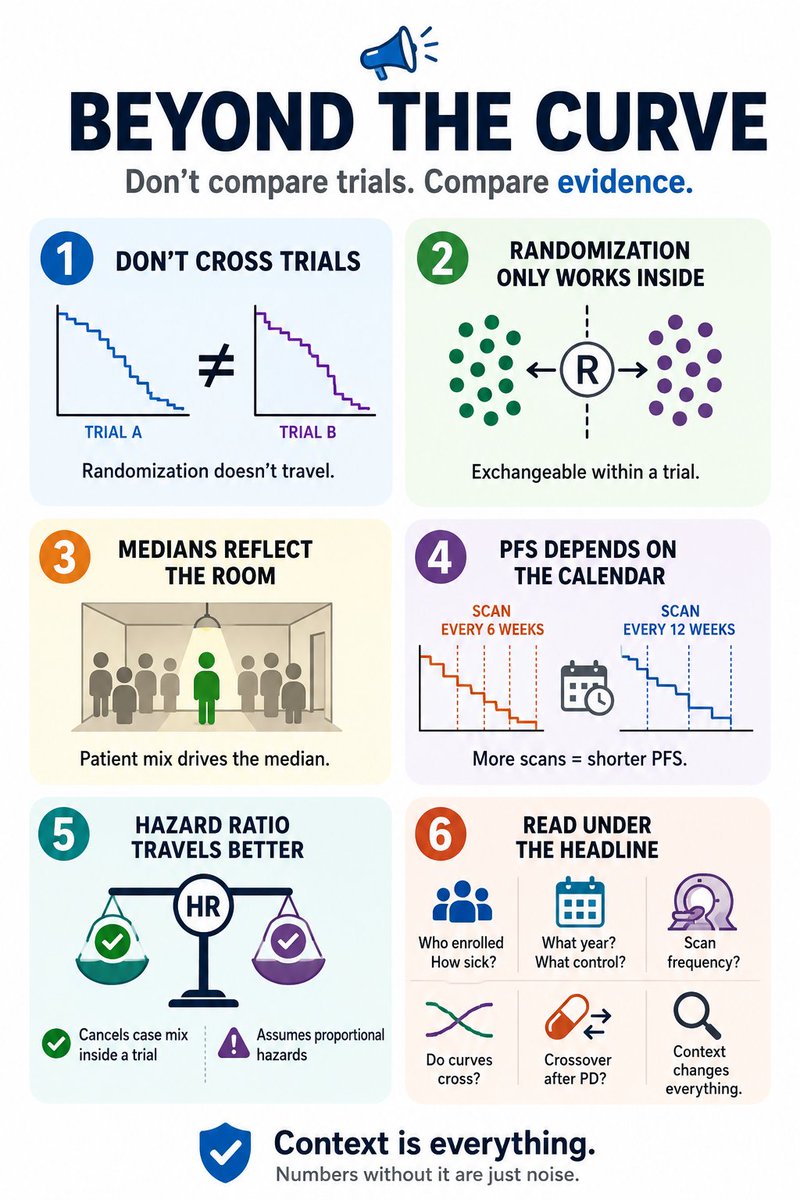
1/ #ASCO26 starts tomorrow. By Friday your feed will be full of survival curves, and the temptation will be everywhere: cross-trial/study comparison.
Before you do so, A few caveats worth keeping in mind
Today, among the goods that are universally intended for everyone, we must also include new forms of property, such as patents, algorithms, digital platforms, technological infrastructure and data. In a context where the wealth of nations depends increasingly on knowledge and technology, when these goods remain concentrated in the hands of a few, without adequate forms of sharing and access, a new imbalance is created that contradicts the universal destination of goods. In turn, it widens the gap between the included and the excluded, between those who can participate in the digital revolution and those who remain on the margins. #MagnificaHumanitas
Humanity, created by God in all its grandeur, is today facing a pivotal choice: either to construct a new Tower of Babel or to build the city in which God and humanity dwell together. In Jesus Christ, this humanity in its grandeur becomes the Way, the Truth and the Life, opening the path for each of us to grow toward fullness. #MagnificaHumanitas
https://t.co/6i9MWs6LJl
Nevertheless the two most promising abstracts imo were from US-originated ADCs:
$ABBV's STEAP1/PSMA - 67% PSA50 and 45% confirmed ORR in heavily pretreated prostate cancer
$LLY's NECTIN4 - 48% ORR in bladder cancer including 40% ORR in Padcev failures
https://t.co/yGBDbtujjJ
https://t.co/q3Mb15QvhL
#ASCO26
Today we reduced headcount by 22%. The business is the strongest it's ever been. So I think it's important to be direct about what I'm seeing and why.
First, I made this decision and I own it. I did it because the way to operate at the highest level of productivity is changing, and to win the future, ClickUp needs to change with it.
Second, this wasn't about cutting costs. Most savings from this change will flow directly back into the people who stay. We'll be introducing million-dollar salary bands. If you create outsized impact using AI, you'll be paid outside of traditional bands.
Most importantly, I have the deepest gratitude for those affected. We're doing this from a position of strength specifically so we can take care of people properly. Everyone affected receives a package aimed at honoring their contributions and easing the transition.
I only see two options: wait for this to play out gradually in the market or be honest about what I'm seeing and act proactively.
THE 100X ORGANIZATION
The primary change is that we're restructuring around what I call 100x org. The goal is 100x output. The roles required to build at the highest level are fundamentally different than they were a year ago.
Incremental improvements to existing systems won't get us there. We need new ones. That means creating enough disruption to rebuild rather than iterate on what's already broken.
The common narrative is that AI makes everyone more productive. It doesn't. Many of the workflows of today, if left unchanged, create bottlenecks in AI systems.
These roles will evolve. But waiting for that to happen naturally means falling behind now.
The 100x org is actually heavily dependent on people - infinitely more than today. This is only possible with 10x people that have embraced and adopted new ways of working.
THE BUILDERS, AGENT MANAGERS, AND FRONT-LINERS
— THE BUILDERS: 10X ENGINEERS
I don't think most companies have internalized what's actually happening with AI in engineering. The common narrative is that AI makes all engineers more productive. That may be true in isolation, but at an organization level - that is the farthest thing from reality.
Here's what we've validated recently at ClickUp: the great engineers, the ones who can orchestrate, architect, and review, are becoming 100x engineers. They're not writing code. They're directing agents that write code. The skill is judgment.
AI makes the best engineers wildly more productive, and everyone else using AI slows these engineers down.
Think about it - the bottlenecks are (1) orchestration - telling AI what to do, and (2) reviewing - what AI did. Everything is leapfrogged and no longer needed.
So who do you want orchestrating and reviewing code?
And how do you want your best engineers to spend their time?
If your best engineers are spending time reviewing other people's code, then this is inherently an inefficient bottleneck. These engineers can review their agent's code much faster than reviewing human code.
The new world is about enabling your 10x engineers to become 100x.
The wrong strategy is to push every engineer to use infinite tokens. Companies doing this are celebrating 500% more pull requests. But customer outcomes don't match the volume of code being generated.
I call this the great reckoning of AI coding, and every company will face this soon if not already.
More code is just another bottleneck to the best engineers, and ultimately to your company's impact as well.
— THE BUILDERS: 10X PRODUCT MANAGERS
Product management and design roles are merging.
Designers that have customer focus, become more like product managers.
And product managers that have intuition for UX become more like designers.
The bottleneck of user research is gone. It takes us just one mention of an agent to kickoff research and analyze results.
The bottleneck of product <> design iteration is also gone. The product builder iterates on their own, along with agents and skills that ensure alignment with quality and strategy.
Also controversial today - I believe that the wrong strategy is to have your PMs shipping code - that just introduces another bottleneck that the best engineers will waste their time on.
To be clear, PMs should be coding but they should do this in a playground to iterate, validate, and scope. That code should not go to production.
Everything outside of managing systems, orchestrating AI, and reviewing output becomes a bottleneck.
That's why the other roles that are critical along with these are the systems managers (to reduce bottlenecks) along with a bottleneck you can't replace - customer meeting time.
— THE SYSTEM MANAGERS
Ironically, the people that automate their jobs with AI will always have a job. They become owners of the AI systems - agent managers. We have many examples of these people at ClickUp.
The underlying systems in which we operate are absolutely critical to get right. I think most companies are delusional to think they can iterate on existing systems and compete in this new world.
You must create enough disruption so that old systems are deprecated entirely. If there's any definition for 'AI native' that's what it is.
— THE FRONT-LINERS
In a world that will become saturated with AI communication, the human touch will matter more than anything to customers.
This is a bottleneck that you shouldn't replace - even when agents are high enough quality to do video meetings.
One-on-one meeting time with customers is something that shouldn't be automated. The systems around the meetings should be - so that front-liners spend nearly 100% of their time with customers.
REWARDING 100X IMPACT
In a world where companies are able to do so much more with less, where does that excess money go?
In our case, much of the savings in this new operating model will flow directly back to those that enabled it.
We must reward people that create productivity accordingly. This aligns incentives on both sides. Plus, in a world where your best people create 100x impact, you can't afford to lose them.
You should aim to retain these employees for decades. The context they have and their ability to efficiently orchestrate and review will be nearly impossible to replace.
Compensation bands of today should be thrown out the door. We're introducing $1 million cash/year salary bands with a path available to nearly everyone in the company if they produce 100x impact by creating or managing AI systems.
THE FUTURE
Nearly every company will make changes like these. The ones that do it proactively will define what comes next.
The future is not fewer people. It's different work, new roles, and better rewards for those who embrace it. We're already seeing entirely new roles emerge, like Agent Managers, that didn't exist a year ago.
ClickUp is positioning to lead this shift, not just internally, but for our customers too. I've never been more certain about where we're headed.
JUST IN: Vatican announces that Pope Leo XIV’s first encyclical — titled Magnifica Humanitas, on the safeguarding of the human person in the age of AI — will be presented at 11:30am on Monday, May 25, in the Vaticanʼs Synod Hall, in the presence of the Holy Father.
Speakers at the presentation will include:
Cardinal Víctor Manuel Fernández, Prefect of the Dicastery for the Doctrine of the Faith;
Cardinal Michael Czerny, Prefect of the Dicastery for the Service of Integral Human Development;
Professor Anna Rowlands, Political Theology, including Catholic Social Teaching, and theological ethics of human migration, Department of Theology and Religion, Durham University, United Kingdom;
Christopher Olah, co-founder of Anthropic (USA) and head of interpretability research for artificial intelligence;
Dr. Leocadie Lushombo, Political Theology and Catholic Social Thought, Jesuit School of Theology / Santa Clara University, California.
Concluding remarks will be delivered by thel Secretary of State, Cardinal Pietro Parolin.
The presentation will also include an address by Pope Leo XIV.
Magnifica Humanitas was signed and dated on May 15, the 135th anniversary of the promulgation of Pope Leo XIII’s Encyclical Letter Rerum Novarum.
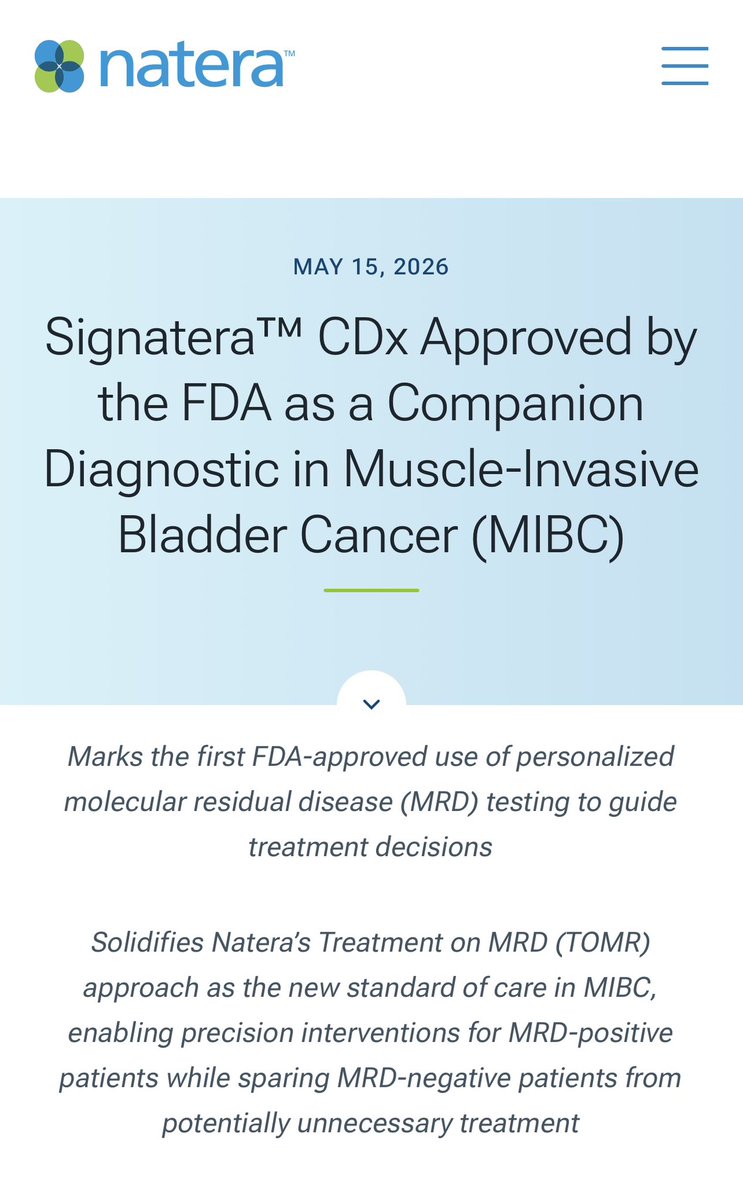
JUST IN: @FDA approves adjuvant PD-L1 inhibitor Atezolizumab in Muscle-Invasive Bladder Cancer post surgery & ctDNA MRD (+) by @NateraGenetics Signatera CDx approved as companion diagnostic.
MRD-guided adjuvant therapy is moving into practice in Bladder Cancer!
FDA link: https://t.co/DPjLN6Ag2Z
The FDA approves the signatera ctDNA assay for muscle invasive bladder cancer patients post surgery.
This is based on the results of Imvigor011 study (atezo vs placebo in ctDNA positives, surveillance for the ctDNA negatives).
It opens a new chapter for personalised therapy in urothelial cancer. Focusing on early treatment for those patients that need it and sparing those at lower risk potentially harmful treatment makes sense.
‘It is the first companion diagnostic approval in the field of blood-based MRD.’
https://t.co/dGAIblVrzc