Yesterday, $DELL spiked 45% after its Q1 earnings.
Options exploded 20000%-30000% in 1 day (rare).
Next week, there's 4 earnings with exact same set-up:
1. $CRWD 📅 Earnings: June 3 (After Close)
As enterprises deploy thousands of AI agents, cloud workloads, and connected endpoints, the security perimeter expands infinitely, making Falcon's AI-driven threat detection not optional but mandatory.
No one builds a $500B AI datacenter and skimps on security. $CRWD is the toll booth on the AI buildout highway and that moat compounds with every new customer and dataset feeding its threat intelligence engine.
Target: $800 median | $700 Wedbush & Benchmark | $750 Oppenheimer
2. $AVGO 📅 Earnings: June 2 (After Close)
Custom AI chip (XPU) demand from hyperscalers accelerating every quarter. $AVGO is the silent infrastructure backbone of the AI supercycle.
While $NVDA dominates training, Broadcom owns the custom silicon layer designing the XPUs that $GOOG, $META, and Tiktok use to run inference at hyperscale, plus the networking chips that stitch datacenters together.
As hyperscalers race to reduce $NVDA dependency and build proprietary AI chips, Broadcom is the only company with the design expertise and manufacturing relationships to deliver.
Target: $500 avg | $480 Susquehanna | $560 high
3. $PANW 📅 Earnings: June 2 (After Close)
Platformization strategy converting AI security budgets into sticky, recurring revenue.
AI doesn't just create new threats it supercharges existing ones, making next-gen cybersecurity a non-negotiable line item for every enterprise on the planet.
PANW's platformization strategy is purpose-built for this world: one unified platform replacing dozens of point solutions, with AI models running across network, cloud, and endpoint security simultaneously.
Target: $320 avg | $340 high | $300 median (75 analysts)
4. $GTLB 📅 Earnings: June 2 (After Close)
AI-native DevSecOps platform controls full dev lifecycle as code volumes explode.
AI is going to produce more code in the next five years than humans wrote in the last fifty and all of it needs to be managed, secured, and deployed somewhere.
While competitors like GitHub Copilot focus on code generation, GitLab controls the entire pipeline and that becomes more valuable, not less, as AI-generated code volumes explode.
Target: $40 median | $60 high (Macquarie) | $27 low (Cantor)
$ORCL earnings is on June 10 and $MU is on June 24. These will explode like $DELL did most likely.
♻️ RESHARE this post and write 1 comment, I'll DM the best $MU contract to get for earnings right now.
🚨 Anthropic just showed a 24-minute workshop on how to actually do prompts for Claude.
Taught by the people who built it.
Free. No registration. No paywall.
I've seen $300 courses that don't cover what they teach in the first 8 minutes.
Watch it and bookmark it now.
My guest today is Paul Tudor Jones (@ptj_official), one of the greatest macro traders of all time.
He correctly predicted the 1987 stock market crash and shorted the Japanese bubble in 1990. For over 40 years, his flagship fund has had a negative correlation to the S&P 500. 100% of his returns are alpha.
He says today's market has so many similarities to 2000, "the easiest bear market I've ever seen in my whole life."
He makes the case for going long dollar-yen, why Bitcoin beats gold as an inflation hedge, and why he was wrong about Warren Buffett.
But what I'll remember most from this conversation is Paul's zest for life. He's 71 and still wakes at 2:30 every morning to trade the London open. He works out for two hours a day. He walks with his wife every evening. He travels the country chasing peak spring and peak fall. He's so excited about the songs picked for his funeral that he wishes he could be there to hear them.
Paul has lived five lifetimes in one. He's one of the most entertaining and interesting people I've met, and the conversation will leave you searching to be as passionate about what you do as he is about what he does.
Enjoy!
Timestamps:
0:00 Intro
1:00 The Kindest Thing
13:19 Trading vs. Investing
17:33 Lessons from Warren Buffet
22:24 The Existential Risks of AI
29:54 The Nature of Trading
31:46 Bitcoin
35:55 Bubbles
42:08 A Day in the Life of PTJ
46:00 Information Overload
47:07 Passion for Markets
50:49 The Robin Hood Foundation
54:18 The Workless World
56:03 Journalism
1:00:00 Principal Components of a Great Life
1:05:06 Kill Them With Kindness
Crazy opportunity with MSTR June 2028 LEAPs right now.
Potential 25x without Strategy buying any more Bitcoin. (lol)
It's ~$5,000 for the $175 strike price contract.
If Bitcoin simply just reverts back to the Power Law regression fit line, Bitcoin is $300k in June 2028.
BTC today: $66,000
BTC in June 2028: $300,000
BTC multiple: 300,000 / 66,000 = 4.545x
That is a +354.5% BTC return.
If MSTR is 33% amplified Bitcoin, then I’m treating that as:
MSTR return = BTC return × 1.33
So +354.5% × 1.33 = +471.5%
Starting from MSTR = $126.40, that gives a projected MSTR price of about:
$722.43
For your June 2028 $175 call:
Expiration value = ($722.43 - $175) × 100
= $54,743 intrinsic value
If you paid $5,000 for the contract:
Net profit: about $49,743
Return on premium: about +994.9%
$5,000 turns into about $54,743 total value at expiration, for roughly a 10.95x outcome, assuming MSTR actually delivers that 33% amplification all the way up.
That is not including them buying ANY more Bitcoin.
What if they expand to 2.0 mNAV in the Bitcoin bull market?
This is where the rocket fuel gets injected.
If today’s valuation implicitly reflects ~1.0x mNAV baseline (simplification for modeling), then:
mNAV expansion to 2.0x = another 2x on price
$722 × 2 = ~$1,444 MSTR
Final intrinsic value: ($1,444 − $175) × 100 = $126,900
Final value: $126,900
Cost: $5,000
→ Profit: ~$121,900
→ Return: ~+2,438%
What just happened conceptually is you stacked three convex layers:
BTC: 4.5x
MSTR amplification: 1.33x
mNAV expansion: 2.0x
That’s effectively:
4.545 × 1.33 × 2 ≈ 12.1x on MSTR
And your option turns that into ~25x on your capital
And remember, this isn't modeling in them accumulating Bitcoin over the next two years... this is leverage + multiple expansion on the capital they already have.
Not financial advice, this is financial entertainment.
Already stacked to the gills with ASST Jan 2028 LEAPs but I like this idea to give me more time for BTC to moon.
Some mouth-watering entries here for those with conviction in Bitcoin.
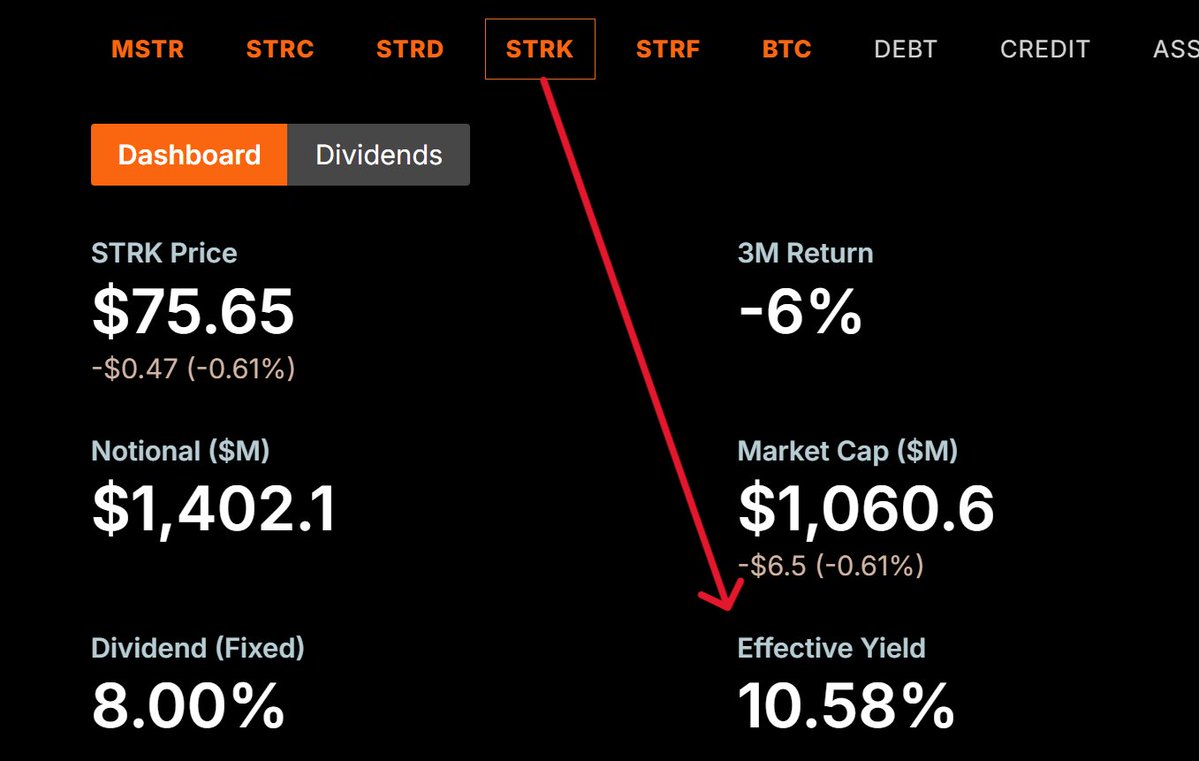
🔥STRK IS THE ULTIMATE EARLY RETIREMENT WEAPON🔥
Take $1,000,000. Buy STRK.
At a 10.58% effective yield, it throws off $105,800 a year in ROC dividends, tax-deferred, while you sit on your porch like a financially weaponized swamp wizard and let the rest of society commute to meetings about “synergy.”
You live on the cash. You do nothing heroic.
No landlord calls. No tenant explodes the dishwasher.
No startup founder with “disruptive vision.”
No 4:30 a.m. options gambling because your retirement plan is built out of emotional damage and Celsius screenshots.
Just collect the yield and wait.
If you're a Bitcoiner, you probably think Bitcoin compounds at 25% annually or so.
MSTR, with their current level of Bitcoin amplification, compounds at 33.25% annually.
You let that run for 10 years.
At the end, you convert your STRK into MSTR at 0.1 MSTR per STRK share.
Result:
You collected $1,058,000 in cash over the decade to live on.
Then you still end up with roughly $3.17 million of MSTR.
Then you sell covered calls on your $3.17 million MSTR stack and never run out of money while you wait for the Grim Reaper to take your SOUL.
Or do anything with it. Play Scrooge McDuck with your cash in a hot tub.
So the trade is:
Retire now. Live on the ROC dividends.
Let Bitcoin do its apocalyptic compound-interest black magic.
Convert later into a giant MSTR position.
This is what happens when capital markets accidentally invent a structure that lets you eat steak in the present while smuggling volatility into the future.
The average retirement planner wants you clipping coupons at 73.
This thing says: here’s six figures a year to breathe, and a giant pile of leveraged Bitcoin equity waiting at the end like a flamethrower in a trust fund.
Boomers got a pension.
You get a yield wrapper that pays you to front-run monetary collapse.
That’s progress.
New COOKBOOK edition out
Magus — Stacking chips
Doc — I don't need the pico bottom
Charlie — It’s a peaceful life
Stoic — November 2026?
Mercury — How far does this go?
Read below 👇
What can you learn from a trader with $36M+ in profit? 🐋📈
We’re breaking down the strategy of Wallet 0x418a:
✅ Fast Cuts: Median trade duration is only 2.5 hours for losers.
✅ Long Holds: Held an $ENA short for 79 days for a $9.5M gain.
✅ Risk First: Average leverage of 3.9x with a massive liquidation buffer.
Stop guessing. Start mirroring the whale's edge on BitMEX.
More on our blog: https://t.co/5a9WxVMaA0
That's 8 hours of video!
If you can't get to it all today, click below and retweet the top tweet to keep the list handy for later!
Then, follow me @pyquantnews for tweets, threads, tools, and code to help you get started with Python for quant finance.
I genuinely think we’re stepping into a completely new era for income investing in the UK/EU.
For decades, if you wanted meaningful monthly income, you basically needed £500k+ invested into something like the S&P 500.
At ~1.4% dividend yield, £500k only brings in around £7,000 per year — ~£580/month.
Great for long-term growth… but not exactly life-changing income.
But with option-based and covered-call funds now arriving from the US, the game is shifting.
For the first time, it’s becoming realistic for people to generate real monthly cashflow with far less capital.
Example:
Put £50,000 into a higher-yield fund like $MAGD or $FEPI — both paying around 25–30% yields with surprisingly low NAV decay so far — and you’re looking at £1,000+ per month in income.
That’s already more monthly cashflow than a traditional £500k S&P portfolio would give you in dividends.
We are early in Europe.
The ecosystem is tiny compared to the US.
The products are new here in the UK.
But the strategies have been running across the pond for a while now.
I’m honestly so excited about this shift.
Over the next few years, it’s going to become completely normal for people to cover real bills and monthly expenses with far smaller portfolios than what was historically required.
If you haven’t started yet, now is the time to research and understand these funds.
Getting ahead of this trend could change everything for a lot of people.
Ideally we see $ETH run down and close $3,834 nPOC level in confluence with Lower Limit before we look for an upward move towards Median ML, $4,687 nPOC and then Upper Limit.
Once again, we look to bid discounted prices, not get bearish at them.
#Ethereum
My best read on what's coming for BTC in the next few weeks based on Treasury refinancing patterns we've been tracking on the dashboard.
September has $2.35T in Treasury debt hitting the public markets for refinancing, which puts it right at the edge of what I would class an extreme event. I've been classing them based on size. This only just makes the cut.
The pattern I've identified this year shows these high pressure refi months create pretty predictable Bitcoin moves.
We typically see a drawdown in the first week of the month when the refinancing pressure peaks, usually hitting around days 4-5. For an event this size, I'm expecting something in the 6-8% range from wherever we start September. This could potentially bring us back to Liquidity Fair Value.
What's been interesting is how reliable the recovery has been. Once Treasury gets through the initial auctions and proves they can handle the volume, Creates credit, Bitcoin has bounced back hard every time.
For September's $2.35T event, I'm looking for an 11-12% rally from whatever low we hit. Higher beta plays which we should be positioned in should outperform this considerably.
My plan is simple, watch for that early September weakness around the 4th-6th, then position for the relief rally that typically plays out over the following 10-15 days. The whole cycle has been running like clockwork this year.
The Treasury's massive shift to short-term debt has created these monthly pressure points that I don't think the market has fully adapted to yet. Each month they're rolling over amounts that would have been considered really extreme just a few years ago, but now it's just becoming the new normal and we need to adjust accordingly.
The opportunities are there if you know when and where to look... And that place is on the Dashboard.
Free 3 day trail still in please for new recruits.
https://t.co/PipXclZSvk
long ago, I grew tired of allowing the market to dictate whether I was a genius, or delusional
because conviction is only rewarded if the market rallies
otherwise, that conviction is merely delusion behind a mask
the way to overcome this is by relying on one's abilities, instead of the market
but that creates inherent issues as well
by leaning into manual execution, we present new obstacles for ourselves:
- "what if I cut at the lows?"
- "what if I buy the top?"
- "what if I miss out?"
we no longer allow the market to take the wheel, and as a result, we're susceptible to our own poor execution - in addition to market variance
that thought is scary - it's often more comforting to subscribe to a higher power to dictate our outcome
but it can just as easily be enlightening.
because ironically, the mental blockade we create by deciding to rely on our abilities is overcome by continuing to rely on our abilities:
- "even if I cut at the lows, I can buy the next breakout"
- "even if I buy the top, I will cut when my trade is invalid"
- "even if I miss out on this rally, I can catch the next, or trade a different asset"
understanding this brings true solace; being at utmost peace with the market
the impact this has on a trader cannot be overstated - it is a superpower.