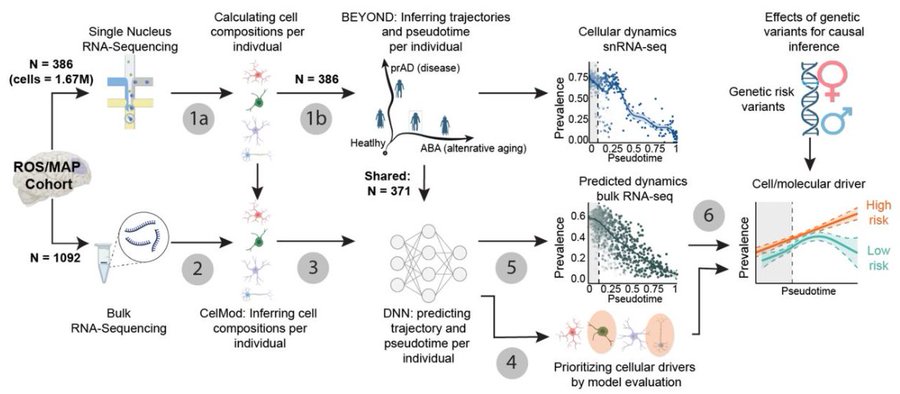
Presenting DeepDynamics, a joint effort by the @naomi_habib and @BarakRaveh Labs. We have built a deep learning framework that bridges bulk and single-cell RNA-seq to map the cellular cascades underlying Alzheimer’s Disease (AD) and aging. #alzheimer#deeplearning#ROSMAP
1/10
Check out this great new print from @yael_heyman on spatial transcriptomics and intestinal zonation! I particularly love her “transplant” experiments, showing that cells transplanted to a new location adopt the local zonation pattern!
Excited to share our study @CellCellPress introducing a novel class of macrophage-targeted immunocytokines (MiTEs) that engage myeloid, T and NK cells to boost anti-tumor immunity in solid tumors. Led by @MVLocquenghien, @PascaleZwicky & @CuriousKX (1/16)
https://t.co/2z69HAdAEs
Excited to see this out: A spatial atlas of human gastrointestinal acute GVHD reveals epithelial and immune dynamics underlying disease pathophysiology https://t.co/0kifEYyR6S
Do we need LLMs to predict epigenomes from DNA—or is biophysics enough? 🧬
IceQream (IQ) is a biophysics-based framework that predicts epigenomes with SOTA-level accuracy—and is fully explainable.
@NatureComms: https://t.co/mPzl0PDkrN
Thread 🧵👇
1/
Check out our recent work with John Rioux and the iGenoMed Consortium! Serum proteomic and metabolomic profiling in #IBD patients initiating vedolizumab identified pro-inflammatory analytes associated with treatment response.
https://t.co/ebM1g36k8p
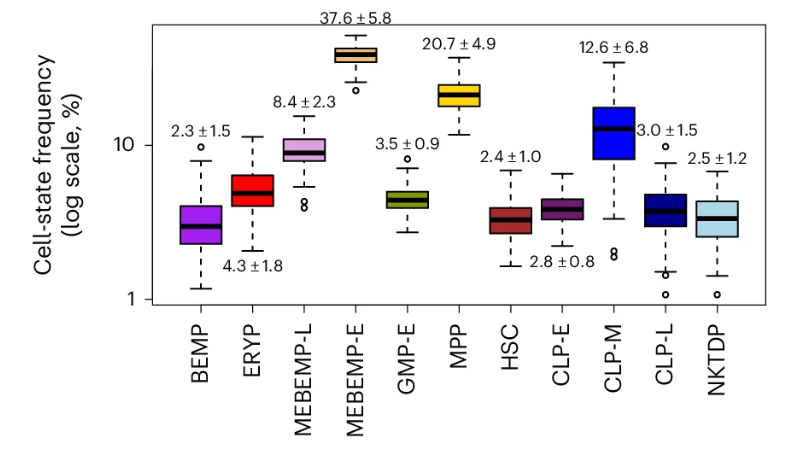
Our Lab together with Amos Tanay lab has created the first reference model for HSPCs published in Nature Medicine yesterday.
https://t.co/qxiLTZmw3W
you can look at the data here (really nice tool)
https://t.co/Ed3SjGWX33
Very excited to share our latest work in @NatureGenet w/ @cssmillie’s lab: a spatial transcriptomics atlas of stricturing #Crohns disease that offers new insights into mechanisms driving fibrotic complications in chronic gut inflammation...(cont.)
https://t.co/ZelsqBcqc7
First lab tweet! Sharing new papers:
PRINT Using Perturb-map, we show how ovarian tumors resist immunotherapy https://t.co/JY4HFv928D
PREPRINT Developed new technology to easily generate cell-targeted LNP-RNA @SantagataMDPhD@JoshuaBrodyMD@yizhoudonglab
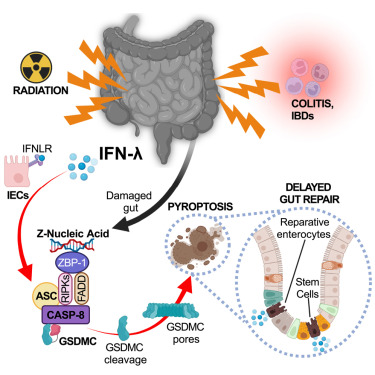
IFN-λ directs the sensing of Z-form nucleic acids generated during gut injury and repair, triggering cell death and altering healthy epithelial regeneration @CellCellPress@Lo_Zanzi@achillebro@kjena21 @JulienMamb14132
https://t.co/dar9Zm2Sbc
Excited to share one of our apex studies from our @NCIHTAN center, focused on the transition to metastasis, shedding light transition to #CRC#metastasis. Joint work with @KarunaMDPhD, led by @andrewrmoorman and @elliebenitez11. -->
https://t.co/9mVfnoJtNe
We are excited to share our new research article, in which we, for the first time, identified a human intestinal reserve stem cell, namely tuft cells, by combining novel organoid models and single-cell genomics (link: https://t.co/ZN5mqLMFWL).
Our latest preprint is out! 🚨We discovered that intestinal stem cells actively fight bacterial infections. Learn more about it in our new study by @SachaLEBON in collaboration with @matanhofree https://t.co/ZMppWIR7LD
Preprint alert! A spatial atlas of human gastro-intestinal acute GVHD reveals epithelial and immune dynamics underlying disease pathophysiology https://t.co/qtyqlepJod. We examined how immune cells are organized in the gut and what happens to them in GVHD. TL;DR Timing is key!
The radial positioning of genomic loci, i.e. how far they are from the nuclear lamina has been associated with genome structure and function for several decades.
But in genomics everything is correlated, e.g. radial positioning with genomic compartments with gene activity etc
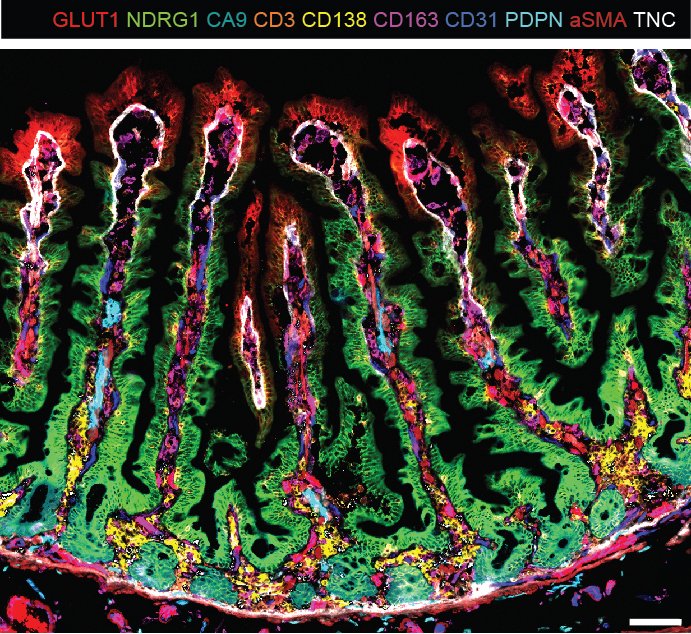
Happy to share our new paper: A spatial expression atlas of the adult human proximal small intestine, out today in @Nature: https://t.co/JuisyVCx24. We describe the zonated expression patterns of cells along and across the villus axis in the healthy adult small intestine.
Thrilled to share this amazing news about our recent #glycotime paper in @NatImmunol revealing a unique serum IgG glycome connected with pathogenic ASCA that precedes IBD diagnosis
@gaifem_joana @claudia_msr @i3S_UPorto https://t.co/4wFmS7p2VZ