In our Nature paper, we introduce the first superhuman Stratego AI, which we built using general techniques that we developed for RL & test-time compute under imperfect information. 1/N
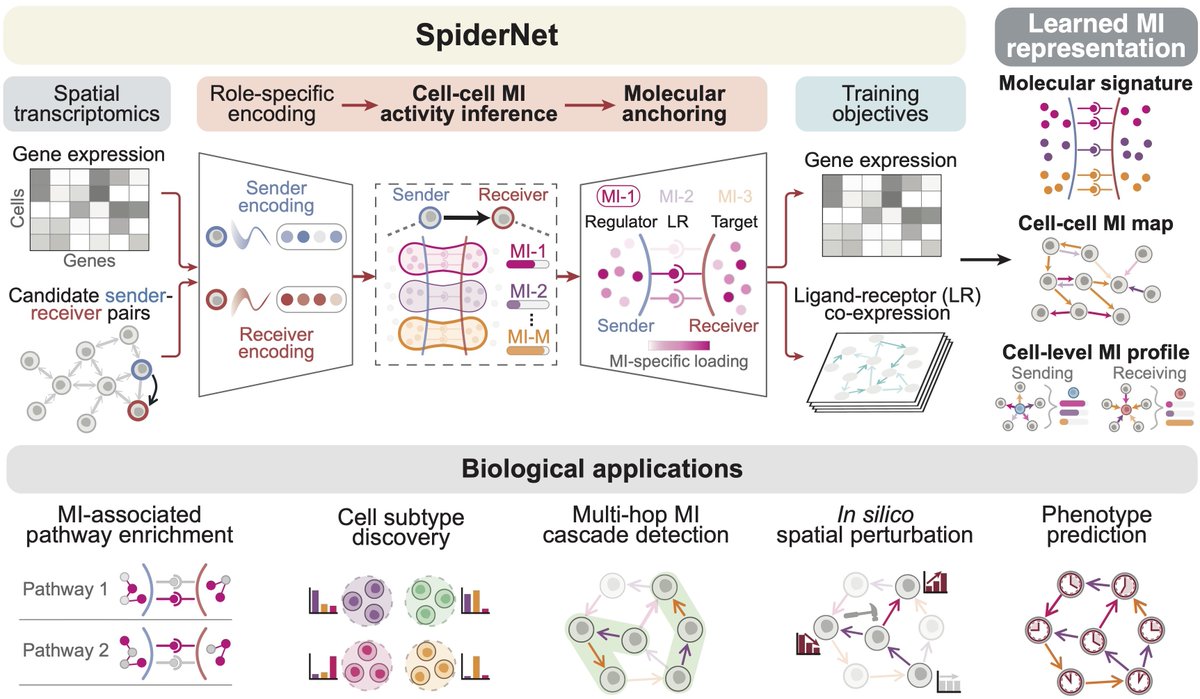
We asked a basic unanswered question in tissue biology: Can the many molecular exchanges between neighboring cells be organized into reusable communication programs - much like genes into pathways?
We introduce SpiderNet, which learns cell-cell meta-interactions (MIs): directed sender->receiver programs linking sender regulators, ligand-receptor bridges, and receiver responses, while mapping where each program is active in tissue. Across diverse contexts, MIs recur, form multicellular relays, predict neighboring-cell responses to perturbation, and connect local signaling to tissue states and phenotypes.
We hope MIs provide an intermediate language for spatial omics, moving from catalogs of local contacts toward interpretable, comparable, and eventually perturbable programs of multicellular regulation.
📚 Preprint: https://t.co/kYYKZgtKoR
🚀 Led by the amazing Junjie Tang @JJTang_1995 in the lab.
If every step in a scRNA-seq experiment loses just 1% of the signal, you lose almost 40% of the total signal after 50 steps.
Noise and poor reproducibility are common problems when working with this kind of data. Yet, as computational biologists, we often treat data collection as a black box and start our work from the count matrix.
I wrote a post about what can go wrong before that matrix reaches us, from sample selection and tissue handling all the way to sequencing and read counting. I hope it helps other computational biologists better understand where their data came from.
Post: https://t.co/fxRcSYm5qp
I spoke with @Nature, alongside several other researchers, about why many AI researchers still choose academia despite the growing pull of industry. Academia's unusual freedom to choose which questions are worth pursuing is powerful. But I do not think academia and industry need to be opposites. As AI reshapes science, we need models that let them co-evolve, combining academia's long-term freedom and openness with industry's resources, scale, and ability to rapidly translate ideas into impact. https://t.co/9yeHuYA23A
@yuejiec very true. just like cooking - AI gives us all a better equipped kitchen but what matters is the chef's taste, what / how they actually serve, and whether the meal is memorable 🍳
Do spatial transcriptomics foundation models (SFMs) actually learn biologically meaningful spatial patterns? 🧬
Excited to share our new work assessing if current spatial foundation models learn multi-scale spatial variation in gene expression (spoiler: mostly no)
20 years ago today, on April 7, 2006, I submitted the only paper I published during my PhD to @genomeresearch. By today's standards, the work feels too simple, and every figure looks plain. Science has moved fast, and I am working on completely different problems now. That era is gone. https://t.co/dEkBHAbqE4
very comprehensive Review on single-cell foundation models from @JiayuanDing, @Xiaojie_Qiu, @TheodorisLab, and colleagues. After going over it, I would encourage the authors to make it more critical rather than primarily an inventory of models.
First, I think Fig 1 needs some rethinking. The definition of scFM has become too loose. For example, the actual model unit of GET is celltype pseudobulk aggregated from scATAC-seq, hence not single cell model. Also thanks for highlighting our TissueNarrator, but we certainly do not consider it a bona fide scFM - it is a specialized spatial transcriptomics model built by leverging an existing foundation LLM (Qwen). TissueNarrator is very interesting and we re having lots of fun w/ it but it's not a scFM. Anyway - Fig 1 seems to mix FMs, specialized models built on FMs, and task-specific models into one big family tree.
More broadly, I think the more interesting question for a scFM review in 2026 is not how many scFMs now exist or how their architectures differ, but what has the scFM paradigm actually bought us? Since the first wave around scBERT/Geneformer/scGPT, the number of models, parameters, and pretraining cells has exploded, but as a field we are not convinced that capabilities have advanced proportionally.
- Where has large scale pretraining enabled something that a strong specialized model could not do ?
- Where do scFMs consistently beat strong task specific or even simple baselines?
- Where is the broad evidence for true cross-context generalization on biologically interesting tasks?
The Review mentions many of these challenges indeed, but I think they should be much closer to the central theme of the article rather than appearing mainly in a later Challenges section :-)
I might almost suggest to flip the review around and instead ask:
- what have we actually learned after several years and many scFMs?
- What claims have survived independent benchmarking?
- What has scaled and what has saturated?
- What capabilities are genuinely attributable to pretraining and where do we still need much more evidnece?
- What important biological problems remain essentially unsolved by scFMs ?
Given the current rate of model proliferation, there may be another 50 scFMs by this time next year and this inventory / figure will become outdated very quickly. To me, a more useful and timely "state of the field" critique would be much more valuable and long-lasting than another "model zoo" review .
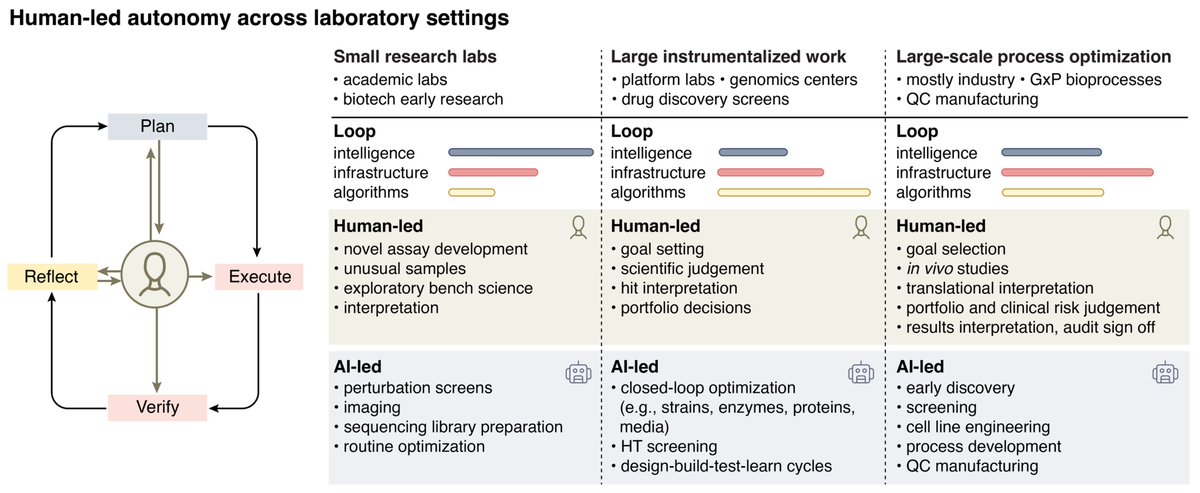
As a collaboration between my group at @SCSatCMU, Aviv Regev's team at @genentech, and @michellearning's team at @medra_ai, we are pleased to share our Perspective, "Towards human-led, agent-driven autonomous laboratories for the life sciences." 🤖 https://t.co/tJBVnIXtTr
This preprint release is coordinated with a complementary Perspective by @MengdiWang10, @lecong, and colleagues: https://t.co/x2AFNMmEkC. Together, the two Perspectives examine the future of autonomous science from complementary angles.
Our Perspective was Led by @WenduoC in my group, with @mishamamq, @ShenShuaik4260 and @zocean636 at CMU; Anna Hupalowska, Jennifer Rood, Christine Bakan, and Aviv Regev at @genentech/@Roche; and Gaurav Agrawal and @michellearning at @medra_ai.
🚀https://t.co/tJBVnIXtTr
@BoWang87 Well, drugs are just one application. Biology is much broader. If these VC models truly live up to their promise, they should indeed help us understand, predict / simulate, and design biological systems. I believe that has always been the larger vision of computational biology ?
Excited to showcase the science and people behind our GigaTIME paper, recently published in Cell.
Paper: https://t.co/BtjFg7jCdk
Model: https://t.co/wKxElvud7t
Code: https://t.co/35X1bLgqr9
Azure Foundry: https://t.co/9ub2ubLdph
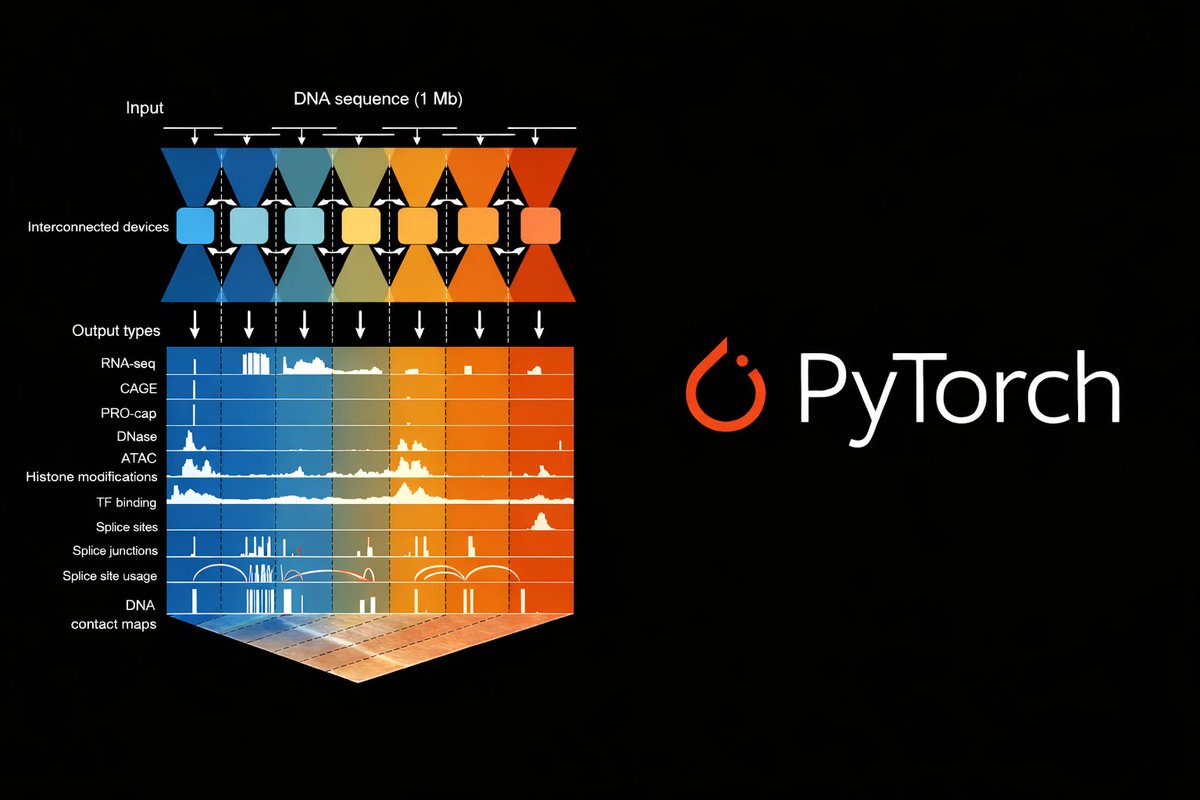
Thrilled to announce alphagenome-pytorch, an accurate, readable, and careful port of AlphaGenome's architecture and weights to PyTorch. Work with @gtcaa@m_kjellberg@chriswzou@tuxinming as part of the GenomicsxAI initiative between @anshulkundaje and @pkoo562 labs.
Excited to share our new work. Over the past decade, single-cell genomics has transformed our ability to map cellular systems. But a major question remains:
Can we predict how perturbations reshape cellular trajectories over time?
In 2018, we first showed that it is possible to predict cellular responses to perturbations — ranging from disease signals to chemical treatments — even in unseen contexts. In 2022, we introduced CPA (MSB 2022; NeurIPS 2022), extending this idea to predict responses to unseen chemical and genetic perturbations, including their combinations.
Since then, the field of perturbation modeling has grown enormously. The community has pushed the space forward with many creative ideas and powerful models. It’s exciting to see how fast things are moving — even though many fundamental challenges remain.
One of the biggest is that cells are not static. They move through trajectories during development, immune responses, and disease. Yet most current models still predict perturbation effects within a single state, rather than how early perturbations propagate across future states and reshape downstream outcomes.
To address this, we developed PerturbGen, a trajectory-aware generative AI model that predicts how genetic perturbations reshape downstream cellular states.
Huge credit to the people who made this work possible. Thanks to co-first authors @lifeisscience_5, @Adib_m_, @Tomo_Isobe, @Amirhossein Vahidi, @delshadveghari & Anthony Rostron. Special recognition to @lifeisscience_5 and @Adib_m_ for driving this work over the finish line.
Grateful for our outstanding collaborators from @HaniffaLab, @BertieGottgens lab @GosiaTrynka and many others — a true cross-institute effort across @SCICambridge, @OpenTargets ,@sangerinstitute and @Cambridge_Uni.🎉
PerturbGen learns transcriptional dynamics across cellular trajectories. By introducing perturbations at an early source state, it can simulate how these effects propagate into future states along differentiation trajectories.
Scaling this across genes enables the creation of dynamic in silico perturbation atlases — maps of how perturbations reshape biological trajectories over time.
We explored this idea across three biological questions.
First, in a human in vivo LPS immune challenge, PerturbGen predicted that perturbing a transient IL1B signal dampens downstream inflammatory programs in myeloid cells, with pathway changes reversing signatures observed in an independent IL-1β stimulation experiment.
Second, in human hematopoiesis, PerturbGen predicted transcriptional responses to CRISPR transcription factor knockouts and enabled construction of perturbation atlases revealing lineage- and age-specific regulatory programs. These programs could also be linked to human genetics and blood diseases, including recapitulation of signatures associated with ETV6-related thrombocytopenia.
Finally, we asked whether perturbation modeling could help improve complex tissue models.
We built a dynamic perturbation atlas of human skin organoids to identify perturbations that could guideorganoid cells towardhuman fetal skin states.
PerturbGen prioritized activation of Wnt signaling via GSK3β inhibition. Experimental validation confirmed the prediction: treatment with CHIR99021 induced stromal gene programs and shifted organoid fibroblasts toward transcriptional states observed in fetal skin stroma.
Together, these results show how trajectory-aware perturbation modeling can connect gene perturbations to developmental programs, human genetics, disease mechanisms, and experimental interventions.
More broadly, we think these point toward a future where single-cell atlases become predictive systems.
As atlases expand across tissues, developmental windows, and modalities, models like PerturbGen could enable dynamic, virtual perturbation atlases— allowing us to simulate interventions, generate hypotheses, and design experiments before stepping into the lab.
Preprint
https://t.co/3peW7du2qM
Code
https://t.co/cmK0ymY5X7
Excited to see how the community builds on this work.