I spoke with @Nature, alongside several other researchers, about why many AI researchers still choose academia despite the growing pull of industry. Academia's unusual freedom to choose which questions are worth pursuing is powerful. But I do not think academia and industry need to be opposites. As AI reshapes science, we need models that let them co-evolve, combining academia's long-term freedom and openness with industry's resources, scale, and ability to rapidly translate ideas into impact. https://t.co/9yeHuYA23A
Thrilled to release two new preprints on intelligent labs for driving science and innovation. This is in close coordination with Aviv Regev, Jian Ma (@jmuiuc), Michelle Lee (@michellearning), and the teams at @Genentech, @SCSatCMU, and @Princeton University.
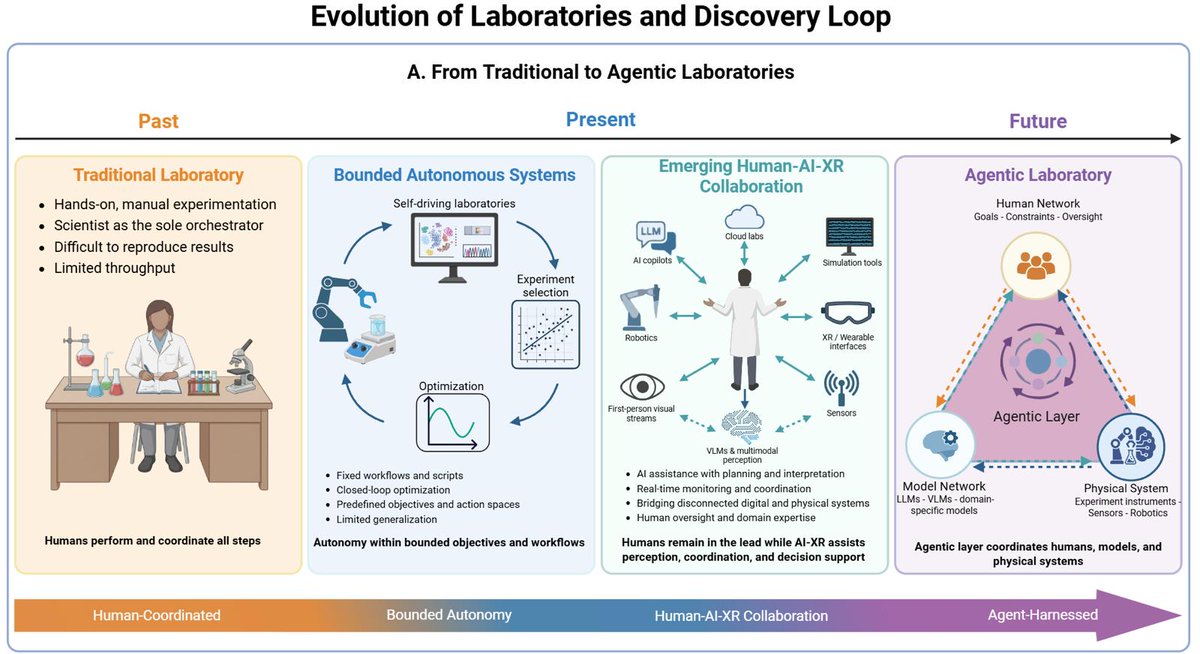
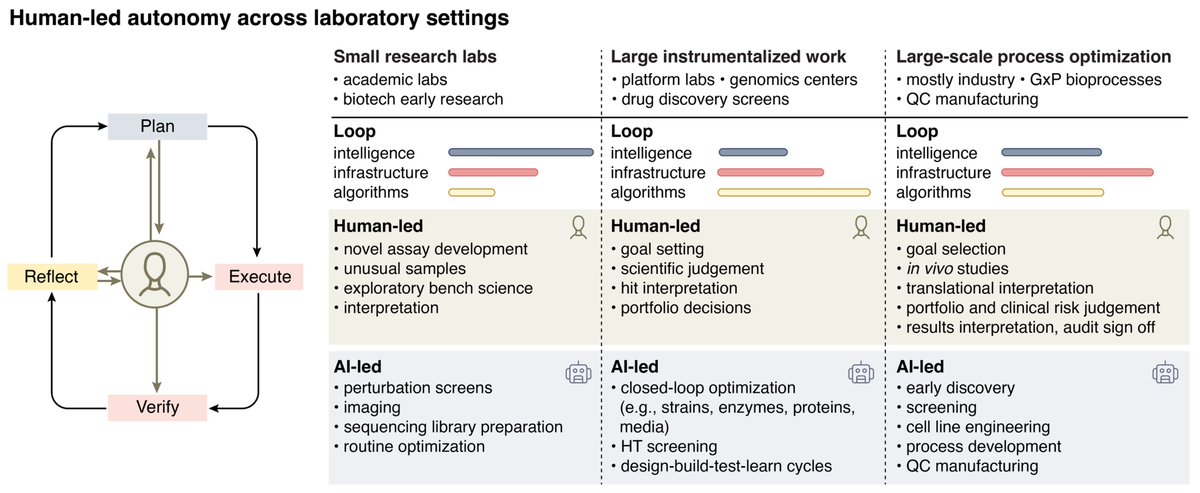
In our perspective, we argue that the next generation of labs should be human-in-the-lead and AI-empowered, integrating human intent, machine reasoning, and physical experimentation through scientific world models and an agentic harnessing layer.
Done responsibly, these systems have the potential to make scientific discovery more programmable, reproducible, adaptive, and scalable while enabling scientists to focus on higher-level scientific reasoning and discovery.
It's been a privilege to pursue this Perspective with @MengdiWang10 and an outstanding group of scientists and innovators advancing the intersection of computation, AI, science, and medicine. We're excited to continue exploring where this vision leads.
Our preprint: https://t.co/aKEkUIaNwb
Preprint led by Jian and Aviv team: https://t.co/yOzQ6cI9XD
This also kicks off a new Gladstone-Stanford AI Hub efforts, led by Katie Pollard at @GladstoneInst and myself, with an amazing team of scientists including Emma Lundberg (@Prof_Lundberg), Brian L Trippe (@brianltrippe ), Anshul Kundaje (@anshulkundaje ), Barbara Engelhardt (@BeEngelhardt), Christina Theodoris (@TheodorisLab), Catherine Tcheandjieu (@ines_catherine), Bruce Conklin, Alexander Marson, Stacie Dodgson (@StacieDodgson), Seth Shipman (@seth_shipman), Vijay Ramani, Danielle Swaney (@dlswaney), and Nevan Krogan. Excited to be building together across two great institutions!
Thrilled to co-author this Perspective on the future of agent-driven autonomous labs! Great collaboration between @SCSatCMU@genentech@medra_ai. Check out the complementary Perspective from @MengdiWang10's team too — two angles on the same vision 🔬🤖
As a collaboration between my group at @SCSatCMU, Aviv Regev's team at @genentech, and @michellearning's team at @medra_ai, we are pleased to share our Perspective, "Towards human-led, agent-driven autonomous laboratories for the life sciences." 🤖 https://t.co/tJBVnIXtTr
This preprint release is coordinated with a complementary Perspective by @MengdiWang10, @lecong, and colleagues: https://t.co/x2AFNMmEkC. Together, the two Perspectives examine the future of autonomous science from complementary angles.
Our Perspective was Led by @WenduoC in my group, with @mishamamq, @ShenShuaik4260 and @zocean636 at CMU; Anna Hupalowska, Jennifer Rood, Christine Bakan, and Aviv Regev at @genentech/@Roche; and Gaurav Agrawal and @michellearning at @medra_ai.
🚀https://t.co/tJBVnIXtTr
As a collaboration between my group at @SCSatCMU, Aviv Regev's team at @genentech, and @michellearning's team at @medra_ai, we are pleased to share our Perspective, "Towards human-led, agent-driven autonomous laboratories for the life sciences." 🤖 https://t.co/tJBVnIXtTr
This preprint release is coordinated with a complementary Perspective by @MengdiWang10, @lecong, and colleagues: https://t.co/x2AFNMmEkC. Together, the two Perspectives examine the future of autonomous science from complementary angles.
Our Perspective was Led by @WenduoC in my group, with @mishamamq, @ShenShuaik4260 and @zocean636 at CMU; Anna Hupalowska, Jennifer Rood, Christine Bakan, and Aviv Regev at @genentech/@Roche; and Gaurav Agrawal and @michellearning at @medra_ai.
🚀https://t.co/tJBVnIXtTr
CENO: A Genome-Scale World Model for Evolutionary Sequence Interpretation and Programmable Regulatory Design
1 CENO is presented as a “genomic world model”: one autoregressive generative system that keeps nucleotide-resolution state over very long contexts, can score counterfactual mutations via likelihood deltas, can condition on homologous evidence (MSA), and can generate sequences for downstream structural/functional objectives.
2 The core architecture is a hybrid causal backbone that interleaves Mamba-2 sequence-mixing blocks, sparse attention blocks, and mixture-of-experts capacity. Models are trained at 300M/600M/1B total parameters (about 100M/200M/400M active parameters per token).
3 A staged context curriculum separates model scale, context length, and data composition: Stage I/II at 8k tokens on broad cross-domain genomes; Stage III continues at 131k tokens; Stage IV continues at 1M tokens using long windows from complete eukaryotic genomes. This is used to test whether whole-genome continuation improves gene-scale reconstruction and long-range reasoning (not just accepting longer inputs).
4 Practical long-context inference is a key claim: in long-prefill and sustained decoding benchmarks, CENO maintains high tokens/s/GPU at 131k context and avoids OOM failures seen in some large long-context baselines under matched setups.
5 Long-range “use of context” is probed directly. In a synthetic DNA needle-in-a-haystack retrieval assay, distant inserted sequences measurably shift terminal base predictions across 32k–1M contexts, with retrieval generally improving with model size and later long-context training.
6 Without any task-specific fine-tuning, long-context continuation produces chromatin-scale signals: attention maps show higher within-TAD vs across-boundary attention at 131k vs 8k, and this pattern generalizes across 5 human cell types and 5 mouse cell/tissue settings (strongest for the 600M and 1B models).
7 Frozen-state representations also encode boundary information: linear probes trained on hidden states (with the backbone frozen) distinguish TAD boundary bins from matched random bins, with AUROC rising markedly when using 131k vs 8k contexts in both human and mouse settings.
8 For interpretation, CENO is evaluated with a unified zero-shot variant-effect paradigm: score variants by reference–alternate log-likelihood deltas across a broad benchmark spanning splicing, expression/eQTL, enhancer–gene links, structural variants, ClinVar pathogenicity, BRCA, Mendelian/complex traits, and fitness assays. Aggregate rankings place long-context CENO-1B checkpoints near the top overall, while task-level leadership varies by dataset and context.
9 Long context yields the clearest functional gains where distance matters: on TraitGym, moving from 8k to 131k matched-input evaluation improves AUROC more strongly for distal variant–gene pairs (e.g., beyond 100 kb), consistent with long-range regulatory dependency.
10 For generation, CENO is tested on (a) partial-gene continuation across eukaryotic, bacterial, and archaeal species, where recovery improves with scale and later whole-genome long-context training, and (b) structure-guided long insertion design at boundary-deletion and neo-domain loci. Candidates are selected with one structure oracle (Akita) and evaluated with a held-out model (AlphaGenome), showing cross-model transfer for boundary restoration at specific loci and partial attenuation of ectopic contacts in a duplication setting.
11 Evolutionary conditioning is added via post-training on packed real MSA contexts (CENO-P): row-local layers preserve within-sequence modeling while fusion layers allow homologous rows to condition target representations. Variant scores remain simple likelihood deltas under the same MSA context, and post-training substantially improves BRCA1/2 AUPRC versus the matched pretrained backbones.
12 On cross-species conservation/enrichment benchmarks, CENO-P ranks first across multiple species panels with strong odds ratios, suggesting the MSA-conditioned likelihood interface captures evolutionary constraint signals broadly across clades when homologs are available.
13 For programmable regulatory design, CENO is used as the backbone of a mouse cortex cell-type-specific enhancer workflow: a CENO-based accessibility oracle is trained on scATAC-seq peak regions, interpretable motif grammar is extracted via in silico mutagenesis, and a conditional generator is optimized via supervised fine-tuning plus GRPO-based reinforcement learning to increase predicted target-cell accessibility while penalizing off-target activity.
📜Paper: https://t.co/URqrsYNuTW
#ComputationalBiology #Genomics #DNAFoundationModels #LongContext #GenerativeModels #VariantEffectPrediction #MSA #Evolution #RegulatoryGenomics #EnhancerDesign
Very excited to share our @ScienceMagazine paper on single-cell #3D#genome reorganization in #Alzheimer's disease.
We jointly measured gene expression and 3D genome architecture in individual human brain cells using #GAGEseq, then integrated these data w/ chromatin accessibility and spatial transcriptomics. We uncovered increased #compartment #mingling and distance-dependent rewiring of gene regulatory contacts in AD.
We also developed #Hicformer, a transformer-based model that integrates DNA sequence with 3D genome features to predict cell type-specific gene expression and prioritize candidate regulatory elements.
Huge kudos to co-first authors @zocean636 and @xinyuelu1999; and many thanks to Zhijun Duan @UW, Hansruedi Mathys @PittTweet, & David Bennett @rushalzheimers for the wonderful collaboration, as well as to all our co-authors. @CarnegieMellon@SCSatCMU@CMUCompBio #AlzheimersDisease #3DGenome #SingleCell #AI
https://t.co/G3yPdRMeym
We are excited to announce our new paper GO-CRE! In the paper we use Reinforcement Learning on our DNA Language Model “HybriDNA” to generate cell type-specific CREs. We deconvoluted each iteration of RL to interpret the model’s learning trajectories of CRE grammar and validated the generated sequences under MPRA.
It has been a long work after many things happened to the AI4S team I interned at Microsoft. It wouldn’t have been possible without @fiberleif and @ZeyuCHEN19 ‘s great mentorship!
Hi folks, back to twitter after 2 yrs~I would like to share my lab's first work entitled "Reconstructing sequence-grammar trajectories enables interpretable and tunable cis-regulatory element design", posted on bioRxiv: https://t.co/Yh1cugwalC
Hi folks, back to twitter after 2 yrs~I would like to share my lab's first work entitled "Reconstructing sequence-grammar trajectories enables interpretable and tunable cis-regulatory element design", posted on bioRxiv: https://t.co/Yh1cugwalC
Happy to share that our SkillFoundry paper is now accepted to #COLM2026@COLM_conf ! This space is moving incredibly fast around agentic AI for scientific discovery. @ShenShuaik4260 and @WenduoC in my group have been pushing on several exciting projects in this direction
Scientific agents are getting powerful, but they still rarely work together out of the box. Each agent has its own interface, assumptions, tools, and artifacts. Composing them into a reliable workflow still takes a lot of manual wiring.
We built AgentCo-Op to make agents cooperate. Given a task, AgentCo-Op retrieves relevant agents, tools, skills, repos, datasets, and workflow priors, then synthesizes an executable multi-agent workflow with typed artifact handoffs and bounded local repair. Instead of designing every workflow from scratch, AgentCo-Op turns existing scientific agents and tools into interoperable workflow components.
Project: https://t.co/trq6nOo5W7
Paper: https://t.co/pYRWiPOtQb
Code: https://t.co/rOwOBncz3S
Thanks to my co-authors @WenduoC, Shike Wang, @mishamamq, and @jmuiuc for guidance and support throughout this work.
#MultiAgent #LLMAgents #AI4Science #ComputationalBiology
A lot of scientific know-how already exists in Gtihub repos, APIs, notebooks, docs, and research papers. But agents still cannot really make use of it out of the box because it is scattered everywhere,
We built SkillFoundry to bridge that gap. It turns fragmented scientific resources into reusable #skills that agents can actually use.
The basic idea is to use a Domain Knowledge Tree to guide the search, mine candidate skills from heterogeneous resources, package them into executable skills, test them automatically, and then keep refining the library based on what works, what fails, and what overlaps.
With the agent skills automatically designed by SkillFoundry, we see gains on 5/6 MoSciBench datasets, and Codex + SkillFoundry does much better on cell annotation than Codex alone, while staying competitive with systems like SpatialAgent.
We also gave Biomni automatically designed skills from SkillFoundry for the scDRS workflow, and it outperformed Biomni running on its own.
Project: https://t.co/D18DwSXdgz
Paper: https://t.co/PHwjPswN0g
Thanks to my co-authors @WenduoC@mishamamq@TurcanAlistair@martinjzhang and @jmuiuc for guidance and support throughout this work.
We are sharing SkillFoundry, a framework for converting heterogeneous scientific resources into validated #agent#skills. In addition to benchmark improvements, we show utility on genomics workflows. Still early, but very encouraging. https://t.co/98YD27iHwj
Glad to share some side work I did in the summer! RCCR is a simple yet powerful fine tuning strategy for tasks that are intrinsically Reverse-Complement consistent. It is a plug-in replacement of the standard DNA LM finetuning!
Reverse–Complement Consistency for DNA Language Models
1. This paper introduces Reverse-Complement Consistency Regularization (RCCR), a novel method to enhance the reliability of DNA language models by ensuring predictions are consistent between a DNA sequence and its reverse complement. This addresses a critical issue where existing models often fail to capture the inherent symmetry of DNA sequences, leading to inconsistent and unreliable predictions.
2. RCCR is a model-agnostic fine-tuning objective that directly penalizes the divergence between a model’s prediction on a sequence and the aligned prediction on its reverse complement. It is applicable across diverse tasks including sequence classification, scalar regression, and profile prediction, demonstrating its versatility and broad applicability.
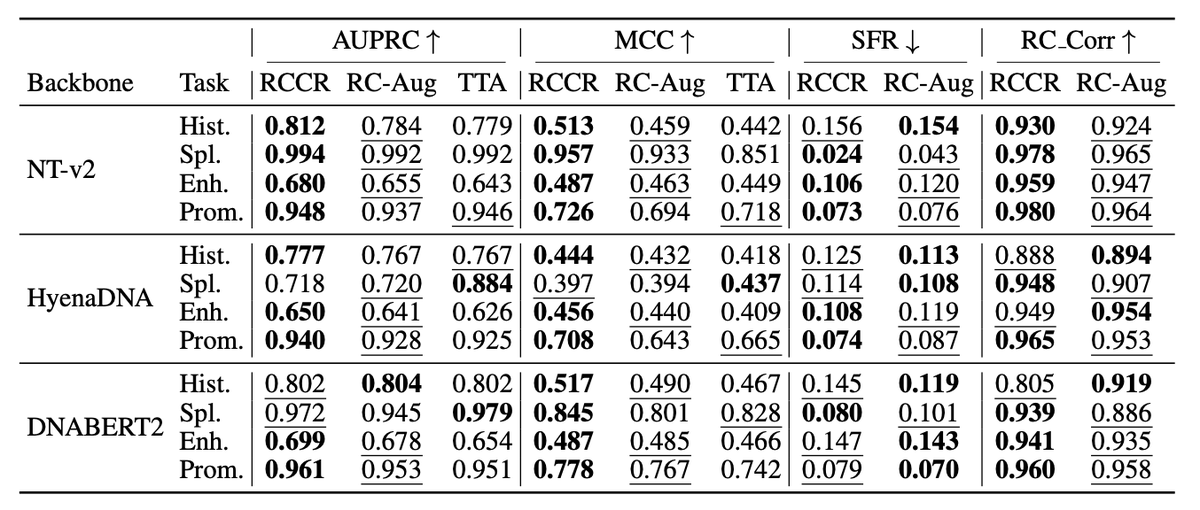
3. The method is evaluated on three different backbone models—Nucleotide Transformer, HyenaDNA, and DNABERT-2—and shows substantial improvements in robustness and accuracy. RCCR reduces prediction flips and errors while maintaining or improving task accuracy compared to existing methods like RC data augmentation and test-time averaging.
4. RCCR incorporates a key biological prior directly into the learning process, making it an intrinsically robust and computationally efficient solution. It produces a single, robust model without doubling inference cost, unlike test-time averaging.
5. Theoretical guarantees are provided, showing that symmetrization is risk non-increasing under RCCR and that global minimizers are RC-consistent with RC-symmetric labels. This ensures that enforcing agreement during training does not sacrifice task performance.
6. RCCR introduces a compact RC robustness suite (SFR, RC-Corr) to standardize the reporting of orientation robustness alongside task metrics. This allows for more comprehensive and comparable evaluations across different models and tasks.
7. The experiments include a negative control on strand-specific prediction, demonstrating that RCCR is not suitable for tasks that require explicit RC variation. This highlights the importance of applying RCCR appropriately based on the biological context of the task.
8. The authors conclude that RCCR is a powerful tool for improving the reliability and interpretability of DNA language models by directly encoding a fundamental biological prior. Future work could explore extending this approach to other biological symmetries and generative models.
📜Paper: https://t.co/3iCPlpxK2U
#DNALanguageModels #ReverseComplement #Genomics #ModelRobustness #Bioinformatics
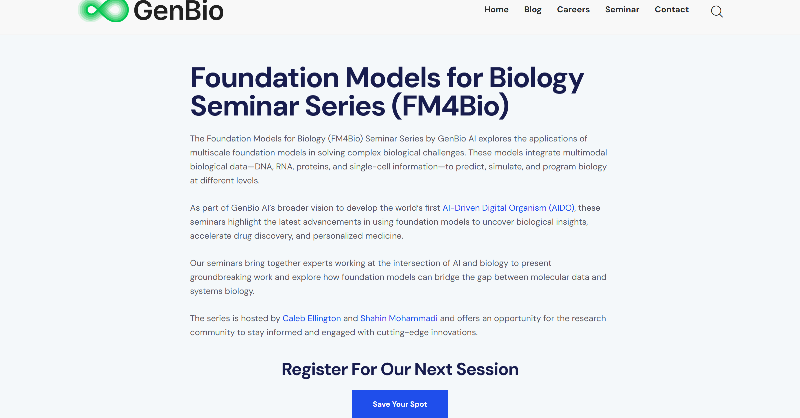
🔬 How's AI transforming biology?
📡 FM4Bio Seminar Series—exploring how foundation models simulate, predict & program life (DNA → cells).
🧬 Join top AI + bio researchers.
👉 https://t.co/1lagKHG2P3
🚀 Research Update!
Excited to share HybriDNA: A Hybrid Transformer-Mamba2 Long-Range DNA Language Model, now on arXiv!
DNA is the language of life, but modeling it is challenging: ultra-long sequences, single-nucleotide precision, and the need for both understanding & generation. HybriDNA tackles this with a decoder-only Hybrid Transformer-Mamba2 model, scaling to 131kb context & achieving SOTA across 33 DNA tasks! 🧬
🔹 Hybrid Transformer-Mamba2 for long-range genomic modeling
🔹 SOTA on BEND, GUE & LRB benchmarks
🔹 Scales up to 7B params, improving with size
🔹 Efficient long-context DNA modeling
📄 Read here: https://t.co/ELX9fA3MlU
🌐 Project page: https://t.co/MQGJ1nvIlb
Huge thanks to my co-authors @_albertgu, @tri_dao from Princeton and CMU, and all the researchers at MSR AI for Science. Special gratitude to my mentors @fiberleif and @TaoQin for their continuous support!
#MachineLearning #Genomics #AI4Science #DNA #FoundationModels #HybriDNA