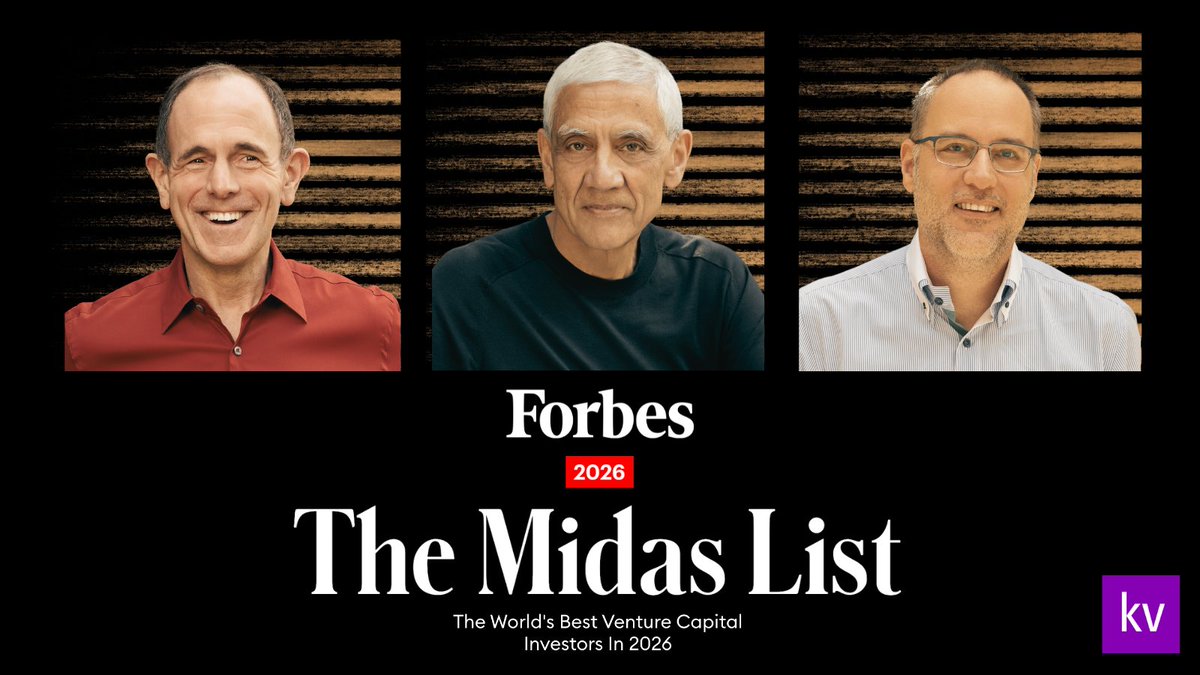
A landmark day for KV: @vkhosla named #1 on the @Forbes Midas List, 25 years after topping the inaugural edition. First at the birth of the internet. Now at AI’s defining moment. This year, he’s recognized for the first institutional check into @OpenAI – when others saw a not-for-profit research lab with no product and no revenue, Vinod saw the start of the most transformative technology shift in history.
Congrats to managing partners @rabois and @SStrohband, recognized for their early bets on @tryramp and @DoorDash, and @RocketLab and @gitlab 🎉
At KV, we back founders bold enough to make the impossible possible. This recognition belongs to the entrepreneurs who see the future before it exists.
https://t.co/ie8IMO4lP6
These numbers are shocking. It's like we got a new frontier AI model but for the body.
Lilly's phase 3 results for retatrutide:
> highest dose lost 28.3% of body weight in 80 wks
> 70 lbs ave
> 45% lost 30% or more of their body weight
> 65% on the top dose no longer clinically obese
Retatrutide is more dynamic than semaglutide and tirzepatide because it targets three receptors (GIP, GLP-1, and glucagon), versus one and two, respectively.
Side effects, on the highest dose (12mg), were higher for retatrutide than tirzepatide (nausea and GI), with an 11.3% drop out rate. The lowest 4mg dose still delivered 19% loss with fewer dropouts than placebo.
Robots cracking an egg, slicing tomatoes, cooking an actual omlette, ... pretty unbelievable for 2026! The rate of progress in both hardware and software is awesome.
Anthropic Says Life Sciences Is Its Biggest Bet After Code.
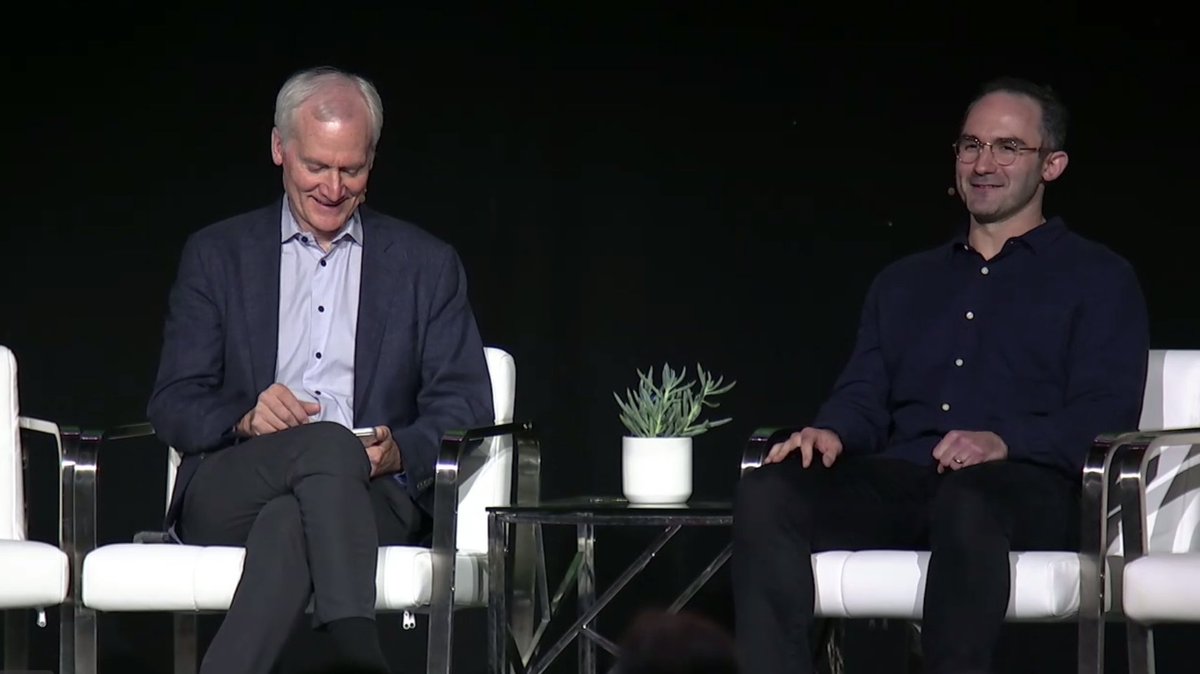
Eric Kauderer-Abrams started @AnthropicAI 's life sciences division ten months ago. He took on the stage at @SynBioBeta with Marc Tessier-Lavigne from @Xaira_Thera , and what caught my attention was how plainly Eric stated the following:
"The greatest opportunity to have a beneficial, scaled impact with everything that's happening in frontier AI is in the life sciences."
After coding, it's their biggest investment area. They've been training Claude on bioinformatics, chemistry, molecule design, structural biology, clinical regulatory. Their models went from mediocre in life sciences to roughly PhD level across most domains in under a year. That's a steep curve.
But what I found more telling than the benchmarks was the infrastructure they're building around it. Wet labs for basic research so their own scientists hit the walls firsthand. An acquisition of Coefficient Bio (acquired by Anthropic) to teach @claudeai how to think like a biotech program manager, not just a bench scientist. The gap between "Claude can answer a biology question" and "Claude can help you run a drug program" is enormous, and they're clearly aware of it.
Marc mentioned that 90% of drugs fail in the clinic. Two-thirds of those failures aren't bad science, but patient matching. You have a good target, a good drug, and you can't find who will respond. That's the problem both of them kept circling back to, and it's where causal AI models trained on real perturbation data might actually move the needle.
Marc said nobody's pushing a button for a development candidate anytime soon. But Anthropic went from $1B to $30B in revenue in sixteen months. That kind of resource behind this kind of focus is new. It's fun to think of what R&D can look like in the next few months!
#SynBioBeta2026 #SyntheticBiology #Biotech #AIxBio
The @KariusInc metagenomic blood test (infectious disease liquid biopsy) can identify/diagnose brand new emergent infectious agents (e.g. R. lanei), due to the breadth and power of its sequencing based assay and AI interpretation tools. Hyperscaling #Biosecurity
https://t.co/kNeMq31mBd
A milestone day for clinical trial innovation.
We’re announcing the first real-time clinical trials, where @US_FDA can see data signals and endpoints in real time. A quick explainer:
Every startup should run cash like a Formula One car. Full speed on the straight. Brake as late and hard as possible into the curve.
The danger does not come from a high burn rate - but from not being able to change it rapidly when things change.
A recent conversation with our portfolio founder on risk and burn management, and the metrics that actually matter:
https://t.co/zjEyfoEHtQ
Here's YC's official advice about being truthful and precise about what is pilot, bookings, revenue and recurring revenue.
Founders, particularly first time founders, need to sear this into their brains. Don't mistake one tier for another. Be precise, and always be truthful.
Steve Jobs walked into a room full of MBA students and asked how many were going into consulting.
Hands went up.
He said their careers would be “like a picture of a banana.”
“You might get a very accurate picture. But you never really taste it.”
He spent 60 minutes explaining what actually builds careers:
"Without owning something over an extended period of time, where one has a chance to take responsibility for one's recommendations, where one has to see one's recommendations through all action stages and accumulate scar tissue for the mistakes and pick oneself up off the ground and dust oneself off, one learns a fraction of what one can."
He continues:
"Coming in and making recommendations and not owning the results, not owning the implementation, I think is a fraction of the value and a fraction of the opportunity to learn and get better."
"You do get a broad cut at companies, but it's very thin."
Then the line that made the room go silent:
"It's like a picture of a banana. You might get a very accurate picture, but it's only two dimensional. Without the experience of actually doing it, you never get three dimensional."
"So you might have a lot of pictures on your walls. You can show it off to your friends. You can say, look, I've worked in bananas, I've worked in peaches, I've worked in grapes."
"But you never really taste it."
The room applauded.
This was 1992. Jobs had been fired from Apple seven years earlier. He was running NeXT. He had scar tissue.
An MIT student asked him: where would Apple be if you hadn't left?
Jobs paused.
"I've obviously thought about this a lot. I think everybody lost. I think I lost. I think Apple lost. I think customers lost."
"And having said all that, so what? You go on. It's not as bad as a lot of things. Not as bad as losing your arm."
That's Steve Jobs. Getting fired from the company he built, comparing it to losing a limb, and shrugging.
He spent the rest of the talk explaining what he learned about building companies.
On competitive advantage:
"Hardware churns every 18 months. It's pretty impossible to get a sustainable competitive advantage from hardware. If you're lucky, you can make something one and a half or two times as good as your competitor. And it only lasts for six months."
"But software seems to take a lot longer for people to catch up with."
"I watched Microsoft take eight or nine years to catch up with the Mac, and it's arguable whether they've even caught up."
On technology windows:
"You can use the concept of technology windows opening and then eventually closing."
"Enough technology from fairly diverse places comes together and makes something that's a quantum leap forward possible. And a window opens up."
"It usually takes around five years to create a commercial product that takes advantage of that technical window opening up."
"And then it seems to take about another five years to really exploit it in the marketplace."
He gave examples from his own life:
Apple II lasted 15 years. DOS lasted 15 years. Mac was eight years old at the time and would easily last another five.
"These things are hard. They don't last because it's convenient, or even because it's economic. They last because this is hard stuff to do."
On management:
"I've never believed in the theory that if we're on the same management team and a decision has to be made, and I decide in a way that you don't like, and I say, come on, buy into the decision."
"Because what happens is, sooner or later, you're paying somebody to do what they think is right, but then you're trying to get them to do what they think isn't right. And sooner or later, it outs."
His approach:
"The best way is to get everybody in a room and talk it through until you agree."
Then this:
"We don't pay people to do things. That's easy, to find people to do things."
"What's harder is to find people to tell you what should be done. That's what we look for."
"So we pay people a lot of money, and we expect them to tell us what to do. And when that's your attitude, you shouldn't run off and do things if people don't all feel good about them."
A student asked: what's the most important thing you learned at Apple that you're doing at NeXT?
Jobs thought for a moment.
"I now take a longer-term view on people."
"When I see something not being done right, my first reaction isn't to go fix it. It's to say, we're building a team here. And we're going to do great stuff for the next decade, not just the next year."
"So what do I need to do to help so that the person that's screwing up learns, versus how do I fix the problem?"
"And that's painful sometimes. And I still have that first instinct to go fix the problem."
"But taking a longer-term view on people is probably the biggest thing that's changed."
On not knowing your own competitive advantage:
"A lot of times you don't know what your competitive advantage is when you launch a new product."
"When we did the Macintosh, we never anticipated desktop publishing. Sounds funny, because that turned out to be the Mac's compelling advantage."
"We anticipated bitmap displays and laser printers. But we never thought about PageMaker, that whole industry really coming down to the desktop."
"But we were smart enough to see it start to happen nine to twelve months later. And we changed our entire marketing and business strategy to focus on desktop publishing."
"And it became the Trojan horse that eventually got the Mac into corporate America."
The same thing happened at NeXT.
They built software to help developers create apps faster. Their target customers were Lotus, Adobe, WordPerfect.
Then big companies started showing up and saying: "You don't understand what you've got. The same software that allows Lotus to create their apps faster is letting us build our in-house apps five to ten times faster."
"And you dummies don't even know it."
Jobs admitted: "It took them about three months before we finally heard it."
On hiring:
"It seems like all the good people I really want to hire, it takes me a year to hire them. It's always been that way, even at Apple."
"I usually meet somebody that is really good. And you can't get them. And then you go try to find other people. And nobody measures up."
"When you meet somebody that good, you always compare them to this one person. And you know you're going to be settling for second best if you compromise."
"And I've always found it best not to compromise, and just keep chipping away."
His VP of Marketing took a year and a half to hire.
"And they're all worth it."
This talk is Steve Jobs at his most unfiltered. A founder with scar tissue explaining what he learned the hard way.
This 60 minute MIT lecture will teach you more about building companies than every startup book you've read combined.
Bookmark & give it an hour, no matter what.
Japanese engineers developed a “Sword Tip Visualization System” for the Fencing World Championships, and it makes fencing look absolutely incredible to watch.
Paul Graham spent 20 years watching founders and found the visionary model was backwards.
Bill Gates built a BASIC interpreter for a machine with a few thousand users. Mark Zuckerberg built a website so Harvard undergrads could stalk each other. Neither one knew what they were going to become.
That is the opposite of how every startup school, pitch deck, and vision statement tells you to operate. You're supposed to walk in with a 10-year roadmap. TAM charts. A precise picture of the future you're building.
The people who built the biggest companies didn't have a precise vision. They had a direction. Gates had "microcomputers are interesting." Zuckerberg had "Harvard undergrads will use this." That was the entire thesis.
The math explains why. If your target is 10 years out and 100x bigger than anything that exists, every assumption in your model compounds error. Interest rates move. Hardware costs collapse. A competitor pivots. By year three the roadmap is a museum piece and you're optimizing for a world that never arrived.
Graham's analogy is Columbus. Columbus didn't have a map of the New World. He had "there's something to the west" and a boat. The destination was wrong, the continent was wrong, the math on how far was wrong. The direction was right, and the direction was enough.
The inversion every founder gets wrong: the popular image of the visionary is someone who sees the future precisely. Empirically, it's someone who sees it blurry and walks toward the blur while everyone else is drawing detailed maps of imaginary places.
Gates didn't set out to dominate microcomputer software for four decades. Zuckerberg didn't set out to build a universal vacuum for human time. They started with something small that worked, and the opportunity to move came later.
The VCs who fund vision decks and the founders who write them are playing the same game. The founders who actually built those companies weren't in the room.
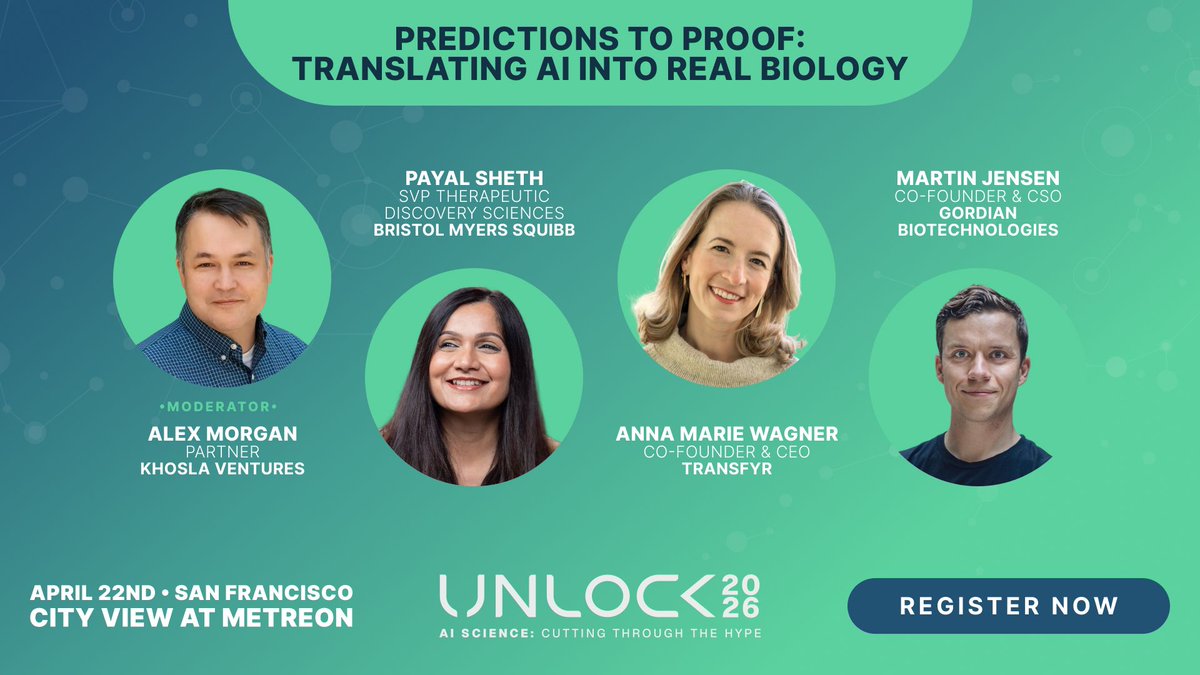
AI can design new molecules, but how do you get them into the real world? Payal Sheth (SVP @ Bristol Myers Squibb), @AnnaMarieWagner (Transfyr), and @MartinBJensen (@GordianBio) dig into where digital-to-physical breaks down in biology. Moderated by @genomicsdoc@khoslaventures