We’ve received notice that the Department of Commerce has lifted export controls on Claude Fable 5 and Mythos 5.
We'll begin restoring access tomorrow, and will share an update soon.
We’re grateful to our users for their patience, and to everyone who worked with us on redeploying the models.
As engineering, product, design, DS, etc. melt into a new kind of role, I was reflecting on what roles might look like in the future. For example, when I look at the Claude Code team I see what I think is five archetypes:
1. Prototyper: comes up with brand new ideas; churns out many ideas, most of which don't ship
2. Builder: quickly turns a prototype/idea into production-grade product/infra
3. Sweeper: cleans up the UI, simplifies the code and system, unships, optimizes performance
4. Grower: takes a product that has been built and iterates on it to improve Product-Market Fit
5. Maintainer: owns a mature system to make it secure, reliable, fast, and efficient as it scales
Many people span across 2 roles, and sometimes 3 roles. I also notice that these roles are not really tied to job function -- eg. across Anthropic, some designers match category 1, some 2, some 3; same for engineers, PM, DS.
A healthy team needs a mix of these, depending on the product:
- A product that is new and pre-PMF needs people that are strong at 1+2+3
- A product that is growing and has found PMF needs 2+3+4 and some 5
- A product that has strong PMF needs 3+4+5 and some 2
Maybe product roles of the future will look more like this, and less like the domain-specific roles of today?
At Hugging Face we've been building our own agent that we use via Slack (Moon Bot). Honestly, building your own is quite simple and you'll be happy you did: any model you want (self-hosted if needed), fully customizable to your stack (drop in a skill file and it can use any internal tool, codebase, or DB), your data never leaves your infra, every session auditable in your own bucket. and ofc no lock-in and no waitlist and not overpriced :).
read more: https://t.co/7l1w3cib0M
Introducing Claude Tag, a new way for teams to work with Claude.
In Slack, Claude joins as a team member with access to the channels and tools you choose. Tag Claude in and delegate tasks to it while you focus on other work.
Claude Code and Claude Design now sync both ways.
Run /design-sync to pull your design system into your repo and build against your real components, or push what you've built back into Claude Design and keep editing on the canvas.
New in Claude Design: it stays on brand with your design system across projects, lets you edit directly on the canvas, syncs with Claude Code, and connects to more of the tools you already use.
Introducing Claude Fable 5: a Mythos-class model that we’ve made safe for general use.
Its capabilities exceed those of any model we’ve ever made generally available.
Each time we release a model, we run the same test: give it code that trains a small AI model, ask the new model to speed it up. It takes a skilled human 4-8 hours to reach 4x faster.
In May 2024, Claude Opus 4 averaged a ~3x speedup. This April, Mythos Preview achieved ~52x.
In the last 6 months at @Ahrefs, we analyzed over 1 billion data points across 14 studies. Here's what we learned about AI search optimization:
1) "Best X" blog listicles are the single most prominent content format cited by AI chatbots. They make up 43.8% of all page types cited by ChatGPT specifically.
2) 67% of ChatGPT's top 1,000 citations come from sources marketers can't influence: Wikipedia (29.7%), homepages (23.8%), app stores (6.6%). Only 32.3% are influenceable content like educational pages, reviews, news, and blog posts.
3) 28.3% of ChatGPT's most-cited pages have zero Google organic visibility. These pages get cited repeatedly by ChatGPT despite not ranking in Google at all. A completely separate discovery layer.
4) ChatGPT only cites about 50% of the URLs it retrieves. It fetches dozens of pages per query but uses half as background context without attribution. This means that being retrieved and being cited are very different things.
5) Adding schema markup had zero meaningful impact on AI citations. AI Overviews actually dipped −4.6%, while AI Mode (+2.4%) and ChatGPT (+2.2%) showed changes indistinguishable from zero.
6) YouTube mentions have the highest correlation (0.737) with AI brand visibility out of all the factors we studied (including all the conventional SEO metrics like backlinks, page count, DR, etc). This held true for both Google-owned and OpenAI products.
7) AI Overviews reduce clicks to the #1 result by 58%. That’s up from 34.5% just 10 months earlier. The trend is accelerating.
8) 99.9% of AI Overviews appear on informational intent queries. Transactional, navigational, and local searches are almost entirely AIO-free. Shopping triggers AIOs just 3.2% of the time.
9) For a given search query, Google’s AI Mode and AI Overviews reach the same conclusions 86% of the time — but cite almost entirely different sources (only 13.7% citation overlap).
10) AI Overviews change every 2.15 days on average, with 70% of content differing between consecutive observations. But semantic similarity stays at 0.95. The words, sources, and entities constantly shuffle, but the actual meaning barely moves.
With 𝗮𝗱𝘀 𝗶𝗻 𝗔𝗜 𝗠𝗼𝗱𝗲, your brand doesn’t just show up - 𝗶𝘁 𝗮𝗻𝘀𝘄𝗲𝗿𝘀.
At #GML2026, we announced that we are testing a new generation of ad formats in AI Mode. Powered by Gemini, these ads are more visual, capable of reasoning, and bring a new level of helpfulness to both the user and the advertiser.
Here are three new formats we are testing to help you reach high-intent customers in AI Mode:
🛒 𝗗𝗶𝗿𝗲𝗰𝘁 𝗢𝗳𝗳𝗲𝗿𝘀
💬 𝗖𝗼𝗻𝘃𝗲𝗿𝘀𝗮𝘁𝗶𝗼𝗻𝗮𝗹 𝗗𝗶𝘀𝗰𝗼𝘃𝗲𝗿𝘆 𝗮𝗱𝘀
✨ 𝗛𝗶𝗴𝗵𝗹𝗶𝗴𝗵𝘁𝗲𝗱 𝗔𝗻𝘀𝘄𝗲𝗿𝘀
Explore everything we announced by visiting Accelerate with Google:👇
https://t.co/54M3WZy1hA
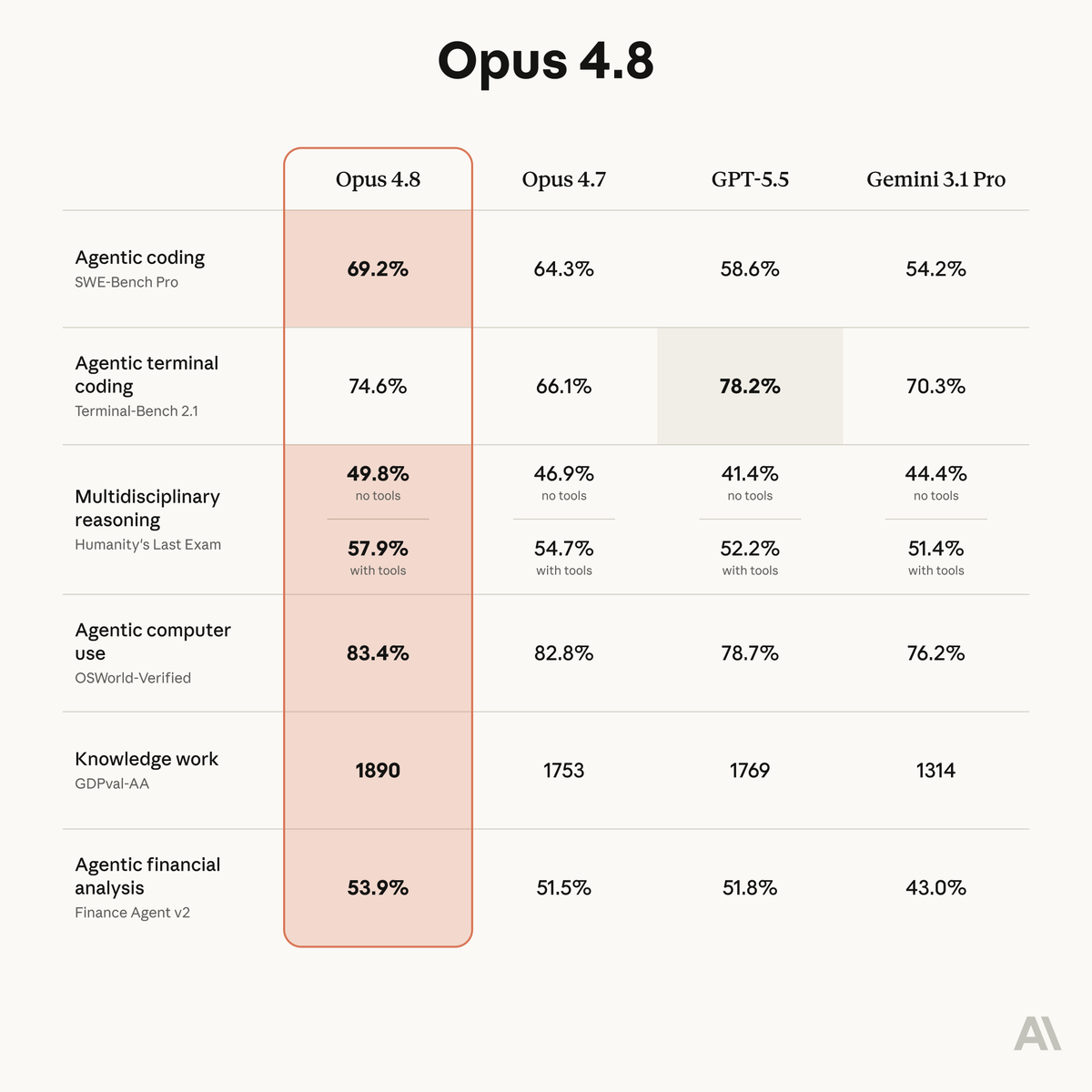
Introducing Claude Opus 4.8: it builds on Opus 4.7 with sharper judgment, more honesty about its own progress, and the ability to work independently for longer than its predecessors.
Available today at the same price.
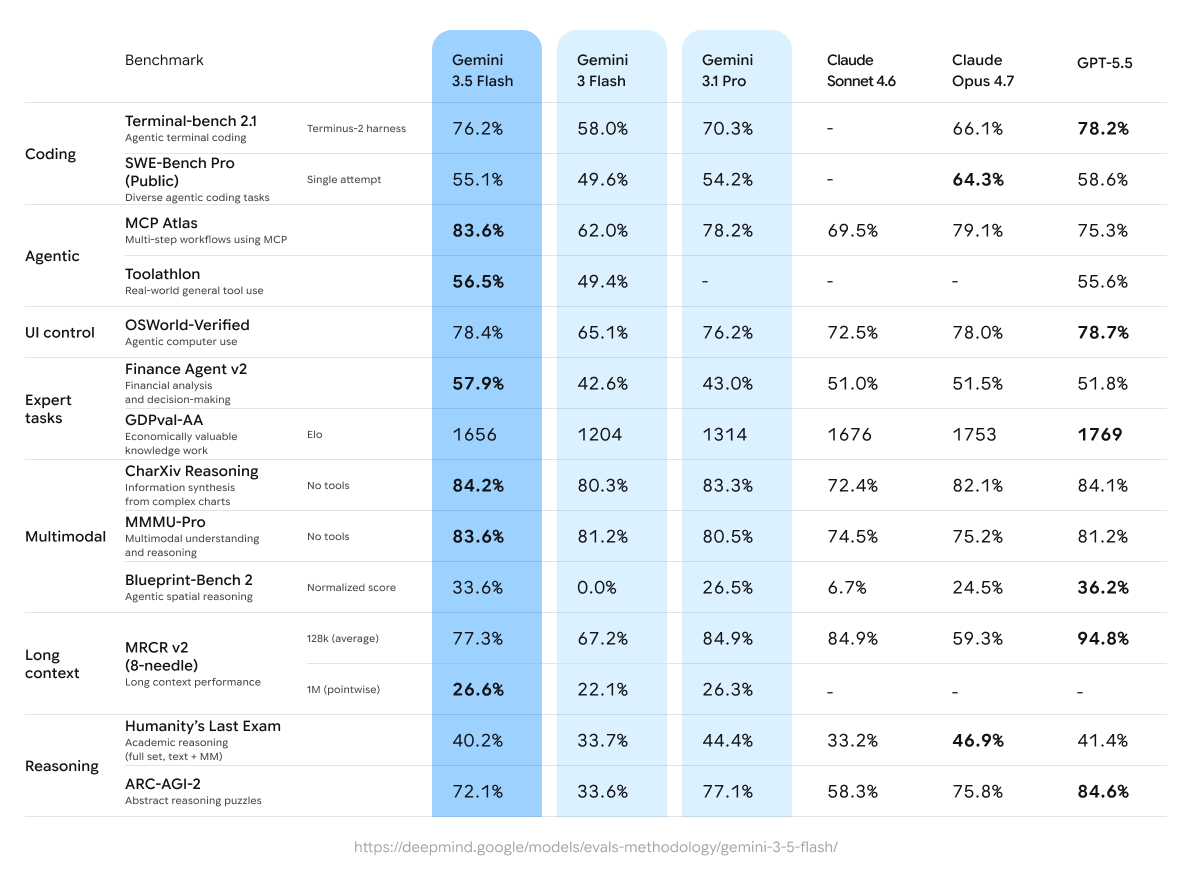
Welcome to Gemini 3.5 Flash, our most powerful model to date. It pushes the frontier of intelligence, speed, and cost putting 3.5 Flash in a class of its own.
We spent the last 6 months making sure Flash is great for real world use cases. It's available everywhere now!
Personal update: I've joined Anthropic. I think the next few years at the frontier of LLMs will be especially formative. I am very excited to join the team here and get back to R&D. I remain deeply passionate about education and plan to resume my work on it in time.
The need and opportunity for professional services and FDEs to deploy agents right now is massive.
Every tech wave offers a new era of consulting and tech services requirements. Moving from analog to digital led to a massive wave in the 90s. Moving from on-prem to cloud did the same in the 2000s. But this is going to be at a scale far greater than the others.
The reason is that agents fundamentally change the underlying workflows of an organization. Unlike most prior eras of technology, where it was a change in medium of the service being delivered (on-prem CRM to cloud CRM), agents rewire the business process itself. And unlike upgrading a tech system, business processes are full of idiosyncrasies.
Every industry will have its own variants, and every department within those industries will have variants as well. Not to mention the bespoke difference between firms. Bringing agents to marketing in CPG will look different from marketing in healthcare. Bringing agents to sales in a B2B software company will look different from a car dealership.
And none of the change is easy technically. You need to first modernize your infrastructure and data and make sure it’s ready for agents; access controls, entitlements, and permissions need to be mapped in a way that works for agents and people; you need to make sure agents have the right context to work with; you need to consistently eval and maintain the agents when there are model upgrades; and you need to drive the change management of the process itself to figure out which parts the people do and what agents do.
That’s an insane amount of technical and domain-specific process work to be done to make this all happen. Huge opportunity for new service providers, as well as internally teams and roles to emerge, to help drive this change.
FAQ schema died twice from spam. The second time was last Wednesday.
The fix is a new schema .org type: FAQSection. I filed it.
https://t.co/PJ5IutjSmA