My detailed 65-hour exposure of a supernova focuses on a shockwave. I just wrapped it up, will be sharing it publicly Thursday assuming my proofs look good when they arrive next week.
You can see it in this photo of the milky way I took in 2023...
The Chandelier Cluster ✨🌟
Every "lightbulb" in this cosmic chandelier is actually an individual star, located about 27,000 light-years away.
This is a globular star cluster, which means it's a tightly packed group of stars held together by gravity: https://t.co/GTbyXKTwi5
Super! 💫
Data from @chandraxray has uncovered possible remains of a supernova in the middle of our Milky Way galaxy. If confirmed, this supernova piece would be one of the closest to our galaxy’s central black hole that we have ever found. https://t.co/gI5TfSJ45E
Could the Little Mermaid turn into stardust instead of seafoam?
It would seem so in this beautiful nebula. The featured image shows the Mermaid Nebula, also known as the Betta Fish Nebula, which is part of the G296.5+10.0 Supernova Remnant.
The blue color visible here originates from doubly ionized oxygen (OIII), while the deep red is emitted by hydrogen gas. Estimated to be located a few thousand light-years away and about 10,000 years old, this nebula was formed when a massive star exploded as a supernova.
It left behind a peculiar pulsar, a young radio-quiet neutron star that spins around about twice every second. The bright stars shown in the image are unassociated with the nebula. The pulsar can be detected in the X-rays but it does not have a confirmed detection in the optical (visible light) so far. As a result, the pulsar itself is not visible in this image.
Image Credit & Copyright: Data acquisition: Sy Ming Wong; Processing: Guangyan Gao
Text: Cecilia Chirenti (NASA GSFC, UMCP, CRESST II)
What is happening inside this unusual nebula?
Planetary nebula Tc 1, captured here in exquisite detail by the James Webb Space Telescope, is the celestial site where buckyballs were first identified in 2010.
Buckminsterfullerene — as buckyballs are officially called — is a molecule with 60 carbon atoms (C60) arranged in the shape of a soccer ball.
The molecule is named for architect Buckminster Fuller because of its resemblance to the geodesic dome he helped popularize. Webb’s new data reveal where the C60 molecules live in this nebula, and the geometry is striking: they populate a thin spherical shell around the central star, visible here as the bright edge of the nebula’s glowing orange central region.
Look closely near the nebula’s heart and a more perplexing feature emerges: a delicate structure shaped uncannily like an upside-down question mark, fitting punctuation for the many questions this nebula still poses.
Image Credit: NASA/ESA/CSA/J. Cami (Western University); Image Processing: K. Beecroft
Text: Jan Cami (Western University) & Cecilia Chirenti (NASA GSFC, UMCP, CRESST II)
This striking new view of the Pinwheel Galaxy combines X-ray light from Chandra with other types of light from ground-based observations, @NASAHubble, and XMM-Newton. The galaxy is roughly 170,000 light-years across, making it about 70% larger than our own Milky Way Galaxy.🌀
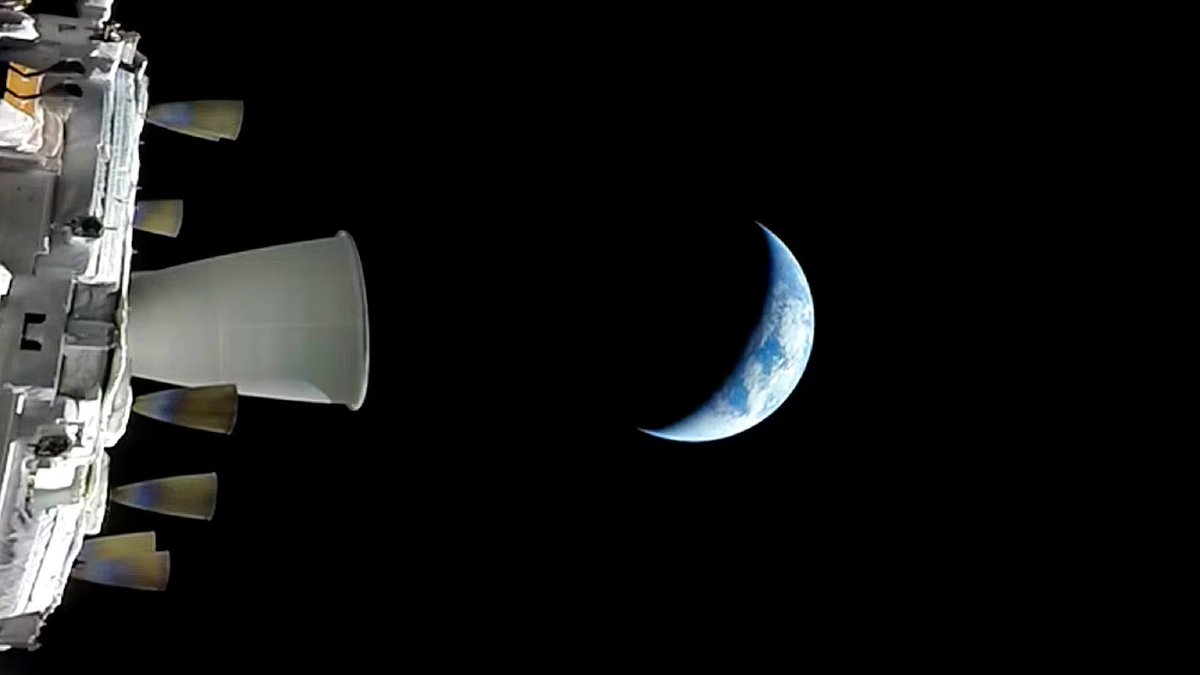
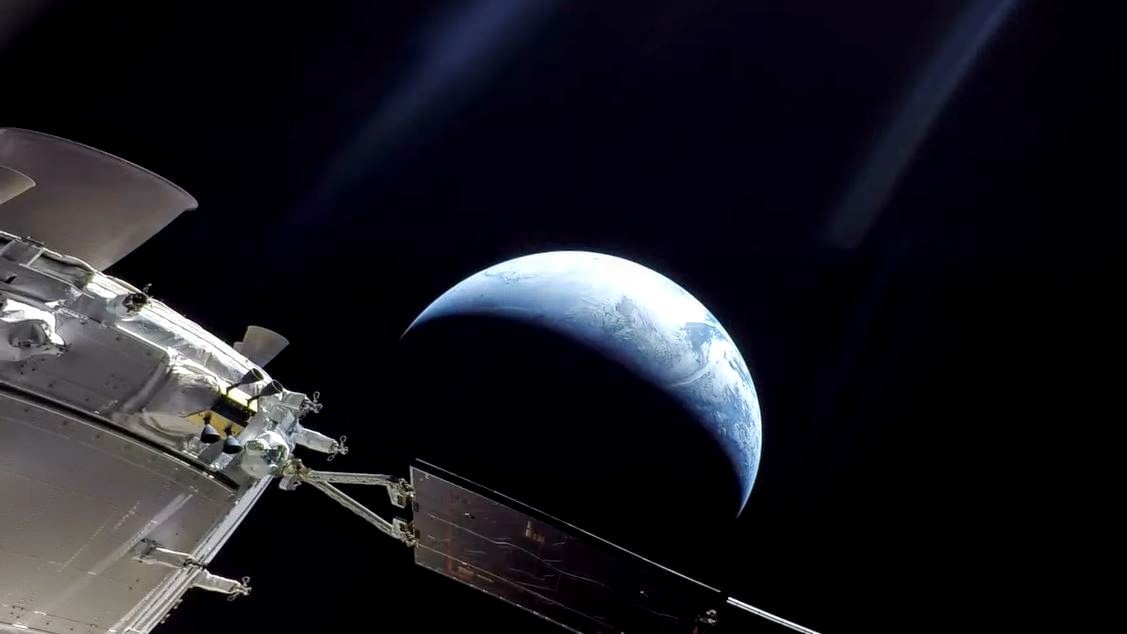
STUNNING🚨: Artemis II crew captured a stunning image of Earth this morning from 41,000 miles away.
The first time since 1972 that humans have seen a crescent Earth in full.
Astronomers have reported the detection of an unusually massive merger between two stellar-mass black holes, an event that sent powerful gravitational waves rippling across the universe.
The collision involved two black holes whose combined mass exceeded roughly 100 times the mass of the Sun, making it one of the most massive stellar-mass black hole mergers recorded so far.
Most mergers previously detected by observatories such as @LIGO and @ego_virgo involve systems totaling only a few tens of solar masses, so the sheer scale of this event immediately attracted attention.
The gravitational-wave signal allowed researchers to reconstruct the masses and dynamics of the binary system as the two black holes spiraled together and finally merged into a single, more massive remnant.
Events like this produce a characteristic “chirp” in gravitational-wave detectors as the orbit shrinks and the frequency of the waves rapidly increases just before the final collision. The newly formed black hole then briefly vibrates in what physicists call the ringdown phase, emitting gravitational waves that encode information about its mass and spin.
What makes this event particularly intriguing is that black holes of this size are not easily produced by the collapse of ordinary massive stars. Stellar evolution models predict a range of masses where black holes should be rare or even absent because extremely massive stars lose much of their material through violent stellar winds or pair-instability supernovae before they can collapse.
The fact that both objects in this system appear to fall into this unusually high-mass regime suggests that they may themselves be the products of earlier mergers. In other words, they could be “second-generation” black holes that formed when smaller black holes previously collided in dense stellar environments such as globular clusters.
Another intriguing possibility raised by the researchers is that such a merger might produce not only gravitational waves but also a burst of electromagnetic radiation, potentially in the form of gamma rays, if the collision occurred in a region containing gas or other matter.
While black hole mergers are usually expected to be “dark” events, interactions with surrounding material could briefly light them up, offering astronomers a rare opportunity to observe the same cosmic event using both gravitational-wave detectors and traditional telescopes.
👉 https://t.co/J6AyrYM7rw
When we map the distribution of galaxies across the observable Universe, we don't see a random scatter of points. Instead, a striking pattern appears.
Galaxies gather along enormous filaments and sheets that stretch for hundreds of millions of light-years, intersecting in dense clusters like knots in a cosmic net. Between these structures lie immense regions where almost nothing seems to exist. These vast expanses are known as cosmic voids, and although they may look like empty gaps in the cosmic web, they are in fact among the most important structures in the Universe.
A cosmic void can span tens or even hundreds of millions of light-years. Inside one of these regions the number of galaxies drops dramatically, sometimes to only a few percent of the cosmic average.
If you could travel through a typical void, you might journey for tens of millions of light-years before encountering another galaxy. In contrast, along the surrounding filaments galaxies appear crowded together, forming the luminous scaffolding that outlines the large-scale structure of the cosmos.
Despite their name, voids are not completely empty. They still contain extremely diffuse gas, dark matter, and occasionally a few isolated galaxies. But the density of matter is so low that these regions behave very differently from galaxy clusters or filaments. Gravity has less material to work with, so the complex interactions that dominate dense environments are largely absent. In many ways, voids are the quiet backwaters of the Universe.
To understand where these enormous pockets of near-nothingness came from, we have to go back to the earliest moments after the Big Bang.
The young Universe was remarkably uniform, but not perfectly so. Tiny fluctuations in density were present, regions where matter was just slightly more concentrated than average, and others where it was slightly less dense.
Over billions of years gravity amplified these initial differences. The denser regions pulled in more matter and eventually formed galaxies, clusters, and filaments. Meanwhile, the underdense regions gradually lost material as matter flowed outward toward those growing structures. As the surrounding cosmic web thickened, the emptier regions expanded and became the enormous voids we observe today.
The result is a Universe that resembles a sponge or foam on the largest scales. Dense filaments and clusters form the walls and intersections, while voids occupy the vast spaces between them. In fact, voids make up most of the volume of the observable Universe. Even though galaxies dominate our view of the sky, the majority of cosmic space lies in these enormous underdense regions.
Because they contain relatively little matter, cosmic voids evolve in a surprisingly simple way compared with dense regions. In clusters of galaxies, gravitational interactions between large numbers of objects create complicated and chaotic dynamics. In voids, by contrast, there is far less to disturb the overall expansion of space.
Matter continues to drift outward toward the surrounding filaments, allowing the voids to slowly grow larger with time.
This simplicity makes voids extremely valuable to cosmologists.
Dense regions can be messy and difficult to interpret, but voids often preserve a cleaner record of the underlying physics shaping the Universe. By measuring how voids expand, how their shapes evolve, and how they are distributed across space, astronomers can test fundamental aspects of cosmology.
One of the most important questions concerns the nature of dark energy, the mysterious component thought to drive the accelerated expansion of the Universe. In environments packed with matter, gravity complicates the picture.
Inside voids, however, gravity is weaker, allowing the expansion of space itself to dominate the dynamics. This means the growth of voids may carry subtle signatures of the physics behind cosmic acceleration.
1/2
Wolf kills provide substantial food for a lot of animals in winter as you can see in this footage from a fresh deer kill we found a couple weeks ago. Unfortunately, the camera only lasted 12 hours before it filled up on footage of ravens, which were at the carcass when we arrived and shortly after we left.
The wolves came back that evening and cleaned up the kill. We have footage of them on another camera that we had set-up near the kill but not on the kill. When we came back to grab our cameras, the deer had been totally consumed—all that was left was fur.
While the video highlights how wolves create substantial food for scavengers, it also shows how wolves are in competition with all these scavengers for their own kills.
Wolves have to eat their kills as quickly as they can to avoid losing large amounts of their kills to ravens, eagles, foxes, etc. But obviously, there is a limit to how much wolves can eat and digest in one sitting…so wolves often lose a sizable chunk to scavengers. Estimates indicate wolves, on average, likely lose upwards of ~10-20% of the biomass of their deer kills to scavengers.
Also, 99% sure that the one eagle was a golden eagle (the other was obviously a bald eagle) but will let some more skilled birders confirm that one for us!
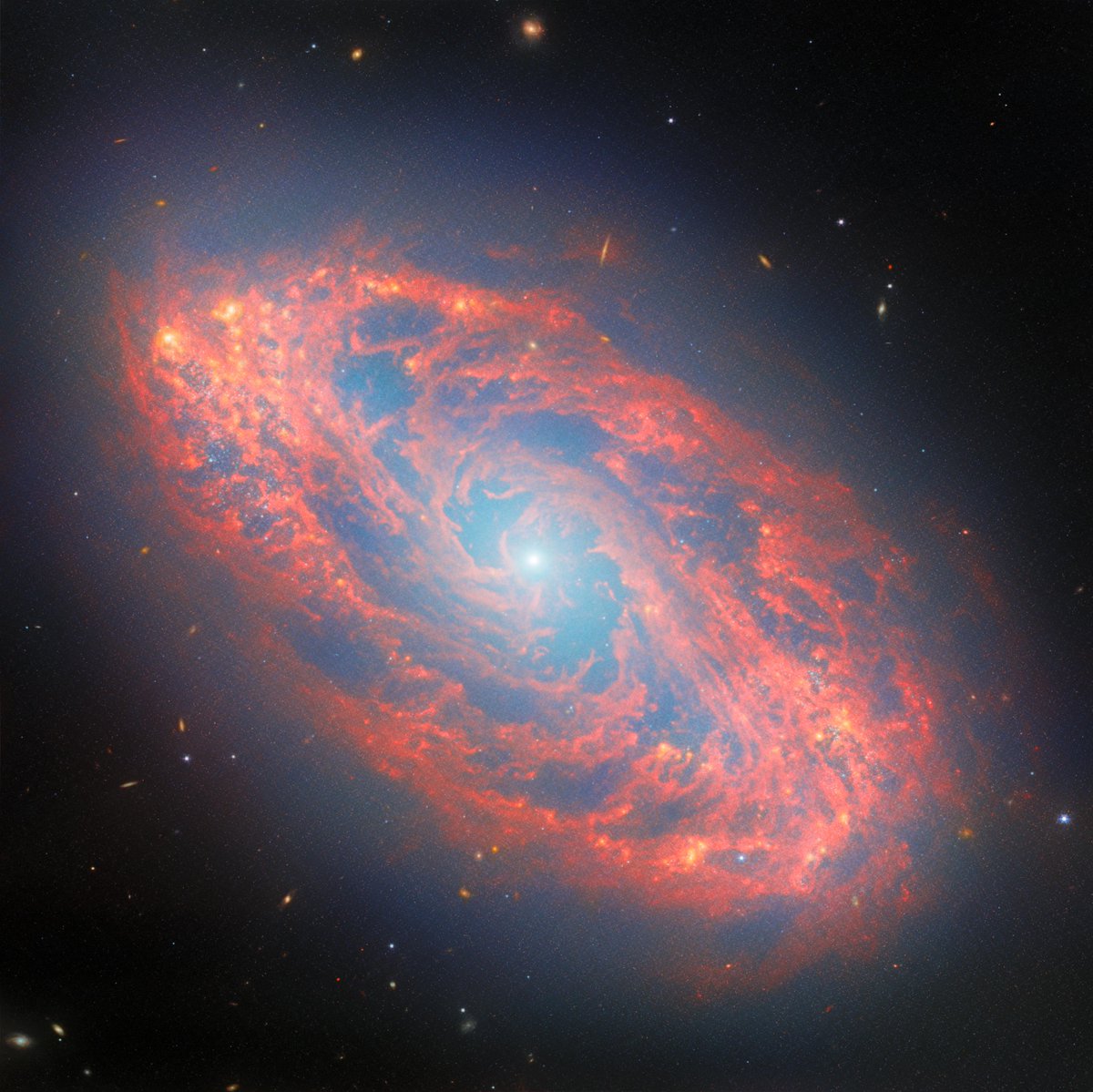
Light from the age of the dinosaurs 🦖
The light that Webb collected to create this image has been journeying to us from spiral galaxy NGC 5134 for 65 million years, or since soon after Tyrannosaurus rex went extinct!
https://t.co/OycR8tv6Gt