@colludingnode@ThinkingUSD We’re all competing on SOV now.
All time and value compresses to that singular question.
Where does humanity store their time?
It struck me the last few days that if P ≠ NP then it puts a dagger right in the heart of fast take off and AI going to superhuman at everything instantly theories.
Let's look at why.
Today’s exponential curve is reinforcement learning on top of language models, and it climbs fastest wherever an answer is cheap to check.
Did the code pass the tests? Is the proof valid? Did the exploit pop the box? Those are yes or no questions a machine can grade a million times a day, which is why coding, math and cyber went vertical.
There’s a deep reason that trick works, and it sits at the beating heart of every paranoid fast-takeoff story. It’s P versus NP.
NP is the class of problems where a proposed answer is quick to check. P is the class where an answer is quick to find.
I think P ≠ NP is obvious through direct observation of reality.
You can build a brick wall and it takes a long time. I can easily check that you built the brick wall by looking at it. While there may be an optimal path algorithm to build that wall (like an optiminal build order in a real time strategy game) there is no way to make that wall super fast without the right amount of time passing, even if you know the best algo to build it.
In short, for the hardest problems in NP, finding is brutally harder than checking.
If me and the computer scientists are right, that gap is exactly what reinforcement learning on verifiable tasks feeds on. Generate a mountain of candidates, grade them cheaply, keep the winners, do it again. The checker does the heavy lifting. The model only has to get lucky a little more often each round.
Now flip it around. Send a van to 100 delivery stops and there are roughly 9.3 × 10 to the 157th power possible orders. Every new stop multiplies the possibilities again. A machine can score any proposed route in seconds, but no known shortcut guarantees finding the best one without enormous search.
Time can be the wall too. A side effect that strikes one patient in 100,000 can slip through a small trial and emerge only after years of widespread use. You can’t compress those patient-years into an instant answer.
And most of the real world isn’t a formal problem in the first place. Economics, policy, medicine and taste don’t ship with a verifier. Time grades them. Labs grade them. People grade them, slowly, and often only once.
Fuzzy outcomes are not verifiable, like is this ad persuasive or will my mother like this Christmas gift or is this a good movie or will this argument convince enough people to take this action?
And if P ≠ NP, worst-case search stays hard no matter how smart the searcher is. Nobody gets to brute-force everything. There’s no runaway where one mind solves every problem at once.
Now there’s a big middle ground to the worst case NP problem. SAT was the first problem ever proven NP-complete, and modern SAT solvers still crack industrial instances with millions of variables, because real problems have hidden structure the worst case doesn’t. Engineers use them to verify chip designs and plan schedules. Amazon runs a billion SMT queries a day to check access policies, on a problem that’s PSPACE-complete, a class above NP.
And NP isn’t the top of the mountain. Generalized chess is EXPTIME-complete, provably out of reach of any fast algorithm. Generalized Go is PSPACE-hard, and EXPTIME-complete under Japanese ko rules. Nobody has a proof of optimal Go play. AlphaGo didn’t need one. It estimated positions with a learned value network, searched, and beat the European champion 5–0. Close enough wins.
But that was a game with perfect information and closed rules.
So in essence there are three classes of problems.
First, cheap to check: code, proofs, exploits. That goes vertical.
Second, hard to check, but heuristics, probability and simulation make it verifiable enough: chip verification, scheduling, Go. That climbs steadily.
Third, out of reach without nearly perfect simulation, like modeling human biology deeply enough to cure any disease. That’s where the curve stalls. You get what we already see: systems that are wildly superhuman wherever a cheap checker exists, solid wherever a good enough one exists, and ordinary, or worse, where neither does.
Jagged supersmart, but not a smooth takeoff or superhuman in evertyhing instantly. Jagged forever.
Now if you can simulate reality at a granular enough level, biology for instance, and you can run it forward faster in time on chips that do not exist yet and may never exist, then you can likely find optimal routes to almost everything but that does not make them fast and still leaves huge blind spots like 'will this drug have side effects in a decade?'
But frankly if you can do super granular simulation, you're already God like as a civilization and don't really need AI because you can just simulate reality in a vat to find out anything really.
The molecular machines inside a single human cell are super freaking complex, vastly more complex in physical dynamics, energy efficiency, and adaptability than our most powerful supercomputers.
The atomic interactions inside a single protein machine are so intricate that even the world’s fastest supercomputers struggle to simulate just one full cycle of its operation in real time.
And even simulation has its failings. We likely will never get a Psychohistory because a truly complex system will have too many variables changing at once to get a consistent output, so at best you're picking from countless strong possibilities but never actually predicting the future with any real clarity.
So where does that leave us?
Mixed take off and jagged forever intelligence is likely where all this is going.
@ymichel@QualiaQuanta@__alpoge__ A posição oficial da Lean FRO e da Mathlib Initiative está aqui: https://t.co/X6wSJPBLQg. O enunciado é a definição RiemannHypothesis da Mathlib, revisada por especialistas, e ferramentas independentes confirmam que o teorema provado é exatamente esse enunciado.
@lord_proto@kennyistyping@gakonst Yes they are predictably declining in purchasing power for the last 100 years and run by morons to support a system that is irrepably broke
@ChuckCook all numerical data pointed to Riemann hypothesis, it was more or less "proven" numerically, the proof doesn't really matter
all numerical data points to P != NP...
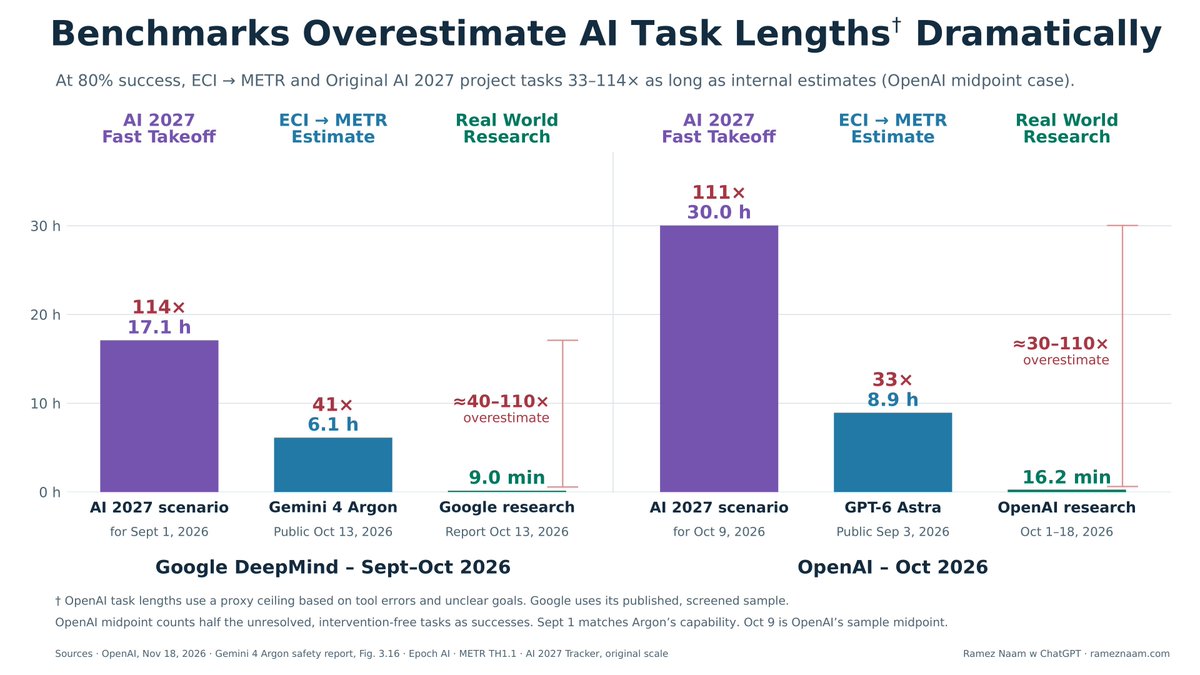
New from me: The most important graphs in AI are wrong. Specifically, measures of the length of task AIs can autonomously accomplish are dramatically different than real-world data from inside OpenAI and Google. 🧵
https://t.co/IbKK0ybQjV
@BoringBiz_ Do you know how many human hours and years of life are stolen by governments through inflation?
That money goes to wars, paying off bureacrats and controlling the population globally.
Its literally the biggest crime perpetrated against humanity...
Extrapolate this across thousands of domains and it’s why I’m incredibly skeptical of AGI.
It’s clear domain specific models are the future and I don’t see one model encompassing everything.
It may even perform worse overtime in narrow domains.
i fine-tuned qwen3-vl 8b to watch a video and tell you how the shot was made. i'm calling it shot reader.
camera height, lens, angle, how the camera moves. who's in frame, where they stand, where they walk.
turns out that's hard for ai. even opus 5.5 and gemini 4, with a prompt written specifically to reverse-engineer shots, get the camera height and move both right less than half the time. open models out of the box: 5%.
shot reader gets 69%. it's 2.4x faster than opus, ~30x cheaper, and small enough to run on your own gpu.
why it matters: ai can already write blender. getting a shot right starts with reading it.
see a shot → get the plan → rebuild it in 3d, reshoot it, remix it.
open weights on hugging face, link below.