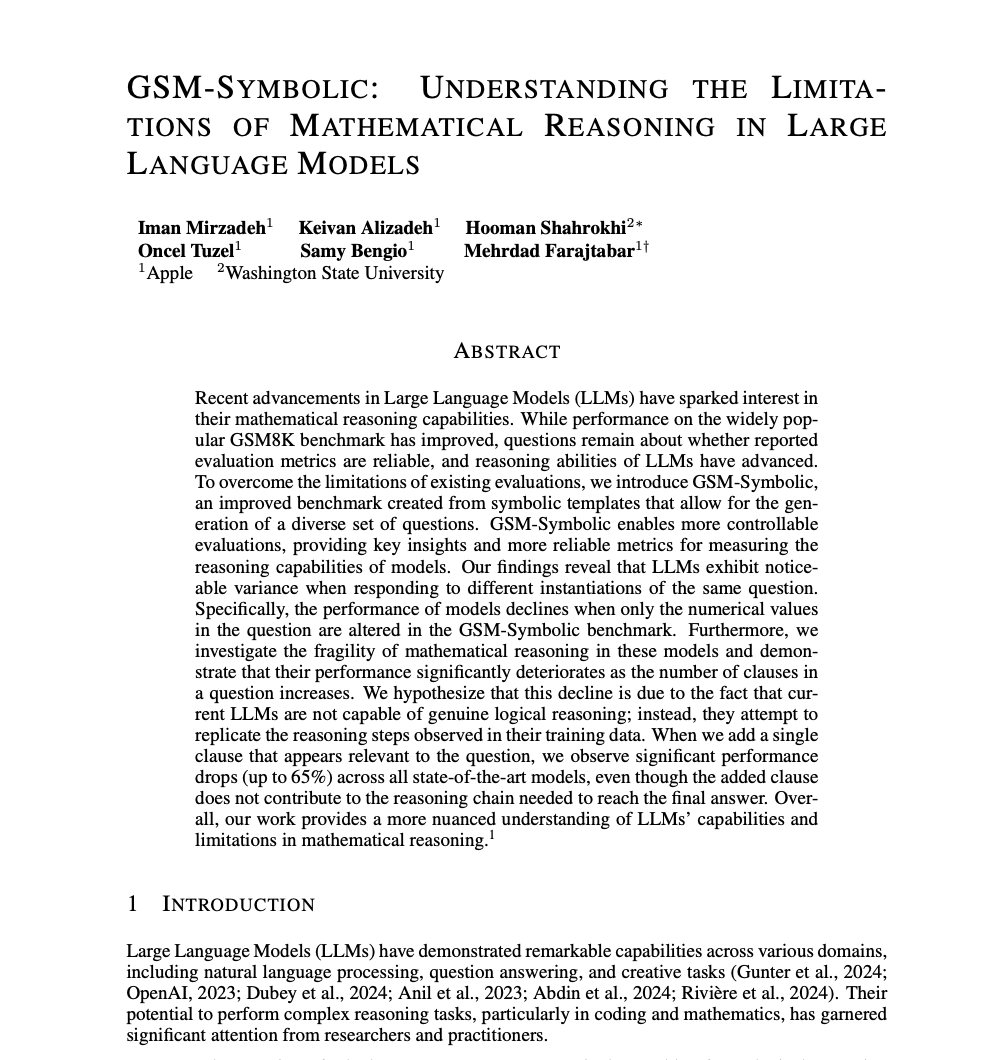
Apple argues that AI models cannot do math.. not even the grade school math.
For years, labs like OpenAI and Google have bragged about near-perfect scores on benchmarks like GSM8K. They claimed AI had mastered logical problem-solving.
Apple decided to test if that was true.
They built a new benchmark called GSM-Symbolic. Instead of static questions, it uses templates to dynamically change names, numbers, and variables.
The results exposed a devastating truth.
When Apple changed the simple numbers inside a basic word problem, model accuracy plummeted. The AI wasn't solving the math. It was relying on pattern matching from its training data.
It was guessing based on familiarity, not reasoning.
Then they ran the test that exposed the illusion entirely.
They added a single, irrelevant clause to a math problem. Just a sentence of background text that looked important, but had zero impact on the actual calculation.
Every single frontier model, from ChaTGPT to Claude, suffered massive performance drops.
Some crashed by up to 65%.
Just by adding a piece of noise that a seven-year-old child could easily ignore.
The conclusion is blunt.
Current AI models do not possess genuine logical reasoning. They do not understand math. They are sophisticated mimicry engines replicating the shape of human logic without actually thinking.
When the pattern is clean, they look like geniuses.
The moment you introduce a minor twist, a variable change, or a distraction, the illusion shatters.
Apple Silicon is built for MoE models -- huge unified memory, modest bandwidth. Dense models are the opposite: bandwidth-bound, and everyone "knows" Macs are slow at them.
Today we're changing that. https://t.co/liyzSFqLAa is now improving Qwen3.8 27B from @QwenDevs. Under 16 hours in: +153% over baseline. 2.5x faster than out of the box MTP decode.
I think that's barely the start. When a belief is that widely held (Mac is slow at dense models), few has gone looking. The low-hanging fruit is still there.
We've improved based on feedback from the last challenge.
- MTP on day 1. Speculative decoding is the whole game for dense models, and the draft head weights are yours to edit.
- 8 hidden length, not 1. Laguna's score overfit a single 512-token fixture. Now every run is the median across eight weights.
- New leaderboard. Ranks total improvement contributed, not who happens to hold the record right now. The old view lives on as the lineage board (better name welcome).
- Automated review. Every submission gets screened for benchmark gaming before it scores.
Next up: enabling multiplatform starting with CUDA.
200km, 30 Passagiere mit je 25kg Gepäck, rein elektrisch!
30 Minuten Ladezeit, entspricht der turn around Zeit.
Rund 3€ Stromkosten pro Passagier!
Welcome to the future!
We promised open weights for Qwen3.8. Now, time to meet them! 🎉
⚡ Qwen3.8-27B:
- A native multimodal dense model. With just 27B parameters, it outperforms Qwen3.7-Plus overall and shines in real-world coding & office workflows.
- 262K native context, easily extendable to 1M tokens via YaRN.
- Built for builders. Highly efficient, high-quality, and licensed under Apache 2.0.
🚀 The open weights for Qwen3.8-2.4T-A95B (Max-level) have also been released recently.
Whether you're shipping lightweight applications with Qwen3.8-27B locally or building agents with Qwen3.8-2.4T-A95B, they're yours now!
Download, deploy, and build something we haven't imagined yet. 👀👇
- Hugging Face:
https://t.co/4kaAcqYEVj
- ModelScope:
https://t.co/eRIMZCGkhC
@preston_vanloon Only problem could be institutional stakers pushing out solo stakers long term. + limited staking positions/seats lead to FOMO. Once out as a solo-staker - never likely to get back in ... staking reward curve must not go down too steep to keep solo stakers!
Goodbye, Poseidon!
An epic 8-year, 8-figure rabbit hole in post-quantum cryptography reaches its dream conclusion. The Ethereum Foundation is abandoning Poseidon for L1, pivoting to SHA or BLAKE. This milestone unlocks ultimate security for lean Ethereum and foreshadows a golden era of hash-based cryptography.
Since 2018, the Ethereum Foundation has invested in magic cryptographic bricks, so-called "SNARK-friendly hashes". In 2019, Poseidon was born. It held strong and became the dominant SNARK-friendly hash, securing billions via zkrollups and zkVMs.
In a stunning reversal, breakthrough SNARK designs show that SNARK-friendly hashes aren't necessary after all. Off-the-shelf traditional hash functions like SHA2 and BLAKE2s can now match Poseidon in a SNARK. In hindsight the key was not SNARK-friendly hashes, but hash-friendly SNARKs.
The secret is doing maths over the smallest prime number: 2. So-called "binary fields" natively speak the language of bits, aligning with the boolean operations inside traditional hashes. This is a stark departure from "prime fields", where awkward large-prime arithmetic makes bit manipulation painfully expensive.
We're talking sci-fi cryptography. 1M traditional hash calls proven per second, on a laptop. Just 100x overhead vs native CPU boolean compute. Nobody predicted such performance, not even the handful of binary-field visionaries. Hat tip to the research geniuses: Jim and Ben with Binius in 2023; Ron, Benedikt and William with Flock in June.
With SHA2, the lean aesthetic of minimal assumptions reaches its climax. The EF's principled stance on pure hash-based cryptography has aged like fine wine. We now enjoy foundations the world can trust for decades and centuries, foundations worthy of the dream of an internet of value.
Speed of deployment is a secondary win. There's no longer a need to wait years for Poseidon cryptanalysis to bake. Emile and Thomas from the EF post-quantum team are moving at breakneck speed with binary fields. The strawmap now points to a production-grade leanVM in 2027, with CL, DL, EL deployments in 2028.
As AI becomes exceptional at cryptanalysis, the contrarian bet to avoid riskier structures like lattices and isogenies is visibly paying off. The past weeks have been brutal. Lattice-based "HAWK" and isogeny-based "SQIsign", both signature schemes in NIST's Round 3, have suffered blows. Sources I trust say more blood is coming.
On AI, the open autoresearch trend kicked off by ECDSA[.]fail is spreading fast, with amazing outcomes from zk[.]golf and SNARK[.]fast. Days ago SNARK[.]fast crossed 1.8M BLAKE3/sec proven on an M3 Max. Stay tuned for fresh autoresearch challenges dropping tomorrow.
Also tomorrow: Ethproofs call #10, dedicated to binary fields. Possibly the most noteworthy Ethproofs call yet. Experts leading the charge will present the future of hash-based SNARKs at 2pm UTC. What an incredible time to be alive. To witness history, DM me for a calendar invite :)
Today I can confidently claim that hash-based cryptography has won out for blockchain post-quantum signatures. SNARK succinctness compresses arbitrarily many signatures into one small proof per block. SNARK flexibility yields k-of-n threshold signatures, complex multisigs, and more.
Ultimate security. Uncompromising performance. Full programmability.
Believe in something. Believe in hashes.
Joe Rogan sat down with the Harvard scientist who reversed aging in actual human cells.
He named 5 everyday things quietly costing you 15 years of your life.
And the one that matters most has nothing to do with food, training, or supplements:
1. The person you wake up next to
Today, we’re coming out of stealth with TensorScale (@TensorScaleAI ), and we're already running the fastest video inference in the world.
MiniMax (@MiniMax_AI ) H3 — one of the leading open video models — now runs 10x faster and at half the cost on our inference stack.
I’m building the company with long-time colleagues Teng Teng (@tt_tsio), Ye Wang (@yewang_ts), and Yun Tang (@_tangyun_). The AI stack was built for language models. We're rebuilding it for video and world models.
Enter: EthCoordinate.
tl;dr: EthCoordinate is a crypto-native organization born inside the EthStaker community, bringing together separate efforts under one umbrella to help with Ethereum governance coordination, support Forkcast, increase stakeholder engagement on proposed or upcoming EIPs and, of course, continue providing software, tooling, and technical support for home stakers.
EthStaker started in 2020 when a loosely connected group of Ethereum enthusiasts joined efforts to speed up the development of the beacon chain. The organization steadily evolved, incorporating as a 501(c)4 nonprofit and taking up initiatives around independent participants of Ethereum's consensus mechanism, aka home stakers.
Throughout the years, it has played a decisive role in coordinating the launch and operation of devnets, testnets, and mainnet hard fork upgrades; facilitating information flows and generally connecting dots that needed connecting.
This year's tectonic organizational changes in the ecosystem have opened up functional gaps in Ethereum coordination. To close these gaps and continue supporting the network, EthStaker's core members are joined by mission-aligned fresh blood to aggregate efforts under one name to produce greater results than operating independently.
EthCoordinate is a natural evolution of EthStaker; as Ethereum mainnet heads to its third radical consensus protocol change at a steady pace, it’s time for EthStaker to recalibrate around what Ethereum’s evolving community needs.
Our mission is to facilitate interaction between stakeholders of the ecosystem to accelerate the adoption of the Ethereum network and to provide continuity for governance operations.
We believe that the Ethereum mainnet is an unparalleled bedrock for the augmentation of humanity's productivity output and that ETH, the asset, is the token that aligns the incentives of all actors involved.
We stand up for our values, combining technical rigor with pragmatism for Ethereum to continue being the most accessible and credibly neutral global blockchain.
The team is 10 long-tenured Ethereum professionals and currently our main work streams are:
⇥ Maintain a high-quality venue for independent stakers to remain engaged and informed
⇥ Facilitate coordination around core protocol development and adjacencies
⇥ Develop and steward Forkcast, the most popular platform to track the research and engineering initiatives around Ethereum's core protocol
⇥ Facilitate research, discussion, and coordination around protocol economics in support of Ethereum's long-term economic health
⇥ Maintain open source tools and documentation used by participants of the consensus set
We're energized for this chapter in Ethereum coordination & our role in it.
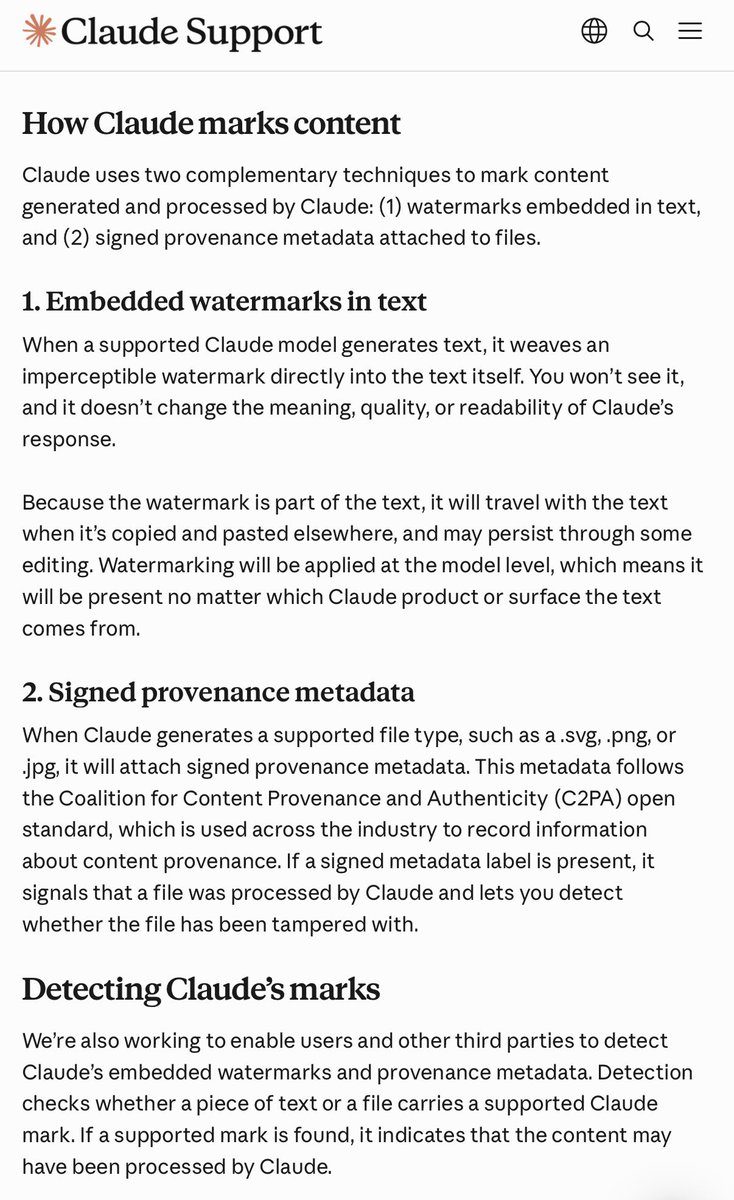
🚨 HUGE NEWS: Claude now embeds an invisible watermark into every piece of text it generates.
Anthropic just documented how it works. Two marks, both machine-readable:
> Text: an imperceptible watermark woven into the words themselves. You can’t see it, and it doesn’t change meaning, quality, or readability.
> Files (.svg, .png, .jpg): signed provenance metadata on the C2PA open standard, so you can tell if a file’s been tampered with.
The watermark is applied at the model level.
That means it shows up no matter where the text comes from: the API, Claude, Claude Code, Cowork, Claude Tag, and even when a supported model runs through AWS, Google Cloud, or Microsoft Foundry.
Models launched on or after August 2, 2026 mark from day one. Older models are getting it during a transition period.
Every sentence Claude writes for you now carries a signature you’ll never see.
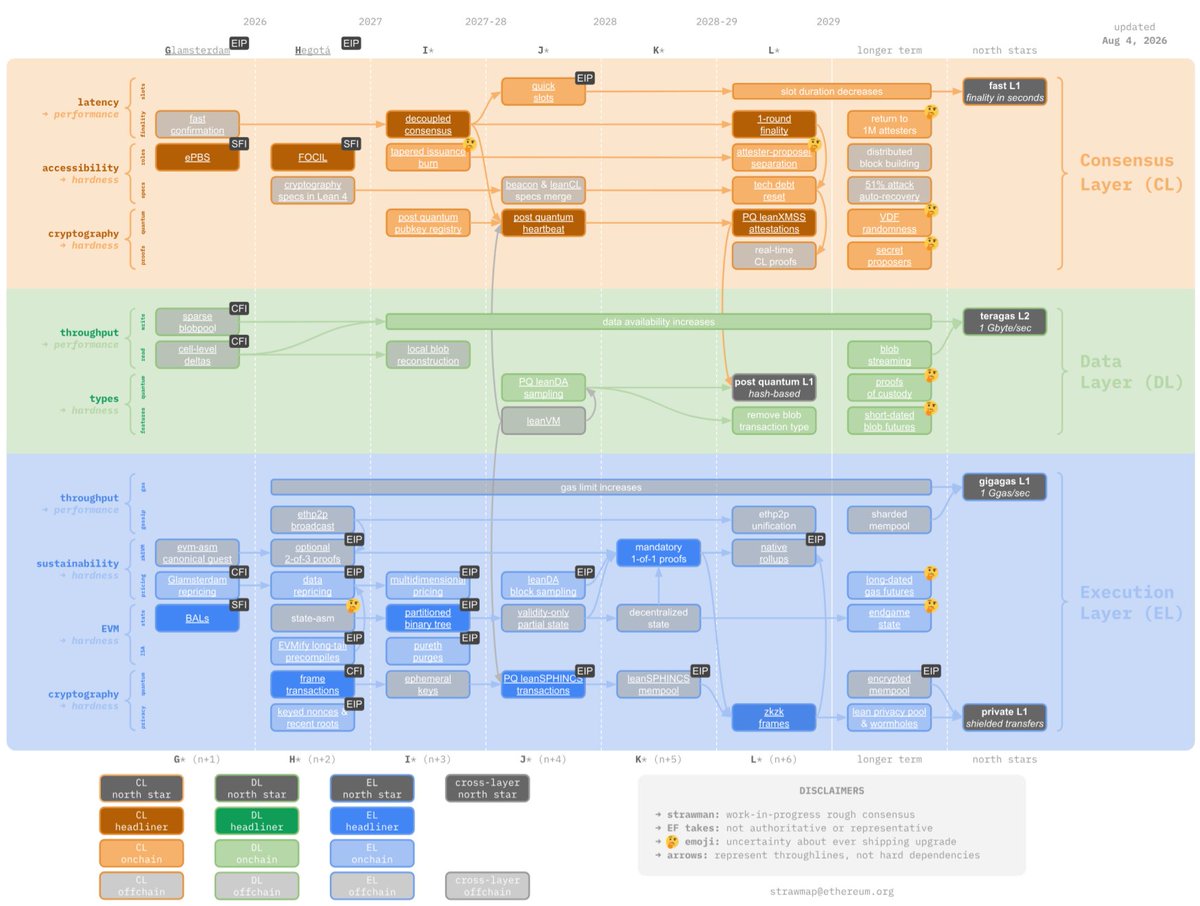
I updated my 2023 roadmap diagram to overlay where the items that were there sit in the current Strawmap ( https://t.co/I35mrXutP2 ).
In general, a lot of overlap, but:
* Some things got reshuffled in order (eg. quantum safety up-prioritized)
* Some things deprioritized (eg. VDFs; many EVM improvements)
* Some things replaced with superior constructions (eg. Verkle -> unified BT -> PBT; state expiry -> new state types)
What's most striking, however, is that some completely new things are in the strawmap that are NOT in this diagram, because they were not in the 2023 roadmap at all. These reflect changing priorities.
Notably:
* First-class attention to strong privacy. This covers: keyed nonces and recent roots, aspects of FOCIL, lean privacy pool & wormholes
* Aggressive scaling in the context of post-quantum. This covers: leanSPHINCS signatures and aggregation, zkzk frames (see https://t.co/ibrOpMxMfO )
* Lean-ification of the spec, to assist in formal verification (full FV of everything is only possible because of modern AI)
* Blob and gas futures (this idea just didn't exist back in 2023)
* Native rollups (SNARKs were nowhere near mature enough to even consider this back in 2023)
* A more open design space for the "future of the EVM". zkzk frames already implies that the protocol will expose to users some ISA that's not the EVM - current leading candidates are leanISA and RISC-V. These ISAs are more simple, modern and efficient than the EVM. Once they're there, why not expose them to developers everywhere? (And then, why not turn the EVM into being an IR on top of that ISA, instead of an enshrined feature massively complicating the base protocol?) Though much of the deeper exploration here is too early even for the strawmap.
* New state types are not just a replacement for expiry, they're a fundamentally different paradigm to how Ethereum does scaling
A common theme in scaling, found in both state types and zkzk frames (both new ideas), is that instead of trying to maximally scale ALL ethereum activity, we try to create specialized mechanisms that have more restrictive properties that make them more scaling-friendly, while supporting the heaviest loads incurred by users and applications today (eg. token transfers, swaps) and tomorrow (eg. privacy protocols).
The other common theme is treating STARKs and AI-accelerated FV as first-class objects, that we are okay betting the technical future of Ethereum on. There are recursive STARKs in many layers of the protocol, one particular primitive (the "aggregate to union verified dependencies" primitive) is expected to be used in *three* places in the protocol: EL, CL and DL. This can only be safe with formal verification, which is itself only feasible with modern AI tools.
In general, many steps forward in maturity. And a huge amount of hard work by many dozens of Ethereum researchers and developers on all of these features.
Ethereum will be quantum-safe. Ethereum will put users' privacy first. Ethereum will be secure. Ethereum will be censorship-resistant. Ethereum will be highly performant and scalable while satisfying the above. And Ethereum will be Lean.
🚨David Sinclair: “AI helped us do 160 years of biology work in two months.”
ROGAN: “What?!”
SINCLAIR: “We’re looking for molecules, a single molecule that can replace this cocktail... You need a molecule to do three or four activities in the cell. Finding one activity is what pharmaceutical companies do. It takes hundreds of millions, if not billions, to make a drug.”
“My little lab of 20 people and students are trying to make one drug do three or four different things. That’s beyond the reach of pharmaceutical experience, at least five years ago.”
“This funnel is full of a trillion molecules, and we have to come down to one. We don’t look for a trillion molecules at the bench. That would take 160 or thousands of years... so we do it inside the computer.”
“We just use a lot of compute, and we dock each of these molecules against the enzymes that we now know how they work, thanks to Google DeepMind solving the problem of how all our proteins look, 20,000 of them.”
1 trillion candidate molecules.
Filtered to 200.
Two months.
“Next week, we’re testing these 200 against human cells, and we’ve also got AI helping us tell if the human cells go from 92 years old back to 20. We can tell that just by looking at them, thanks to AI.”
Dr. David Sinclair is a Harvard geneticist and one of the world's leading longevity researchers.
Fascinating to hear how he's using AI to compress 160 years of biology work into two months.
What other decades of work is about to become two months?
@joerogan@davidasinclair
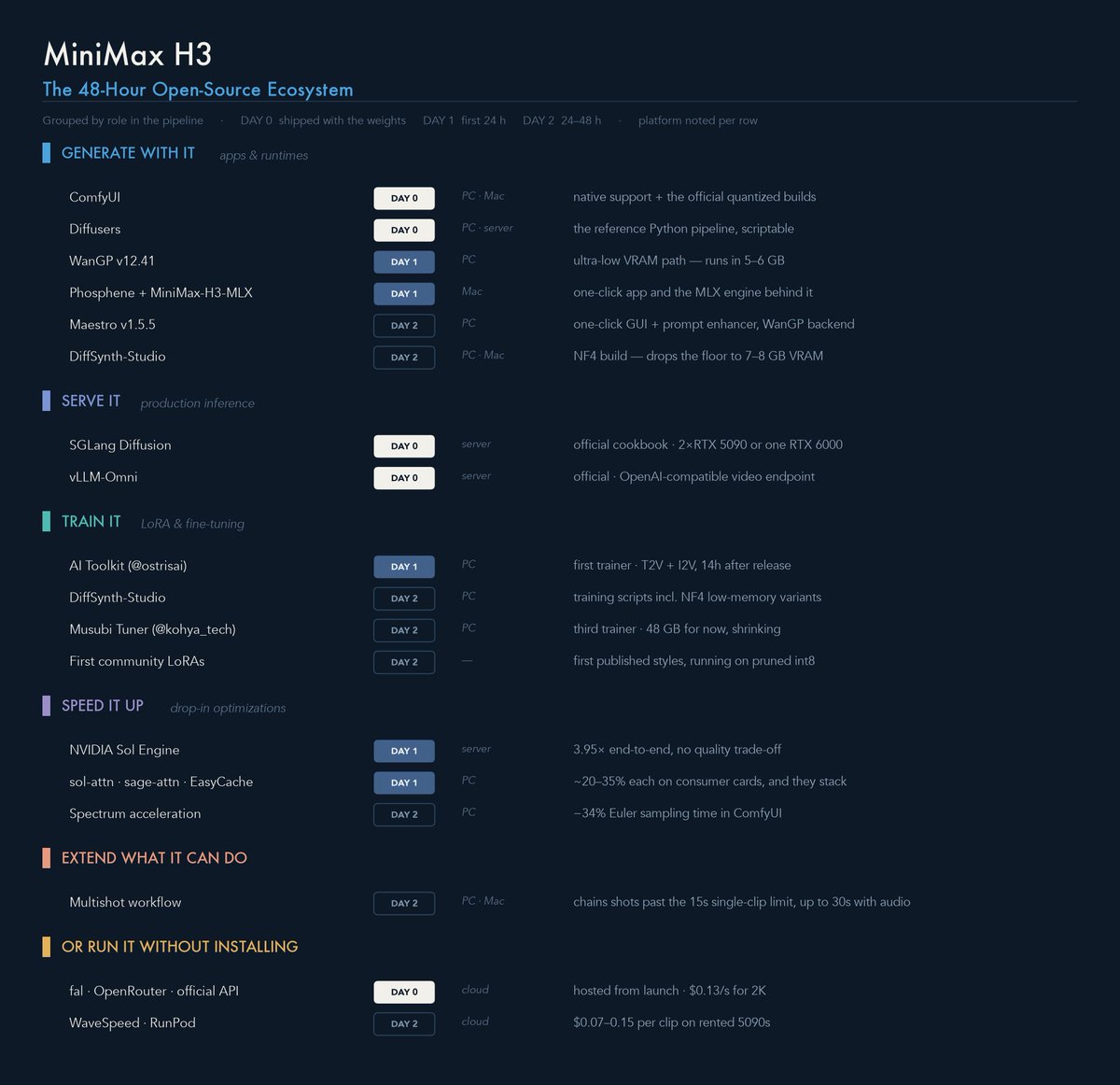
Maestro v1.5.5 with MiniMax H3 is out! 🩵
The community got H3 running on hardware we never tested - from a gaming GPU to MacBooks running fully offline - and built tooling we didn't plan for within 48 hours.
We're genuinely glad we opened it up. <3
Ok now I see the complication a 50% of supply hardcap live algorithm instead of just changing the formula of the curve. Also the exclusivity problem of the last spots that earn rewards and make staking possible sounds like a bad condition to have resulting in rather lower rewards.
@jdetychey@pintail_xyz@dapplion@Pa7x1@ladislaus0x The more I think about it, the more I like it, except for inpredictability of rewards. How about a hard cap of staking at 50% of ETH supply with an issuance curve that also goes down, but not to 0%?
🚨 New EIP: Tapered Issuance Burn
We just submitted an EIP to ethereum/EIPs: a minimal, market-driven fix to Ethereum's issuance policy removing the incentive for stake growth beyond 50% of ETH supply.
EIP-8361 by @pintail_xyz, @jdetychey, @dapplion, @pa7x1, @ladislaus0x & @drakefjustin 🧵
Palantir CEO Alex Karp RIPS into Anthropic’s Dario Amodei and OpenAI’s Sam Altman for making customers pay while transferring all the alpha in their business to them:
" All I did is put out facts. There's been no response to these facts."
" I've spent a lot of time with Dario and the EA crew. They want to tell you we have to march into a future where we own nothing, where our businesses aren't profitable, where none of us have jobs, and where our adversaries win."
"What if I charged you a million dollars and you found out I migrated your whole bank account into my bank account?"
" First of all, they don't create a lot of value. Second of all, the value they create gets migrated to someone else. And they're all running around saying, 'No ontology, no love,' which is a saying from the '70s I had to look up."
" I've spent a lot of time with Dario. He's not the caricature people think. They have a philosophy. That philosophy is a very important philosophy, the determinant of philosophy in the tech scene over the last couple years, and that philosophy in its business practice basically says in simple terms—I own the future, therefore you should migrate the value of your business to me and be happy with the derivative of that that you sometimes get after a wealth tax."
"Palantir, we get paid a lot of money. Why do we get paid a lot of money? Because we create value for the customer first, and value that they keep."
Via @CNBC@seemacnbc