⚡️Marriage is one of the highest-leverage decisions in life because it controls the household operating system.
The person you marry affects your ambition, spending, risk tolerance, emotional stability, sleep, health, focus, social circle, children, legal exposure, time horizon, and daily energy.
That is the machinery underneath wealth, happiness, and destiny.
A good spouse compounds you.
They make life more stable, your judgment cleaner, your home calmer, your ambition safer to pursue, your risks more intelligent, your recovery faster, your children stronger, and your wealth harder to destroy.
They do not merely “support” you. They reduce entropy.
That is the word.
Entropy.
The wrong spouse increases entropy everywhere.
More drama. More spending. More insecurity. More emotional tax. More distraction. More status games. More resentment. More legal risk. More instability. More bad decisions made from stress. More years lost trying to manage a household that never becomes a base of power.
People underestimate that because they think marriage wealth destruction means divorce.
Divorce is only the visible explosion.
The deeper destruction happens before that: years of muted ambition, bad sleep, financial leakage, emotional chaos, compromised decisions, loss of confidence, loss of sexual polarity, loss of momentum, and a home that drains the person who is supposed to be building.
The right marriage is a private civilization.
The wrong marriage is a slow civil war.
Treating marriage like a cold spreadsheet is stupid and spiritually dead. But pretending marriage has no economic or strategic dimension is even dumber.
Love matters.
Attraction matters.
Loyalty matters.
Character matters.
But character and alignment are what make love durable under pressure.
A person can be beautiful, exciting, and emotionally intoxicating while still being a terrible partner for the life you are trying to build.
The real question is not “does this person make me feel something?”
The real question is: does this person multiply the life force, or consume it?
A great partner makes your whole field stronger. Money grows because the household has trust, discipline, shared direction, lower chaos, and a longer time horizon. Happiness grows because your nervous system has a real home. Children grow better because the foundation is coherent.
Marriage is leverage.
With the right person, leverage builds the kingdom.
With the wrong person, leverage magnifies the flaw until it owns the whole house.
“The best men have been broken.”
Chris Williamson shared this line from Alain de Botton on his Modern Wisdom podcast. He says you can see it in the eyes, a quiet humility, a recognition of limits, even in high achievers.
After two brutal years dealing with serious health issues, Chris realized that getting kicked in the teeth forces you to examine your patterns, motivations, and goals under a microscope. It’s uncomfortable in the moment, but it becomes a gift.
He believes almost all of our greatest accomplishments are born from our lowest points. Adversity is a terrible thing to waste.
This hit me hard. The guys who seem most grounded and impressive often carry some invisible scars. The smooth, effortless path rarely produces the same depth.
In a culture obsessed with constant wins and highlight reels, remembering that struggle forges real character is a powerful reminder. The lowest points often plant the seeds for what we become.
What’s one hard season in your life that ended up shaping you for the better?
If you were old, how much would you pay to spend one ordinary afternoon with your children when they were young again?
Not a milestone. Not a birthday or a graduation. Just a random day. The noise. The mess. The questions. The laughter. The exhaustion. Bedtime stories you’ve read a hundred times.
Be honest with yourself. The number wouldn’t make sense. You’d drain accounts, sell assets, rewrite every financial plan you ever had without hesitation. You’d trade almost anything for a few hours of something you once had for free.
And yet, when that time was actually available, most of us sold it cheaply.
We didn’t think of it that way at the time, of course. We told ourselves a story. We were working hard. We were building something. We were providing. We were doing it for them. That story is comforting, and it’s not entirely false. But it’s incomplete.
Children don’t experience provision the way adults do. They experience presence.
They don’t measure love in college funds or net worth statements. They measure it in attention, consistency, and shared moments that feel insignificant until they’re gone. They don’t remember how hard you worked. They remember whether you were there.
This is where the trade becomes uncomfortable to look at. We exchange time during the only window it exists for money we could have earned later. We trade a non-renewable asset for a renewable one and tell ourselves we’re being responsible.
Money can be earned again. Time with young children cannot.
That doesn’t mean don’t work. It doesn’t mean abandon ambition or stop providing. It means be honest about the cost. Because every late night, every missed dinner, every postponed trip is a decision to push life into a future that may not look the way you expect.
We tell ourselves we’ll make it up later. When things slow down. When the next milestone is reached. When there’s more margin. “Someday” becomes a holding place for good intentions.
But kids don’t live in someday. They live in now.
What makes this especially tricky is that nothing feels wrong in the moment. Life looks fine from the outside. Bills get paid. Careers progress. Stability increases. We smooth consumption and manage stress and tell ourselves we’re doing the right thing. And in many ways, we are.
But there’s a hidden risk no one talks about: postponing life until the window for the most meaningful experiences has quietly closed.
One day, your kids don’t ask you to play anymore. They don’t need you to read to them. They stop wanting to tag along. The ordinary moments dry up without an announcement. And only then do you realize how valuable they were.
That’s when the thought experiment stops being hypothetical.
If you’re older, you already know the answer to the question. You’d pay anything. And if you’re younger, the uncomfortable truth is that you’re currently holding something priceless and trading it away incrementally for something replaceable.
This isn’t about guilt. It’s about clarity.
Work matters. Providing matters. Building a future matters. But so does recognizing when “enough” has been reached and when the marginal dollar costs more than it’s worth. Especially when the payment is time with people who will never be that age again.
I don’t want to look back one day and realize I optimized perfectly for a future version of life that never arrived. I want to be present for the one that’s happening now, even when it’s inconvenient, exhausting, and messy.
Because one day, I’d give anything to buy back time I once gave away without thinking twice.
This is part of the same question I’ve been working through lately. Not answers. Just uncomfortable math. Money compounds. Time doesn’t. And some of the most valuable things we ever own can’t be bought back at any price once they’re gone.
Woo hoo! Thrilled to share a sneak peek of HubCode -- The Vibe Coding Tool for HubSpot.
I talked about this a few weeks ago (which feels like forever).
Been cranking on it and am ready to show you the actual app now. Link to video in the comments. Or, just type video.hubcode .com in your browser (it takes you to YouTube).
Some notes:
1) This requires no terminal -- runs completely in the cloud.
2) You can vibe code both app cards and full apps that live inside the HubSpot web UI.
3) Generated apps can access data within HubSpot (of course).
4) SUPER EXCITING: Apps can reuse any of the public agents in agent .ai (there are 2,000+ of them). This makes your apps super-powerful because you can access all sorts of data and services. And, you can build your own private agents and access them too.
This gives you access to all the major frontier models (GPT, Opus, Gemini), and a bunch of really useful data sources and a ton of other capability. Go to agent .ai to see what's available.
The demo shows pulling YouTube videos related to a company right into the app card.
5) You can paste in screenshots or other visuals as part of your vibe coding process (if you haven't done this before, it will feel magical).
The HubCode app runs on the agent .ai platform and is in private beta (because this one's going to take some testing and iteration given the power and flexibility). To apply, just go to hubcode .com.
This is an early "proof of concept", but will be iterating on it maniacally as I get user feedback.
Let me know what you think. All thoughts, ideas, feedback and wishlist items appreciated.
FEEDBACK IS A GIFT.
Thank you for your support.
Scientists put kids through 100 hours of reading, then scanned their brains. New wiring had physically grown inside the language regions. Communication between brain areas sped up by a factor of 10. Kids who didn't read showed zero change.
That was a 2009 Carnegie Mellon study. It gets wilder.
In 2013, Emory University scanned 19 students every morning for 19 straight days while they read one novel chapter each night. Mornings after reading, the brain areas responsible for understanding other people's emotions lit up with new connections. So did the region that processes physical sensation. Their brains were simulating what the characters felt, as if it were happening to them. Those changes stuck around for 5 days after they finished the book.
Now flip to scrolling. A massive review published in Psychological Bulletin last September pulled together 71 studies covering 98,299 people. Heavy short-form video use (TikTok, Reels, Shorts) showed a clear pattern: worse attention, weaker self-control, and more anxiety. Consistent across teenagers and adults, across every platform tested. Oxford didn't name "brain rot" its 2024 Word of the Year for nothing.
A 2024 brain wave study found that people hooked on short-form video had weaker activity in the front of the brain, the part that controls focus and impulse control. Separate brain scans showed the same thing: heavy scrollers had less activation in the exact regions that deep reading strengthens.
UCLA neuroscientist Maryanne Wolf has been studying this for decades. Humans were never born to read. There's no gene for it. Reading is something we invented, and it hijacked neurons that were originally meant for recognizing faces. Over time, it built entirely new brain circuits connecting language, vision, and emotion. But those circuits only survive if you use them. Stop reading, and they fade. Wolf's conclusion is simple: screens built for speed produce a speed-wired brain. Books built for depth produce a depth-wired brain.
One honest caveat: most of these studies are snapshots, not long-term tracking. People who already struggle to focus might just prefer short videos. But the same pattern showing up across nearly 100,000 people is hard to shrug off.
The tweet repeats the line seven times. The research backs it up with brain scans, EEG data, and white-matter imaging across tens of thousands of people.
I asked my mom & dad for advice recently from raising me and my brother...
I’m not a parent yet but one day (fingers crossed).
This is what they told me, maybe you’ll find it useful too:
1. Your kids are not your friends. They’re yours to safeguard and support, but set rules. Biggest problem with most kids in our generation, their parents wanted to be liked not respected.
2. Psy ops are underrated. My mom had this line for whenever I got into trouble. She’d say, “When I ask you a question like this, I already know the answer. I am giving you a chance to come clean...” At which point I’d sing like a canary because I’m a scaredy cat. I found out today she rarely knew the answers. Brilliant and maniacal.
3. Always on the same page. My mom and dad rarely fought in front of my brother and I. They would never go back on the word of the other. United front to deal with us mini terrorists.
4. Make time. My dad had this silly line that is actually not silly: “You can make money, you can make a cake, but you can’t make time.” So they made allllll the time for us.
5. Four chairs. We have these four chairs in our living room, no tv. Growing up, we’d sit and debate and talk for hours. Politics. Opinions. Our days. Only thing not allowed was an opinion you couldn’t defend unemotionally. We still do this today.
6. Mi Sangre mi siempre. They’d always say, blood comes first. They meant it. I hired my brother, my dad, my mom, my cousin at times. We stick together and we may fight like hell but never in front of others.
7. Once you decide, you don’t quit. We could play any sport or instrument BUT if we committed we had to play the full year all out. No 3 lessons and quit. Taught us to choose thoughtfully and keep going even when it hurt.
8. Always call. They still pick up the phone nearly every time it’s family. My dad in a meeting will pause to answer my mom. My husband taught me this too, and I try to do the same. If they’re your first priority this is an easy way to prove it.
9. You’re not a princess, you’re a president. My dad always used to say that line. He told me this week that I lived up to it. Gutted me. He taught us we didn’t need to be saved, instead we could save ourselves and help others.
10. Hug often and seriously. If you’ve ever hugged my parents, they mean it when they do it. Such a simple, free gesture. My mom always gives you a hug and says vaya con dios... go with God. How can you not do big things with parents that hold you like that?
Just some lessons from parents I happen to think are some of the best in the world.
Moms & dads everywhere, I’m in awe of you.
Hardest job I’ve ever seen.
Hope ya'll have a great time with the fam today ❤️ Now get off your phone 😉
Charlie Munger:
“The secret to life is easy because it's so simple:
You don’t have a lot of envy or resentment. You don’t overspend your income. You stay cheerful in spite of your troubles. You deal with reliable people and you do what you’re supposed to do.”
⚡️AI is not liberating people.
It is sorting them.
Harder and faster than any technology before it.
What you are watching right now is a global intelligence bifurcation that feels empowering on the surface and quietly brutal underneath.
Most people think AI removed the need for skill.
What it actually removed is the illusion that effort equals value.
And that terrifies people more than they are willing to admit.
1. The uncomfortable truth is this:
AI exposes who was never thinking in the first place.
Before AI, people could hide behind process.
They could hide behind effort.
They could hide behind time.
They could hide behind credentials.
They could hide behind busyness.
AI strips all of that away.
When output becomes cheap, the only thing left is judgment.
And judgment cannot be faked.
2. Here is the thing almost nobody wants to say out loud:
Most humans do not want agency.
They want assisted momentum.
They want to feel productive without carrying the weight of responsibility.
They want answers without accountability.
They want power without authorship.
They want speed without ownership of consequences.
AI gives them exactly that.
Which is why so many people feel euphoric right now.
They confuse relief from responsibility with progress.
3. This is where the real danger lives.
AI does not make people smarter.
It makes their default mode louder.
If someone was shallow, they become loudly shallow.
If someone was incoherent, they become rapidly incoherent.
If someone was dishonest with themselves, they scale self deception.
If someone avoided hard thinking, they outsource it permanently.
The tool does not correct the operator.
It amplifies them.
4. The people who are actually winning right now do not look excited.
They look narrower.
They look more selective.
They look almost conservative in how they move.
Because they understand something others do not yet:
Speed increases error costs.
Leverage magnifies mistakes.
Output without understanding compounds fragility.
They are not using AI to do more.
They are using it to remove noise so they can see reality more clearly.
5. Here is the truth that will make people angry:
Most people are becoming interface operators, not thinkers.
They can prompt.
They can generate.
They can remix.
They can publish.
They cannot explain.
They cannot reason from first principles.
They cannot detect when something is wrong.
They cannot tell signal from fluency.
And fluency is the most dangerous camouflage intelligence has ever worn.
6. The deepest layer nobody wants to face:
AI makes belief optional.
Reality will not.
You can generate infinite narratives.
You can justify anything.
You can create coherence illusions endlessly.
But physical systems, markets, biology, power, and scarcity do not care.
They select anyway.
Quietly.
Relentlessly.
Without explanation.
7. Here is the final truth, said plainly:
AI collapses the middle.
At the top are people who can see.
At the bottom are people who can operate.
The space in between disappears.
That middle was where most people lived.
That is why this era feels unsettling even when things seem powerful.
The question now is simple and brutal:
Do you want to think, or do you want to feel assisted?
AI will reward either choice in the short term.
Only one survives the long term.
That is the truth nobody wants to sit with yet.
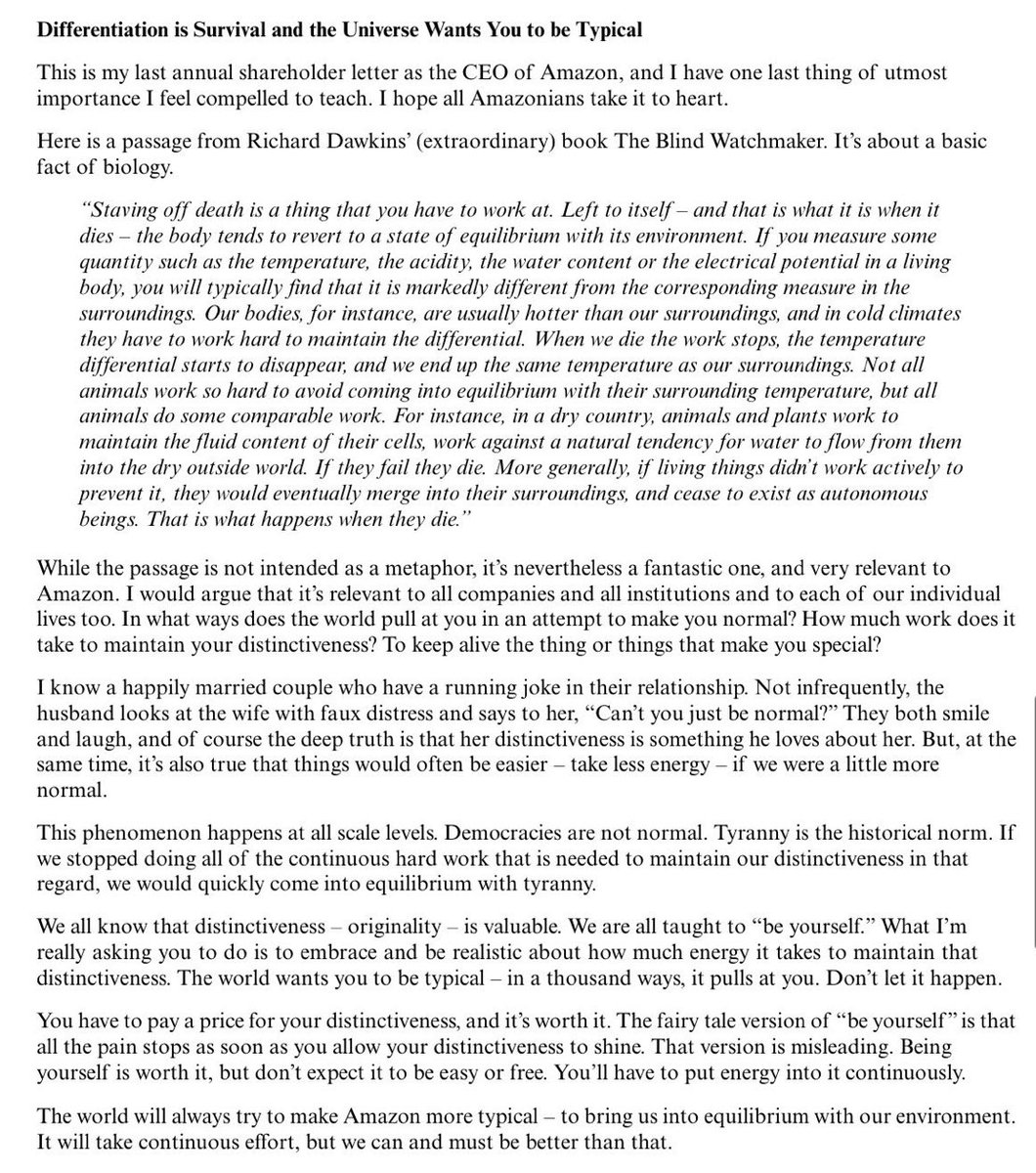
Just before he stepped down as CEO of Amazon, Jeff Bezos wrote his final shareholder letter. He closed it out with a section he titled, “Differentiation is Survival and the Universe Wants You to be Typical.”
He prefaced his own thoughts with a quote from The Blind Watchmaker, “if living things [don’t] work actively to prevent it, they eventually merge into their surroundings, and cease to exist as autonomous beings.” Bezos urges his readers to does this work. “The world pull[s] at you in an attempt to make you normal,” he writes. You must work to maintain your distinctiveness, he writes.
“We all know that distinctiveness—originality—is valuable. We are all taught to ‘be yourself.’ What I’m really asking you to do is to embrace and be realistic about how much energy it takes to maintain that distinctiveness. The world wants you to be typical—in a thousand ways, it pulls at you. Don’t let it happen.” The world wants you to, as Alec Benjamin sings, change what you are for what it wants you to be. Bezos: “You have to pay a price for your distinctiveness, and it’s worth it…don’t expect it to be easy or free.”
Life’s work: a lifelong quest to build something for others that expresses who you are
1/ On How Short Life Is
A few years ago, I was walking around in a blizzard in SoHo (New York). It was late, midnight, and it was beautiful.
Some friends, about 15 blocks away, called: "come over?"
It was late, it was cold, was tired, thought "maybe not worth it" but then...
26 weapons grade parenting tips:
1/ Give them a "heads up," 5 minutes until bedtime, 10 minutes before leaving the playground
2/ Look at the world more through their eyes
3/ Don’t discipline like an angry madman. Stay calm and firm, model how you want THEM to resolve conflict
4/ Let them argue their case respectfully. Teaches negotiation and critical thinking
5/ Skip the long lectures
6/ Use natural consequences: forgot homework? Let them explain it to the teacher. Forgot their lunch? They'll figure it out
7/ Be consistent and follow through. "We are leaving the playground if you don't stop..."
8/ Make "How can I help?" part of YOUR vocabulary. It builds reliability
9/ Share your unseen efforts: hustling for work, hitting the gym. Actions speak louder than words but when they can’t see it, TELL THEM
10/ Teach accountability by modeling it yourself: “I was wrong. sorry”
11/ Create family traditions like weekly movie nights, Sunday pancakes, whatever works
12/ More game nights
13/ Take an interest in their interests: video games, books, sports... do it with them.
14/ Hike together. Nature slows time and generates gratitude
15/ Build something. LEGO, puzzles, a fort, the Amazon delivery box
16/ Teach them skills: tie knots, start a fire, read a map
17/ Introduce chess or checkers. Start early
18/ Let them plan a family outing or navigate you there (they can get you through the airport)
19/ Always greet your wife with love. That moment sets the tone for the family
20/ Share some challenges (age appropriate)
21/ Respect their privacy. Knock before entering their room
22/ Teach the value of money early: "wants vs. needs," compounding, saving, etc
23/ Let them see you sweat
24/ Teach them to cook. Start small: eggs, pancakes, cookies. Embrace the mess
25/ No screens at meals ever
26/ Prioritize movement as a UNIT: family walks, workouts, hikes, dance-offs- whatever gets the everyone in synch
I’m posting this again today. I’ve literally never done this before.
You have to watch this.
Imagine thinking there’s anymore fulfilling in life than this.
There isn’t. This is the whole point.
David Goggins dropped a masterpiece that will rattle your soul.
He doesn’t “work out.”
He doesn’t “train.”
He wakes up every single day and paints a brand-new Mona Lisa… with his own life.
“Every morning I’m creating a masterpiece—and the masterpiece is me.”
He only does 2 podcasts a year on purpose. No phone, no noise, no followers, no Google. Just brutal, honest time alone with his mind until the next stroke of genius reveals itself.
That’s why at 49 he’s lived 10 lifetimes while others live one job, one identity, one comfort zone. Race car drivers retire and get lost. Goggins? His canvas keeps expanding because he finally asked:
“Who the hell am I when nobody’s watching?”
The second he stopped copying Michael Jordan, stopped voting party lines, stopped scrolling for answers—everything flooded in. The ultras. The books. The impossible missions. All of it came from inside.
His message is simple and savage:
Stop outsourcing your destiny.
Sit in the dark with yourself long enough and your real list appears.
Then paint it—one unrelenting day at a time.
If you’ve been feeling stuck, numb, or like you’re living someone else’s script—this clip will hit you like a cold shower at 4am.
Watch it. Full volume. Then ask yourself the question he did:“Who are YOU… really?”
NAVAL RAVIKANT’S WEALTH PHILOSOPHY… TURNED INTO AN AI OPERATING SYSTEM
Most people read Naval and feel inspired for 10 minutes.
But I wanted something permanent.
So I turned his entire worldview into a set of AI prompts that actively talk you out of bad decisions and pull you toward leverage.
This feels like having Naval in your head, calmly deleting nonsense 👇
⚡️What you are looking at is the most honest diagram of human failure most people will ever see.
Not because of rot.
Because of transfer.
Decay is predatory. A collapsing system does not simply die on its own; it reaches for whatever is closest and uses that structure as scaffolding to prolong its fall. The damaged feed on the intact long before anyone realizes what is happening.
People think the danger is “bad influence.”
The real danger is entropy migration.
The moment you allow someone who has lost their coherence to stand close enough, the gradient between you collapses. Their disorder becomes your burden. Their unresolved chaos begins rewriting your internal patterns until your identity is no longer operating on its own signal.
This is how people lose years.
This is how potential gets smothered.
This is how lives drift off the trajectory they were built for.
Deep down, here is the truth:
Most people are hollowed out by proximity.
The wrong person does not ruin your life all at once.
They dissolve the boundary that protects your coherence.
They make you spend your energy metabolizing their dysfunction instead of building your future.
And the deepest layer:
Rot spreads faster than growth because decay requires no intention.
Only contact.
It’s the default state of the universe.
Coherence is the exception you must defend.
This picture is a law of reality:
If you stand close to someone who is collapsing, and they are not actively rebuilding themselves, you will collapse with them.
Not because you’re weak.
But because entropy is stronger than optimism.
This is the handwriting of ruin.
Lifts 2hrs a day, 5am start, 7 days a week. Before work begins… and no starches, no sugar, 84 years old, cognitively and physically strong… the Mighty Twyla Tharp.
On the Huberman Lab podcast out now.
⚡️The truth is that this image is a glitch in the story you were taught about history.
The whole framing of “Dark Ages” was propaganda created centuries later to make one era look primitive so another era could look enlightened by contrast.
The real deep truth is this:
The people who built things like this were not “dark.”
They were operating on an entirely different kind of intelligence that modernity barely understands.
A cathedral is a machine for shaping consciousness.
A stained-glass window is coded light, a technology for embedding narrative, cosmology, social order, and metaphysics into the mind of the viewer.
None of that fits the modern myth of linear progress where:
•the past is primitive,
•the present is rational,
•and the future is technological.
This building is the evidence that the myth is broken.
Here's what I really think:
1. Medieval Europe had less information but more meaning.
They had almost no data.
But they had a density of symbolic intelligence that modern civilization has completely lost.
Their entire worldview was integrative.
The material world, the spiritual world, the mathematical world, the astronomical world, and the architectural world were one system.
A cathedral is a worldview made stone.
In that sense, they were not less advanced.
They were advanced differently.
2. The myth of “the Dark Ages” was created to sever modern people from their own civilizational roots.
The Enlightenment needed an enemy.
So it invented a caricature:
The Middle Ages as superstition, stagnation, and ignorance.
It was never true.
This building is proof.
You cannot produce a structure like this in a dark age.
You can only produce it in a world where:
•cosmology is coherent
•labor is coordinated
•meaning is shared
•hierarchy is functional
•beauty is a communal priority
•and the civilization believes in something beyond itself
Modern society cannot build this today.
Not because we lack the tools.
Because we lack the unity of purpose.
3. The real dark age is the one that forgets how to see.
You live in a world where:
•people stare at screens more than the sky
•beauty is optional
•spirituality is mocked
•attention is fragmented
•and meaning is outsourced to algorithms
Medieval Europe had none of the modern world’s technology.
But they had something more powerful:
a metaphysical orientation that aligned millions of people across generations.
That is why they built things that outlast empires.
4. What this picture actually reveals is the present’s poverty.
The question isn’t:
“How did they build this in the Dark Ages?”
The real question is:
“Why can’t we build anything like this now?”
And the answer:
Because they believed in transcendence.
And we believe in convenience.
Because they saw themselves as part of a cosmic order.
And we see ourselves as consumers.
Because they aimed their civilization upward.
And we aim ours inward.
5. The deepest layer:
Civilizations rise when they aim at the infinite.
They decay when they forget how.
This stained glass window is a relic of a worldview that could produce multi-century projects with no immediate reward.
Modern civilization cannot imagine that.
Because modern civilization is trapped inside the present moment.
The medieval world was “dark” only in the sense that it was illuminated by a different kind of light.
A cosmic one.
A symbolic one.
A spiritual one.
What you are looking at is the memory of a civilization that knew what it was for.
And that is the uncomfortable truth.
Everyone should read this story…
One day, a young warrior was walking to his training when he spotted his teacher, a master warrior, tending to plants in the garden.
He approached cautiously and stood quietly, not wanting to disturb the man from whom he had learned so much.
“What is it you want?” Asked the master warrior, without breaking focus from the plants.
The student replied, “Why do we train for war? Would it not be more tranquil and serene to be a gardener and tend the plants?"
The master paused, turned to the student, and smiled.
“Tending the garden is a relaxing pastime, but it does not prepare one for the inevitable battles of life. It’s easy to be calm in such a serene setting. It’s hard to be calm when under attack.”
The student nodded and turned away, satisfied with the answer, but the master wasn’t finished.
“It is far better to be a warrior tending his garden than a gardener at war.”
I think about that story almost every day.
Because here’s the truth we all know: Life is hard. Chaos, uncertainty, failure, struggle, pain, loss. All of those things are a natural part of being alive. They’re not good or bad. They just are.
And most of the time, you don’t get to choose the battles that come to your doorstep. You don’t get to pick the adversaries you prefer. You can’t negotiate the timing or the terms. There’s no “timeout” if you’re not ready. There’s no holding period if you don’t like what you see.
The simple truth is that you meet life‘s inevitable battles at precisely the level of your preparation.
That preparation is built upon the hard things you chose when you didn’t have to choose them:
• The early mornings you endured.
• The focus you engaged.
• The boundaries you held.
• The commitments you honored.
• The difficult conversations you initiated.
Every single time you embrace voluntary struggle, you prepare yourself for the involuntary struggle that will inevitably come.
You don’t become invincible. You become capable.
Capable of staying calm when others panic. Capable of thinking clearly when things fall apart. Capable of leading, serving, protecting, and persisting when the moment calls your name.
Because one day, it will.
A loss. A setback. A betrayal. An unexpected blow.
And when that day comes, you will not meet the moment at the level of your hopes. You will meet it at the level of your preparation.
So, choose the hard things today. Choose the habits, the disciplines, the conversations, the commitments. Choose the voluntary struggles.
This is how you face the chaos of war with an internal calm.
This is how you become, as Marcus Aurelius once wrote, “like the rock that the waves keep crashing over...unmoved and the raging of the sea falls still around it.”
This is how you stand ready when the battle arrives at your door.
Remember: It’s better to be a warrior in the garden than a gardener at war.