Our new preprint examines how temporal statistical learning can influence reasoning behavior. This project involved a great group of collaborators that helped bring together knowledge of statistical learning, reinforcement learning models, and pattern similarity analysis.
We have just uploaded a new version of our neural network modeling paper with @hassonlab and @ptoncompmemlab, exploring when to retrieve and encode episodic memories!
Paper: https://t.co/ImnVMgsLqH
GitHub: https://t.co/f18voN5cVp
CodeOcean Module: https://t.co/agqVmuKNuq
The @cosanlab is hiring a new lab manager. Great opportunity to get experience studying emotion and social interactions and also learn Python, fMRI analyses, computational modeling, and more! https://t.co/PTgu8n7rvM
pleased to share work in collab w/ Karina Maciejewska, @KaminskyK, Andy Yonelinas, and @CharanRanganath where we link individual diffs in dual process memory measures w/ ERP signatures. Preprint avail from @biorxivpreprint: https://t.co/AMeM7QNK6M
Super excited to share my PhD labor of love, "The hippocampus constructs narrative memories across distant events," now in @CurrentBiology
Full article here -> https://t.co/e5bYw1IHb7
Many thanks to @UCDavis_Egghead for the thoughtful write-up (RT'd here)
A🧵follows (1/n)
What gets us absorbed in movies and stories? Is there a neural signature of attentional engagement to narratives? Does this neural signature predict what we will go on to remember about a story? work with @monicarosenb@esfinn now out! 1/4
https://t.co/wm11QOJ0h6
New preprint & my first paper w/Randy O'Reilly. We discuss the computational benefits of differentiating b/w content and structure in a variety of domains. We propose that event structure may be represented by the PM Network via predictive learning https://t.co/vkfims6ght
Really excited to share this new manuscript--one of two new submissions from a clever and innovative study by @AlexDavidClarke & @jcrivdeck
This one builds on great work by @mariam_s_aly & Nick Turk-Browne.
I’ve just put a release candidate for seaborn 0.11.2 up on PyPI and GitHub: https://t.co/XomwgAnMMj
This version required a fair amount of tricky manual backporting. It would be really helpful for people to try it out and report any unexpected behavior.
pip install —pre seaborn
I'm excited to share a new review with Randy O'Reilly and @CharanRanganath. We present a biologically-based model of cortico-hippocampal interaction and error-driven learning, which explains not only the testing effect but also the effects of retrieval practice on untested items.
⭐️We're thrilled to release our new "pydata-wrangler" Python package for cleaning and manipulating data!🐍
There's a special focus on text data and NLP (w/ wrappers for all @scikit_learn and @huggingface models).
pip install pydata-wrangler
Or check out https://t.co/8vhNnpJN9Z
Hello! My lab's paper showing phase precession in the human hippocampus was just published by @CellCellPress. Check it out: https://t.co/9PhF2IbTjm. Great collaboration with co-authors: @QasimEtal and @ItzhakFried.
New publication! In life, we can often recall multiple, separate experiences that form a single, coherent narrative. This ability to form a narrative across separated events actually makes it easier to recall each event in detail.
Thread follows: (1/6)
https://t.co/Pi46Z9DMj8
Higher-order sequence learning using structured graphs is a unifying theory of how the hippocampus learns cognitive maps. It provides novel mechanisms for transferable schemas and transitive inference, important topics in AI. Check it out @NatureComms
https://t.co/eLfo1pQV2k
Now out in @ScienceAdvances! Colab with @cosanlab led by @lukejchang. We show how vmPFC exhibits state-like dynamics that track with affective states during movie watching.
1/ My son is “white passing”. Today in class they had someone talk about anti-indigenous and anti-blackness in class. The guy asked if anyone was native, my son did not raise his hand in a class full of Caucasian kids.
New paper from @KaminskyK! Our collaborators at Wright-Patterson AFB examined the effects of DLPFC tDCS on cortical network relationships. Kamin's analyses reveal that the effects are real, but subtle, and surprisingly specific to the stimulation site. Now out in JoCN!
Really excited to *finally* share a preprint for a paper @CharanRanganath and I have been working on for a while: A cortico-hippocampal scaffold for representing and recalling lifelike events 1/13
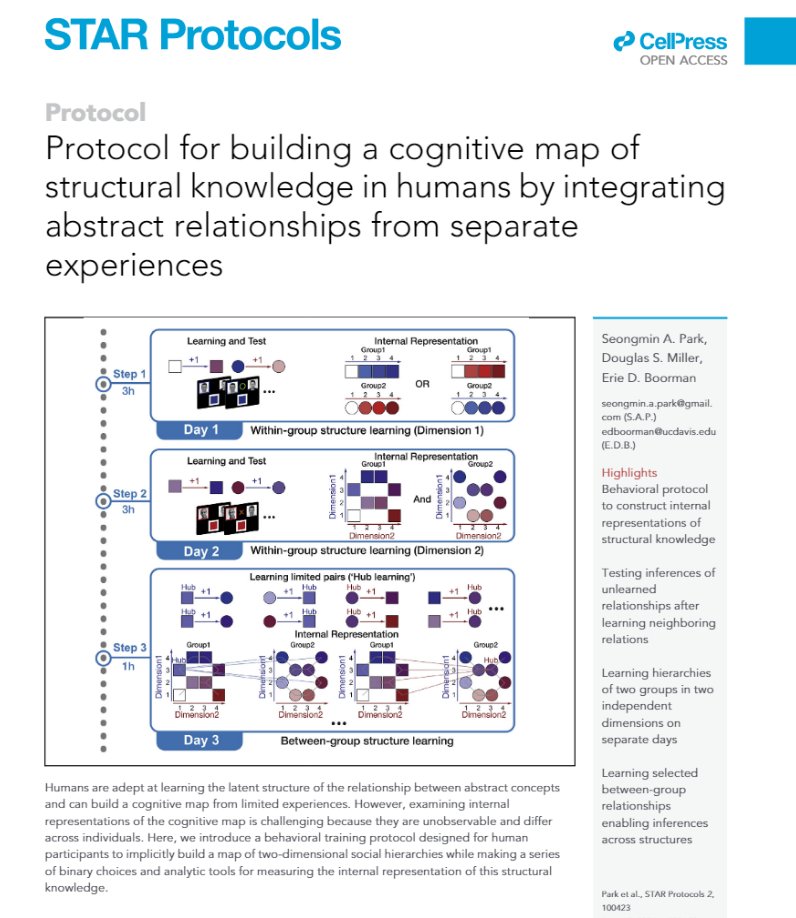
"Protocol for building a cognitive map ofstructural knowledge"
wow, this is a gem by @SeongminAPark Douglas Miller @ErieBoorman !
ps, why nobody is tweeting it?
pps, didn't know that @STARProtocols now became a journal
https://t.co/r37pPWhQWV