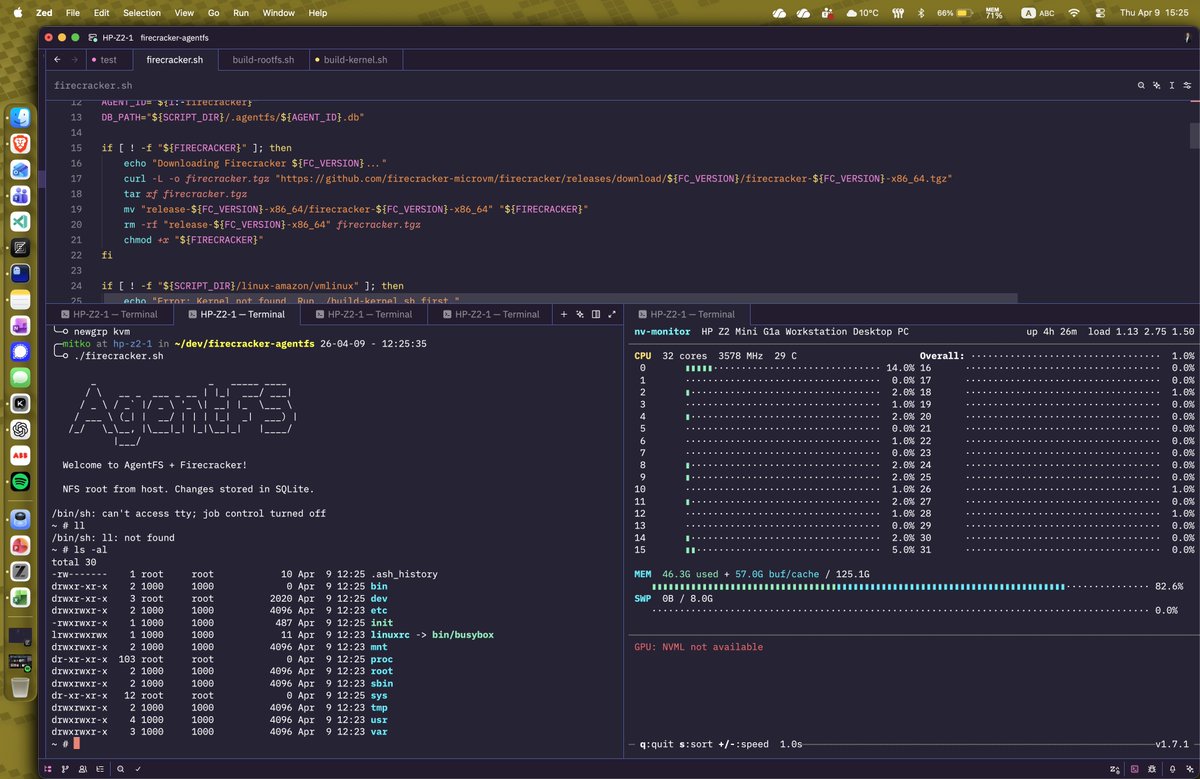
Welcome to AgentFS + Firecracker!
Zed + opencode ~5mins setup. 32-core Ryzen is a beast for agent&tools. Install done by Zed agent with Gemma4-31B. Zero shell commands
Join our private beta today to be one of the first to be given access to the new Turso Cloud: the SQLite-model, but with its power unleashed. Encrypted, in your own account, so you can build trusted agents that scale.
We at @tursodatabase are ecstatic to announce today the private beta of the new generation of the Turso Cloud.
The Turso Cloud has been a great destination for builders building agents, that recognize that agents need millions of databases, and that the SQLite file-based approach is the way to achieve that at scale.
But at the same time, SQLite comes packed with limitations. Over a year ago, @penberg had a bright and bold idea - perhaps the only good idea he had in his life - what if we rewrote SQLite entirely? If we do that, our Cloud can keep the unmatched database density at scale it has today, but without that ceiling that makes SQLite be seen as a temporary solution.
Fast forward to today, Turso, our rewrite of SQLite, is right around the corner. Concurrent Writes are here, and many other features.
And select teams will be able to run it first in the Turso Cloud: query it directly, or use it to sync your Turso databases. All of that, with enterprise-grade encryption, and running in your own cloud account.
Link 👇
When @karpathy built MenuGen (https://t.co/2OjrUJ3aLS), he said:
"Vibe coding menugen was exhilarating and fun escapade as a local demo, but a bit of a painful slog as a deployed, real app. Building a modern app is a bit like assembling IKEA future. There are all these services, docs, API keys, configurations, dev/prod deployments, team and security features, rate limits, pricing tiers."
We've all run into this issue when building with agents: you have to scurry off to establish accounts, clicking things in the browser as though it's the antediluvian days of 2023, in order to unblock its superintelligent progress.
So we decided to build Stripe Projects to help agents instantly provision services from the CLI.
For example, simply run:
$ stripe projects add posthog/analytics
And it'll create a PostHog account, get an API key, and (as needed) set up billing.
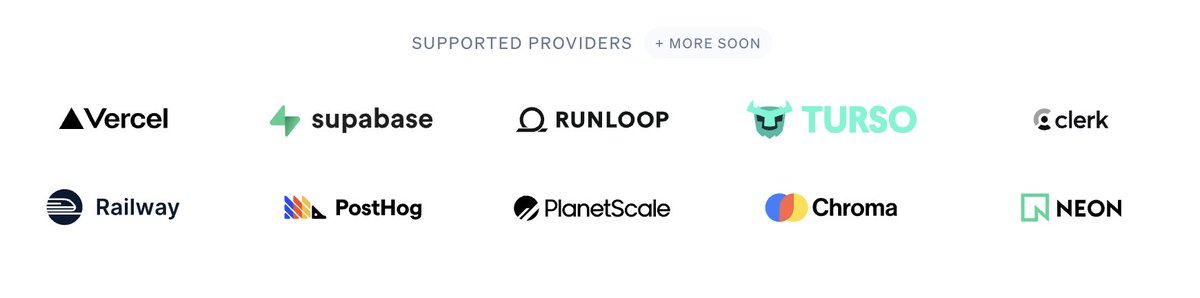
Projects is launching today as a developer preview. You can register for access (we'll make it available to everyone soon) at https://t.co/1tSgGbSLxM. We're also rolling out support for many new providers over the coming weeks. (Get in touch if you'd like to make your service available.)
https://t.co/vjRymcVCKI
We partnered with @stripe on the Stripe Projects developer preview to fix one of the biggest gaps in modern development: clean, deterministic provisioning. Together, we designed a workflow where developers and AI agents can spin up real Turso databases from the CLI, get secure credentials, and stay fully in flow. No dashboards, no brittle scripts: just reliable automation and highly available SQLite ready in seconds. Try it with:
`stripe projects init my-app`
This is a great example of using #Turso with @QwikDev to implement a super snappy newsletter management app that is always fast, regardless of where your users are.
And for me, server functions are just 🔥 Qwik made this all super easy
Turso 0.5.0 is now out!
⚡ Concurrent writes is now beta
🔍 Full-text search with Tantivy
🔒 STRICT mode stable + user-defined types
Big thanks to the 50+ people who contributed over 3,000 commits into this release!
https://t.co/CVwWS2BmT4
How well do you know Turso and The Turso Cloud?
This quiz is a great pulse check on how well you really understand edge‑native databases, branching, and the Turso model.
Quick, clever, and worth a run. See how well you score!
Try it here:
https://t.co/KLKTSZ0pVo
SQLite does not support the DEFAULT keyword, which is standard SQL. This means that there is no way to write a multi-row statement that says "just use the default" for different columns in each of the rows.
Postgres of course, supports that. I am planning to support that on @tursodatabase as well: https://t.co/UN8M1AHhwJ
We do a lot of big features, like concurrent writes, encryption and vector search. But the small details matter too.
@penberg Let us help you with this.
https://t.co/1GBCdCJlmk picked Turso as the recommended DB in the stack.
Happy to spread the word about truly great tech.
What are Turso, Turso Cloud, and libSQL?
I get this question a lot, and AI agents seem confused about it, too.
tl;dr: Turso is a new SQLite-compatible database, rewritten from scratch in Rust, currently in beta. libSQL is our open-source fork of SQLite, which powers Turso Cloud today. Turso Cloud is our managed database service, and we're actively working towards adding Turso to it.
Still confused? That's fair. The names evolved as the product did. Here's the full story in chronological order.
Back in October 2022, we announced a fork of SQLite called libSQL. At the time, we were building an edge-replicated database based on SQLite for our internal use. However, we faced a major problem that there was no way to upstream the core enabling technology, WAL virtualization. We decided to fork SQLite and make it open to everyone's contributions.
With the fork out of the way, we kept building what would become Turso Cloud. One of the most memorable moments was when ThePrimeagen tested our database on his stream sometime in February 2023, while we were still in private beta. The whole team was watching the stream and monitoring our systems, hoping everything would work out fine. In April 2023, we launched a public beta.
With our own fork of SQLite, we spent a lot of time early on trying to address one of its biggest limitations: the single-writer transaction model, which limits scalability and isn't the greatest DX. Me, @sarna_dev, and @iavins built a Hekaton-based MVCC implementation and a prototype of libSQL supporting BEGIN CONCURRENT. However, the integration wasn't great, and there was a lot to do with Turso Cloud, so we shifted priorities there.
During that same time, I began exploring rewriting SQLite. I initially used Zig, thinking I would reuse large parts of the SQLite front-end, for example. However, I also wanted to make the database core fully asynchronous with io_uring support, and it turned out to be very hard to reuse any of the SQLite code for such a fork. With some skill issues during comptime (as ThePrimeagen and Jarred Sumner once framed it), I ended up ditching Zig and, in late August 2024, switched to Rust. I called the project Limbo at the time, but later it was renamed Turso. The whole thing was more of a side quest than anything at that point, mostly exploration.
In early 2024, we had a bunch of people asking for vector support in libSQL. @SivukhinN added support for approximate vector search, similar to pgvector, but we had to compromise on the DX because the changes to libSQL would have been very intrusive. Around this time, we realized that forking SQLite would only take us so far, mostly because the main test suite SQLite uses is fully proprietary, and we had not been able to obtain access to it.
After some back-and-forth, we ended up making my SQLite rewrite side quest public. Surprisingly enough, early people like @Peristocles1, @jussisaur, and @PThorpe92 showed up and started contributing to the project. As we saw more uptake, we made it an official company project in December 2024, renaming it to Turso.
(As a side note, we did end up rewriting the libSQL server components using TigerBeetle-style DST architecture with S3-based diskless architecture in August 2024 and migrating from Fly to AWS. But that part fortunately added very little confusion to users, as it's mostly a Turso Cloud internal detail.)
Today, Turso is in beta with early customers working toward production deployments. The libSQL fork has been an incredible success with 800k weekly downloads for the JavaScript SDK and running production workloads at scale. We're actively maintaining libSQL, but the future is Turso. Built from scratch with no proprietary test suite in the way, Turso supports features like concurrent writes that a fork of SQLite never could, and we're working on bringing it to Turso Cloud.
2.5 years ago, I started a SQLite rewrite as a side quest. Today I'm backporting fixes to a release branch to address issues customers are experiencing as they work towards running it in production.
Reminds me of my Scylla days and the shift when you don't just build, but also start maintaining. That time when people gradually move from trying it out to actually depending on it.
Turso is growing up!
This is a monumental release: Concurrent Writes are finally here.
When we started Turso more than a year ago, we asked a large number of people what is the thing that SQLite lacked but they wanted to see the most. The result was overwhelming: Concurrent Writes.
It is not an easy feature to build: the whole database needs to be able to support MVCC (Multi-Version Concurrency Control). But it possible and doable because we have a full rewrite from a blank slate, and a great and reliable foundation of deterministic testing with both @AntithesisHQ and our own simulator.
MVCC is now no longer experimental and will enter a short beta period (which we do for all features) before we call it GA.
But that's not the only AMAZING thing in this release: SQLite is known to be a very permissive database. Types are suggestions. Turso now not only support STRICT tables, but comes with a type system including the ability to create your own types with the CREATE TYPE statement.
Turso is SQLite reimagined for the age of AI. And it is hard to think of something more important and more overwhelmingly victorious than types.
For the full changelog and goodies, see the post below!