The NMDC will be merging its core, high-performing functionalities directly into DOE-BRIDGE. We extend our deepest gratitude to our core team, advisors, ambassadors and champions, DOE BER, and the community 🦠 🌎 https://t.co/TJZtw6rbFP
A multimodal representation learning platform for accurate molecular ADMET prediction
1. The paper introduces Trimole-Hybrid, a task-wise multimodal ADMET framework built around a simple premise: ADMET endpoints are heterogeneous, so no single molecular representation (SMILES, graph, 3D, descriptors) should be forced to dominate every task.
2. Instead of one universal backbone, Trimole-Hybrid constructs a candidate “zoo” of predictors from complementary molecular views: SMILES language models (ChemBERTa), graph encoders (KPGT), geometry-sensitive EPT/3D-related models, plus classical cheminformatics features (Morgan/ECFP fingerprints, RDKit descriptors, and larger tabular “XL” chemistry priors) with lightweight ML models (XGBoost/ExtraTrees/RF/LR).
3. Core workflow: for each TDC ADMET task, it ranks candidates using validation or scaffold-CV on train/valid only, then freezes the chosen recipe (model family + representation + ensembling/averaging rule + seeds) before scoring on the official held-out test split, explicitly avoiding test-side selection bias.
4. Benchmark scope is broad: 22 scaffold-split TDC ADMET tasks spanning absorption, distribution, metabolism, excretion, and toxicity; tasks include both classification and regression, evaluated with the official metric per dataset (AUROC, AUPRC, MAE, or Spearman).
5. Main results: across the 22 tasks, Trimole-Hybrid matched or exceeded the public TDC top-1 reference on 10 tasks and placed within the top 10 on 21/22 tasks. Top-reference matches included AMES, BBB, HIA, P-gp, AqSol, PPBR, CYP2D6 substrate, CYP3A4 substrate, hepatocyte clearance, and microsome clearance.
6. A key observation is that the “winning” setup differs by endpoint: the best-performing tasks did not rely on one repeated predictor, but on different final compositions (sometimes descriptor models, sometimes deep encoders, sometimes rank/prediction blending and seed/fold averaging), reinforcing the paper’s argument that ADMET benchmarking should report per-task model composition, not just a single model name.
7. Ablations quantify what matters: removing the chemistry-descriptor “sidecar” causes the largest overall loss, while removing EPT/3D candidates, prediction averaging, seed averaging, or task-adaptive selection also degrades performance—supporting the claim that classical chemical priors remain highly competitive, especially alongside deep representations.
8. They also test a naive learned late-fusion MLP trained on cached candidate predictions; it underperforms the final task-wise selection on all 22 tasks, suggesting that generic fusion is not a substitute for task-specific model choice under this benchmark setup.
9. Two molecule-level sensitivity case studies connect benchmark scores to chemical changes: an AMES-positive example where perturbing an N-hydroxy/aniline-like region sharply reduces predicted mutagenicity in a reconstructed proxy model, and an external Deutivacaftor P-gp substrate example where modifying a polar linker reduces the predicted P-gp score while remaining positive—presented as behavioral sensitivity checks rather than causal pharmacophore claims.
💻Code: https://t.co/viOUtLosaG
📜Paper: https://t.co/ha7gE1QQnp
#admet #cheminformatics #molecularML #multimodal #drugdiscovery #representationlearning #TDC #bioinformatics #graphneuralnetworks #3DML
🧬 Big news: myloasm, a metagenome assembler written entirely in Rust, landed in Nature Biotechnology. It untangles closely related strains in noisy long-read data better than anything before it. Rust doing science.
🔗 https://t.co/lkTWSI0j1m
🚨🪲🧬🦠 We have a new preprint out!
Link: https://t.co/LTwq5uhrGf
Insects and microbes are more connected than we often realize. In fact, some insects owe part of their ability to feed on plants to genes they acquired from bacteria millions of years ago.
In this study, we reconstructed the evolutionary history of the bacterial glycoside hydrolase subfamily GH5-40 across leafhoppers. Starting with genome annotation across 24 species and ending with functional enzyme assays, we followed the journey of these genes from their bacterial origins to their current role in insects.
What did we find?
🧬 GH5-40 enzymes are not native to insects. Leafhoppers acquired them from Actinobacteria through an ancient horizontal gene transfer event.
🌿 Rather than remaining as a single borrowed gene, these enzymes expanded repeatedly, evolved new multidomain architectures, and diversified across leafhopper evolution.
💦 Some are highly expressed in the salivary glands, and our experiments show they are active enzymes capable of breaking down plant cell wall polysaccharides, suggesting that leafhoppers secrete them into plants while feeding.
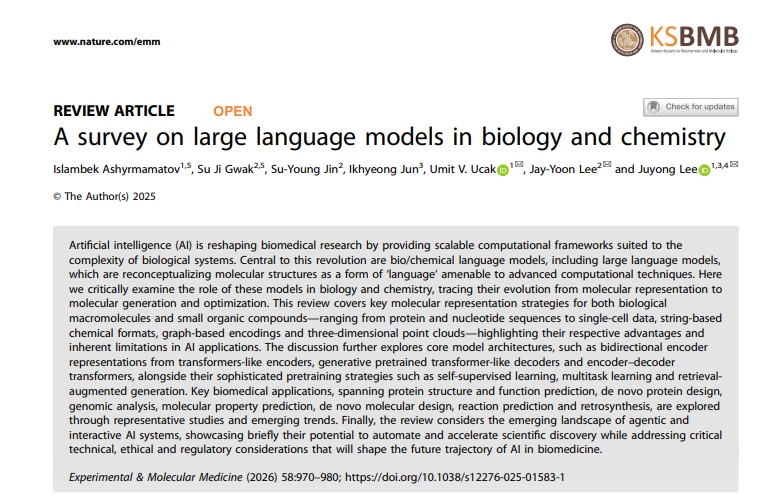
A survey on large language models in biology and chemistry
https://t.co/ka0nxL2OTg
1. Bio/Chemical Language Models: Transforming Biology into a Computational Language
AI is revolutionizing biomedical research by treating biological and chemical systems as forms of language that can be learned, represented, and generated by advanced computational models. Bio/chemical language models are enabling new approaches for understanding molecular structures, predicting biological functions, and designing novel molecules.
2. From Molecular Representation to Generative AI in Biomedicine
Modern AI models leverage diverse molecular representations, including protein and nucleotide sequences, single-cell data, chemical strings, molecular graphs, and 3D structures. Transformer-based architectures, including encoder, decoder, and encoder–decoder models, combined with self-supervised learning, multitask training, and retrieval-augmented approaches, are driving advances in protein design, genomics, molecular property prediction, drug discovery, and chemical synthesis.
3. The Future of AI-Driven Scientific Discovery
Emerging agentic and interactive AI systems have the potential to automate complex research workflows and accelerate biomedical discoveries. However, realizing this potential requires addressing challenges in model reliability, interpretability, ethics, and regulatory frameworks to ensure responsible integration of AI into medicine and science.
#BioAI #AIforScience #FoundationModels #GenerativeAI
Quantifying evolutionary novelty and design efficiency in generative genome design
1. The paper proposes a practical capability-assessment framework for generative genome design that separates two often-confused properties: evolutionary novelty (how far sequences depart from natural genomes) and design efficiency (how well a system finds viable sequences versus baselines).
2. It emphasizes that evaluations should target the model-scaffold, not just the raw model: generation plus downstream filtering/ranking/curation that determines what actually gets synthesized and tested.
3. The framework yields four behavioral regimes: Imitation (low novelty/low efficiency), Optimisation (low novelty/high efficiency), Wandering (high novelty/low efficiency), and Invention (high novelty/high efficiency). These map to different biosecurity concern profiles, especially for de novo hazard creation (which would require both novelty and efficiency).
4. Using the King et al. (2025) ΦX174 bacteriophage dataset (302 synthetic genomes with in vitro plaque readouts), they quantify design efficiency via how well model likelihood discriminates viable vs non-viable designs.
5. Evo 2 likelihood strongly predicts experimental viability (AUC 0.86), with Evo 1 similarly strong (AUC 0.86). A bacteriophage fine-tuned Evo 2 checkpoint performed worse (AUC 0.76), and Nucleotide Transformer showed near-random discrimination (AUC 0.56), suggesting the effect is not universal across genome LMs.
6. A key mechanistic result: Evo 2 likelihood correlates tightly with evolutionary proximity to natural genomes (patristic distance; Pearson ρ = -0.88). High-scoring sequences are those that stay phylogenetically close, implying the model’s efficiency largely comes from interpolation within known evolutionary space rather than extrapolation into new clades.
7. Evo 2 adds information beyond simple “biological plausibility” heuristics. Low-complexity covariates (GC deviation, gene/ORF features, synteny, protein identity, assembly thermodynamics, architecture scores, etc.) explain ~26% of variance (McFadden pseudo-R2), while adding Evo 2 likelihood increases this to ~40% (likelihood ratio p = 2.2e-05).
8. To contextualize efficiency, they compare observed viability at ~97% identity (5.3%; 16/302) to baseline generators. Under an independence approximation, this corresponds to an effective per-mutation failure rate peff ~1.7% (CI ~1.45–2.04%), far below literature estimates for random single mutations in ΦX174-like phage (~20% lethal), implying many-orders-of-magnitude uplift over naive random mutagenesis at the same mutational distance.
9. Even against a more generous “MSA-aware” mutagenesis baseline (mutate only naturally variable sites), the model still shows large uplift across plausible lethality rates, supporting the claim that it is not merely choosing permissive positions but navigating higher-order constraints.
10. Comparing to directed evolution via serial passage simulations: reaching similar sequence divergence (e.g., ~97% identity) can require impractically many passages under typical parameters, implying generative design can traverse comparable novelty levels with much greater time/cost efficiency—yet still without producing phylogenetically distant outputs.
11. Overall placement: Evo 2 on compact phage genomes behaves like an evolutionary optimiser (Optimisation quadrant: high efficiency, low novelty). The authors argue this implies low-to-moderate biosecurity concern for de novo hazard creation in this setting, while noting generalization to larger/less constrained viral architectures remains unresolved.
12. The broader contribution is methodological: a reusable, evidence-based template for tracking whether future model-scaffolds move along the novelty axis toward “Invention,” which would be the key surveillance signal for qualitatively new capabilities.
📜Paper: https://t.co/NTGzYQJq0h
#ComputationalBiology #Genomics #Biosecurity #SyntheticBiology #MachineLearning #FoundationModels #Virology #Phylogenetics #GenomeDesign #AIAlignment
🍏 As part of #ISMB2026 next month, we're running an online Hello @nf_core Tutorial.💻 If you're interested in leveling up you workflows with community best practices and developer resources, this is the session for you. https://t.co/HTFqjXnqRA
Protein language models are accidental taxonomists
1. The paper argues that many high reported scores for multi-species protein–protein interaction (PPI) prediction can be explained by a confounder: models learn taxonomy/phylogeny signals rather than interaction biology, a behavior they call the “accidental taxonomist” hypothesis.
2. Core dataset issue: in BioGRID, 96.5% of positive PPIs are intra-species (same organism), but “randomly paired” negatives are intra-species only ~31.8% of the time. This mismatch lets a model treat “different species” as a proxy for “negative.”
3. A simple simulation shows the shortcut is strong: a perfect classifier for “same species vs different species” could reach ~82% accuracy and AUROC ~0.82 on a balanced PPI dataset, without learning any PPI mechanism.
4. The authors then test whether protein language model (pLM) embeddings encode taxonomy strongly enough to enable this shortcut. Using MLP probes on multiple pLMs, they show embeddings support taxonomic classification from domain down to species, with performance decreasing as labels get more fine-grained.
5. Key observation for pair-input tasks: even when exact species prediction is weak (best weighted F1 ~0.18 across 618 species), a paired binary task (“are these two proteins from the same species?”) is easy from embeddings. Most pLMs exceed 0.8 F1; ESMC600M reaches ~0.87 F1. This mirrors PPI’s two-sequence input format.
6. They propose a practical control: Strategic Sampling (SS) for negatives, where negative pairs are sampled only within the same species, preventing “inter-species = negative” cheating. This is contrasted with Normal Sampling (NS), where negatives are sampled across the whole multi-species pool.
7. Results on rigorously split multi-species BioGRID (C3 splits, 40% identity clustering): NS looks strong on its own validation (mean MCC ~0.71), but collapses when evaluated on an SS test set (mean MCC ~0.23). SS models are lower on validation (mean MCC ~0.39) but generalize better to the SS test set (mean MCC ~0.34). This gap supports the confounder hypothesis.
8. Training dynamics suggest “reward hacking”: NS drives predicted probabilities for positives toward ~0.94 (vs ~0.75 for SS), consistent with exploiting a near-deterministic shortcut; both methods find negatives difficult (negative probabilities ~0.5), indicating the real PPI signal remains challenging.
9. Inter-species PPIs remain a blind spot: on BioGRID-MV (enriched for multi-validated interactions including host–virus), both NS and SS show near-zero recall for inter-species positives (SS: 0/1091; NS: 2/1091), with predicted probabilities near coin-flip. This suggests host–pathogen PPI needs dedicated data and evaluation, not just multi-species scaling.
10. Broader implication: “accidental taxonomist” is not PPI-specific. Any supervised protein task where labels correlate with phylogenetic regions (e.g., EC numbers concentrated in certain taxa) may inflate performance unless datasets control for taxonomy/phylogeny structure.
💻Code: https://t.co/WgkOjcaKwl
📜Paper: https://t.co/YNB6WvBXkP
#Bioinformatics #ComputationalBiology #ProteinLanguageModels #MachineLearning #PPI #DatasetBias #Benchmarking #Phylogeny #Taxonomy #RepresentationLearning
Interpretable enzyme function prediction via sparse autoencoder features of ESMC across the microbial protein universe
1. The paper proposes a “features-first” route to enzyme function prediction: instead of training a new deep model, it uses ESMC-6B’s sparse autoencoder (SAE) features as an interpretable semantic signature to predict EC numbers.
2. Key enabler: the ESMC SAE expands layer-60 hidden states into a 16,384-feature codebook with Top-K=64 sparsity, and each feature has an independently interpretable biological concept label (generated/annotated via multi-agent GPT-5), enabling mechanistic explanations alongside predictions.
3. Benchmark setup: 4,868 reviewed microbial SwissProt enzymes (Bacteria + Archaea), balanced across 7 EC1 superclasses and spanning 161 EC3 subclasses; proteins are 80–700 aa and have ≥3 EC levels. Protein representations are mean-pooled SAE activations, evaluated with simple linear probes.
4. Main EC3 result (161-way classification, 80/20 split): SAE binary features (just the top-64 active concepts per protein) reach 78.9% top-1 and 88.5% top-5 accuracy, outperforming a 3-mer logistic regression baseline (57.3% top-1) and approaching BLASTp (80.5% top-1).
5. Using richer SAE information improves further: the combined binary + activation weights representation reaches 85.6% top-1 and 90.5% top-5, exceeding BLASTp top-1 by 6.4% in this benchmark.
6. Practical advantage over homology transfer: BLASTp returns no hit for 12.6% of test proteins, while SAE features yield predictions for 100% of queries; for the BLASTp no-hit subset, SAE binary still achieves 62.1% top-5 accuracy.
7. “Dark-matter regime” analysis: test proteins are binned by maximum 3-mer Jaccard similarity to training data; in the lowest-similarity bin (<0.20, containing 61% of the test set), SAE top-5 accuracy is 0.656 vs 0.438 for the 3-mer baseline, showing robustness when sequence similarity is minimal.
8. Generalization to unseen enzyme classes: leave-one-EC3-class-out evaluation (60 populous EC3 subclasses held out) trains only an EC1 classifier and tests whether it recovers the correct EC1 superclass for a completely unseen EC3 class; SAE binary achieves 47.7% EC1 recovery (3.3× random; vs 26.6% for sequence features).
9. Interpretability check: the most discriminative SAE features align with known enzymology—e.g., hydrolases linked to α/β-hydrolase catalytic triad/nucleophilic elbow geometry; oxidoreductases to Rossmann NAD(P)H-binding motifs; transferases to P-loop/Walker A phosphate-binding patterns; translocases to multi-helix transmembrane bundle concepts—supporting mechanistic plausibility of the learned “concept” features.
10. Atlas-scale survey: scanning 7.7M ESM Atlas cluster representatives, the authors identify 169,859 “dark enzyme-like” candidates (uncharacterized clusters with enzyme-suggestive Pfam keywords) spanning major microbial phyla, positioning SAE-based signatures as a scalable prioritization tool for experimental enzyme discovery.
💻Code: https://t.co/dqrMyX8yov
📜Paper: https://t.co/f413DfqnL9
#ProteinLanguageModels #EnzymeDiscovery #ECNumber #Interpretability #SparseAutoencoders #Microbiome #Metagenomics #ComputationalBiology #ESMC #ESMAtlas
Sea Cucumber Signals
✔️ https://t.co/AOx44VNWtY
Zheng et al. @OUC1924
This new review in Reviews in Aquaculture explores how neuropeptides regulate key physiological processes in #sea cucumbers, from feeding and growth to #reproduction and #regeneration...(1/2)
Our @WILDLABSNET Boring Fund updates are coming along well! Here's a demo of what our recording search pages will soon look like, including the ability to switch between simple and advanced search functions as well as acoustic measurements to help with filtering!
“It’s a major advance, on the scale of an AlphaFold4. The problem, of course, is that we know nothing of the details.”
Isomorphic Lab’s proprietary drug-discovery model is a major advance
https://t.co/AhhVEDOhP2
We are delighted to share that the GA4GH April Connect meeting agenda is now available, featuring more than 30 collaborative sessions to advance responsible genomic and health data sharing.
View the Connect agenda: https://t.co/18Icbhwx4Q