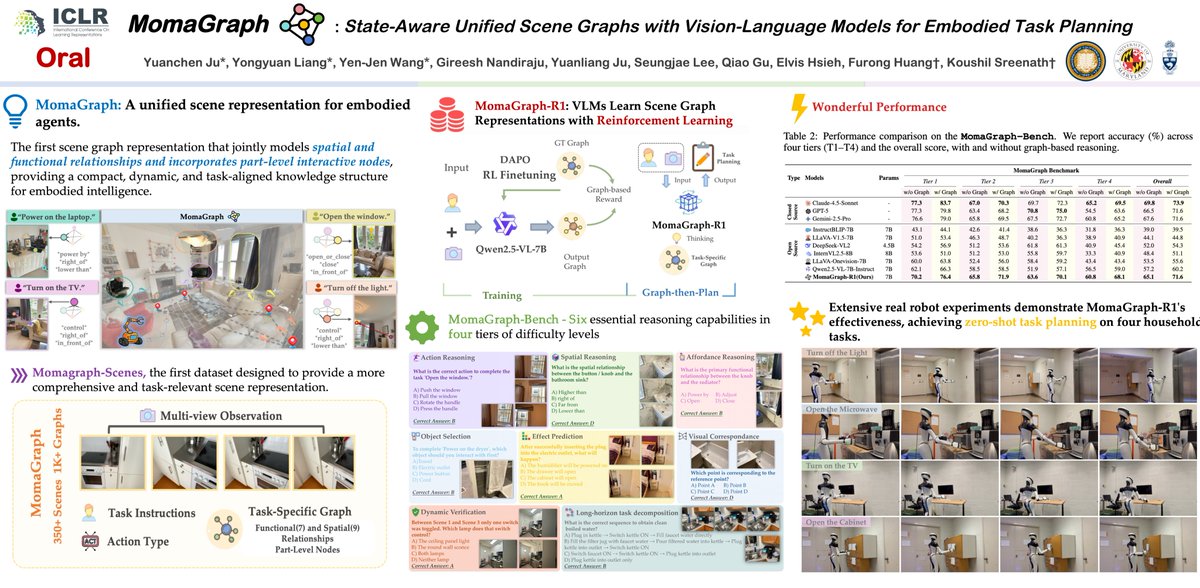
Our #ICLR2026 Oral paper MomaGraph will be presented at Oral Session 3D Vision language models II, April 24th 10:30 BRT. Poster session is at Pavilion 3 P3-#1313, April 23rd 3:15-5:45 PM BRT.@furongh will be there, feel free to stop by and chat!💐
🤖For embodied agents in household environments, we tackle two fundamental questions: 1️⃣ What is the optimal scene representation? 2️⃣ Can a VLM leveraging this representation actually improve spatial understanding and task planning?
Introducing MomaGraph: State-Aware Unified Scene Graphs with Vision-Language Models for Embodied Task Planning. 👉: https://t.co/KK4YCknG1K and 🔗:https://t.co/TfeZwIHMkE
Key Ideas:
MomaGraph jointly models spatial AND functional relationships with part-level interactive nodes.
MomaGraph is designed to be: ✅ Task-Relevant: Filters visual noise to keep only what matters for the instruction. ✅ Dynamic & State-Aware: MomaGraph adapts. 🔄 It explicitly models object states and dynamic changes in the environment.
We built MomaGraph to bridge the gap between the Spatial VLM and Robotics communities. 🌉 Our hope is that this work serves as a foundation for the next generation of intelligent, adaptive embodied agents. 🦾✨Questions and feedback welcome. 🚀
#Robotics #EmbodiedAI #CV #LLM #SceneGraph
Me and @AveryJuuu0213 will be presenting our #ICML2026 Spotlight HDFlow today.
⏰Wed, Jul 8, 2026 • 5:00 PM – 6:45 PM KST
📍HALL A #807
Come and chat if you're interested. Also happy to chat about tackling long-horizon robotic tasks using RL, WAMs and JEPA-based world models.
Can a world model 🌏 learn to predict how 198 different deformable objects move -- not just one rope or cloth?
That question motivated Deform360: 1,980 real-world interactions captured from 41 synchronized views with bimanual touch sensors, which becomes crucial when vision is occluded.
Accepted at #ECCV2026. 🧵
1/5
#ICML2026Spotlight Standard diffusion is powerful, but inference latency is a real headache for real-time robot control. HDFlow uses rectified flow for instant trajectory generation in long-horizon tasks. Fantastic work by @girish_432@AveryJuuu0213 !
🎉@icmlconf 2026 Spotlight!
🤖 Can generative planners be highly exploratory for long-horizon tasks & fast for real-time control?
Single-paradigm models struggle with speed.
Introducing HDFlow: Hierarchical Diffusion-Flow Planning! We combine the best of both worlds.
(1/7)
🎉@icmlconf 2026 Spotlight!
🤖 Can generative planners be highly exploratory for long-horizon tasks & fast for real-time control?
Single-paradigm models struggle with speed.
Introducing HDFlow: Hierarchical Diffusion-Flow Planning! We combine the best of both worlds.
(1/7)
@girish_432 We’re excited to present HDFlow as an ICML 2026 Spotlight🔥, come visit our poster on Wed, Jul 8, 5:00–6:45 PM KST at Hall A #807, happy to discuss hierarchical planning, diffusion-flow models, and long-horizon robotic control! @icmlconf
Happy to share that SuperFlex is accepted to ECCV’26! 🇸🇪✨
SuperFlex as SuperDec is a feed-forward method for superquadric decomposition, but it achieves a huge jump in the reconstruction quality by incorporating deformable superquadrics and a novel loss function ✨
How can we scale perception-based humanoid learning without collecting massive humanoid teleoperation data?
🚀 Excited to finally share VLK!
What excites me most about VLK is that it reframes data collection as a data generation problem. Instead of relying on expensive humanoid teleoperation, we automatically generate synchronized vision, language, and whole-body kinematics from reconstructed real-world scenes.
Making this vision a reality required bridging three fundamental challenges:
👀 Perception: Bridging the RGB sim → real gap through visual domain randomization and motion blur mitigation during both training and deployment.
🤖 Embodiment: Bridging the kinematics → dynamics gap with real-time VLA deployment, test-time RTC, and SceneBot, enabling seamless deployment on a real humanoid.
🌍 Environment: Bridging the real-world → synthetic gap to enable scalable Vision-Language-Kinematics data generation through scene reconstruction and interaction synthesis.
It has been an amazing journey working with such an incredible team. For a complete walkthrough of the project, check out @jiaman01's thread below 👇
🌐 Project: https://t.co/PnvpCDW4fi
📄 Paper: https://t.co/DPe20ilXm7
🎦 Video: https://t.co/BivXCxkzcq
Huge thanks to my amazing collaborators @jiaman01@eric_srchen@TakaraTruong @ Pei Xu, and to our advisors @pabbeel@rocky_duan@KoushilSreenath@akanazawa@carlo_sferrazza@GuanyaShi@ckarenliu.
Humanoid robots often fail when conditions change.
A heavy backpack. A soft floor. A steep slope. Suddenly, the same controller may not work.
Meet FADA.
🦾
It adapts a humanoid to new conditions using only its own experience, keeping what the robot wants to do and changing only how it does it.
About two minutes. No rewards. No demonstrations. No simulator retuning.
🧵
Today, we give robots a /skills library that self-evolves and compounds indefinitely! Introducing ASPIRE: a robot solving its 100th task is no longer as clueless as solving its first. Coding agents observe multimodal sensory traces from simulation and real robots, launch an evolutionary search over control programs, and distill the best know-how into an ever-expanding library.
ASPIRE is a new type of continual learning: "training" is skill refinement instead of gradient descent.
"Trained model" is a repo of sensorimotor skills instead of floating weights.
“Distributed training” is a panel of agents each practicing a different skill instead of sharded minibatches.
Here's the beauty: ASPIRE gives the tired terms "sim2real transfer" and "cross-embodiment transfer" a whole new meaning. Bridging the sim-to-real gap is notoriously brutal. An end-to-end policy has to swallow both the visual shift (sim looks toyish next to a real camera) and the subtle contact physics it never quite gets right. ASPIRE sidesteps the mess, because it doesn't ship pixels or weights across the gap, but ships the know-how. The robot still has to practice in the real world, not zero-shot, but it gets there way faster because it isn't rediscovering the strategy from scratch. Same for going single-arm to bimanual hardware, which usually requires new data and retraining from zero. ASPIRE achieves up to ~10x cut in "transfer learning” tokens (yes, tokens are the new unit of *training* compute ;)
Check out our gallery of 150+ tasks and 90+ skills the robots taught themselves, all on the website! Kind of wild that we can ship the "learned weights" as an HTML page rather than a GGUF. We'll open-source the full stack so your own robot library starts compounding from ours!
Deep dive in thread:
People are talking about building world models for AI systems. But for world models to be truly useful for robots, they need to model the changing dynamics of the physical world, such as gravity, friction, and external disturbances.
Introducing IMPACT: Internal Model Predictive ConTrol. Inspired by the mechanism in human cerebellum, we propose learning an internal model of environmental dynamics on the fly and adapting to changing dynamics accordingly. This internal model runs at 1000 Hz on real robot hardware!! Controlled experiments in both simulation benchmarks and the real world demonstrate that IMPACT significantly outperforms baseline methods.
Sharing Awesome FlexiTac, a curated research list for flexible tactile sensing in robotics!
https://t.co/RppBYQ47k5
Since its release, our tactile sensing platform has seen broad adoption across academia and industry. Hope this list helps the community discover related work and push tactile sensing forward.
PRs are welcome!
Video world model imaginations🌎💭can miss critical but plausible outcomes of robot actions.
Introducing 𝙎𝙩𝙧𝙚𝙨𝙨𝘿𝙧𝙚𝙖𝙢: inference-time steering for video WMs, imagining plausible✅, high-impact⚠️ futures for 𝙧𝙤𝙗𝙪𝙨𝙩🛡️ policy evaluation and improvement.
(1/15)
The term "continual learning" has become overloaded if you see it as an ML problem.
One classic thread is about memorization: regularization-based continual learning methods, such as EWC, MAS, and SI, estimate which parameters mattered for previous tasks and resist changing them too much.
One modern thread is about adaptation: test-time training and inference-time learning methods, such as TTT, adapt part of the model on the incoming test stream before making predictions.
These are sometimes discussed as separate threads. But in modern scalable architectures, I think they are better seen as complementary constraints: a model that learns quickly at test time also benefits from a mechanism for deciding what not to forget.
In our #ECCV2026 paper, we study this in large-scale 4D reconstruction: how to build fast spatial memory that can adapt over long observation streams while reducing collapse and forgetting.
Instead of using fully plastic test-time updates, we stabilize fast-weight adaptation with an elastic prior that balances adaptation and memory.
Key ideas:
- Elastic Test-Time Training: Fisher-weighted consolidation for fast-weight updates
- EMA anchor weights that provide a moving reference for stability
- Chunk-by-chunk inference for long 3D/4D observation streams
We show that this scales across large 3D/4D pretraining settings, including both LRM-style and LVSM-style models, and improves reconstruction across benchmarks including Stereo4D, NVIDIA, and DL3DV-140.
We release model checkpoints across different design choices: resolution, post-training curriculum, and whether the model uses an explicit 4DGS intermediate representation.
- Homepage: https://t.co/7iXjTiKcdu
- Paper: https://t.co/SBUu9kGS87
- Code: https://t.co/FMrStj4fW6
- Models: https://t.co/8lo3Dk95en
This work is co-led with @Xueyang_Y, contributed by @zhnhoy5@YuncongYY, and advised by @SLED_AI@gan_chuang.
Introduce EgoInfinity:
a web-scale (14.6 yrs, 142M clips)
data engine that automatically lifts Youtube videos into 4D hand-object interaction, and retargets for robot learning
Not only a dataset, but a modular, upgradable engine
HF Space: https://t.co/2jNxLV8XFJ
Children learn from play. Can robots do the same?
We propose 𝐏𝐥𝐚𝐲𝐟𝐮𝐥 𝐀𝐠𝐞𝐧𝐭𝐢𝐜 𝐑𝐨𝐛𝐨𝐭 𝐋𝐞𝐚𝐫𝐧𝐢𝐧𝐠, a paradigm that gives embodied coding agents a play stage before downstream tasks arrive, and instantiate it with 𝐑𝐀𝐓𝐬 (Robotics Agent Teams), where robots discover reusable skills through curious play.
Co-led with @jiaxin_ge_
New collaboration between NVIDIA and Physical Intelligence: We propose SC3-Eval that evaluates robot policies entirely inside a world model post-trained from Cosmos3-Nano. The policy acts, the model imagines the consequences, and the imagined evals predict real-world results. 🧵
Introducing ABC: open data, training, and infrastructure for robotics.
We release the largest teleop dataset to date, and extensively investigate design decisions, pretraining, and post-training techniques.
@arthurallshire@Cinnabar233@adamrasb@redstone_hong@davidrmcall
Autoresearch just left the sandbox and entered the embodied world.
We are excited to introduce 𝐄𝐍𝐏𝐈𝐑𝐄: a system that drops frontier coding agents onto a fleet of real robots and hands them the entire loop:
reset the environment → search the literature → implement ideas and build the infra → train and deploy → self-verify → analyze the logs and rewrite the code → repeat, until the policy is reliable in the real world. No human in the loop.
Guided only by the robot's self-proposed, heuristic-based success signal, the agents hill-climb to 99% on dexterous real-world tasks: organizing pins into a box, seating GPUs, tying zip-ties.
We envision the bottleneck in robotics shifting — from building smarter algorithms to building the closed physical feedback loops an agent can finally turn on its own.
🔗 https://t.co/3tL2ArGo3v
From @NVIDIA@CMU_Robotics@Berkeley_AI
🧵