It’s out!🥳 Immensely proud of my friend and colleague Tanay Kaymak. It was a great pleasure to work on this project alongside of him and learn about eosinophilic esophagatis which is a rare but horrible disease that causes dysphagia and food impaction. https://t.co/izzLGeL9KW
Today, the New England Journal of Medicine published what may be a landmark moment: doctors used customized gene editing inside a living baby to treat a deadly genetic disease called carbamoyl-phosphate synthetase 1 (CPS1) deficiency. Is it time to prepare for a world where we don’t just treat genetic diseases, we rewrite their story? Will gene editing change the future of medicine?
Key Points for the Public:
- Think of it as the first real-life genetic fire rescue; editing a baby’s DNA to prevent brain damage and death.
- They used a tool called base editing, that is considered a precise cousin of CRISPR.
- The authors corrected a disease-causing mutation in the liver using lipid nanoparticles.
- You may recognize lipid nanoparticles as the same delivery technology used in mRNA COVID vaccines.
- Their treatment was "tailor-made for a single patient."
- The personalized gene-editing drug called k-abe was made in under 6 months (incredible!).
- The single infant they used it on had a rare and fatal genetic disorder.
- So far, the treatment has been safe and effective though followup has not been very long.
- The infant tolerated more protein, required fewer medications, and recovered from infections without ammonia spikes (known to be bad for the brain).
My take: This isn’t science fiction anymore, gene editing can be performed in real-time. Gene editing is moving beyond sickle cell. Lipid nanoparticle delivery facilitates re-dosing, making it safer and more flexible. What does this mean for the future? Neurogenetic diseases could be next in line? Could we start moving into rare brain conditions in children or even adult-onset disorders like Huntington’s or inherited forms of Parkinson’s? What was cool about this study was moving from diagnosis to therapy, in just months. The platforms like this one seem to be scalable. Many diseases could share delivery systems with only the guiding RNA changing. Ethics and oversight will be critical. Safety, long-term monitoring, and clear boundaries (e.g., no germline edits) must be built into the future of this therapy. Could this change the arc of progression for many diseases? We hope this technology and approach will move from lethal newborn disorders to slowly progressive neurologic conditions. Has gene editing moved past the dream stage? Is it time to prepare for a world where we don’t just treat genetic diseases, we rewrite their story? https://t.co/1jHOp6ziiB #GeneEditing #CRISPR #Neurology #RareDisease #BaseEditing #PrecisionMedicine #NEJM #Parkinsons #Neurogenetics @ParkinsonDotOrg@FixelInstitute
With @ButovskyLab, we show that silencing TIM-3 in brain-resident immune cells prevents neurodegeneration in a mouse model of #Alzheimers disease. Deletion of TIM-3 in microglia enhances phagocytic clearance of toxic amyloid beta. https://t.co/VSZApkH3jk
Online now: Soluble CTLA-4 regulates immune homeostasis and promotes resolution of inflammation by suppressing type 1 but allowing type 2 immunity https://t.co/gznSAhnyQE
This is like AlphaFold, but for protein localisation rather than folding
It's a deep learning model that predicts a protein's subcellular compartment based on its amino acid sequence alone:
RELMβ mediates a gut immune–epithelial circuit regulating food allergy and tolerance via a novel mode of innate control of adaptive immunity through microbiome editing @Nature
https://t.co/kLAQ0bh1Y7
Free scientific illustrations for biologists! 😍
@NIH has released a library of 500+ free scientific illustrations to create figures, presentations, and illustrations!
all freely available in the public domain.
Retweet and spread the message!
https://t.co/p1bD1kxO7H
Sevgili Daron Acemoğlu’nu yürekten tebrik ediyorum. Çoktan hak ettiği bu büyük ödül için 👏👏🧿🧿💕💕.
Heartfelt congratulations to dear Daron Acemoğlu for receiving this well deserved honor 👏👏🧿🧿💕💕. @DAcemogluMIT
Two children with inflammatory bowel disease had neutralizing anti–interleukin-10 autoantibodies. One child had durable drug-free remission after B-cell depletion and an associated decrease in the anti–interleukin-10 titer. Read the Brief Report: https://t.co/YzKRLvIUnZ
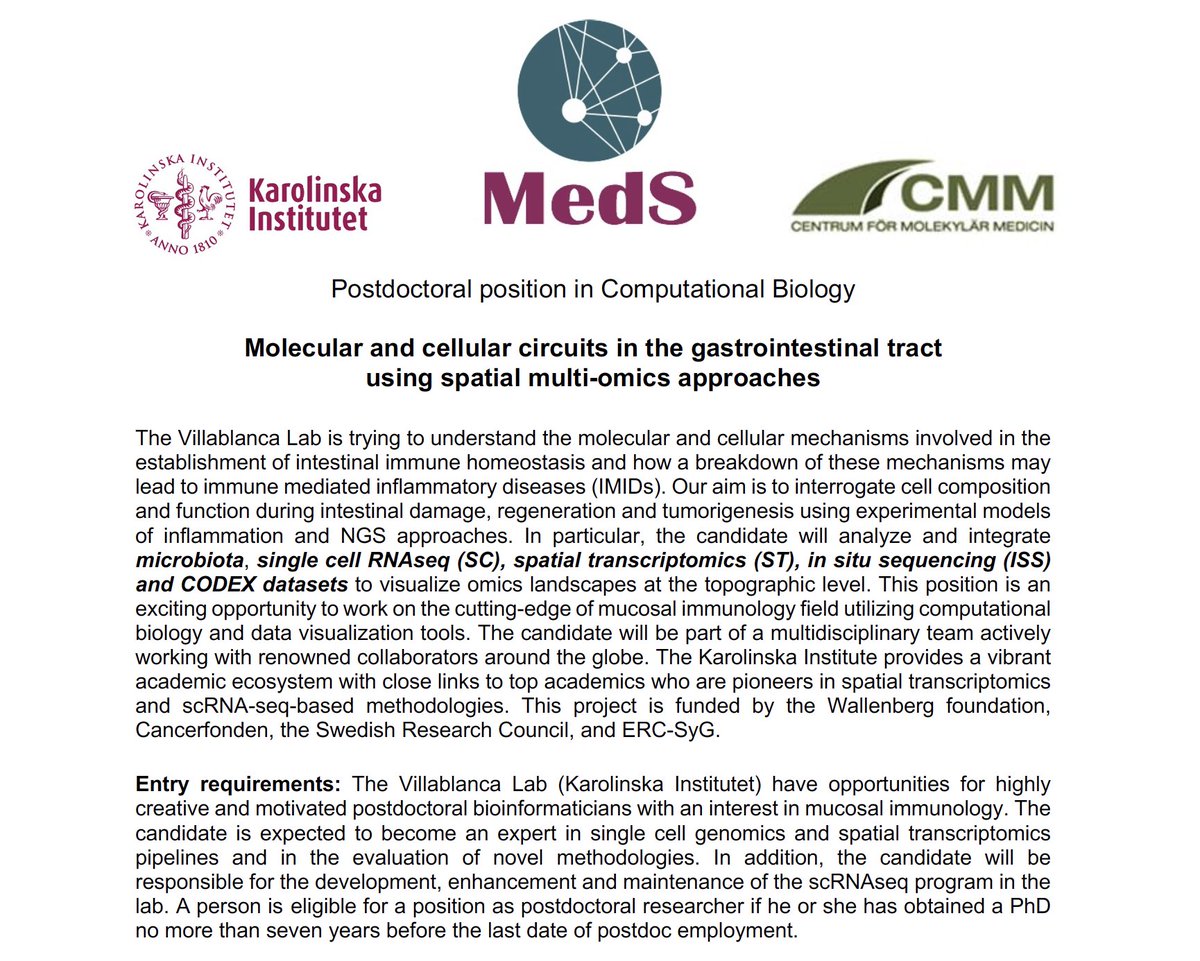
Postdoctoral position open in my lab! 😱
We are looking for a computational biologist interested in Single-cell and Spatial transcriptomics, and of course, in Muc Immunology in the context of inflammatory bowel diseases and colorectal cancer
Please see info 👇👇🏼👇🏾👇🏿 and share!
Please RT! Junior POSTDOC fellowship on Bacterial Quorum Sensing in gut Microbiota funded available in @KarinaXavierLab at
@IGCiencia Portugal. If you want to discover novel mechanisms of Chemical Communication in the
Mammalian Gut Microbiota: Apply at https://t.co/2c67ZWVlDq
Out now! 👇Over a century ago, Elie Metchnikov proposed that #aging is caused by increasing #intestine permeability and toxic #microbiota into our bodies. In our last paper provides evidence for this idea. @ircaninstitute @IGCiencia @CNRS#zebrafish 🐟
https://t.co/nXv8wSxXqS