John Adams, writing to Abigail, about the Continental Congress' vote in favor of independence on July 2, 1776:
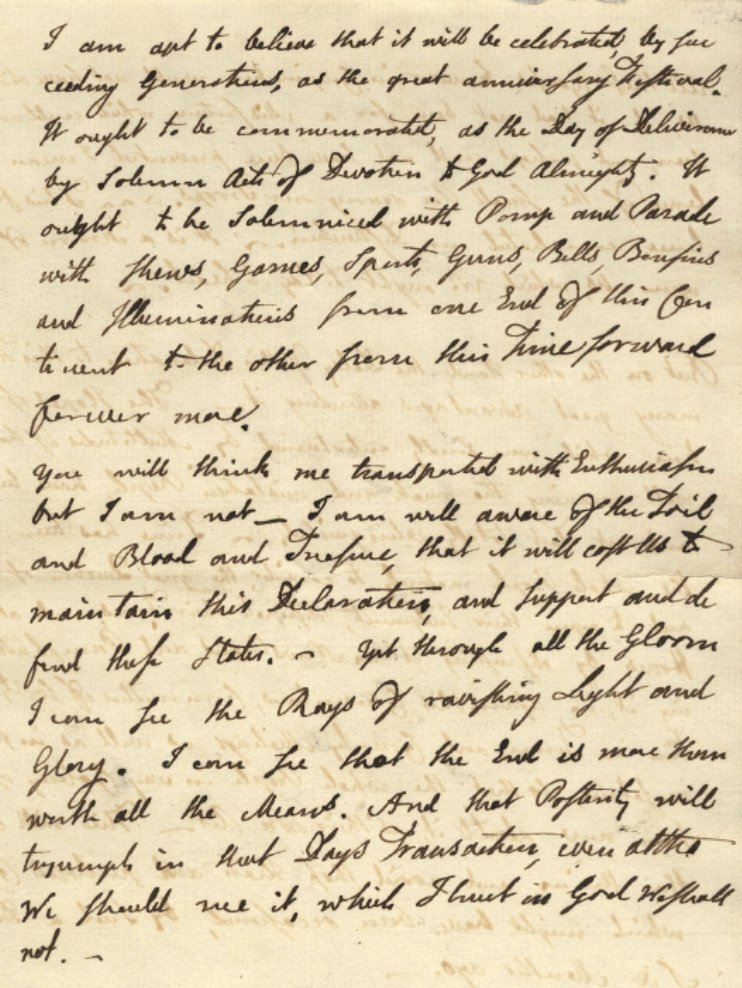
"The Second Day of July 1776, will be the most memorable Epocha, in the History of America. I am apt to believe that it will be celebrated, by succeeding Generations, as the great anniversary Festival. It ought to be commemorated, as the Day of Deliverance by solemn Acts of Devotion to God Almighty. It ought to be solemnized with Pomp and Parade, with Shews, Games, Sports, Guns, Bells, Bonfires and Illuminations from one End of this Continent to the other from this Time forward forever more. You will think me transported with Enthusiasm but I am not. -- I am well aware of the Toil and Blood and Treasure, that it will cost Us to maintain this Declaration, and support and defend these States. -- Yet through all the Gloom I can see the Rays of ravishing Light and Glory. I can see that the End is more than worth all the Means. And that Posterity will tryumph in that Days Transaction, even altho We should rue it, which I trust in God We shall not."
I want to clarify something because I’ve gotten a few questions. Ward 250 is a 100kWt reactor. It is licensed to operate at 100kW thermal power, and peak to 250kW thermal power for up to one day.
It is possible that in the future, we will submit a change to our safety basis and push more power out of it—probably a couple MW is easily achievable. The reactor itself is SIZED to 15MW thermal—meaning, the core region is 5m^3, and HTGRs traditionally run at around 3MW/m^3. 5 x 3 = 15. Some HTGRs have run even higher, and there are ideas of how to achieve 6MW/m^3, which would imply 30MW.
However, it would be extremely disingenuous of me to talk about this as a 15MW (or 30MW) reactor. It is not. It is a 100kWt reactor. As I am typing this it is currently making 100kWt. Future reactors we’ll make with the same core size but larger cooling systems will make tens of MW, but this one does not.
I feel that I should say this because others in the field like to refer to critical assemblies, which as critical assemblies are actually not going to make any power at all, by the theoretical power number that should be achievable by a core of that size. If Valar were to play that game, we would talk about Ward 250 as a 15MW or 30MW reactor.
However, Valar does not play that game. You will notice that we did not refer to our Nova Core as a reactor and did not talk about theoretical power output. If you analyze all of our media, we were very careful to never refer to Nova as a reactor or try to characterize power. Why? Because it is a critical assembly built for zero power criticality.
In 2018, NASA built a small reactor named KRUSTY on the same machine that we took the Nova core critical on, LANL’s Comet. This was a small Be-moderated reactor with sodium heat pipes and a series of 125W Stirling engines adding to ~1kWe. That is a 1kWe reactor. Nova was built on the exact same machine, and contained a larger volume of fuel. But we did not say anything about theoretical power output or call it a “1kW reactor” or some nonsense. Because despite the Nova core containing coolant channels, there there was no cooling system attached to it.
Ward 250 is a 100kWt reactor… because it makes 100kWt. It is making 100kWt right now.
Many podcasters ask me what Delta's number one selection criterion is for a candidate. I think, more than anything, they look for people who do not know the meaning of the word "quit." Whether you’re looking to join Delta or seeking success in any life choice, refusing to quit will take you very far.
The photo is of me coming into the last point on the last day of Delta's Selection and Assessment. I just did 40 miles, carrying 58 pounds in my pack. It took me 15 hours and 15 minutes. I had no idea this was the last day, the finish. I no longer felt that I was connected with my body. I was just moving forward. I didn’t know the meaning of the word “quit.”
President Donald J. Trump awards the #MedalofHonor to #MarineCorps Maj. James Capers Jr. (Retired), and posthumously to Marine Corps Col. John W. Ripley (Retired) during a ceremony at the @WhiteHouse.
Capers received the nation’s highest military decoration after being upgraded from a Silver Star for extraordinary heroism and conspicuous gallantry during the Vietnam War in 1967, and Ripley received the award after being upgraded from a Navy Cross for extraordinary heroism and conspicuous gallantry during the Vietnam War in 1972.
#USMC #MedalofHonor #WhiteHouse #SemperFidelis
Onboard footage from Ukrainian mid-range strike drones as they hunt down rear-area Russian military logistics around Donetsk city.
Some autonomous targeting features are visible.
Allied forces stormed the beaches of Normandy 82 years ago today. The amphibious assault followed years of planning that included collecting #soil and #sand samples from potential landing sites by a select band of men.
#geoscience#geology https://t.co/XorriG1sEh
In a survey, CFR asked members of the Society for Historians of American Foreign Relations what they considered to be the best and worst foreign policy decisions in U.S. history.
They ranked the Marshall Plan as the best U.S. foreign-policy decision.
On June 5, 1947, Secretary of State George C. Marshall proposed the plan in a Harvard commencement address. Less than a year later, President Harry Truman signed it into law, authorizing one of the largest foreign aid programs in history.
From 1948 to 1951, the United States provided 16 countries in Western Europe $13.2 billion in assistance—equivalent to roughly $180 billion today—to buy food and goods and to invest in their infrastructure and industry.
The Marshall Plan revitalized postwar Europe, blunted Soviet influence in Western Europe, encouraged intra-European cooperation, and cemented the United States' leadership of the transatlantic alliance.
Learn more about other foreign policy decisions and how they ranked at the link in our bio.
We partnered with @FireworksAI_HQ to train open-source models for legal. Here's what we found:
1) Hybrid legal agents can beat frontier models on quality and cost by routing selectively to a frontier advisor.
We tested a hybrid setup where GLM 5.1 served as the primary worker, routing tasks to Opus 4.7 as an advisor when needed.
GLM invoked Opus sparingly, just 0.83 times per task on average.
The hybrid setup beat Opus on both quality and cost: 18% all-pass vs 14%, at $368 vs $954 across the same 100 tasks.
2) Post-training can push open models to frontier-level legal performance.
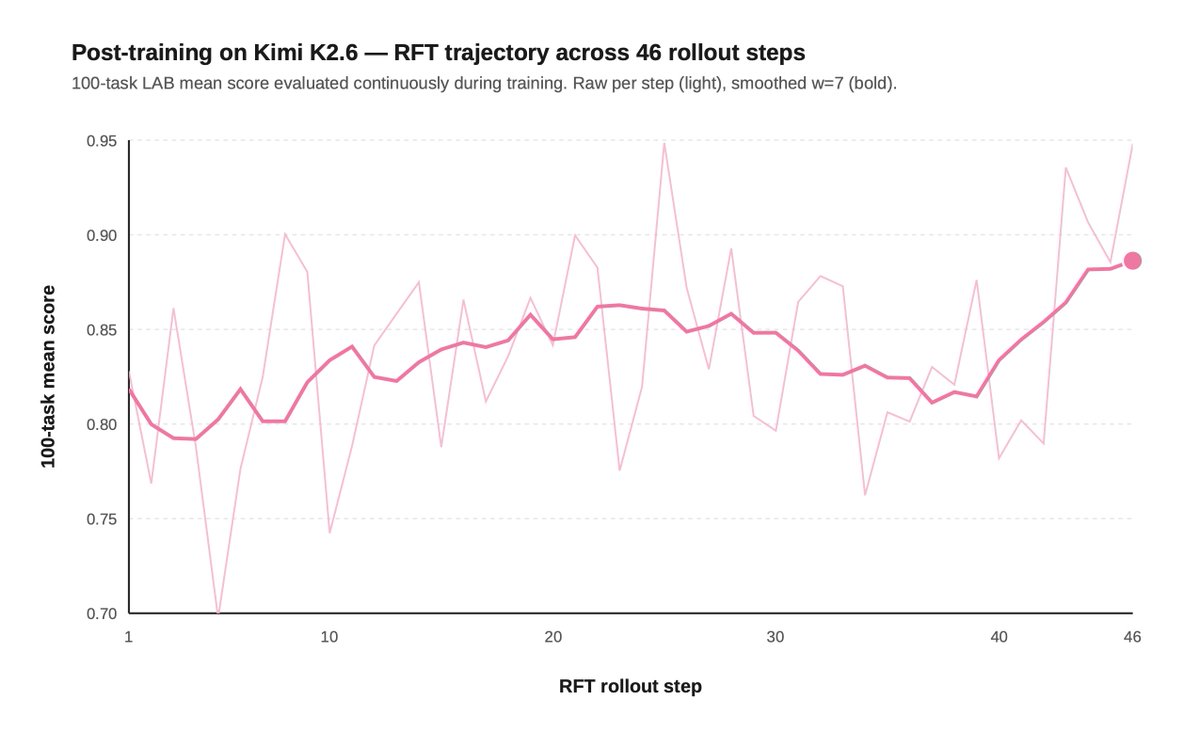
On a 100-task slice of our Legal Agent Benchmark (LAB), SFT moved Kimi 2.6's all-pass rate from 11% to 15%, beating Opus' 14%.
But the cost gap was even more striking: $84 vs $954 across the same 100 tasks, or ~11x cheaper.
We're excited to continue working with @FireworksAI_HQ on the next generation of open-source legal agents.
A happy 80th Dave's Car ID Service birthday to Kaiser-Frazer! The first production Kaiser rolled off the production line May 29, 1946 at the Willow Run, Michigan plant that Ford built to produce B-24 bombers during WW.
Kaiser-Frazer was (kind of) an all-new car company at a time when the idea of upstart competing against Detroit's Big 3 was absolute folly. See Preston Tucker and his ill fated Tucker Torpedo. Dozens of car companies had folded throughout the Great Depression up to WW2, and remaining second tier survivors like Studebaker, Packard, Hudson, and Nash were struggling.
In short it seemed like a kamikaze mission to boot up a new company, but Kaiser-Frazier was unique in that had an enormous amount of money backing it. In the person of cofounder Henry J. Kaiser. He was one of those mythical industrialists of yore, first as a young road contractor in the Pacific Northwest and western Canada. The Federal Road Aid Act of 1916 made him a very wealthy man by his early 30s.
From his HQ in Oakland CA, Kaiser established a concrete mixing plant and a network of joint ventures with other large scale builders and contractors like Bechtel. That consortium - with Kaiser at the helm - won the contract to build the Boulder Dam, renamed the Hoover Dam in 1947.
In 1940 Europe was plunging into war, and even if the USA was officially neutral it was supplying materiel to the UK. Military contracts were growing and Kaiser branched into ship building, eventually becoming America's chief military shipbuilder during WW2.
He was now enormously wealthy, with a vast network of very powerful people in and out of government. In 1944 he met Joseph W. Frazer, another notable WW2 military contractor who won the Jeep contract for Willys-Overland as its CEO.
Frazer was a long time veteran of the car industry, ascending from a showroom salesman to one of the creators of General Motors finance branch GMAC in 1919. From there to the executive suite at Chrysler, then CEO of near-death Willys-Overland in 1938. His Jeep deal saved the company.
When Kaiser and Frazer met in 1944, Frazer had moved on to an even tougher rescue job: head of Graham-Paige. The venerable old car company was clinging to life through WW2 military contracts, but Frazer had a bold idea: to create an all-new postwar car in Graham-Paige plants branded with his name.
Kaiser liked the idea, agreed to financial backing, and they formed Kaiser-Frazer Motors as equal partners in 1945. They debute their prototypes at the January 1946 New York Auto Show, and they caused an enormous buzz. They were the first "envelope" body cars, without the comically bulbous fenders seen on Detroit Big 3 cars of the age. Very chic, very now, very futuristic.
The prototype Kaiser Special was front wheel drive, while the more upscale Frazer Manhattan was convential rear wheel drive. But the front wheel drive design proved too expensive, and production models of both Kaisers and Frazers were real wheel.
And they flew off the shelf - there were waiting lists and dealer premiums due to consumer demand. Kaiser -Frazier had a pioneer advantage as the first modern postwar car, but sadly Kaiser disappeared as a brand name after the 1955 model year; in 1953 Kaiser bought Willys-Overland and merged as Kaiser-Willys, and in 1956 Willys was the only marque they offered, and only utility vehicles like the Jeep. Although "Kaiser" still lived on for several more years through their Argentine operation IKA (Industrias Kaiser Argentino).
Henry Kaiser did move on to one more new frontier: health care. As contractor of the Hoover Dam he provided health insurance to workers, and established the Kaiser Family Foundation and Kaiser Permanante.
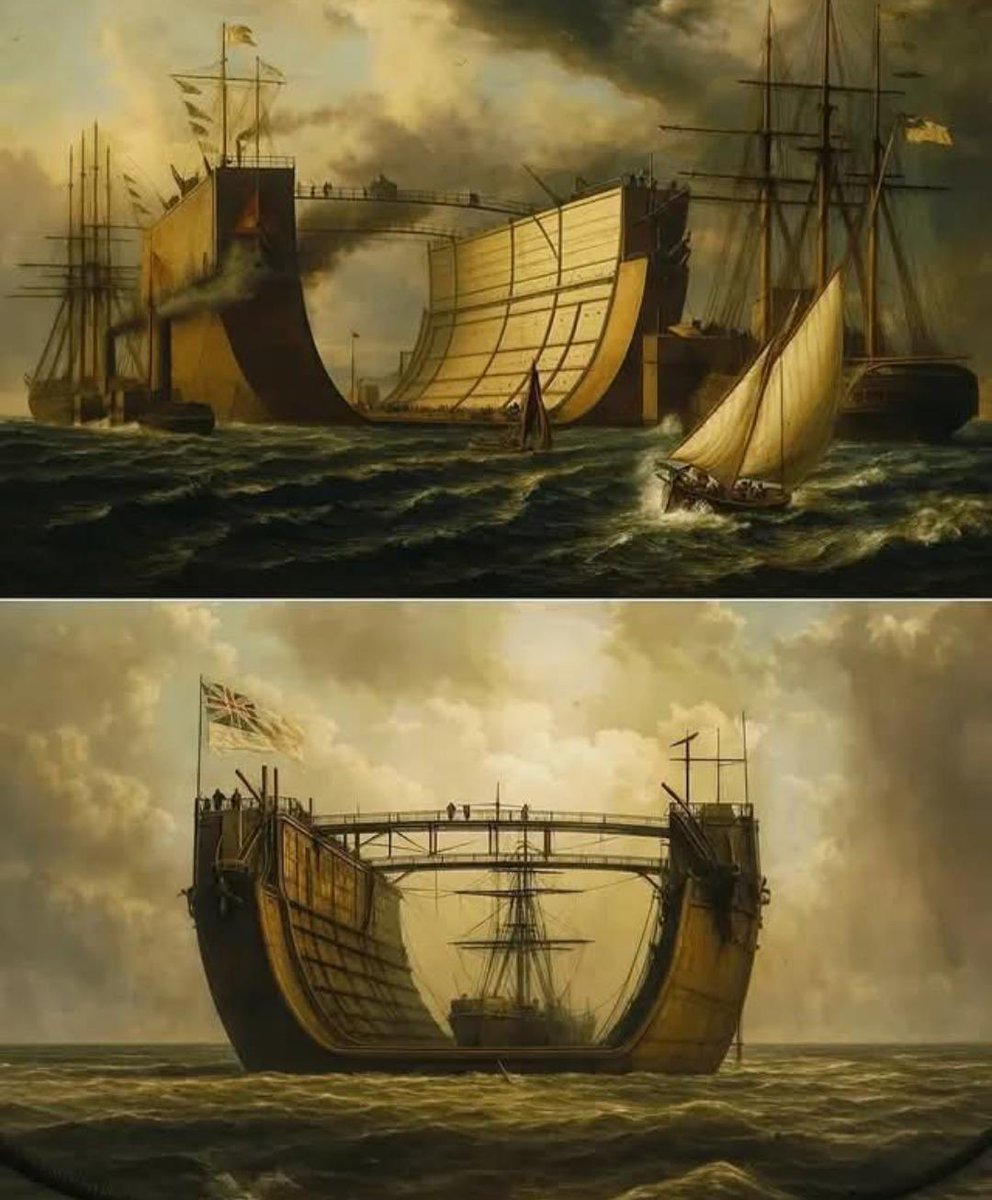
The Royal Navy has a long history of building Floating Dry Docks to maintain the Fleet around the world. In the 1869, the world’s largest floating Dry Dock was towed across the Atlantic to Bermuda to support the Ironclads which at the time was the largest ever built. 🧵1/3