@credistick Admin & Compliance for a £10M UK fund cost 1.4M, is that really true? In the Netherlands you can easily fall under the ‘AFM Light’ regime, making set up costs roughly 50-100k and annual costs 50k as well… can’t believe the difference is so high
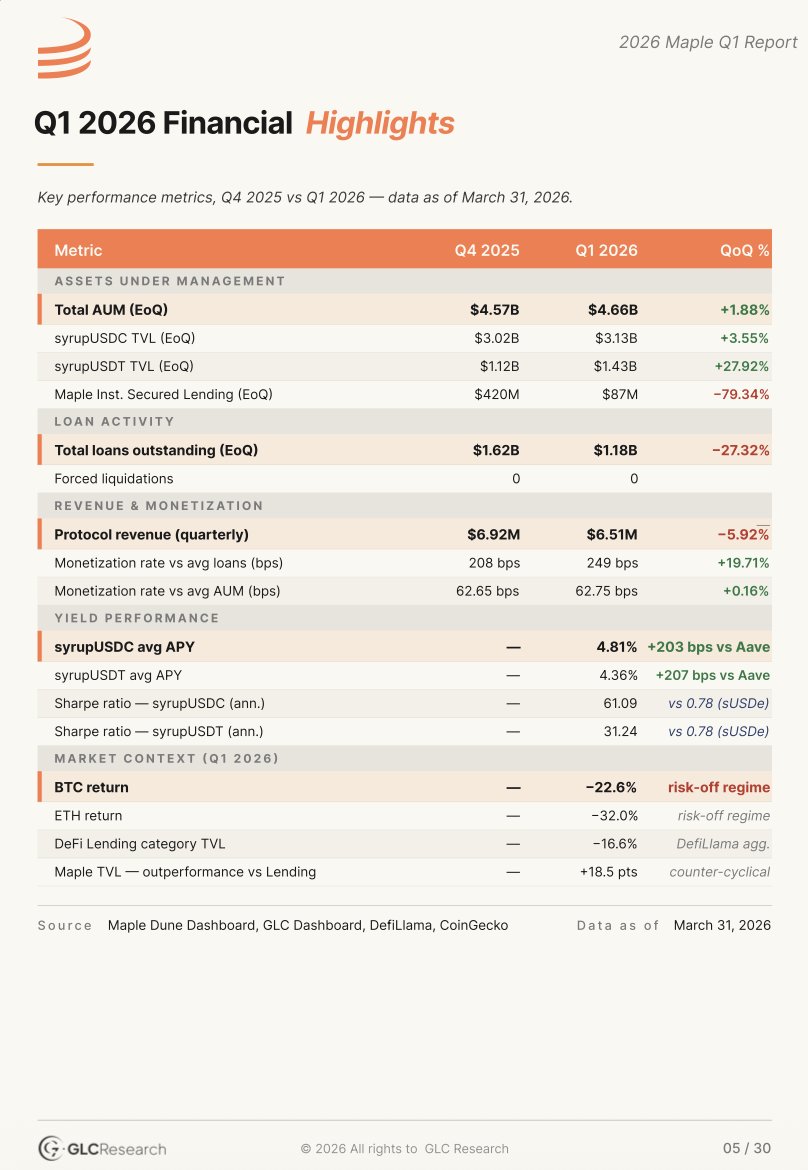
2026 Maple Q1 Report
Today we're releasing our Maple Finance Q1 2026 Report.
We've been covering Maple for over a year now, started when few were paying attention and this quarter gives us something meaningful to document.
Q1 threw everything at the protocol: a -20% crypto market drawdown, geopolitical shocks, and two distinct redemption waves.
Here's how Maple came out the other side:
→ AUM closed at $4.66B (+517% YoY)
→ Maple's revenue: $6.51M (+451% YoY)
→ Zero forced liquidations. 70+ margin calls resolved in a few hours at peak stress.
Enjoy the read. Some excerpts below, with the link to the full PDF and spreadsheet with historical data.
@maplefinance ethereum:0x643c4e15d7d62ad0abec4a9bd4b001aa3ef52d66
Some spicy takes on venture capital:
- Saying that "seed has gotten expensive" or something and then pointing to a valuation - like "they used to be $10 million and now they're $20 million" - is bascially the same thing as people who say Stock A is more expensive than Stock B because Stock A has a share price of $100 and Stock B has a share price of $5.
- The market has gotten better at differentiating among startups earlier and pricing accordingly.
- Some very big funds will generate great returns and some will generate poor returns.
- Some small funds will generate great returns and some will generate poor returns.
- Some concentrated funds will generate great returns and some diverse funds will generate great returns.
- The concentrated funds probably have a higher ceiling, and the diverse ones probably have a higher floor.
- Some generalist funds will do really well, as will some sector-specific ones.
- Some of each will do really poorly, too.
- Ownership % is overrated - easy to measure so gets measured but practically meaningless except in hindsight. No shit it would be better to own 20% of your biggest winner than 10% or 1%.
- Manager-strategy fit matters much more than any prescribed portfolio construction.
- Portfolio construction is overrated, too, because it's something you can measure.
- The best portfolio is one that puts all of its money in the best returning investment of the vintage.
- LPs who invest in emerging managers basically all want high ownership at pre-seed and seed to have the potential for outlier returns, but like, if enough emerging managers fit that box to attract capital, those returns get competed away.
- Plus, the megafunds can usually win whatever they want at pre-seed and seed. They just have the luxury of waiting.
- Even if AI is what everyone thinks it is, there are too many funds and dollars chasing it for it to be a good strategy for all but a pretty small number of funds.
- This will take a while to see, because the companies grow fast and markups will look good on paper for a while. Exits will probably be harder.
- Pretty much every AI application company is long AGI and short ASI.
- But there is a scary amount of consensus around AI. What if AI isn't what everyone thinks it is?
- Tech is going to get much bigger and there will be fewer, bigger winners, which means a lot of this is probably about getting into the companies you think have a shot at being one of those at prices that don't make you throw up too much.
- [always has been meme]
- Greatest job in the world
- All of the above notwithstanding, I'm pretty sure that my strategy is the optimal one.
“While reserves can occasionally boost returns, they can, and more frequently do, bring down fund multiples. They also (dare I say) sometimes create potential conflicts of interest with LPs. This is why LPs want to understand how a GP thinks about using reserves.”
Dirty Secret: Venture Reserves are Not Always a Good Thing, by @SapphireVC
Reserves are a magnifier of performance, but research shows they tend to exacerbate underperformance more than they amplify outperformance.
Essentially, you need to be highly confident that you can put that capital into the right portfolio companies for it to boost your ultimate fund performance.
However, this introduces signalling problems where if you openly use information asymmetry to double-down on "winners", you harm the fundraising chances of other portfolio companies.
Alternatively, if you follow-on at every opportunity, you have to maintain conviction in every portfolio company and beat the odds with the outcome.
Read our guide to reserve strategies for emerging managers, below.
One of the best returning FoF’s I’ve ever seen was a spray & pray one where they don’t do re-ups and only invest in the one of first two funds
It broke my mental model of how venture returns work but in hindsight it makes so much sense
People are waking up to the fact that diversified portfolios (contrary to FoF-coded desires) are the best way to make returns when you’re investing really early
Concentration at VC-level largely serves a portfolio of funds (i.e. a FoF), which get diversification by allocating to many funds (i.e. diversification for me not for thee)
1/ The VC world loves a good binary debate.
“Concentrated funds outperform.”
“Diversification is better for capturing the power law.”
Both sides argue like it’s obvious. Both sides are missing the point.
Here's the nuance most people ignore 👇
You're an emerging VC who just had a great coffee chat with a new family office.
You shake hands, part ways, start walking back to the office. Flip open Claude on your phone.
"Hey Claude, pull our current fund performance against Carta benchmarks, then give me a list of the top 5 investments from the fund & package it up into a deck with some written highlights for this lovely family office manager I just met."
Never write a dull follow-up again
I've done nearly 20,000 workouts in my life, and I've seen what works for all levels. I created a free workout guide to show you what works, whether you're a beginner or advancedI've done nearly 20,000 workouts in my life, and I've seen what works for all levels. I created a free workout guide to show you what works, whether you're a beginner or advancedI've done nearly 20,000 workouts in my life, and I've seen what works for all levels. I created a free workout guide to show you what works, whether you're a beginner or advanced.