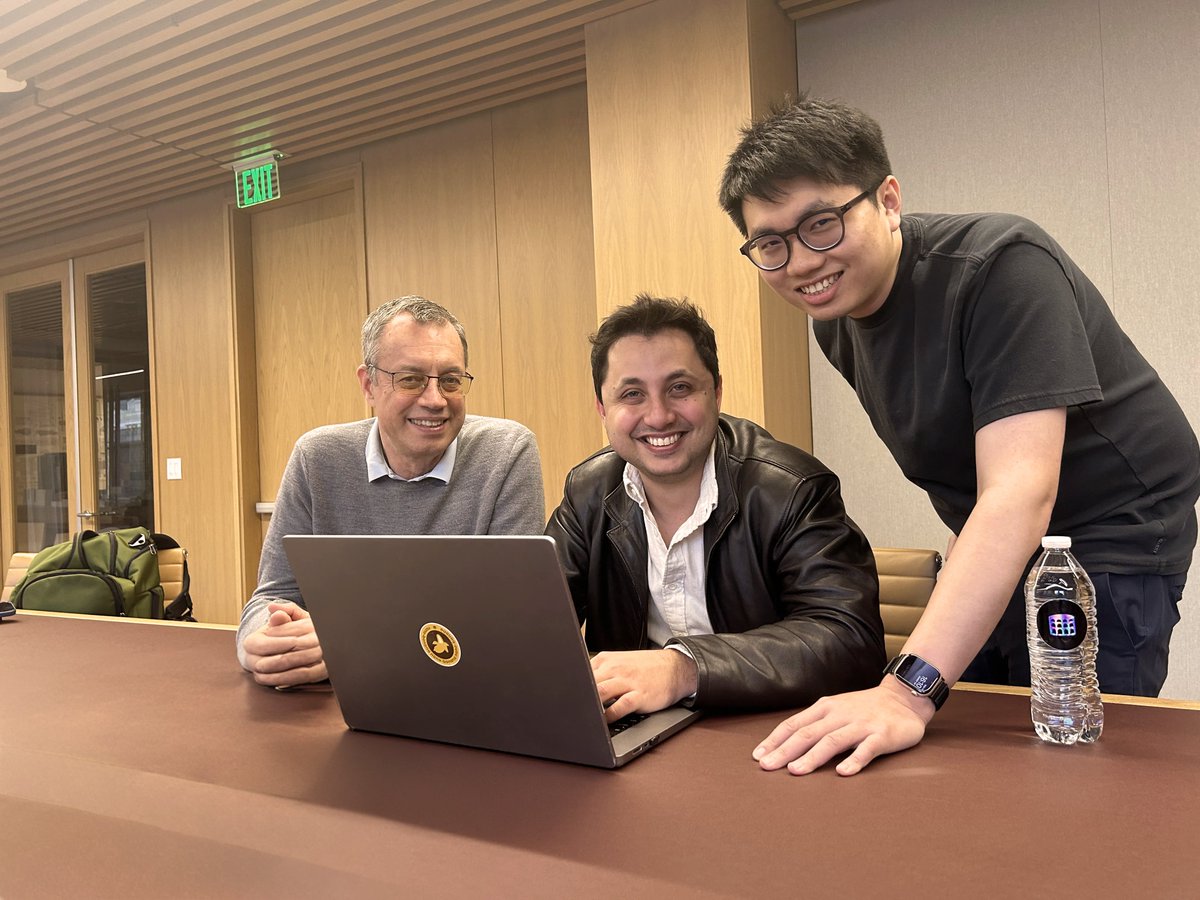
Check out our technical blog for the Agent Arena methodology + a deep dive into how people delegate, correct, and steer agents: https://t.co/uKso7j00H3
1/ Technical thread on #1stProof Problem 6: finding “spectrally light” vertex subsets in a graph, and how its solution fits into the landscape of spectral sparsification + restricted invertibility.
Original thread: https://t.co/c9Z9RH2Ont
Today, we’re excited to announce our $150M Series A at a $1.7B valuation—nearly 3× our May seed round. Since launching evaluations in Sept, our annualized consumption run rate has surpassed $30M.
Our mission is clear: to measure and advance the frontier of AI for real-world use, ensuring that developers, researchers, enterprises, and everyday users can understand how AI behaves where it matters most.
The round was led by @Felicis and UC Investments (@UofCalifornia), with participation from @a16z, @TheHouseFund, LDVP, @kleinerperkins, @lightspeedvp and @LaudeVentures. This milestone reflects a growing industry consensus: AI cannot scale responsibly without independent, transparent, and continuous evaluation.
Over the past year, LMArena has become the world’s most trusted community platform for understanding how AI models perform in real-world conditions. As AI reaches billions of people across the globe, the need for measurement grounded in lived experience—not benchmarks alone—has never been more urgent.
Today, we serve more than 5 million monthly users across 150 countries. Together, our community generates over 60 million conversations every month, evaluating model capability and reliability across text, code, image, video, and search. We will move even faster to build new features and improve our product experience for the community to evaluate the frontier of AI.
This unprecedented engagement signals a fundamental shift in expectations: the world now demands AI that is measurable, comparable, and accountable.
This new funding allows us to meaningfully scale our engineering, research, platform operations, and community initiatives to meet accelerating global demand. With our team, partners, and global community behind us, we’ll keep redefining how the AI frontier is measured and advanced—on our path to building the world’s most trusted evaluation platform.
A new strongly poly-time algo for negative-weight shortest paths, O~(m sqrt(n)) time, by my colleague Satish Rao. This is the same problem Bellman-Ford, which we teach to undergrads, solved in O(mn) 70 yrs ago.
Just 13 pgs! (*puts on todo list to read*)
https://t.co/XsfwCaI1ON
🚀 Do you love math, algorithms, & ML? Join us @UofTCompSci!
I'm looking for excellent PhD students to push the frontiers of computing together. Bonus: Toronto is an amazing tech hub & a super vibrant/safe city!
https://t.co/0cvCOrEmYc
(Deadline: Mon Dec 2) #GradSchool
Pls RT!
@aryehazan \sqrt{\log(n)}-norm of the eigenvalues, aka, Schatten p-norm, of some covariance matrix is used to show an almost-constant bound for the KLS conjecture https://t.co/zbCS85LxiT
STOC 2024 talk videos are now online:
https://t.co/aZtrjSVf8h
If you'd like to dip in, a nice one to start with is
"Tree Evaluation is in Space O(log n log log n)"
by James Cook & Ian Mertz (presented by Ian):
https://t.co/hrf2XDjqNz
Tragic news. Luca Trevisan passed away today. The talk he prepared in his final weeks for the TCS4all workshop will be given virtually in his honor on Monday. I hope many of the TCS community can attend.
https://t.co/RpQKulvDAw
🏆 We're thrilled to announce the recipient of the 2023 #ACMTuringAward: Avi Wigderson! Wigderson is recognized for his foundational contributions to the theory of computation. Join us in celebrating his incredible achievements! Learn more here: https://t.co/UfEpOFgBN2 @the_IAS
The tutorial videos from the STOC'22 workshop on Dynamic Algorithms are now uploaded :)
https://t.co/e4GL1nwtf7
More materials are collected here: https://t.co/FBbB6Wf0fz
Hippos can’t technically swim
The perfect combination of buoyancy and bone density allows them to “fly” thorough water at speeds of 5mph, (8 kph)
propelling themselves using intermittent ground contact, like astronauts on a moon walk
The inimitable @EricaKlarreich writes at @QuantaMagazine about our recent result on almost-linear time algorithms for maximum-flow and other problems
Joint work w/ Li Chen(@lichen225), Rasmus Kyng(@rjkyng), Yang P. Liu (@yangpliu), Richard Peng (@rpeng233), Maximilian P Gutenberg