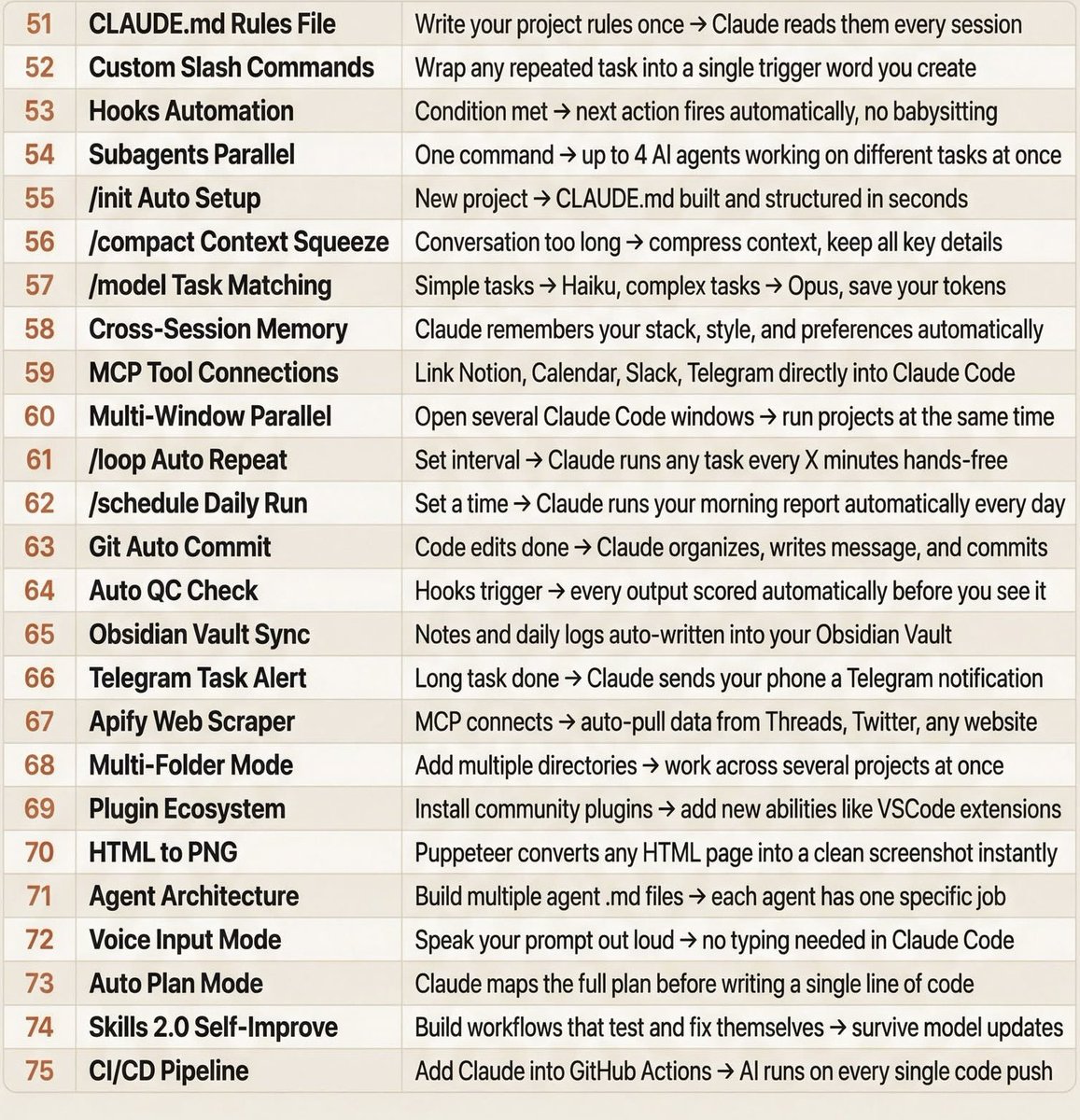
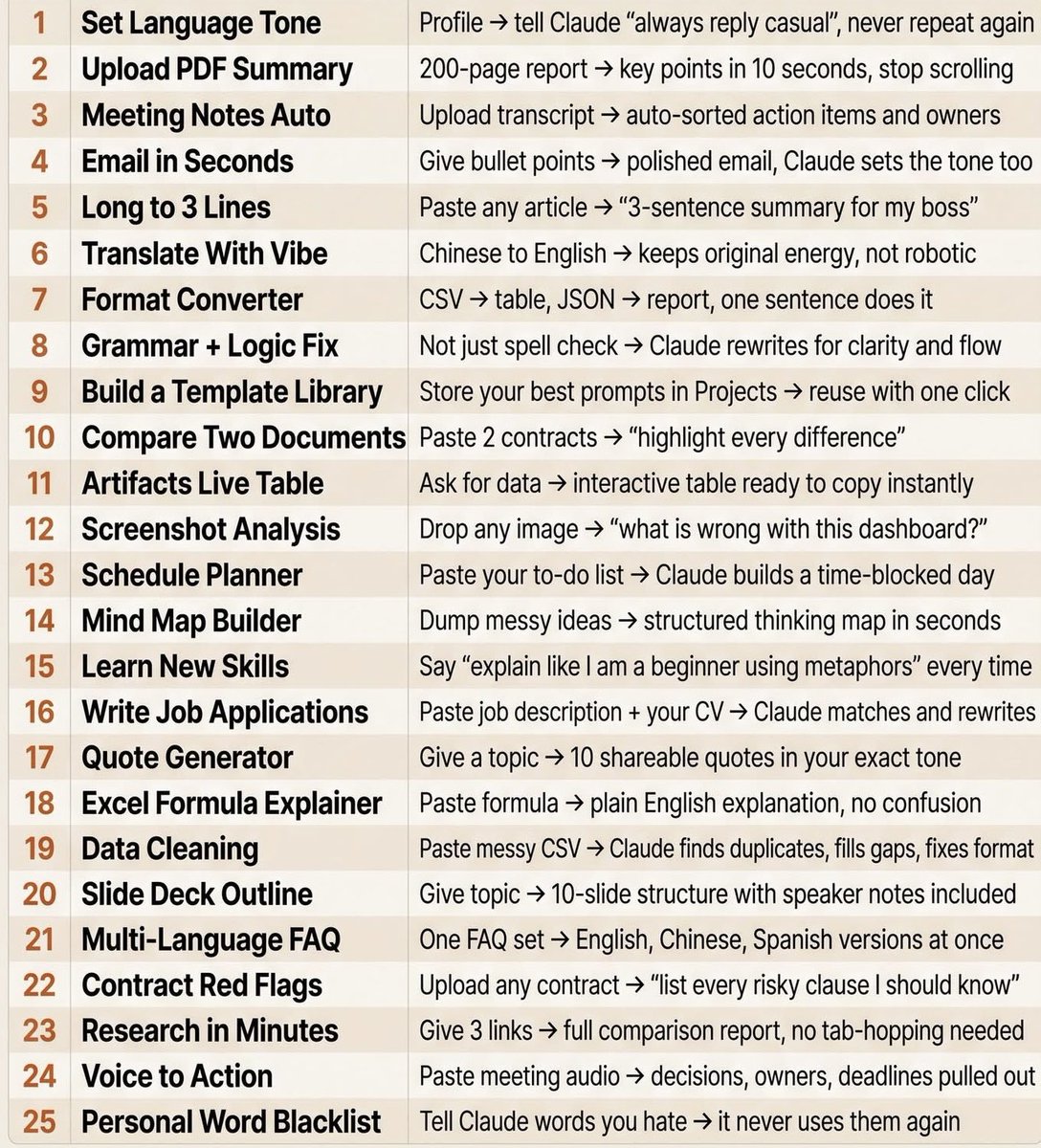
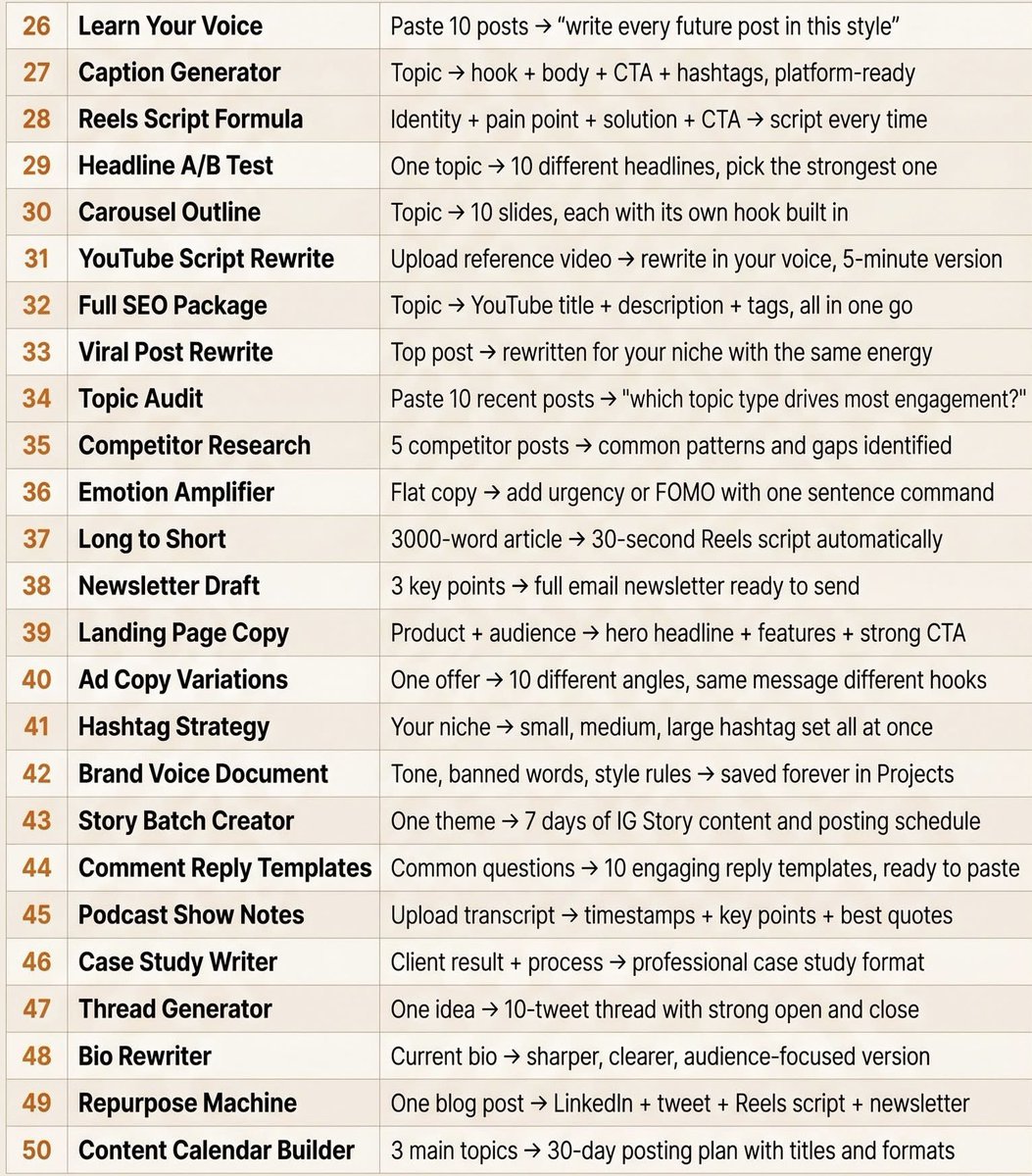
The fastest way to change your life is to rip yourself out of your (physical and digital) environment. Change everything overnight. The places you go, the accounts you follow, the info you consume, etc. It's difficult but it absolutely works.
O engenheiro que criou o Claude Code acaba de lançar um vídeo de 28 minutos onde te ensina a escrever prompts que realmente funcionam.
Já vi cursos de 300 dólares que não chegam nem à metade do que ele explica nos primeiros 10 minutos.
Arquivos CLAUDE.md, atalhos de memória, sessões paralelas e padrões de prompting que mudam o jogo.
Tudo em um único vídeo e completamente grátis.
Não importa se você é desenvolvedor, iniciante ou já usa o Claude há meses. Isso vai explodir sua cabeça.
Some findings from across our Varick customers that might shape how you think about AI adoption going forward:
1. Customers are getting wiser about spend. A few months ago, most were willing to spend an unlimited amount on tokens from OpenAI and Anthropic. Today they're asking us to diligence their AI spend and to match the right model to the right work. That means more work for us and meaningful savings for them. They want to know AI is actually cheaper than just adding headcount, and they want the math to back it up.
2. Customers are accepting that this isn't instant. A few months ago, customers expected to become AI-native over the course of a week and a few software adoptions. Now they're accepting the reality: becoming AI-native means rethinking the architecture of your entire company. I don't mean that in a corny sense. It literally means changing the org charts, the work, and the handoffs in every crevice of the company.
3. Customers are done with the big shops. Microsoft, IBM, McKinsey, Deloitte, and the rest are all pitching AI transformations, and our customers are fed up with paying eight figures for a slide deck. This is the whole reason we have a business: we sit at the bleeding edge of AI while having the business sense to identify the root of a problem and then build the agents to solve it. This used to be something I had to convince customers of before the first sales call. Now they're the ones telling me, "we're never working with McKinsey again."
This past month we had the highest inbound volume we've ever seen. Between April 1 and May 1, 56 companies doing between $500M and $25B in revenue reached out to us. Some of these companies are direct competitors with one another. It's fascinating to watch the race for enterprise AI-nativity unfold in real time. I like to imagine that we change the course of history for our clients.
AI transformations are now the consensus path to realizing AI ROI. AI SaaS doesn't get you there, and giving every employee a Claude or Cowork subscription doesn't move the needle either. The only way to get to hundreds of millions in annual ROI is to combine a team that can learn your business processes on the ground with the engineering capacity to automate every manual process worth automating.
We bet on this thesis a year ago, and we're vindicated more every single day. If you're interested in transforming your company with AI, or interested in joining the company that's leading the AI transformation wave, visit our website.
Cheers.
🚨 BREAKING NEWS: AI can now set up a complete business for you in 24 hours.
Yes, you read that right.
Here are 8 brutal prompts to use with Claude and turn any idea into revenue in 2026 👇
(Save this before your competition sees it)
INSTEAD OF WATCHING NETFLIX TONIGHT.
Spend 1 hour with this.
Claude AI FULL COURSE that teaches you how to BUILD and AUTOMATE anything.
The people who watch this tonight will wake up tomorrow with a new skill.
Watch it and bookmark it now.
My honest advice to someone who wants to make a lot of money.
3 things nobody told you:
1. The only way to make a lot of money is to create a lot of value.
No one hands out money. No one is going to pay you just because they like you or think you're cool. That's not the way the world works.
Money earned is a direct byproduct of value created. Create value, receive value. If money is the goal, value has to be the focus.
This isn't just some vague idea: The only way to get rich is to create an enormous amount of value for others, and capture a small portion of that along the way.
It's not talking about the thing, it's not brainstorming about the thing, it's not asking about the thing, it's not thinking about the thing. The only way to create value is by doing the thing.
And if you don't know where to start, look around you. Customers, colleagues, bosses, shareholders, employees. Every single one of them has a problem. What problems can you solve for the people around you? Figure them out, solve them, scale that solution.
That's how you make money.
2. You have to demonstrate excellence in everything you do.
Your income scales proportional to the amount of excellence that you're able to demonstrate.
Strategic incompetence is a lie. You don't get to pick and choose when to show up, because the world will ignore your best and judge you for your worst. Everything matters. Every single thing.
Top performers show up with energy and enthusiasm for the little things just as much as they do for the big things.
If you're in the top-10% of performers, there's no ceiling for what you can do. But the self-awareness to identify where you currently stack up, and adapt to the honest feedback on it, is very rare.
If you're in the top-10%, you know it. If you're not, figure out why and fix it.
3. You don't need passion, you need energy.
I still have no idea what it means to follow your passion.
You don't have to be passionate about your professional pursuits, you just need to find energy in them. You just need to feel a pull towards them. You just need to feel that spark of curiosity in them.
Passion is usually a byproduct of energy.
When you have energy for something, you'll give it your deep attention to learn more. You’ll ask the right questions. You’ll figure it out. You’ll win.
***
And remember: Nobody is coming to save you. It’s just you. There’s a power in that.
Go do the thing.
Google's former CEO just said what everyone in AI already knows
Building wealth is getting easier if you actually learn the tools
Not by scrolling AI threads
By understanding agents, Claude Code, prompts, memory, skills, MCP, and routines
Save this before it disappears from your feed
Everything below is free:
Agent architecture
https://t.co/hhrSyF3y6u
Claude Code 101
https://t.co/71Zu7xQmxc
Claude Code in action
https://t.co/vg8fPChJxl
Prompt engineering
https://t.co/xEu7M3CPe1
Interactive prompt course
https://t.co/oGCxHkqFBD
Claude.md + memory
https://t.co/v6JKlS4OJl
Skills
https://t.co/AJCWlDcMU7
MCP
https://t.co/tQTUYCwN16
Routines
https://t.co/gAnEdq5SP0
Claude Code ultimate guide
https://t.co/WeDLJBVaGM
Awesome Claude Code
https://t.co/wvpwfcaf6U
Anthropic academy
https://t.co/uu3JyZyWyt
Official Claude Code docs
https://t.co/xuUWAfZGXy
All of this costs $0
Most people will keep asking AI one question at a time
Save this and start learning the stack
2 years ago, I was directionless, unmotivated, and uninspired.
I had just sold my business, didn’t know who I was outside of it, and questioned everything about my abilities.
Today, I’m the cofounder of @tenex_labs, an enterprise AI transformation firm that will be my life’s work and quite possibly a $100 billion company.
I’ve seen what can happen when the right founders are disrupting the right market at the right time. And this is that.
Quick recap:
- We’re on pace to be a Series D startup size by end of year.
- Large portfolio of Fortune 500 clients.
- Best-in-class talent from Amazon, Salesforce, McKinsey, Bain, BCG, Bain, Accenture, Deloitte, EY.
- True AI engineering & transformation acceleration at a time where there’s a lot of snake oil.
I’ve been reflecting on the small & large decisions that have allowed us to compound like crazy the last 12 months. Here it goes:
1. The only thing that matters
The first time I read @pmarca’s essay “Only Thing That Matters,” I couldn’t get myself to agree. I’ve always preached “people are your most important asset,” so I couldn’t square up how something could be more important.
But he was right. Market is everything. If you pick the right market, it’s like a black hole that sucks in everything else you need to build a great business: bags of money and world class talent.
At Tenex, we’re blessed to be building in a space where our TAM is global GDP and every business on earth needs help becoming AI-native.
2. Cofounder market fit
In personal life and founder life you make one choice that changes the entire trajectory of your story: the person you pick to write that story with.
And in business, the choice is actually a set of many micro decisions that compound into either the best move of your career or the worst.
Choice 1: Am I value aligned with this person?
Choice 2: Do we have complementary spikes?
Choice 3: Do we have compatible communication styles?
Choice 4: Do our skills have product market fit with the market we’re in?
I’m super blessed to be a yes on all 4 with my cofounder @ArmanHezarkhani.
3. Stack hubs in GTM
Marketing is nothing more than a game of hubs-and-spokes.
Hubs are digital or physical channels that give you leveraged access to spokes, your ideal end customer.
Your job as a marketer is to define your budget, know the portfolio of hubs at your disposal, determine which hubs to invest in, know when to triple down on outperformers, and proactively stack hubs so new ones perform as old ones plateau.
I, as a creator, was the first hub for Tenex. We knew I’d drive a bunch of business, but we also knew that my distribution would plateau just like any marketing channel on earth. That’s why we’ve stacked a host of hubs like channel partners (I.e @AnthropicAI, @OpenAI, @vercel), branded media (newsletters, playbooks) and creators (@JJEnglert).
4. Novelty is good for ego bad for business
We purposefully kept as many variables constant while building this business.
We’re not reinventing strategy consulting.
We’re not reinventing engineering-as-a-service.
We’re not reinventing change management.
We’re not reinventing forward deployed engineering.
We are only innovating on 1-2 vectors that we believe are mission critical to build a post-AI McKinsey with the set of constraints we face.
One example is pay. We are the first company in the world to pay engineers like salespeople. Every engineer at Tenex has a standard minimum guarantee and is paid uncapped variable upside based on output (read: Storypoints completed). We picked this comp model for 3 reasons: it allows us to hire top talent without raising money, it incentivizes our engineers to gain leverage through optimized AI workflows, and it aligns incentives with clients desires.
5. We’ll eat your scraps
Whether it’s less sexy work (like AI trainings) or a a less sexy category (like being a dev shop), when others have shied away, we’ve leaned in.
Is a training business a great business? No. But being the best at teaching executives and companies how to use AI is an incredible way to build trust and identify other opportunities in a client’s business.
Am I proud of Tenex partly being a dev shop? Absofuckinglutely. Dev shops get an unnecessarily bad rap, and we’re the one to rebrand them. Companies come to us for engineering help, not because they want cheap offshore talent, but because they want worldclass AI engineers they couldn’t hire on their own.
We are in the business of selling trust and however we can get an edge or opportunity to do so, we’ll say yes all day.
Mark Cuban just described the largest wealth transfer of the AI era.
Almost nobody understood what he said.
Cuban: “There are 33 million companies in this country. Aren’t going to have AI budgets. Aren’t going to have AI experts.”
Not tech startups.
The shoe store. The regional trucking outfit. The accounting firm with 12 employees.
The businesses that actually run the physical economy.
They know AI is coming. They have no idea what to do with it.
Cuban: “You’ve got the head of Microsoft saying software is dead because everything’s going to be customized to your unique utilization.”
Software is dead.
The SaaS era ran on one rule. Build a generic product. Force millions of companies to bend their workflows around it. Charge rent forever.
AI ends the contract.
The business stops bending to the software. The intelligence bends to the business.
But customized by whom.
The third-generation manufacturer cannot tell Claude from Gemini. The county hospital is staring at a reactor asking where the light switch is.
Cuban: “Who’s going to do it for them?”
That question is worth more than the frontier models themselves.
Hundreds of billions are being burned to build the foundation. The smartest engineers alive are locked in a bloodbath over who owns the base layer.
Let them fight.
Let them burn the capital. Let them drive the cost of raw intelligence toward zero.
Because the wealth does not collect where the brain is built.
It collects where the brain meets the business.
Every ambitious kid in college right now thinks survival means a seat at OpenAI or Anthropic.
Cuban is staring at the other 99 percent of the economy.
Learn the models. Then learn the messy, unglamorous reality of how a 50-person company actually operates.
Walk through the door. Understand their problems. Wire the intelligence directly into their revenue.
That is not a job title. That is an entire economic class being born.
You do not need to build the brain. You need to build the nervous system.
The biggest winners of the electricity era were not the engineers who built the generators. They were the ones who walked into dark factories and showed the owners where to plug in.
33 million companies are standing in the dark right now.
Silicon Valley is racing to build the god. The fortunes will belong to whoever teaches him a trade.
In 14 minutes, this Anthropic engineer who wrote "Building Effective Agents" will
teach you more about building them right than most developers figure out on their own
in months.
Bookmark this for the weekend. Then read the builder's guide below.
BREAKING: Dario Amodei, CEO at @AnthropicAI:
“I think we might be 6-12 months away from when Claude doing most or maybe all of what we do end to end”.
> AI writes the code
> AI designs the app
> AI fixes the bugs
> AI self-maintains it !???
this is f*king scary guys...
Around this time last year, for the first time in years, I was feeling lost.
I was bleeding money in crypto, my business was stalling, and content was burning me out.
As a last-ditch effort, I tried a Claude prompt I found online (with zero expectations).
The result absolutely shocked me and changed my entire life/business trajectory.
Since using it, I've given it to friends and family, and ALL of them who used it said it was eye-opening.
One of the most valuable prompts I could ever give you. Copy & paste into your LLM.