hello world.
Excited to launch the Ingelfinger Lab account! We’re a young lab in Germany’s Black Forest tackling key questions in immunology with innovative single-cell technologies.
Follow us for updates on systems immunology, machine learning & translational oncology.
fi
hello world.
Excited to launch the Ingelfinger Lab account! We’re a young lab in Germany’s Black Forest tackling key questions in immunology with innovative single-cell technologies.
Follow us for updates on systems immunology, machine learning & translational oncology.
fi
Excited to share our new study out in
@SciImmunology
We show that Monocyte-derived Macrophages drive oxidative damage during neuroinflammation
https://t.co/eGKEMppR9y
#ScienceSaturday
❓ Why do some cancers resist immunotherapy?
➡️ A recent study in Nature found that certain cancers can “trick” the body’s immune system. They do this by changing how cells in the bone marrow develop. These changes cause more immune cells called macrophages��to form — but these macrophages actually block the immune system from attacking the tumor.
➡️ Lung cancers cause this change by stressing cells in a way that activates a protein called NRF2. This reprogramming creates macrophages that protect the tumor instead of fighting it.
➡️ The researchers found that blocking NRF2, through drugs or genetic changes, lowered these protective macrophages, boosted immune cell activity and made immunotherapy work better. This suggests a new way to improve treatments for cancers that usually resist immunotherapy.
🌟 Congratulations to senior author Miriam Merad of the Icahn School of Medicine at Mount Sinai, and collaborators at Institut Gustave Roussy, Harvard Medical School and others for advancing this critical work. @MiriamMerad @SinaiImmunol @IcahnMountSinai
🚨 New preprint!
Generative modeling comes to cytometry.
Meet CytoVI — a deep generative model from the @YosefLab & @IdoAmitLab for antibody-based single-cell technologies (flow, mass cytometry, CITE-seq).
https://t.co/Yo0uP140V7
🧵👇
Thrilled our Perspective in @NatureAging is out! With @MatthewD_Park et al., we spotlight how aging reshapes RTMs and skews myelopoiesis–with consequences for healthy aging and cancer @MiriamMerad
Our new perspective piece in @NatureAging from lab of @MiriamMerad@SinaiImmunol highlights the fundamental role for aging-related changes to resident tissue macs and myelopoiesis in both healthy aging and in cancer:
https://t.co/6E6hIDQhw5
New preprint out! 🚀Spearheaded by @ChiaraFalcomata we could show how pancreatic cancer cells evade the immune system by modulating their TME with the extracellular factors Serpine1 (PAI-1) and Serpinb2 (PAI-2)! #PertrubMap#PDAC
🚨 Our new #preprint is out!
https://t.co/uSE1Y4GkI2
We used #PerturbMap spatial functional genomics in pancreatic cancer to track tumor clone dynamics and uncover how extracellular factors like Serpine1 and Serpinb2 drive immune evasion. 🧵 (1/8)
So excited to share our new paper out in @Nature led by the fabulous @AnaisElewaut and @guillemxtivill providing mechanistic insights into anti-tumor immunity and why it may fail in so many patients! Sky-torial on @obenaufa.bsky.social https://t.co/S5iVP0255c
Macrophages do a whole lot more. They are a major subunit of basically all tissues. They protect the brain from damage, regulate thermogenesis in adipose tissue, and are electrically coupled to cardiomyocytes in the heart. They are the immune system's ultimate Swiss Army knife!
Check out our most recent work resolving a longstanding controversy: which phagocyte subset drives oxidative damage in neuroinflammation? Thank you for the support and the mentoring @SarahMundt5. Thanks to Mundtlab, @BecherLab and all coauthors! Link: https://t.co/bXeVETuYte
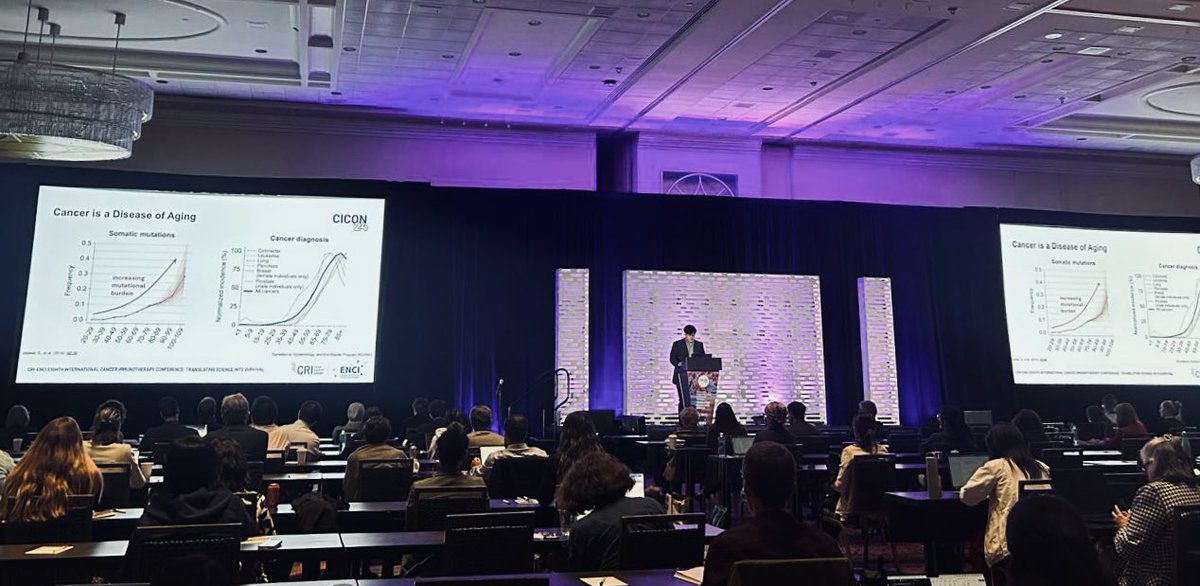
It was a privilege to represent @MiriamMerad lab and share our newest story on cancer and aging at #CICON24. Major thanks to @CancerResearch for this major opportunity!
Read about our study now out @ScienceMagazine : https://t.co/jhee5GYCN6