AI has now solved a major open problem -- one of the best known Erdos problems called the unit distance problem, one of Erdos's favourite questions and one that many mathematicians had tried.
https://t.co/SD1vVPkrHR
The way our immune cells age differs substantially by sex, from single-cell analysis of ~1,000 people. Implications for propensity for autoimmune diseases (women), vulnerability to cancer (men), immunosenescence and inflammaging @NatureAging
https://t.co/GjcuZ8luNM
Introducing kuva: A scientific plotting library in rust, along with cli binary with the option to plot directly into the terminal.
Feel free to drop me some feedback as an issue on the repo
https://t.co/5uSwsOdboA
https://t.co/m5tHEVrtJj
Today I'd like to honor the memory of my mentor and friend, Roger Tsien, born 1952 February 1. Today would have been Roger's 74th birthday.
Most know Roger for his 2008 Chemistry Nobel Prize with Shimomura and Chalfie. Roger made GFP into the versatile imaging method it is now.
It's worth reading the Watson & Crick paper. Note this part: "We were not aware of the details of the results presented [in the Franklin paper] when we devised our structure"
That statement was contradicted in the Acknowledgement, and in detail later
https://t.co/SP4IgVqJno
Divya Deshmukh wins the FIDE Women's World Cup!
What an achievement for a 19-years-old Indian player!
Not only she becomes the youngest Women's World Cup winner, but also gets a GM title.
Amazing feat! Bravo!
The Fields Medalist Maryam Mirzakhani died of cancer in 2017, just as she was advancing the study of impossible-seeming objects called hyperbolic surfaces. Last month, two mathematicians built on her unfinished work to prove a sweeping statement about these shapes. Joseph Howlett reports: https://t.co/BnxrkSISqg
🚨 BREAKING: Praggnanandhaa R wins the 2025 Tata Steel Masters! 🏆♟️
A stunning performance in Wijk aan Zee crowns him champion! 🎉🔥
Congratulations, Pragg!!
Tetanus on demand! (not for bioweapons, but for neuroscience research)
Tetanus toxin induces paralysis by using a protease to cleave VAMP2, a protein required for synaptic vesicle fusion and neurotransmitter release.
To harness this toxicity and use it as a beneficial tool for neuroscience research, we fused a light-sensitive LOV domain from oat plants into tetanus’ protease domain and made its activity controllable by light.
LATeNT (for light-activated tetanus neurotoxin) can be expressed in specific cell populations, and then turned on with a brief pulse of blue light. Synaptic inhibition is potently inhibited only in those cells expressing LATeNT while neighboring cells are unaffected.
We used LATeNT in the mouse brain to discover a new cell population (SST+ interneurons in the hippocampus) that modulates anxiety. 24 hours after shutting off LATeNT by taking away the light, anxiety levels returned to normal.
We are excited for neuroscientists to try this new tool! The inhibitory effect is stronger and more sustained than with other tools like halorhodopsin and DREADDs, but the timing and location of the effect are completely under your control.
Preprint here: https://t.co/ire30ouvXA
Very proud of amazing protein engineer @heegwangroh, our fantastic neuroscience collaborator Ji Won Um, co-first author Dongwook Kim from the Um lab, and our other wonderful co-authors.
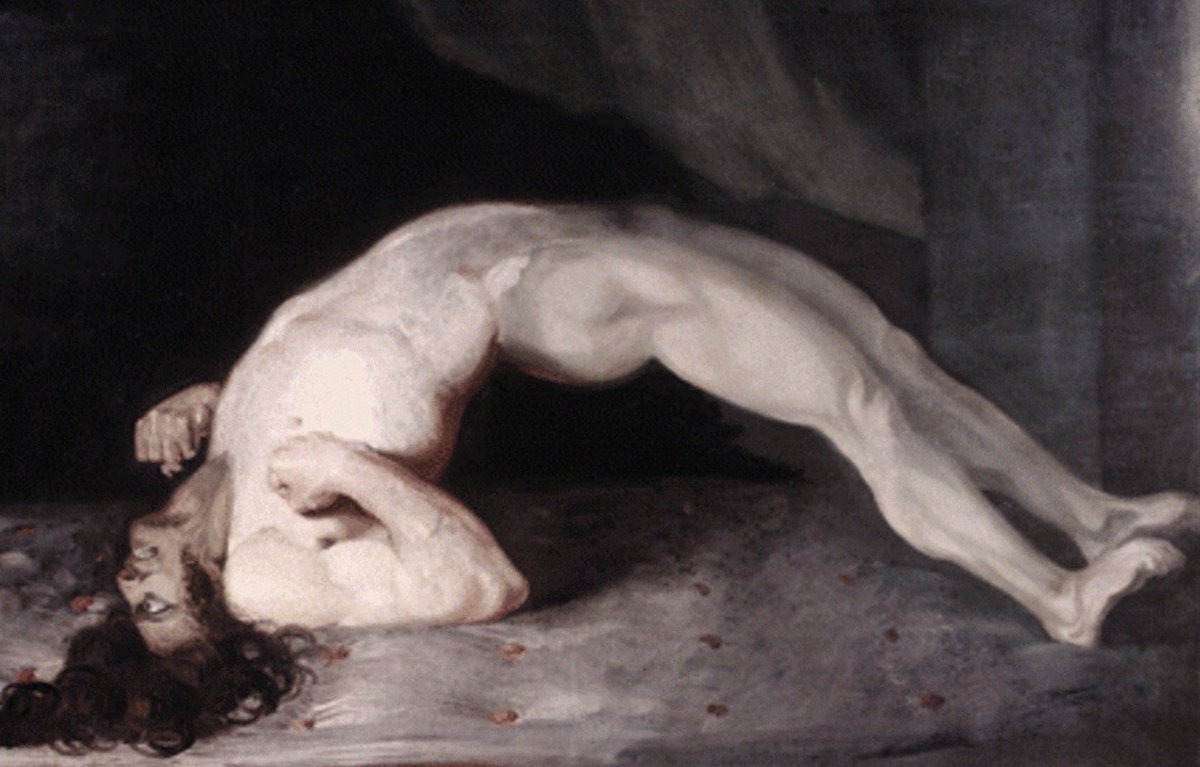
Image credit: painting by Sir Charles Bell depicting opisthotonos, which can be caused by tetanus (1809)
Wrote and directed this film for Fwd by Myntra featuring the world champions- @DGukesh and @vishy64theking . Produced by us at @braindaddotco but mostly by Devarsh!