The key difference between agents and LLMs is environments.
For agents, the scaling law is not only model size — it’s the scale and diversity of environments they can interact with.
But today, most CLAW-like agent environments are manually created: expensive, static, and slow to evolve.
We think the next scaling frontier for agents is environment generation.
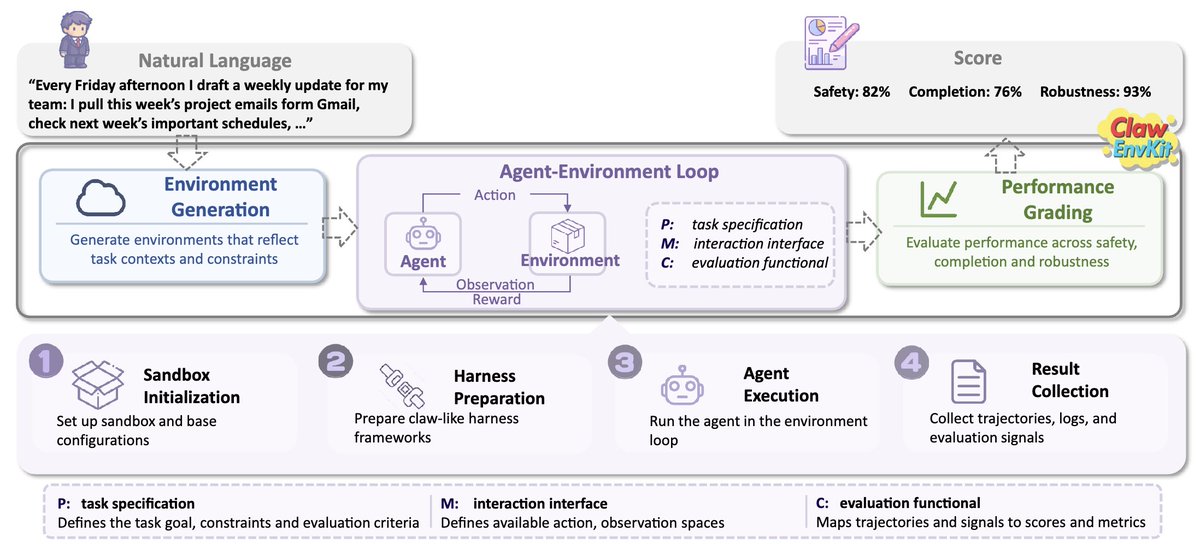
Introducing ClawEnvKit: users can describe a capability in natural language and instantly generate a bespoke, verified environment on demand for claw-like agents.
From handcrafted benchmarks → programmable evaluation.
• scalable environment construction
• isolated sandboxed execution
• automatic validation
• cross-harness evaluation
• live, user-driven environment generation
Paper:
https://t.co/hblxeV1Syo
Code:
https://t.co/owQ81hv6hZ
with @Ming_Liiii@zhoutianyi@cho_jui_hsieh@istoica05 and the amazing ClawEnvKit team! @openclaw@arena@UCLA@umdcs@mbzuai@UCBerkeley
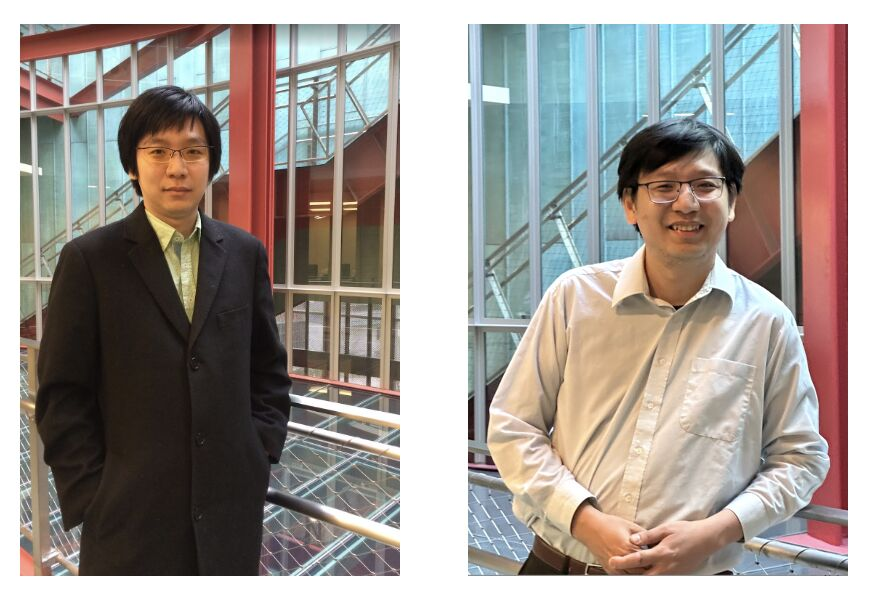
I’ve recently been promoted to Full Professor at UCLA 🎉 It’s been a long journey, with many tears, laughs, and surprises along the way. When I was working on linear models 20 years ago, I couldn’t have imagined we’d be building trustworthy AI agents today.
I feel incredibly fortunate and deeply grateful to my research group, mentors, collaborators, and students who have made this journey so meaningful. I still remember the moment of hooding each of my PhD students. Those are the happiest moments in my career. Many thanks as well to my family, colleagues, and friends for their support. Looking forward to the next chapter.
For those interested, check out our recent work:
https://t.co/QyIEGg3bFc
Photo: a decade after graduation
Merging the domain experts from RLVR into a single model. The problem of on-policy distillation is that the degree of absorption could be limited if the student and teacher are too different. Therefore, during domain-specific RLVR, they incorporate OPD from each other to make them closer. And then they just use weight merging for the final model.
Self-play led to superhuman Go performance, why hasn’t it for LLMs?
In practice, long run self-play plateaus like RL. We study why this happens, and build a self-play algorithm that scales better. It solves as many problems with a 7B model as the pass@4 of a model 100x bigger.
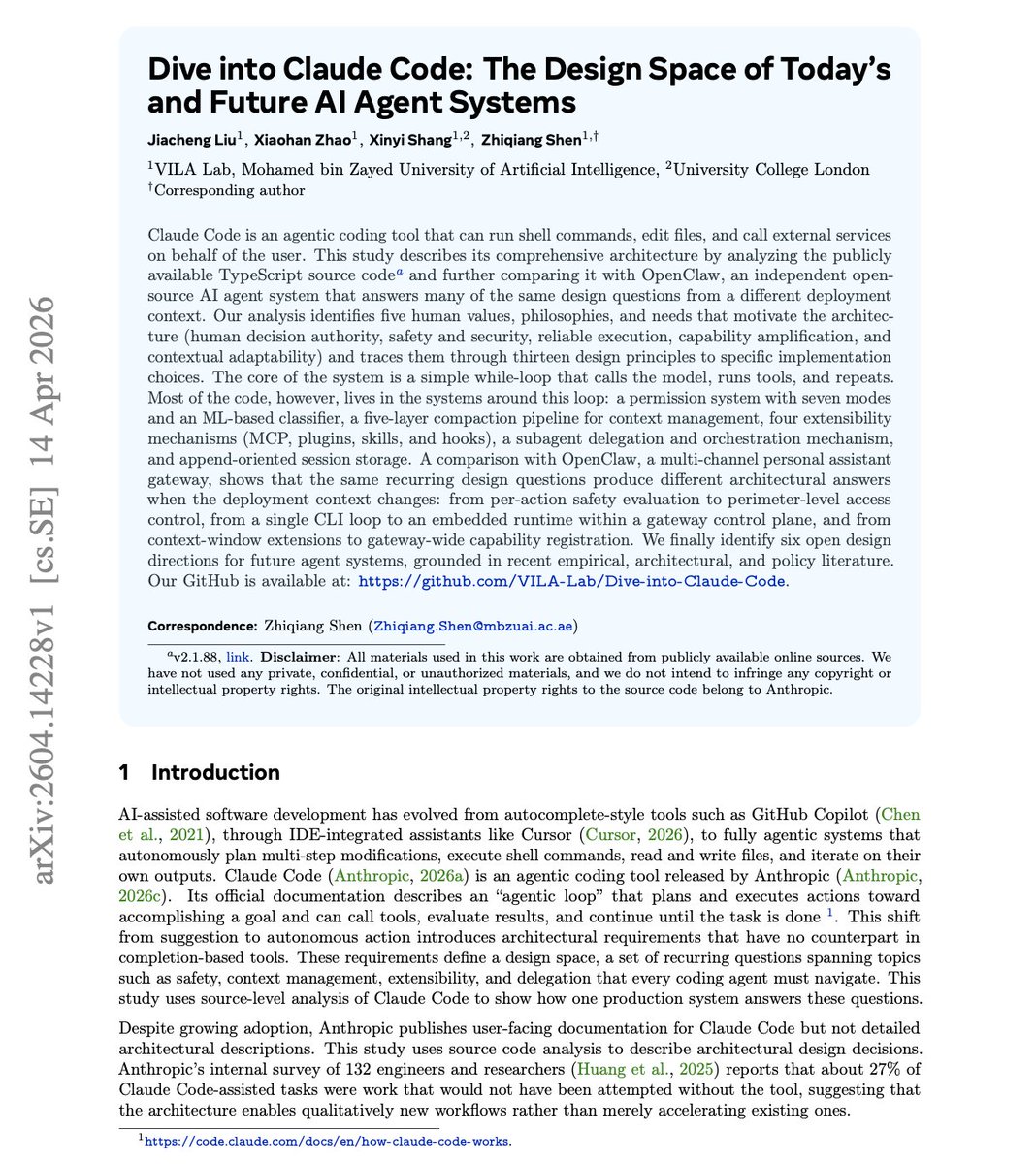
Claude Code fully dissected!
Researchers from UCL reverse-engineered the leaked Claude source. What they found changes how you should think about agent design.
Only 1.6% of the codebase is AI decision logic.
The other 98.4% is operational infrastructure. Permission gates, tool routing, context compaction, recovery logic, session persistence. The model reasons. The harness does everything else.
This is the opposite of what most agent frameworks do today.
LangGraph routes model outputs through explicit state machines. Devin bolts heavy planners onto operational scaffolding. Claude Code gives the model maximum decision latitude inside a rich deterministic harness, and invests all its engineering effort in that harness.
The core loop is a simple while-true. Call model, run tools, repeat.
But the systems around that loop are where the real design lives:
A permission system with 7 modes and an ML classifier. Users approve 93% of prompts anyway, so the architecture compensates with automated layers instead of adding more warnings.
A 5-layer context compaction pipeline. Each layer runs only when cheaper ones fail. Budget reduction, snip, microcompact, context collapse, auto-compact.
Four extension mechanisms ordered by context cost. Hooks (zero), skills (low), plugins (medium), MCP (high). Each answers a different integration problem.
Subagents return only summary text to the parent. Their full transcripts live in sidechain files. Agent teams still cost roughly 7x the tokens of a standard session.
Resume does not restore session-scoped permissions. Trust is re-established every session. That friction is the point.
The bet behind all of this is simple. As frontier models converge on raw coding ability, the quality of the harness becomes the differentiator, not the model.
Paper: Dive into Claude Code (arXiv:2604.14228)
In the next tweet, I've shared an article I wrote on Agent Harness and what every big company is building. Do check.
Does GRPO handle multiple-task advantage normalization effectively? 🤔
🚀We introduce Gaussian GRPO (G²RPO), a novel method that mathematically forcing the advantage distribution of any given task to strictly converge to a standard normal distribution. G²RPO provides:
✅1) intrinsic robustness to outliers,
✅2) symmetric updates for positive and negative rewards,
✅3) uniform variance across diverse tasks.
We adopt G²RPO and task-level response length and entropy shaping which leads to OpenVLThinkerV2!
🏆A new model with SOTA open-source visual reasoning and perception performance among the similar size models.
(1/n)👇
#VLM #LLM #Multimodal #RL #GRPO
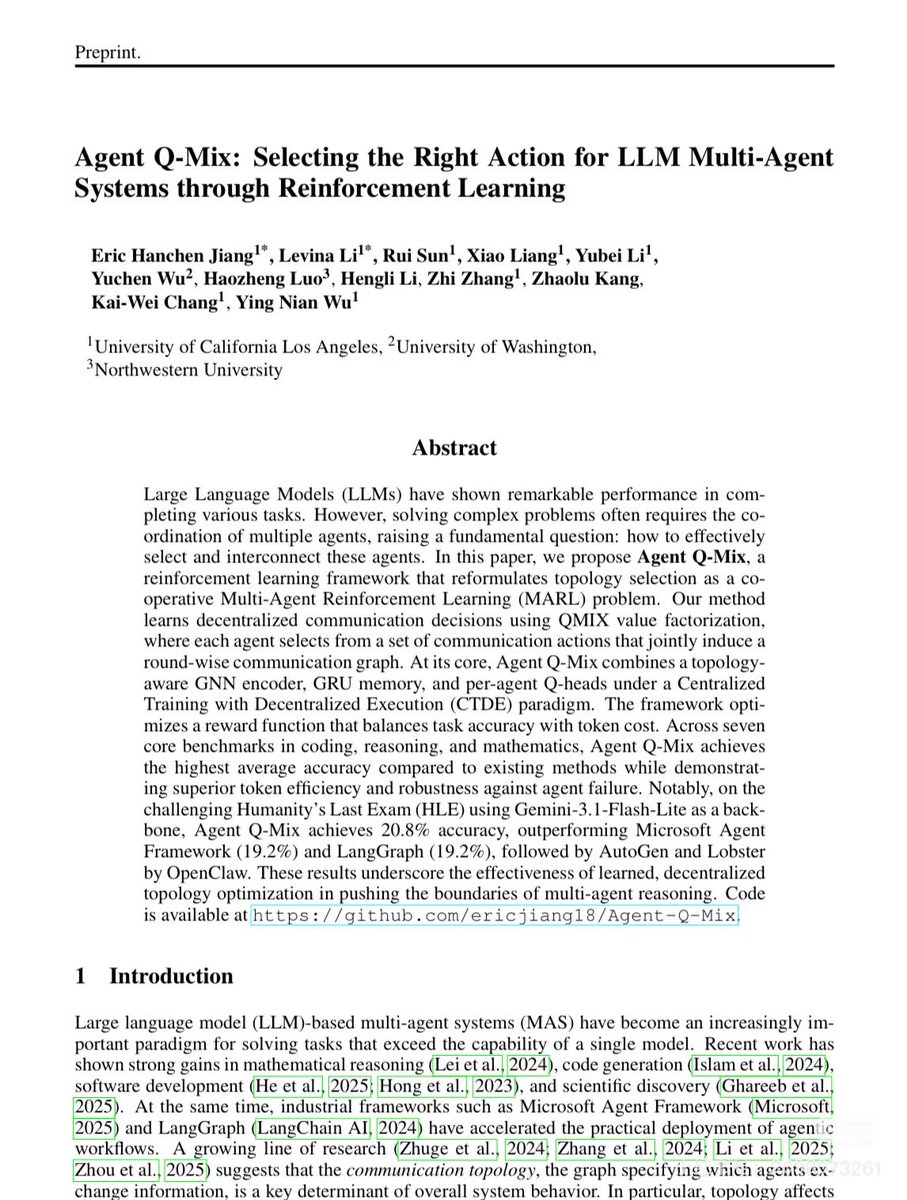
Excited to share our paper🥳: Agent Q-Mix, a collaborative multi-agent rl framework for adaptive communication in LLM multi-agent systems.🎉🎉🎉
Agent Q-Mix outperforms Lobster (OpenClaw), LangGraph, Microsoft AutoGen, while using fewer tokens!🚀
Paper: https://t.co/2wU8i6cLOe
Introducing Hyperagents: an AI system that not only improves at solving tasks, but also improves how it improves itself.
The Darwin Gödel Machine (DGM) demonstrated that open-ended self-improvement is possible by iteratively generating and evaluating improved agents, yet it relies on a key assumption: that improvements in task performance (e.g., coding ability) translate into improvements in the self-improvement process itself. This alignment holds in coding, where both evaluation and modification are expressed in the same domain, but breaks down more generally. As a result, prior systems remain constrained by fixed, handcrafted meta-level procedures that do not themselves evolve.
We introduce Hyperagents – self-referential agents that can modify both their task-solving behavior and the process that generates future improvements. This enables what we call metacognitive self-modification: learning not just to perform better, but to improve at improving.
We instantiate this framework as DGM-Hyperagents (DGM-H), an extension of the DGM in which both task-solving behavior and the self-improvement procedure are editable and subject to evolution. Across diverse domains (coding, paper review, robotics reward design, and Olympiad-level math solution grading), hyperagents enable continuous performance improvements over time and outperform baselines without self-improvement or open-ended exploration, as well as prior self-improving systems (including DGM). DGM-H also improves the process by which new agents are generated (e.g. persistent memory, performance tracking), and these meta-level improvements transfer across domains and accumulate across runs.
This work was done during my internship at Meta (@AIatMeta), in collaboration with Bingchen Zhao (@BingchenZhao), Wannan Yang (@winnieyangwn), Jakob Foerster (@j_foerst), Jeff Clune (@jeffclune), Minqi Jiang (@MinqiJiang), Sam Devlin (@smdvln), and Tatiana Shavrina (@rybolos).
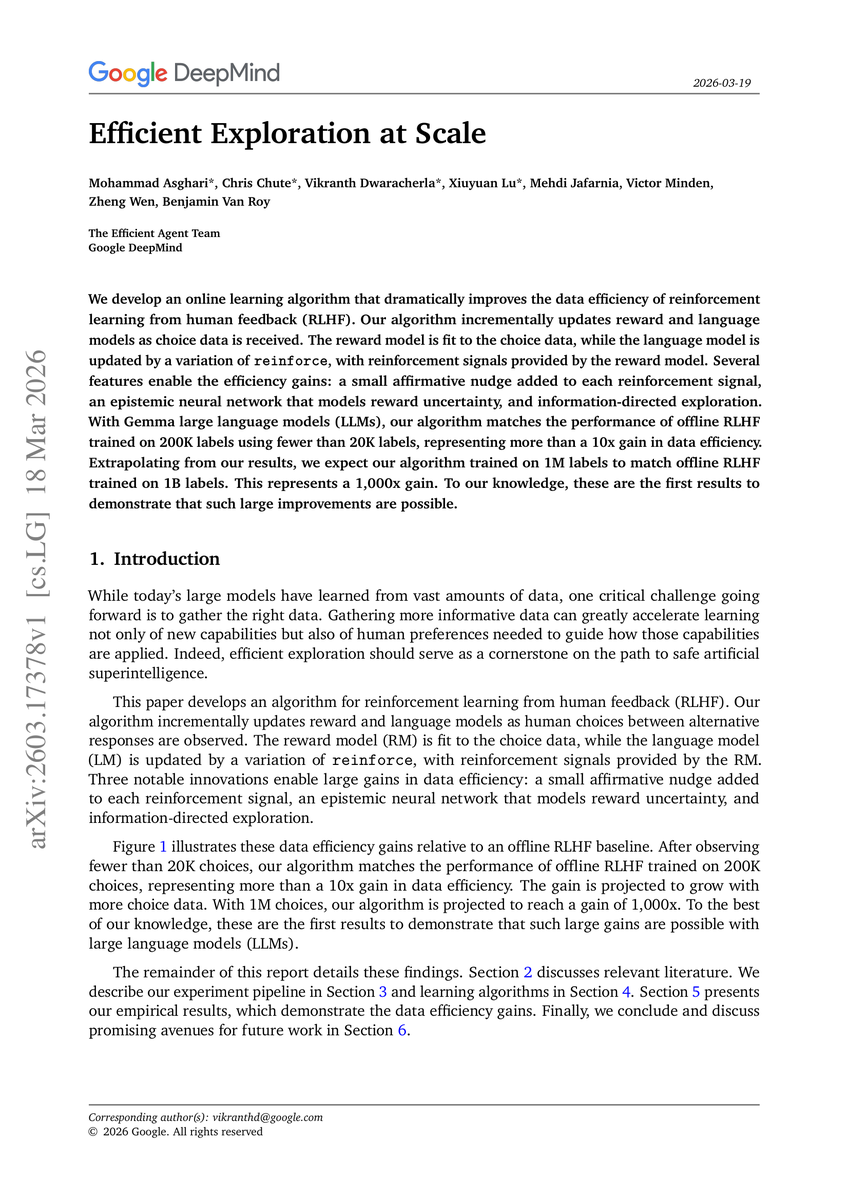
Updating reward model and policy together during RLHF in a per-batch manner, with active learning. It is possible here with model-based feedback. But how could it be implemented practically with actual human feedback?
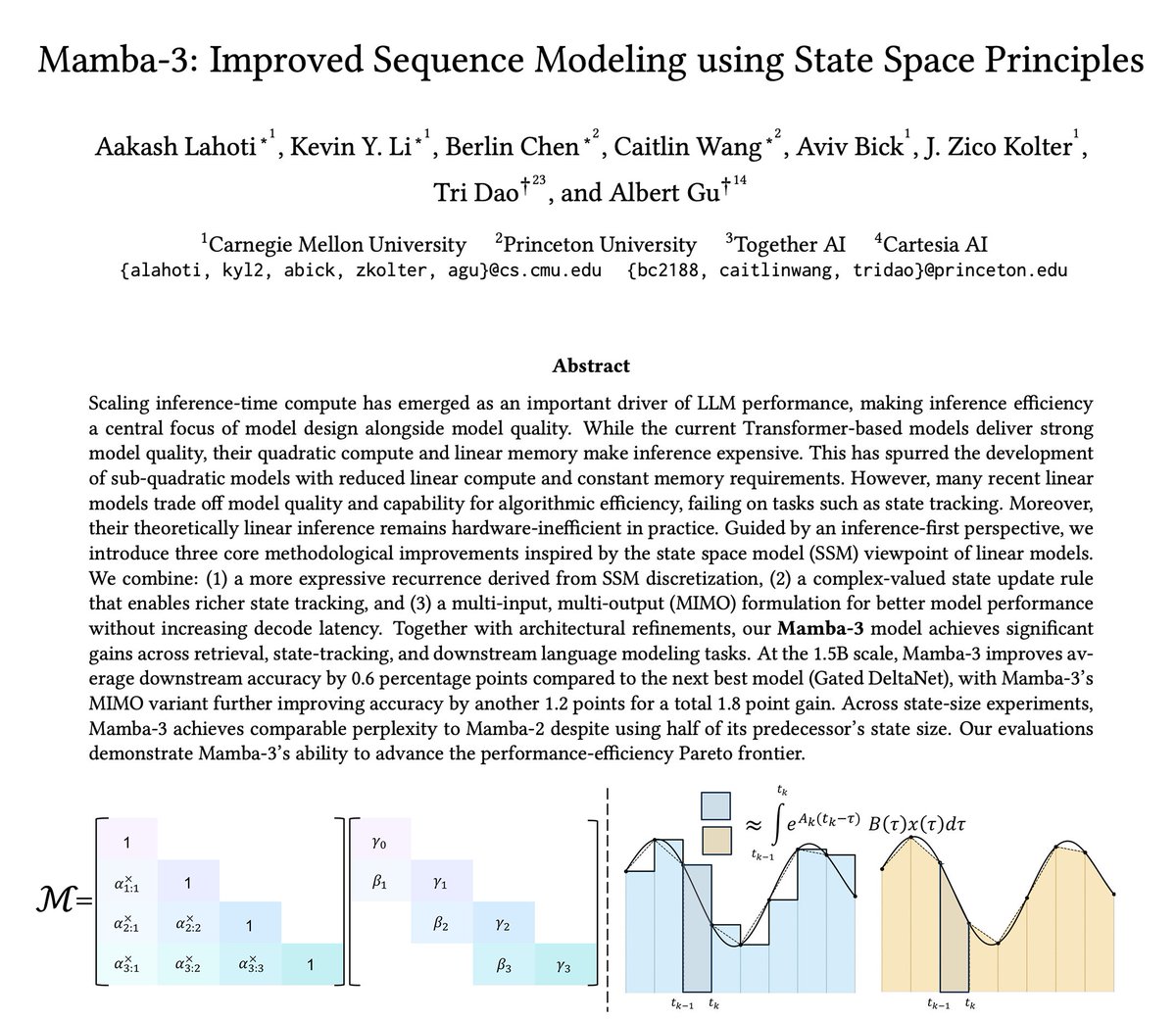
The newest model in the Mamba series is finally here 🐍
Hybrid models have become increasingly popular, raising the importance of designing the next generation of linear models.
We've introduced several SSM-centric ideas to significantly increase Mamba-2's modeling capabilities without compromising on speed. The resulting Mamba-3 model has noticeable performance gains over the most popular previous linear models (such as Mamba-2 and Gated DeltaNet) at all sizes.
This is the first Mamba that was student led: all credit to @aakash_lahoti@kevinyli_@_berlinchen@caitWW9, and of course @tri_dao!
BREAKING: Claude can now research like a Stanford PhD student.
Here are 9 insane Claude prompts that turn 40+ research papers into structured literature reviews, knowledge maps, and research gaps in minutes (Save this)
The Top AI Papers of the Week (March 1 - March 8)
- NeuroSkill
- ParamMem
- Numina-Lean-Agent
- Bayesian Teaching for LLMs
- Auton Agentic AI Framework
- Theory of Mind in Multi-Agent LLMs
- Why LLMs Form Geometric Representations
Read on for more: