BYD beat Tesla while being blocked from the U.S. market.
Tesla’s global sales include China.
BYD’s global sales exclude America.
And BYD still won.
That is the part Western media hates to say out loud:
China is not winning because markets are “fair.”
China is winning despite the walls built against it.
If “distillation” is theft, then almost every model faces the same criticism: they have all learned from vast amounts of human-created content across the internet, news, books, forums, videos, and more. If your own model is built on knowledge taken without permission, can you really claim copyright over it?
X-Humanoid unveiled TG-VLA, which it calls the world's first whole-body VLA framework for full-size humanoid robots.
The goal: move humanoids past "mobile dual-arm systems" to human-like, whole-body coordinated operation. Built on three technologies:
- HEX: an open-source full-size humanoid VLA that learns across embodiments and coordinates the whole body. Claimed SOTA on real-world whole-body manipulation
- HAF-VLA: hierarchical action flow that decomposes whole-body motion into subtasks. Best or joint-best on 6 benchmarks
- DSRL-DCT: online RL for high-DoF humanoids in a compressed latent space. 100% success on mobile manipulation
HEX is open-source.
Cachexia is one of cancer's deadliest complications. It affects about half of all cancer patients, causing severe weight and muscle loss that can reduce quality of life, limit treatment options, and contribute to roughly one-quarter of cancer deaths.
New research by incoming Salk professor Thales Papagiannakopoulos reveals that some lung cancer tumors communicate directly with the nervous system, effectively "hijacking" sensory nerves to drive cachexia.
By disrupting this tumor-to-brain communication, researchers reduced cachexia in preclinical models, uncovering a promising new therapeutic strategy that could improve outcomes for people with lung cancer. 🧠🫁
Read more: https://t.co/iHqjqmE3qt
#CancerResearch #LungCancer #Cachexia #Neuroscience #BiomedicalResearch #SalkInstitute
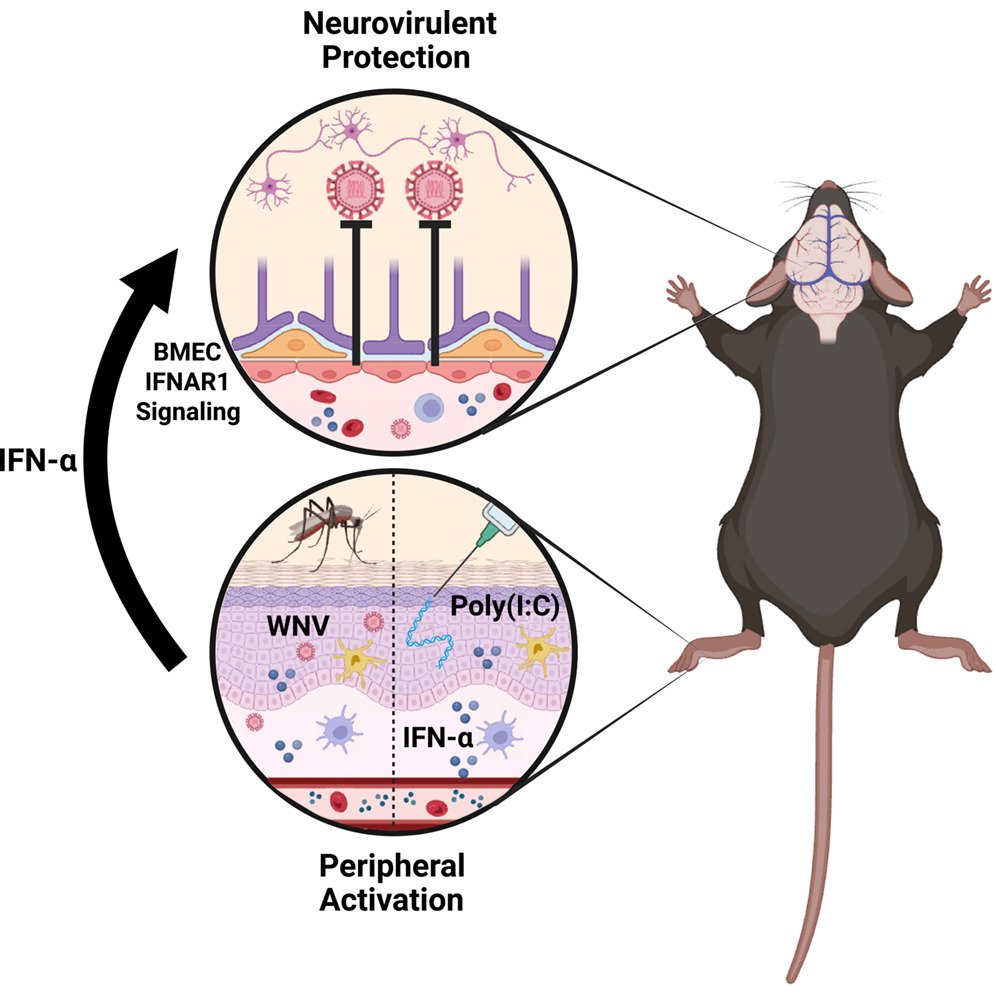
Systematic approaches combining cytokine profiling, single-nuclei #transcriptomics, immune modulation, and genetic perturbations revealed critical roles for systemic IFN-I and IFN-I receptor signaling in brain microvascular #EndothelialCells. https://t.co/p7ICKeQCkE
Don't miss this #OpenAccess study in @ImmunityCP! 🔓
🇺🇸 $1 TRILLION vs 🇨🇳 $123 BILLION in 2027 AI spend, yet China keeps shipping frontier models.
The difference? China’s energy moat.
Cheap, abundant power, lightning-fast data center buildout, lower land/labor costs, and ruthless efficiency mean they deliver the same (or better) punch at a fraction of the price.
My prediction:
China dominates cost-efficient scaling, high-volume inference, open models, and emerging-market adoption through 2030.
The US keeps the edge in frontier research, novel architectures, and high-value proprietary systems thanks to talent and innovation culture.
Outcome? A multipolar win, no single victor, just faster progress for everyone. Users get cheaper, more powerful AI sooner.
Efficiency is the new moat. China engineered it. The race just got a lot more exciting.
What do you think — who scales smarter?
Men are more sexually jealous in cultures where paternal investment is higher.
Plain language: Men are more worried about cuckoldry in cultures where it would be costlier to be cuckolded.
Always remarkable, to me, how context-sensitive and adaptable our evolved psychology is.
Aunque las diferencias psicológicas entre hombres y mujeres suelen ser pequeñas y presentan un amplio solapamiento, este estudio muestra que, cuando se consideran de forma conjunta, adquieren una capacidad predictiva sorprendente. En un reciente estudio, los investigadores analizaron a 2.767 participantes mediante pruebas cognitivas, cuestionarios de personalidad e intereses, y encontraron diferencias en las 13 variables evaluadas, en la dirección esperada. Por separado, la mayoría de esas diferencias eran modestas, pero combinadas permitían predecir correctamente el sexo del participante en el 80 % de los casos.
La mayoría de las diferencias observadas tuvieron un tamaño de efecto pequeño, aunque las relacionadas con las habilidades espaciales fueron moderadas y el interés por las cosas (frente al interés por las personas) mostró una diferencia grande. De hecho, incluso al eliminar del análisis las tres variables con mayor capacidad discriminativa (el interés por las cosas, la rotación mental y el juicio de ángulos), el modelo seguía clasificando correctamente al 71 % de los participantes. Es un buen ejemplo de cómo la acumulación de muchas diferencias pequeñas puede generar un efecto conjunto mucho más potente.
Los autores señalan además que una precisión del 80 % es elevada si se compara con otros métodos. Por ejemplo, las resonancias magnéticas estructurales del cerebro, una vez controlado el tamaño de la cabeza, suelen alcanzar alrededor del 60 % de acierto al predecir el sexo de una persona. La precisión podría aumentar todavía más si se incorporasen variables estrechamente relacionadas con el sexo, como la orientación sexual o determinados rasgos corporales.
Finalmente, el estudio encontró que este perfil psicológico combinado también se asociaba con el grado de segregación por sexo en las elecciones ocupacionales. Los resultados sugieren que muchas diferencias individuales de pequeña magnitud, consideradas de forma aislada poco informativas, pueden adquirir una gran relevancia cuando actúan conjuntamente.
https://t.co/1fmh2Yt28b
Köpeklerin aksine, kedilerin kendilerine doğrudan fayda sağlamayan durumlarda insanlara yardım etme eğilimlerinin olmadığı ve motivasyonlarının öncelikle kendi kişisel çıkarlarına dayandığı deneysel olarak kanıtlandı.
Happy to share our paper about localized signaling from lung cancer to sensory neurons in cachexia together with Michael Cross and @ThalesPapaG at @nyugrossman!
Thank you to @dfg_public for funding my journey
https://t.co/J9SGd5eIbS
Oops, SIGReg did it again! Large scale (CC12M->Datacomp-L) vision-language JEPA pretraining beats CLIP and SigLIP objectives! Thanks to SIGReg, our LeVLJEPA has no collapse, no EMA, no stop-gradient, no negatives, no problem! Checkpoints/demo are live: https://t.co/wz6S6tYB6p
🔥 We introduce LeVLJEPA: the first fully non-contrastive end-to-end vision-language pretraining method competitive with CLIP & SigLIP 💪🏼
👀 No negatives. No temperature. No momentum encoder. No teacher-student.
TL;DR: LeVLJEPA learns image to text structure by prediction: each modality predicts the other's embedding, while SIGReg keeps each embedding isotropic Gaussian. 🧵
📄 https://t.co/1qBXor8qTf
China is now training trillion parameter models on domestic hardware. Meituan’s new 1.6T-parameter LongCat model was reportedly trained on around 50,000 Huawei Ascend chips.
China is adapting to export controls by redesigning the entire AI stack. Rather than matching Nvidia chip-for-chip, Chinese companies are leaning into system architecture, networking, and software optimizations to offset hardware constraints.
This hardware-software co-design is increasingly becoming China’s competitive strategy. This piece is a very accessible primer on what's happening: