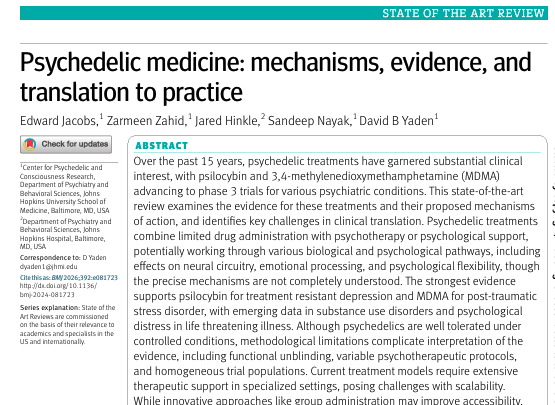
Our (@zarmeen_z Jared Hinkle @sdpnayak@ExistWell) State of the Art Review on psychedelic medicine is now out in @bmj_latest.
A few thoughts on why we wrote it the way we did. 🧵
Very excited to share our new preprint! We explore the link between the locus coeruleus (LC) and arousal for astrocytes, pyramidal cells, interneurons in the hippocampus. A fantastic collaboration with Sian Duss @BohacekLab, and many others: https://t.co/xzEibyWIXn 1/5
An NTS-expressing inhibitory circuit from interpeduncular nucleus to dorsal raphe nucleus controls pain and comorbid depression in male mice: Cell Reports https://t.co/W8V81MNZkR
This year I had the chance to see Edvard Munch’s The Sick Child painting in Oslo. It’s a powerful reminder of what our Institute, NICHD @NIH, works to prevent and cure.
“Basic neuroscience hasn’t produced new drugs.” 💊
Not true - zuranolone (PPD), suzetrigine (pain), gepants (migraine), and more... were born out of a long arc of studies in the lab.
I wrote a Perspective on why this matters. @_TheTransmitter
https://t.co/fSu2yaEdxz
Excited to share our paper just published in #Glia !!
"STIM1-Dependent Calcium Signaling in Astrocytes Controls Glutamate Accumulation and Ischemic Brain Injury During Acute Stroke in Mice" by @neuronchoi et al. https://t.co/X4AFIoN9Cr
The Brain Prize 2025 #webinars uncover how the nervous system drives and responds to cancer - from brain tumours to neural circuit remodeling and cancers outside the brain.
https://t.co/l0WPUM5ZwB
#CancerResearch#Neuroscience#TheBrainPrize
A low-intensity ultrasound treatment clears neurotoxic debris from the brains of mice with induced bleeding that resembles a haemorrhagic stroke, according to a study in Nature Biotechnology. https://t.co/NpNfNhcHHT
Given all research I have seen on disintegration of plaques, I was wondering why nobody thought about human applications:
"A wearable spatiotemporal controllable ultrasonic device with amyloid-β disaggregation for continuous #Alzheimer’s disease therapy"
https://t.co/R6fCmXO6ad
Just out! “The astrocytic ensemble acts as a multiday trace to stabilize memory.” We identified astrocytic ensembles that link experiences across days to stabilize memory https://t.co/po9zIlZvPb. New astrocyte tools are openly available at Addgene: https://t.co/OXCmcYSleI. 1/8
Our paper @molecularbrain investigates the potential of transcutaneous auricular vagus nerve stimulation (#taVNS) as a non-pharmacological treatment for neuropathic pain. Read the full paper here.
https://t.co/Cn5Q8pWwC8
Mouse studies often fail to replicate in surprising ways. Let me enumerate some of the ways:
1. Mice handled by male scientists feel less pain. The finding holds true when a female scientist does the experiment but holds a t-shirt, previously worn by a man, near the mouse. The effect fades after 30 minutes.
2. Mice spend less time licking an irritated part of their body when a human is nearby, “even if that ‘person’ is a cardboard cutout of Paris Hilton.”
3. Mice raised at five different animal facilities in Europe, under otherwise identical conditions, had “persistent differences in body weight” and behavior.
4. If two different scientists at the same university carry out the same experiment on mice, their results will be MORE replicable than if the same exact experiment were carried out by the same person at separate universities.
5. Mice that give birth in cages with little toys or knick-knacks produce more pups. Those pups are larger after 21 days.
6. “Mice housed on deep bedding had smaller adrenal, kidney, liver and heart weights as well as larger body and tail lengths compared with groups kept on shallow bedding” after just 12 weeks, according to one study.
7. Animals stored on higher shelves are more stressed and have impaired immune systems, probably because these areas are closer to lights and vibrate more. Mice on the top shelf of a rack receive 20-80x more light than mice housed at the bottom.
8. Mice exposed to even dim light during the night (e.g. an LED on a computer monitor) “had a body mass gain…about 50 percent more than other mice that lived in a standard light-dark cycle.”
9. After just four weeks, mice exposed to a dim light during the night ate more than those in complete darkness. (Mice, like humans, raid the proverbial refrigerator when they can’t sleep.) Many genes linked to inflammation were also activated.
10. Mice kept in cages with wood chip bedding eat about 1.5 grams of their mattress every day. This changes the bacteria in their microbiomes.
11. (Not about replication, but) about 80% of drugs are tested only on male mice. Even though some drugs, notably Ambien, are more potent in females and cause more side effects.
12. About 6% of all mouse genes are regulated in sex-specific ways. The expression level of more than 1,000 genes varies between males and females, and the level of another 600 genes wobble, up and down, during a female’s estrous cycle.
13. Grain-based food usually contains unknown amounts of phytoestrogens, which change the onset of an animal’s puberty.
14. The standard diet for mice, called AIN-93, hasn’t changed in 30 years. But manufacturing of that food HAS changed: Even if you use “the same grain-based diet used in the past by others, its composition will likely differ.” In other words, the same food used in mouse studies today vs. the 1990s is different, even if its name is unchanged.
15. Mice exposed to a regular, 37 Hertz magnetic field spend less time exploring open spaces, and more time sleeping.
16. Mice are kept in rooms between 69 and 79 degrees F. “But the natural comfortable temperature for mice is warmer — between 30 and 32 degrees Celsius (86 to 90 degrees Fahrenheit).” Colder mice experience more stress, their tumors grow faster than mice kept in warm rooms, and “mice genetically modified to develop obesity only gained a lot of weight at warmer temperatures but not at colder temperatures.”
All links at source below. These studies make for fun reading materials.
Still one of the greatest moments in Nobel history.
At 2:15 a.m. on Oct. 12, 2020, a security camera caught Prof. Emeritus Robert Wilson in slippers at Prof. Paul Milgrom's front door.
The longtime collaborators, who lived across the street from each other, had jointly won the Sveriges Riksbank Prize in Economic Sciences for their contributions to auction design — but only one had been reachable by phone in the middle of the night.
A single dose of #psilocybin induces a rapid and sustained reversal of both mechanical allodynia (pain) and anxiodepression-like states in adult male and female mice
https://t.co/JlIbKQZbJO