จริง ด้วยเหตุนี้เลยอยากสนับสนุนให้ทุกคนทำ Second brain ของตัวเองเอามา Feed ข้อมูลให้ AI
พอไปใช้ AI ตัวไหนก็อ่านข้อมูลเกี่ยวกับตัวเรา เกี่ยวกับงานที่ทำได้ มันก็จะมั่วน้อยลงมากกกกกกกกกกก
This tool is blowing up on GitHub right now
OpenClaude is Claude Code rebuilt to run on any provider. Same terminal, same tools, same subagents, except every agent can sit on a different model.
Split by what the work actually needs, not by which model you like.
> Code and terminal work: Claude or Codex. Both are built around long tool chains, and that is most of what an agent does.
> Bulk file operations and context gathering: whatever is cheapest and fastest, including a local model on your own machine. Hundreds of reads, no judgment involved.
> Long documents and huge context: Gemini. That is where the million-token window earns its keep.
> Review: something from a different lab than the one that wrote the code. The point is a second opinion.
> Anything you do at volume: an open model on your hardware. It costs nothing per run once it is set up.
That is the whole trick: you stop paying flagship prices for work a cheap model could do.
You can also send jobs to the background. Start one, close the terminal, check the log later, kill it if it goes wrong. And it maps your repo so agents stop burning turns working out where anything lives.
Repo: Gitlawb/openclaude
20 AI RESOURCES YOU SHOULD KNOW 📌
1. Hugging Face LLM Course
https://t.co/Xm4cM5VI0o
2. Google ML Crash Course
https://t.co/kpQ3bVGiAb
3. https://t.co/CmLFBHy8lC
https://t.co/pQYlmvSOBw
4. OpenAI Academy
https://t.co/Xmi4DBN8zR
5. Karpathy — Neural Networks: Zero to Hero
https://t.co/SX3lshunqK
6. Full Stack Deep Learning
https://t.co/t69H8xOlT3
7. Hugging Face Learn
https://t.co/dKahBuS4If
8. Microsoft AI for Beginners
https://t.co/V7Oilwt7nA
9. Made With ML
https://t.co/ffzMrwQ7u9
10. https://t.co/bq27x5UKTv
https://t.co/sVCmWuwR4U
11. Stanford CS229
https://t.co/2LBUqM7lOA
12. Stanford CS231N
https://t.co/M5YfWTx6pX
13. Stanford CS224N
https://t.co/QuXDEgkNwx
14. Google DeepMind Learning Hub
https://t.co/6422y9xajv
15. AWS Machine Learning
https://t.co/Da2tgaL0hc
16. PyTorch Tutorials
https://t.co/hEFAsWZCXJ
17. TensorFlow Tutorials
https://t.co/yhzGRIddcV
18. NVIDIA Deep Learning Institute
https://t.co/7rwzGqSnsi
19. Microsoft Learn AI
https://t.co/JTGUYHwbfU
20. Google Machine Learning
https://t.co/CCfEtGjqi3
Save this list.
Learn → Build → Ship.
I’m excited to finally announce the newest edition my Stanford course 𝗧𝗵𝗲 𝗠𝗼𝗱𝗲𝗿𝗻 𝗦𝗼𝗳𝘁𝘄𝗮𝗿𝗲 𝗗𝗲𝘃𝗲𝗹𝗼𝗽𝗲𝗿. It has been 9 months in the making.
Last November, with the release of Claude Opus 4.5, coding agents experienced a step function improvement in capability. We all felt it. The LLMs were more powerful, could reason for longer, solve harder tasks.
This year’s iteration of my course reflects the 2026 metamorphosis of software engineering.
My core belief is simple: AI-native developers of the LLM era are going to become the most important members of any software organization. I have designed my course to train this next generation of engineers.
𝗪𝗵𝗮𝘁’𝘀 𝗱𝗶𝗳𝗳𝗲𝗿𝗲𝗻𝘁 𝘁𝗵𝗶𝘀 𝘁𝗶𝗺𝗲 𝗮𝗿𝗼𝘂𝗻𝗱
First, 85% of my Fall 2025 class material is being thrown out. The Fall 2026 syllabus reflects the core capabilities AI-native engineers must have: agent skills, advanced context engineering, MCP portals, agent-ready codebase principles, agentic code review, security, parallelizing background agents, software factories, and more.
Second, I am going to teach my students how to have software taste. Every student will be required to ship pull requests to production-grade, real-world codebases. The course is collaborating with the top open-source AI repos who will offer support and mentorship to students on how to meaningfully contribute to their projects.
This has never been done before in any university course so I am incredibly grateful to our OSS Partners: @browserbase, @HeyGen, @CopilotKit, @semgrep, @OpenHandsDev, @milvusio, @marimo_io, Pi, @crewAIInc, @warpdotdev, @vercel, @cmux, @arizeai, @UnslothAI, and @anyscalecompute.
𝗪𝗵𝗮𝘁’𝘀 𝘀𝘁𝗮𝘆𝗶𝗻𝗴 𝘁𝗵𝗲 𝘀𝗮𝗺𝗲
I’m fortunate to again have AI software engineering leaders and founders as guest speakers to share their learnings from building top coding agent products. Thank you to @leerob from @cursor_ai, @bcherny of @claudeai code, @EnoReyes of @FactoryAI, @silasalberti of @cognition, @0xine of @semgrep, Rajesh Bhatia of @Cloudflare , @amasad of @Replit, and @eladgil.
All resources will be available online. All classes will be available to the public.
9/22 on Stanford campus. See you in class.
https://t.co/wTokHyUMsz
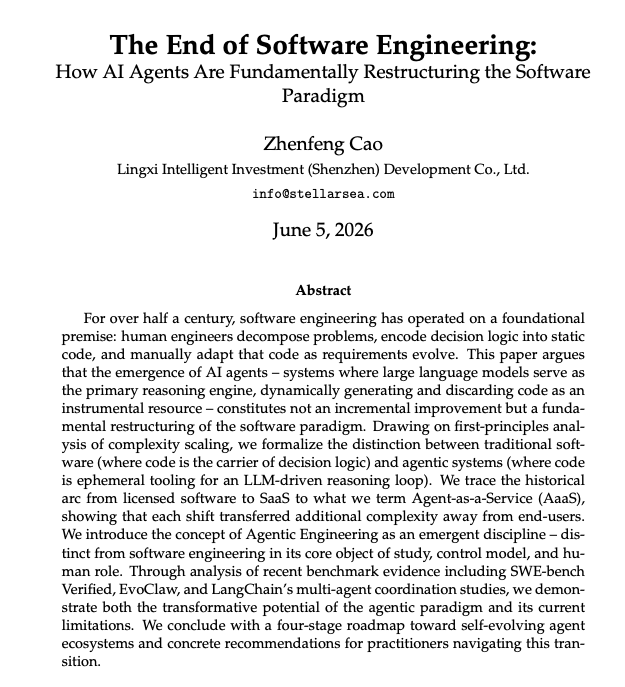
So everyone's excited about this "research", but it's not research.
It's an opinion piece from an investment firm.
And the big conclusion is that software engineers need to become software engineers:
"The most valuable skill is no longer writing code efficiently but articulating tasks with sufficient clarity, context, and constraints..."
That's always been the most valuable skill.