1/8 What remains undiscovered in the human kidney? 🔍
While building an integrated human kidney atlas for the Human Cell Atlas, we discovered new biology—presented in our new preprint, with highlights below. 🧵
https://t.co/Z1veUKiFqS
1/8 What remains undiscovered in the human kidney? 🔍
While building an integrated human kidney atlas for the Human Cell Atlas, we discovered new biology—presented in our new preprint, with highlights below. 🧵
https://t.co/Z1veUKiFqS
7/8 This atlas was an extraordinary team effort. 🙏
Congratulations to my postdoc @stasinosmd and our outstanding team—and many thanks to every data contributor, collaborator, coauthor and member of the @humancellatlas Kidney Bionetwork who made this resource possible!
Are single-cell foundation models (scFMs) a true biological breakthrough, or just over-hyped architecture tweaks?
To separate genuine conceptual advances from incremental hype, the lead authors of pioneer models, including Geneformer, Cell2sentence @david_van_dijk , Nicheformer @fabian_theis , GET @raulrabadan, CellPLM @tangjiliang , and our Tabula, have united to publish a systematic, critical synthesis of the scFM landscape.
Designed for the broader scientific community, this guide cuts through the noise to show how emerging model designs can truly support grounded biological discovery.
📄 Paper: https://t.co/FE6TloCWqs
📷 Curated paper list: https://t.co/pCdWf45OjK
Led by the incredible @JiayuanDing
and @shiyu_jiang23 , Zhaoyu Fang, Yujie Zhang, @xutzhang , @jkobject , Weixu Wang, @alexanderfuxi , Aakash Patel, Syed Rizvi, @Y_Ryan_Lu , @SiyuHe7 , @YixinxinWang , @KejunYing , @peterpaohuang , @YifanLu2024 , @Nanguage , Mengchen Wang, Ziyang Miao, Jianhui Lin, Jimmy Ding, Jerry Wang, @imweio , @TianlongChen4 , Guoxian Yu, Min Li, Jiayi Ma, @feiwang03 , @Yuyingxie , @cmuptx , @PengHeAtlas , Emily B. Fox, @dasongle , @ericxing
Give it a read, we hope you will enjoy it!
Excited to share our @CellCellPress spatial atlas of the human brain vasculature. Across 314,535 transcriptomes and 1.5M cells, we reveal stereotyped vascular ensembles underlying specialized function, disease risk, and segment-selective drug responses.
https://t.co/AlyPneNH6A
I'm maintaining an active list of biology-related job openings at various levels (PIs, staff scientists, postdocs, PhDs, etc.). Please feel free to subscribe or contribute! https://t.co/xbZdjDvu1u
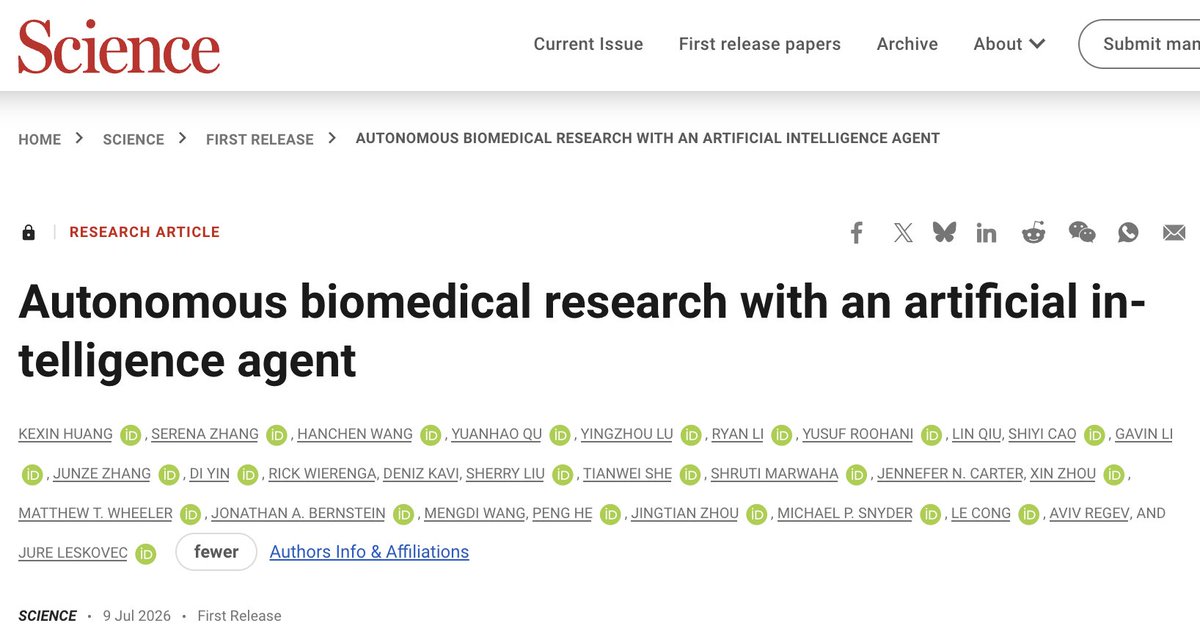
Today, we're excited to share that Biomni is published in @ScienceMagazine.
Biomedical research is still fragmented, manual, and difficult to scale. In this work, we introduce Biomni - the first general-purpose biomedical AI agent with an integrated biology environment that can reason, plan, and execute end-to-end scientific workflows.
We show that, with the right environment and harness, AI can automate large-scale omics analyses, orchestrate laboratory robotics, optimize molecular properties, and even train new AI models for biology.
We also introduce a reinforcement learning recipe for continually improving biomedical AI agents, enabling open-source models to achieve frontier-level performance.
It's surreal to look back. We started the Biomni project in early 2024, when agentic AI was still nascent. It is exciting to see tens of thousands of biologists collaborating with agents every day to accelerate science.
Try Biomni: https://t.co/Pzm8TVlkNA
Read more: https://t.co/pRstxzPKDi
This work is not possible without this truly inter-disciplinary team: @serena2z@hcwww_@YuanhaoQ Minta Lu, Ryan Li, @yusufroohani Lin Qiu @shiyi_c98 Gavin Junze Di @rickwierenga@kavi_deniz Sherry @TianweiShe Shruti Jennefer Xin Zhou @MWheelerMD Jon Bernstein @MengdiWang10@PengHeAtlas@zhou_jingtian@SnyderShot@lecong Aviv Regev @jure@StanfordAILab@genentech@phylo_bio@arcinstitute@UW@berkeley_ai@RetroBio_@tamarindbio@Princeton@UCSF
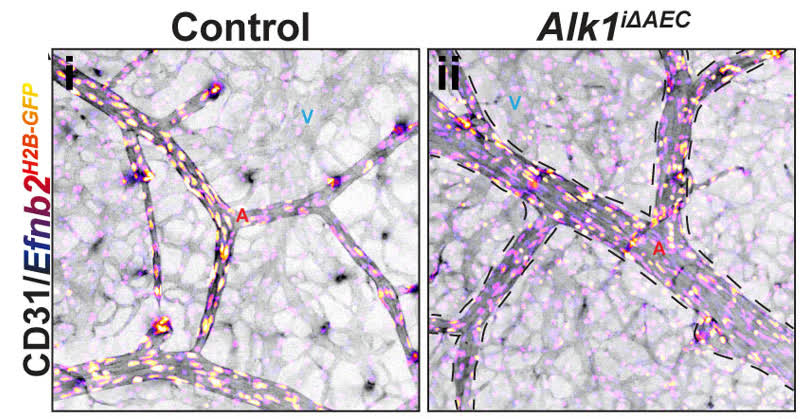
Zhang et al demonstrate that removal of #Alk1 in #AECs of the mouse establishes a preclinical model of hereditary hemorrhagic telangiectasia (#HHT). Learn more about the mechanism of severe #nosebleeds at https://t.co/zfXGlkezXs
@mf_navedo @_kyleJacobs @PengHeAtlas
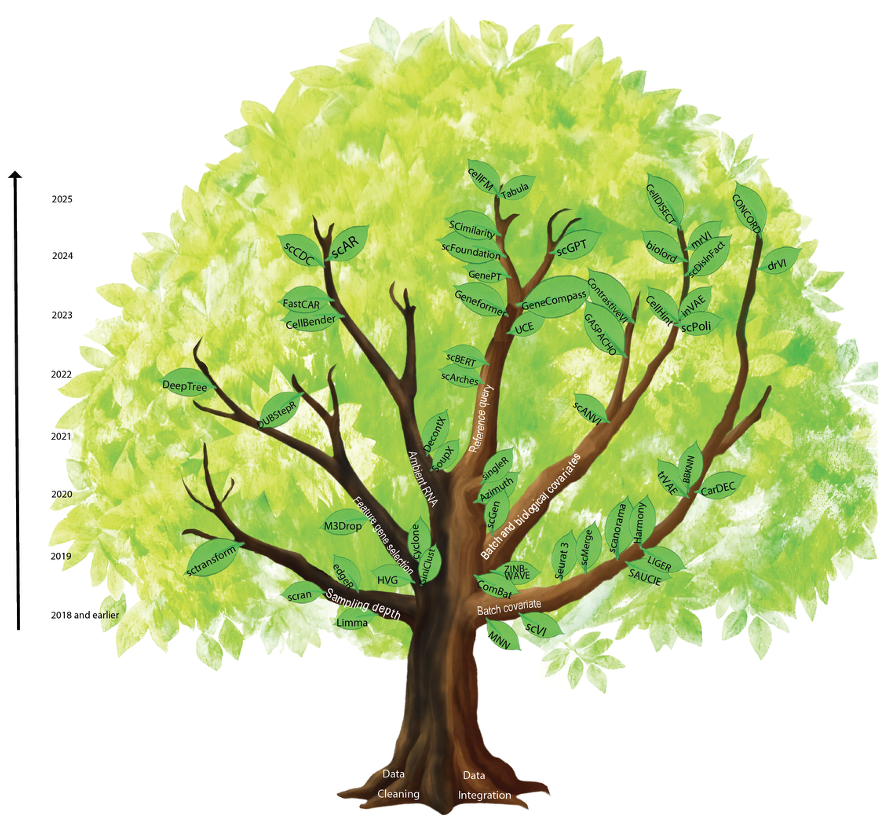
📢New Perspective out! @PengHeAtlas, Sarah Teichmann and colleagues review widely adopted batch correction methods and propose a path toward more informed, context-aware approaches for future method development. https://t.co/RMZwSGjX81
🔓https://t.co/5CbDod7Ag9
Our Perspective paper "Toward informed batch correction for single-cell transcriptome integration" is out in @NatComputSci 🔗https://t.co/mr2NKvpNxs
We review a decade of batch-correction methods and propose to move from "blind" integration to "informed" modeling.🧵👇
8️⃣The Future: leverage high-quality references and interpretable models to convert "unknown" Class II effects into "known" Class I artifacts. 🔄
Long-term🚀: Robust reference-based analyses resilient to batch effects—ultimately reducing the need for post hoc correction altogether